
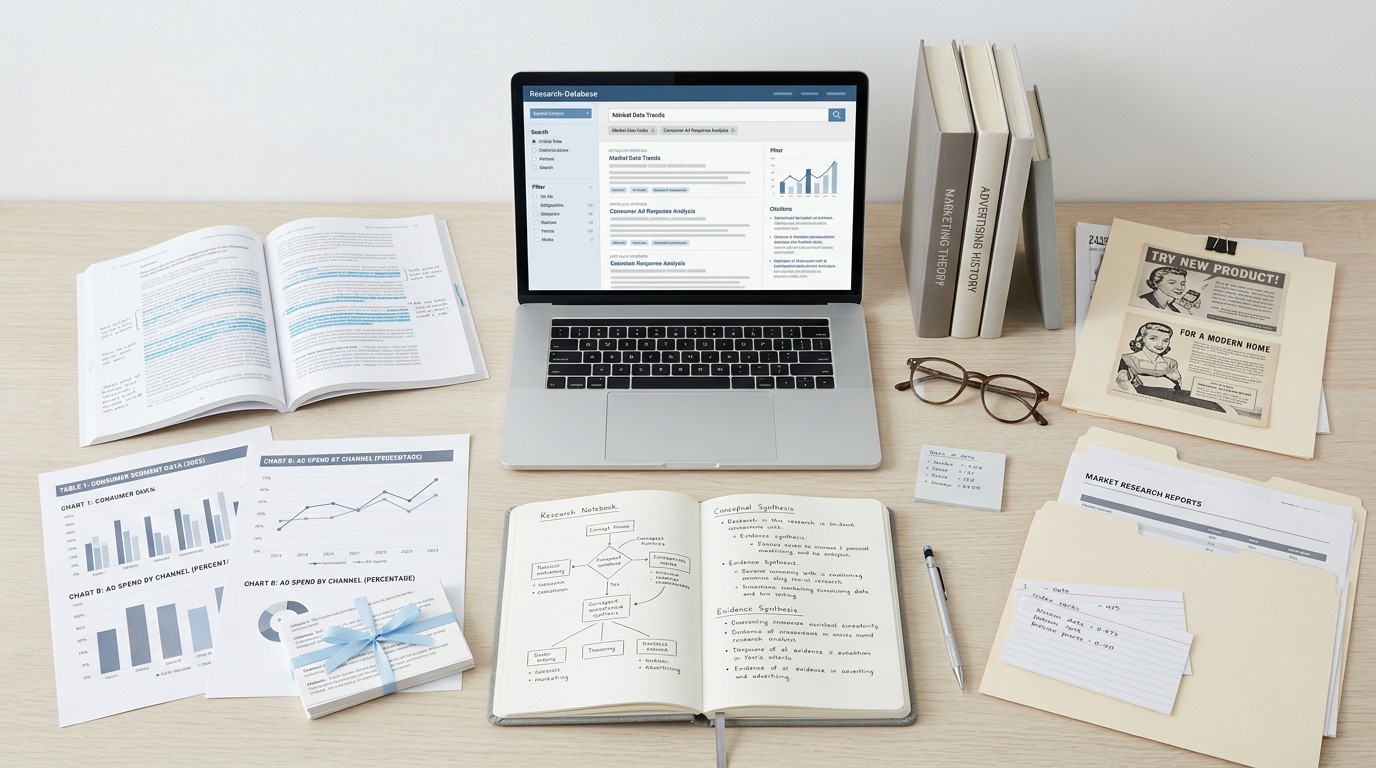
Advertising and marketing research can draw from academic scholarship, government data, industry reports, company records, trade publications, consumer research, advertising archives, market databases, news reporting, and primary research. The quality of a research project depends not only on how much information is collected, but also on whether the sources are appropriate for the question being investigated.
The AAMA Advertising & Marketing Research Sources Guide provides a practical framework for locating, evaluating, and using research sources. It is designed for students, academics, professionals, agencies, brands, journalists, researchers, and anyone preparing marketing plans, competitive analyses, presentations, reports, case studies, or academic work.
Different sources answer different questions. An academic article may provide strong theoretical or experimental evidence, while government data may provide reliable population statistics and an industry publication may offer timely information about market activity. Strong research often combines several types of evidence rather than relying on a single source.
Start With the Research Question
Before searching for information, define what you are trying to learn. Broad searches can produce large volumes of material without providing the evidence needed to answer a specific question.
A research question might ask:
- How large is a market?
- How are consumer behaviors changing?
- What advertising methods are most effective?
- How is a particular demographic group changing?
- What competitors are doing?
- How have media habits evolved?
- How does a marketing concept affect consumer decision-making?
- What regulations apply to a particular advertising practice?
- How has a brand or category developed historically?
The question should guide the source selection.
A question about population change may require government statistics, while a question about persuasion theory may require academic research. A competitive analysis may rely more heavily on company filings, advertising, pricing, websites, trade reporting, and customer reviews.
Primary vs. Secondary Sources
One of the most useful distinctions in research is between primary and secondary sources.
Primary Sources
Primary sources provide original evidence or information created close to the event, activity, research, or organization being studied.
Examples may include:
- Original research studies
- Survey datasets
- Interviews
- Company filings
- Advertisements
- Annual reports
- Speeches
- Historical documents
- Campaign materials
- Government datasets
- Court decisions
- Regulatory documents
Primary sources can provide direct evidence without relying entirely on another person’s interpretation.
Secondary Sources
Secondary sources analyze, summarize, interpret, or report information originally produced elsewhere.
Examples may include:
- Academic review articles
- Textbooks
- News articles
- Industry analysis
- Case studies
- Research summaries
- Historical accounts
Secondary sources are valuable for understanding context and interpretation, but researchers should examine the original evidence when an important claim depends on it.
Academic Journals
Peer-reviewed academic journals are among the most important sources for research on advertising, marketing, consumer behavior, communication, psychology, economics, management, media, and related disciplines.
Journal articles may provide:
- Experimental research
- Surveys
- Statistical analysis
- Theoretical frameworks
- Literature reviews
- Longitudinal studies
- Consumer research
- Advertising research
- Market analysis
Academic research is particularly valuable when the research question concerns how or why a marketing phenomenon occurs.
However, publication in an academic journal does not mean every conclusion should be accepted without evaluation. Researchers should still examine the methodology, sample, limitations, date, and relevance to the question being studied.
Related AAMA Resource: Recommended Marketing & Advertising Journals
Academic Databases
Academic databases provide access to scholarly journals, conference papers, dissertations, books, working papers, and other research materials.
Universities and libraries may provide access to databases covering:
- Business
- Marketing
- Advertising
- Psychology
- Communication
- Sociology
- Economics
- Media studies
- Statistics
Database availability varies by institution.
When searching academic databases, use several combinations of keywords rather than relying on a single phrase. Terminology may differ among disciplines, and older research may use different language for concepts that are described differently today.
Google Scholar
Google Scholar can be a useful starting point for finding academic papers, books, theses, conference materials, and citations.
It can help researchers:
- Locate papers by topic
- Find later research citing an important study
- Identify frequently cited articles
- Discover related terminology
- Locate alternate versions of papers
Search results should still be evaluated individually. Inclusion in an academic search engine does not guarantee that every document has undergone the same level of peer review.
University Libraries
University libraries can provide access to scholarly databases, books, archival collections, dissertations, historical newspapers, industry databases, and specialized research materials that may not be freely available online.
Students and faculty should become familiar with the research services offered by their institution.
Librarians can also be valuable research partners. They can help identify appropriate databases, refine search strategies, locate difficult sources, and distinguish among different types of publications.
Books & Academic Presses
Books can provide broader context than individual journal articles and are particularly useful for subjects such as:
- Marketing theory
- Advertising history
- Consumer behavior
- Branding
- Media history
- Research methods
- Economics
- Business history
- Communication theory
Books published by university presses and established academic or professional publishers can be strong sources, but publication quality still varies.
Check the author’s expertise, publication date, citations, methodology, and relationship to the research question.
Literature Reviews
Literature reviews summarize and evaluate existing research on a topic. They can be especially useful when entering an unfamiliar subject because they identify major theories, recurring findings, disagreements, and influential studies.
A good literature review can help researchers:
- Understand the state of existing knowledge
- Identify foundational studies
- Discover competing explanations
- Find gaps in research
- Develop better search terms
Whenever possible, use the review to locate the original studies supporting claims that are important to your work.
Meta-Analyses
A meta-analysis combines results from multiple studies using statistical methods. When well designed, it can provide a broader estimate of an effect than a single study.
Meta-analyses may be useful for questions involving:
- Advertising effectiveness
- Consumer response
- Pricing
- Persuasion
- Media effects
- Behavioral interventions
The quality of a meta-analysis depends on the studies included, the selection criteria, statistical methods, and potential publication bias.
Government Data
Government agencies produce large amounts of economic, demographic, labor, business, consumer, geographic, regulatory, and statistical information.
Government sources can be particularly useful for:
- Population estimates
- Income
- Employment
- Business formation
- Industry size
- Consumer spending
- Geographic analysis
- Economic conditions
- Trade
- Regulation
These sources are often valuable because the methodology and definitions are documented and the data may be collected systematically over long periods.
U.S. Census Bureau
The U.S. Census Bureau provides demographic, economic, housing, business, and population data that can support market analysis and audience research.
Potential uses include:
- Market sizing
- Geographic analysis
- Population trends
- Household characteristics
- Business counts
- Income analysis
- Demographic profiles
Researchers should pay attention to the dataset, year, geography, estimate type, and margin of error when interpreting Census information.
Bureau of Labor Statistics
The U.S. Bureau of Labor Statistics provides information about employment, occupations, wages, prices, productivity, and labor-market conditions.
Marketing researchers may use these data to study:
- Employment trends
- Occupational markets
- Consumer prices
- Regional economic conditions
- Industry employment
- Career information
These datasets can be particularly useful for professional, economic, and market analysis.
Bureau of Economic Analysis
The U.S. Bureau of Economic Analysis produces economic statistics involving gross domestic product, personal income, consumer spending, industries, regional economies, and other measures.
These data can help marketers understand broader economic conditions surrounding consumer and business behavior.
Economic indicators should generally be interpreted in conjunction with the specific market or audience being studied.
Federal Trade Commission
The Federal Trade Commission is an important source for information involving advertising practices, consumer protection, endorsements, deceptive claims, privacy, competition, and enforcement activity in the United States.
FTC materials may include:
- Rules
- Guidance
- Enforcement actions
- Consumer-protection information
- Policy statements
- Business guidance
When researching advertising requirements or enforcement history, original regulatory materials should generally be preferred over summaries from unrelated websites.
Securities & Exchange Commission Filings
Publicly traded companies file financial and business information with the U.S. Securities and Exchange Commission.
Company filings can provide information about:
- Revenue
- Business segments
- Competition
- Risks
- Strategy
- Customer concentration
- Market conditions
- Acquisitions
- Geographic operations
These documents can be valuable for competitive and industry research because companies are required to disclose substantial information about their businesses.
Marketing researchers should remember that company filings are written for financial and regulatory purposes rather than specifically for marketing analysis.
Other Government Agencies
Depending on the research question, useful government sources may include agencies involved in:
- Transportation
- Agriculture
- Health
- Education
- Energy
- Communications
- Trade
- Small business
- Housing
- Finance
Do not restrict government research to one or two familiar agencies. The organization responsible for regulating or measuring a particular industry may maintain specialized datasets that are highly relevant.
State & Local Government Data
State, county, and municipal agencies may provide information that is unavailable at the national level.
Potential sources include:
- Population data
- Business licenses
- Development information
- Tourism statistics
- Transportation
- Local economic reports
- Property data
- Community profiles
These sources can be particularly useful for local-market planning.
Industry Associations
Professional and trade associations often publish information about the industries they represent.
Materials may include:
- Industry statistics
- Surveys
- Research reports
- Standards
- White papers
- Market trends
- Professional guidance
- Conference materials
Association research can provide valuable specialized information, but researchers should consider the organization’s interests and methodology.
An association representing an industry may have access to excellent data while also having a reason to present that industry favorably.
Professional Organizations
Professional organizations may publish research, educational material, standards, career information, ethics guidance, and industry commentary.
These sources are especially useful for understanding professional practices and terminology.
Researchers should distinguish between formal research, professional guidance, opinion pieces, and promotional material even when all are published by the same organization.
Market Research Firms
Market research companies produce reports covering industries, categories, consumers, products, media, technology, and business trends.
These reports may provide:
- Market size
- Forecasts
- Consumer behavior
- Competitive analysis
- Segment information
- Industry trends
Commercial research can be valuable, particularly when proprietary datasets are involved.
However, researchers should examine the stated methodology, sample, definitions, forecast assumptions, and date before relying on a report.
Syndicated Research
Syndicated research is collected by a research company and sold or licensed to multiple clients.
Examples may include:
- Consumer panels
- Retail measurement
- Media audiences
- Brand tracking
- Purchase behavior
- Category data
Syndicated research can provide consistent benchmarks and large datasets that would be expensive for a single organization to collect independently.
Researchers should understand what population the dataset represents and how the information was collected.
Consumer Panels
Consumer panels track information from groups of participants over time or provide access to participants for repeated research.
Panels may measure:
- Purchases
- Media usage
- Attitudes
- Brand preferences
- Household behavior
Panel data can be particularly valuable for longitudinal analysis, but researchers should understand recruitment, weighting, attrition, and representativeness.
Media Measurement Sources
Media research organizations provide information about audiences, media consumption, advertising activity, ratings, impressions, and other measures.
Depending on the medium, these sources may cover:
- Television
- Radio
- Digital media
- Streaming
- Out-of-home advertising
- Podcasts
Media measurement should be interpreted according to the methodology used. An impression, listener, viewer, visitor, and subscriber are different measures and should not be treated interchangeably.
Advertising Platforms
Advertising platforms provide campaign and audience data through their reporting systems.
Platform data may include:
- Impressions
- Clicks
- Conversions
- Reach
- Frequency
- Audience characteristics
- Cost
- Video viewing
- Engagement
These data can be important for campaign management, but marketers should remember that platforms frequently measure and define performance within their own ecosystems.
Independent analytics or business data may provide useful additional context.
Website Analytics
Website analytics provide behavioral information about how people reach and interact with digital properties.
Potential measures include:
- Users
- Sessions
- Traffic sources
- Pageviews
- Engagement
- Conversion
- Ecommerce activity
- Navigation paths
Analytics can show observable digital behavior, but they usually cannot explain motivation by themselves.
Combining analytics with surveys, interviews, or other research can produce a more complete picture.
CRM & Customer Data
Organizations often possess valuable research information within their own customer databases.
These data may include:
- Purchases
- Leads
- Customer value
- Retention
- Product usage
- Geographic information
- Sales activity
- Support interactions
Internal customer data can provide direct evidence of actual behavior.
However, database quality, missing records, privacy requirements, and historical inconsistencies should be considered before drawing conclusions.
Sales Data
Sales data can help identify:
- Product performance
- Revenue trends
- Seasonality
- Customer behavior
- Regional differences
- Promotion response
- Channel performance
Sales are outcomes influenced by many variables. Researchers should be careful when attributing a sales change to advertising or another marketing activity without additional evidence.
Company Annual Reports
Annual reports can provide useful information about an organization’s strategy, financial performance, products, markets, risks, operations, and priorities.
They can be particularly useful for:
- Competitive analysis
- Industry research
- Historical analysis
- Business-model research
Remember that companies use annual reports partly to communicate their own interpretation of performance and strategy.
Use them alongside independent sources where appropriate.
Investor Presentations
Investor presentations can contain information about:
- Growth priorities
- Market opportunities
- Customer segments
- Product strategy
- Competitive positioning
- Financial performance
These presentations can reveal how companies describe their businesses and markets to investors.
They should not automatically be treated as neutral market research.
Company Websites
Company websites are valuable primary sources for understanding how organizations describe themselves.
Researchers may examine:
- Products
- Services
- Pricing
- Positioning
- Messaging
- Leadership
- Locations
- Customer segments
- Case studies
- Claims
A website is strong evidence of what a company publicly communicates. It is not necessarily independent evidence that every claim is true.
Advertising
Advertisements are primary sources for studying brand positioning, creative strategy, claims, visual identity, audience assumptions, historical marketing practices, and competitive communication.
Advertising research may examine:
- Television commercials
- Print advertisements
- Digital advertisements
- Social media advertising
- Outdoor advertising
- Direct mail
- Catalogs
- Radio
- Packaging
Historical advertising can also provide evidence of how brands and social attitudes changed over time.
Advertising Archives
Advertising archives preserve historical campaigns, print advertisements, commercials, trade materials, and other primary sources.
They can support research into:
- Advertising history
- Brand evolution
- Creative trends
- Cultural representation
- Media development
- Product categories
- Historical claims
Researchers should document dates, publication context, advertiser, medium, and archival source whenever possible.
Trade Publications
Trade publications report on industries for professional audiences.
They can provide timely information about:
- Campaigns
- Agencies
- Media
- Technology
- Personnel
- Mergers
- Industry trends
- New products
- Business strategy
Trade journalism can be extremely useful for understanding current industry activity and historical context.
However, trade reporting should be distinguished from peer-reviewed research.
Business Journalism
Major business publications can provide reporting on companies, industries, consumers, markets, technology, and economic conditions.
Strong journalism can help researchers understand events and identify original documents, interviews, or datasets.
For important factual claims, follow references back to original filings, studies, data, or official statements when possible.
General News Sources
General news reporting can provide important context for changes in consumer behavior, politics, culture, regulation, technology, and economic conditions.
Source quality varies substantially.
Consider:
- Reporting standards
- Named sources
- Supporting evidence
- Corrections practices
- Separation of reporting and opinion
- Original versus republished reporting
News is often most valuable for establishing what happened and when, while other sources may be better suited to establishing broader causal conclusions.
Press Releases
Press releases are primary sources for understanding what an organization officially announced.
They can provide information about:
- Product launches
- Leadership changes
- Partnerships
- Acquisitions
- Campaigns
- Research releases
Press releases should be treated as organizational communications rather than independent verification.
If a release claims that a company is “the fastest-growing brand in America,” determine what evidence supports that claim before repeating it as fact.
Case Studies
Case studies can provide useful detail about specific marketing situations, strategies, implementations, and outcomes.
They may come from:
- Universities
- Researchers
- Agencies
- Brands
- Technology vendors
- Professional organizations
Case studies produced by vendors or agencies can be valuable examples but may emphasize successful outcomes and omit unsuccessful experiments or complicating factors.
Use them as evidence of a specific example rather than automatically assuming the same result will apply elsewhere.
White Papers
White papers may provide research, technical explanation, market analysis, or strategic guidance.
Quality varies widely.
A strong white paper should explain:
- Who produced it
- What evidence was used
- How the research was conducted
- What assumptions were made
- What limitations exist
A polished PDF is not evidence of research quality by itself.
Blogs & Expert Commentary
Blogs, newsletters, podcasts, videos, and expert commentary can provide useful explanations, practical experience, emerging ideas, and links to stronger sources.
They are particularly useful for discovering:
- New terminology
- Industry debates
- Emerging technologies
- Practical implementation issues
- Potential research leads
For major factual or academic claims, look for stronger supporting evidence whenever possible.
Social Media
Social media can be useful as a primary source for studying public communication, brand activity, audience reaction, cultural conversation, and individual statements.
It should be used cautiously when establishing broader facts.
Potential problems include:
- Unverified claims
- Deleted context
- Misleading screenshots
- Fake accounts
- Automated activity
- Selective amplification
- Unrepresentative audiences
Social-media popularity should not be mistaken for population-level opinion.
Forums & Online Communities
Forums and communities can reveal how particular groups discuss products, brands, problems, and experiences in their own language.
These sources can be valuable for exploratory research.
They may help identify:
- Customer frustrations
- Product use cases
- Common terminology
- Emerging issues
- Questions worth investigating
However, community participants are self-selected and should not automatically be treated as representative of the broader market.
Reviews & Ratings
Customer reviews can provide useful qualitative evidence about experiences with products and services.
Researchers can examine:
- Recurring complaints
- Product strengths
- Service problems
- Customer vocabulary
- Feature preferences
- Purchase motivations
Reviews can be influenced by selection bias, fake reviews, incentives, platform behavior, and unusually positive or negative experiences.
Use them as one evidence source rather than a complete representation of the customer base.
Historical Newspapers & Magazines
Historical publications can provide primary evidence about how products, advertising, consumer behavior, business practices, and social attitudes were presented at a particular time.
They can be especially valuable for advertising and marketing history.
When using historical sources, consider the norms, terminology, and media environment of the period rather than interpreting everything exclusively through contemporary expectations.
Historical Company Materials
Catalogs, brochures, annual reports, packaging, correspondence, advertisements, sales materials, and internal documents can provide valuable evidence about the development of brands and industries.
Libraries, museums, universities, companies, collectors, and archives may preserve these materials.
Whenever possible, record provenance and publication date.
Books as Historical Sources
Books written during the period being studied can provide useful contemporary perspectives.
Books written later may provide greater historical synthesis but rely on interpretation of earlier evidence.
Researchers should distinguish between contemporary primary evidence and later historical analysis.
Dissertations & Theses
Graduate dissertations and theses can contain extensive literature reviews, original research, and specialized analysis.
They may be especially valuable for narrow subjects that receive limited coverage in commercial publications.
Research quality varies, but dissertations often provide detailed methodology and extensive bibliographies that can lead to additional sources.
Conference Papers
Academic and professional conferences may publish papers, proceedings, presentations, or research abstracts.
Conference research can provide early access to developing scholarship, but some work may not yet have undergone the same review process as a later journal publication.
Check whether a conference paper was subsequently published in a peer-reviewed journal.
Working Papers
Working papers allow researchers to circulate findings before formal publication.
They can be valuable for emerging research, particularly in economics, business, and social science.
Because working papers may later change, check whether a newer version or final publication exists.
Data Repositories
Research institutions, universities, governments, and other organizations may make datasets publicly available.
Raw data can allow researchers to conduct their own analysis rather than relying entirely on someone else’s summary.
Before using a dataset, review:
- Definitions
- Collection method
- Sampling
- Time period
- Missing data
- Documentation
- Restrictions
A large dataset is only useful when the variables are understood correctly.
Search Engines Are Discovery Tools
Search engines are useful for locating sources, but search results themselves should not be treated as the final evidence.
Search rankings can be influenced by:
- Relevance
- Popularity
- Optimization
- Personalization
- Freshness
- Authority
- Commercial factors
Use search engines to locate the underlying report, dataset, article, filing, or primary source.
AI-Generated Answers Are Not Primary Sources
Generative AI can help researchers identify terminology, develop search strategies, organize ideas, summarize supplied material, or discover areas that require further investigation.
It should not replace source verification.
When factual claims matter, researchers should locate and evaluate the underlying evidence rather than citing an AI-generated response as if it were the original source.
The same standard applies to automatically generated summaries presented by search engines and other software.
Evaluate Who Produced the Source
Ask:
- Who created this information?
- What expertise do they have?
- What organization do they represent?
- Why was the material produced?
- Who funded the research?
- Does the source have a commercial or advocacy interest?
An interested party can still produce accurate and useful information. The relationship should simply be understood.
Evaluate the Methodology
When a source presents research findings, examine how the findings were produced.
Look for information about:
- Sample
- Recruitment
- Sample size
- Question wording
- Data collection
- Experiment design
- Statistical analysis
- Weighting
- Field dates
- Limitations
Claims become harder to evaluate when the methodology is absent.
Evaluate the Date
Marketing, technology, media, law, culture, consumer behavior, and platform practices can change quickly.
Older sources can remain valuable for theory, history, and foundational research, but may not accurately describe current conditions.
Ask whether the date matters for the specific claim being made.
A classic theory may remain relevant decades later, while a five-year-old social-media usage statistic may already be obsolete.
Evaluate the Population
Determine whom the research actually studied.
A study involving American college students cannot automatically be generalized to all consumers worldwide.
Check:
- Geography
- Age
- Customer status
- Industry
- Professional role
- Sample source
- Eligibility criteria
The population should match the conclusion being drawn.
Evaluate Sample Size
Sample size affects precision, but a large sample does not automatically make a study reliable.
Ten thousand responses from a biased sample may provide worse evidence than a smaller, carefully selected sample.
Evaluate sample size alongside sampling method, target population, response rate, and research design.
Evaluate Definitions
Different sources may use the same word to mean different things.
Terms such as:
- Customer
- User
- Impression
- View
- Engagement
- Conversion
- Small business
- Household
- Millennial
- Market share
may be defined differently across studies.
Do not compare numbers until you understand whether the definitions are compatible.
Evaluate Geographic Scope
National statistics may conceal important regional variation.
Likewise, research conducted in one city or country may not apply elsewhere.
Always identify the geographic scope before generalizing the findings.
Evaluate Commercial Interests
Many excellent marketing datasets and reports are produced by companies that sell advertising, software, research, consulting, or other services.
Their information should not be dismissed automatically.
However, ask whether the research methodology and interpretation could be influenced by a commercial objective.
For example, a company selling influencer-marketing software may have an incentive to emphasize the growth or effectiveness of influencer marketing.
Separate Data From Interpretation
A source may present accurate data and then make a debatable interpretation of what those data mean.
For example:
Data: Online sales increased 12%.
Interpretation: Consumers are abandoning physical retail.
The second statement goes substantially beyond the first.
Researchers should distinguish the measured result from the explanation attached to it.
Follow Citations Back to Their Source
Secondary articles often repeat statistics from other publications.
When an important statistic is cited, trace it back as far as practical.
A number may have traveled through:
- A blog post
- A news article
- A consulting report
- An original survey
The original survey provides the strongest opportunity to evaluate how the number was actually produced.
Watch for Circular Citations
Circular citation occurs when several websites appear to confirm a claim but ultimately trace back to one unsupported source.
Ten articles repeating the same statistic do not constitute ten independent sources.
Trace important claims back to their origin.
Look for Corroboration
When possible, compare important findings across independent sources.
If government data, academic research, company filings, and independent industry analysis point in the same direction, confidence in the broader conclusion may increase.
Disagreement among credible sources is also useful. It may reveal differences in methodology, definitions, populations, or interpretation that deserve attention.
Distinguish Evidence From Examples
An individual campaign, customer story, advertisement, or company example can demonstrate that something occurred.
It generally cannot establish how common that outcome is.
For example, one successful viral campaign does not prove that viral marketing consistently produces strong business results.
Use examples to illustrate and larger evidence to generalize.
Distinguish Expertise From Evidence
An expert opinion can provide valuable interpretation based on experience and specialized knowledge.
It should still be identified as interpretation when the claim is not supported by direct evidence.
Strong research often combines expert insight with data, primary sources, and documented methodology.
Avoid Citation Laundering
Citation laundering occurs when weak claims gain the appearance of credibility because they are repeated by more authoritative-looking publications without independent verification.
Do not assume that a statistic is reliable simply because it appears in a professionally designed report or respected publication.
Find the original evidence when the claim is important.
Maintain Research Notes
Keep a record of the sources reviewed throughout the project.
Useful information may include:
- Source title
- Author
- Organization
- Publication date
- URL or database
- Research method
- Key findings
- Relevant quotations
- Limitations
- How the source may be used
Good source management makes later writing, citation, verification, and updating much easier.
Record Access Dates When Appropriate
Online resources can change.
For web-based sources that may be updated continuously, recording the access date can help establish what information was available when the research was conducted.
Academic citation styles differ in how access dates should be handled, so follow the requirements appropriate to the project.
Preserve Original Documents
When appropriate and legally permitted, preserve copies of important reports, datasets, filings, advertisements, or other source materials used in significant research.
Webpages can change, links can break, and documents can be replaced.
Good research practices help preserve the evidence supporting the final work.
Use Citation Management Tools
Citation-management software can help researchers organize sources, store bibliographic information, and format references.
These systems are particularly helpful for:
- Academic papers
- Literature reviews
- Large reports
- Books
- Long-term research projects
The tool should assist organization rather than replace verification of citation details.
Use the Appropriate Citation Style
Academic institutions and publishers may require citation systems such as APA, MLA, Chicago, or another style.
Professional marketing reports may use footnotes, endnotes, hyperlinks, or source notes instead.
The exact format can vary, but readers should be able to determine where important information came from.
Build a Source Hierarchy
For important factual claims, a useful preference order is often:
- Original data or primary documentation
- Peer-reviewed or authoritative analysis
- High-quality secondary reporting
- Professional commentary
- Informal discussion
This hierarchy is not absolute.
A well-reported investigative article may be more useful for a particular question than a corporate primary source that intentionally omits context. Researchers should use judgment.
Combine Source Types
Strong marketing research often combines multiple forms of evidence.
For example, a market-entry project might use:
- Census data for population
- Government economic data for market conditions
- Academic research for consumer behavior
- Industry reports for category trends
- Company filings for competitors
- Advertising archives for historical positioning
- Customer interviews for motivations
- Survey research for measurement
Each source contributes a different part of the picture.
Recommended Research Workflow
A practical source-research process can follow this sequence:
- Define the Research Question
- Identify the Information Needed
- Review Existing Internal Data
- Search Academic Literature
- Search Government Sources
- Review Industry Research
- Locate Company and Competitive Sources
- Review Trade and Business Reporting
- Locate Relevant Primary Sources
- Identify Gaps
- Conduct Primary Research if Necessary
- Evaluate Source Quality
- Verify Important Claims
- Compare Independent Sources
- Record Methodology and Limitations
- Organize Citations
- Translate Findings Into Conclusions
Not every project requires every step. The process should be scaled to the importance of the decision and the level of confidence required.
Research Quality Matters More Than Research Volume
A folder containing hundreds of reports does not necessarily represent strong research.
Good research depends on selecting evidence that is relevant, credible, correctly interpreted, and appropriate to the question being answered.
A small group of strong primary sources, carefully selected academic studies, reliable datasets, and well-reported contextual sources may provide a better foundation than dozens of low-quality summaries.
Ask What the Evidence Can Actually Support
Before making a conclusion, ask:
- What does this source directly demonstrate?
- What am I inferring?
- Does the sample support this generalization?
- Does the date still matter?
- Are the definitions compatible?
- Is there independent corroboration?
- Could another explanation fit the evidence?
- What important limitations remain?
The purpose of research is not to accumulate citations. It is to improve the quality of the conclusion.
Related AAMA Resources
Continue developing your research skills with the Recommended Marketing & Advertising Journals, Marketing Research Methods Guide, How to Design a Marketing Survey, Marketing & Advertising Glossary, Advertising & Marketing Publications Directory, Government Data Sources for Marketers, Marketing Research & Consumer Data Sources, and Advertising Archives & Historical Collections. These resources provide additional guidance for locating evidence, evaluating research, understanding methodology, and building stronger academic and professional work.
The AAMA Resource Library will continue expanding with academic references, research directories, worksheets, templates, and professional resources designed to support credible and evidence-based advertising and marketing research.