

Category: Industry Education
Industry Education provides clear, practical resources for understanding advertising and marketing concepts, terminology, practices, and professional standards. The section supports students, educators, early-career professionals, and experienced practitioners looking to strengthen their knowledge of the industry.
-
What Is a Marketing Channel?
A marketing channel is a route through which an organization reaches, communicates with, sells to, or serves customers. That definition is broader, and more useful, than treating a channel as simply an ad placement or a digital platform. A channel is not just where a message appears. It is a pathway that connects a business…
-

What Is Content Marketing?
Content marketing is a strategic approach to creating and distributing valuable content aimed at a specific audience to achieve business goals. It differs from general content creation by focusing on audience needs and measurable outcomes. Effective content marketing fosters trust, engagement, and long-term relationships while emphasizing genuine transparency and value exchange.
-

What Is a Conversion?
In marketing, a conversion refers to a specifically defined action a marketer wants a user to take, such as a purchase or signup. It is vital to clearly define conversions based on campaign objectives, as not all actions have equal value. Understanding and measuring conversions effectively are critical for successful marketing strategies.
-

What Is a Conversion Rate?
Conversion rate measures the frequency of desired actions taken by an audience relative to opportunities for those actions. Its meaning varies based on the denominator used, making context essential for evaluation. Professionals should understand what defines a conversion and its relevance in the customer journey to avoid misinterpretations and ensure accurate assessments.
-

What Is an Owned, Paid, and Earned Media Model?
The owned, paid, and earned media model organizes brand communications into three categories: owned media (controlled channels), paid media (purchased exposure), and earned media (gained attention). While useful for planning and coordination, the model’s limitations include overlapping definitions and the need for comprehensive strategies, emphasizing interconnectedness among media types.
-

What Is Consumer Research?
Consumer research systematically studies consumer behavior regarding products and services, guiding marketing decisions through evidence-based insights. It includes various methods like surveys, interviews, and observations to answer specific business questions. While it enhances understanding of the market, it doesn’t eliminate uncertainty or guarantee success, requiring careful execution and interpretation.
-

What Is a Focus Group?
Focus groups are qualitative research tools where moderated discussions with small participant groups reveal insights about perceptions, language, and consumer behavior regarding products or brands. Unlike surveys, they do not yield statistically representative results, but they inform marketing strategies by exploring nuanced understandings of consumer motivations and reactions.
-

What Is a Customer Journey?
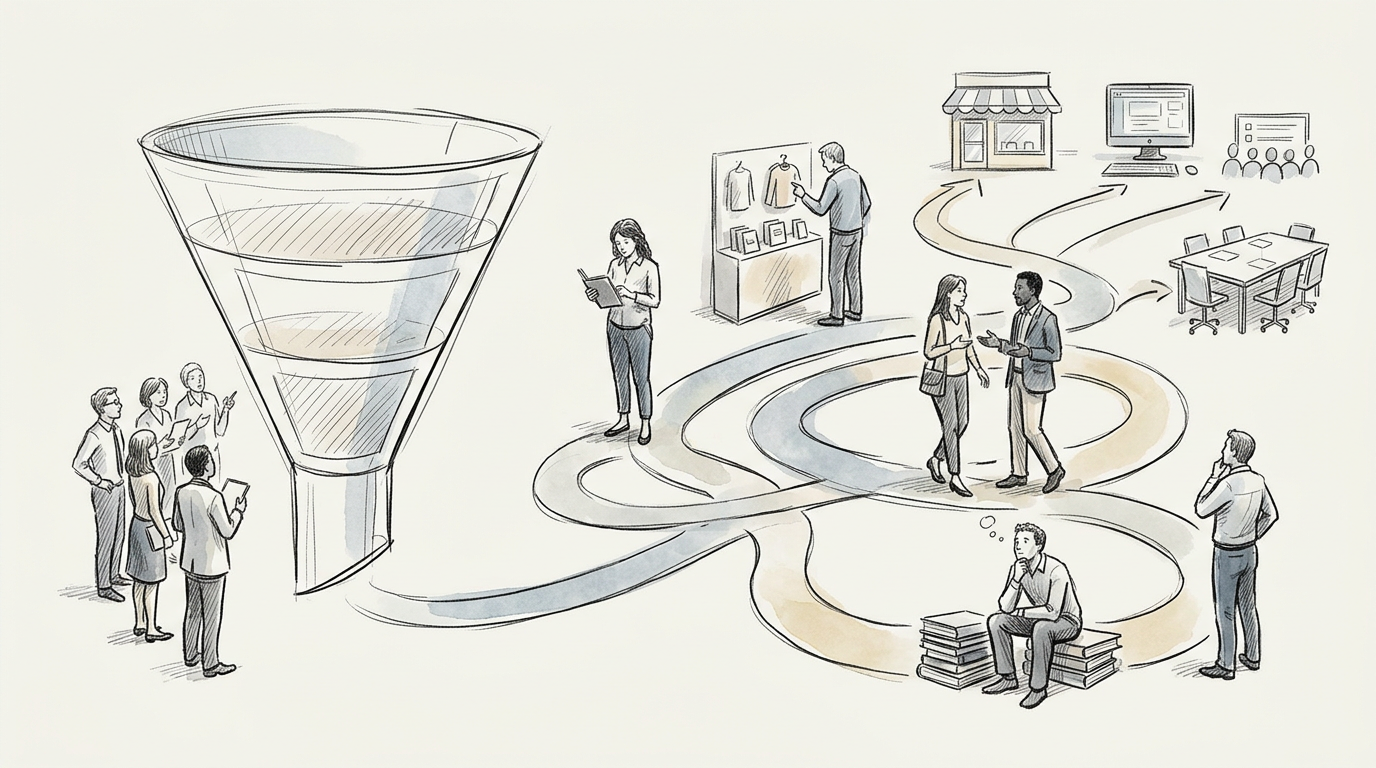
The customer journey encompasses the various interactions and experiences a consumer has with a brand, from awareness to post-purchase. It includes stages like evaluation, purchase, and service, demonstrating that journeys are non-linear rather than a simple funnel. Understanding this concept is crucial for effective marketing and customer experience management.
-
What Is a Marketing Funnel?
The marketing funnel is a framework that outlines audience progression from awareness to action, emphasizing the importance of each stage. It helps marketers strategize planning, messaging, and measurement while acknowledging that customer behavior is nonlinear. Despite its limitations, the funnel remains vital for organizing marketing efforts and improving decision-making.