
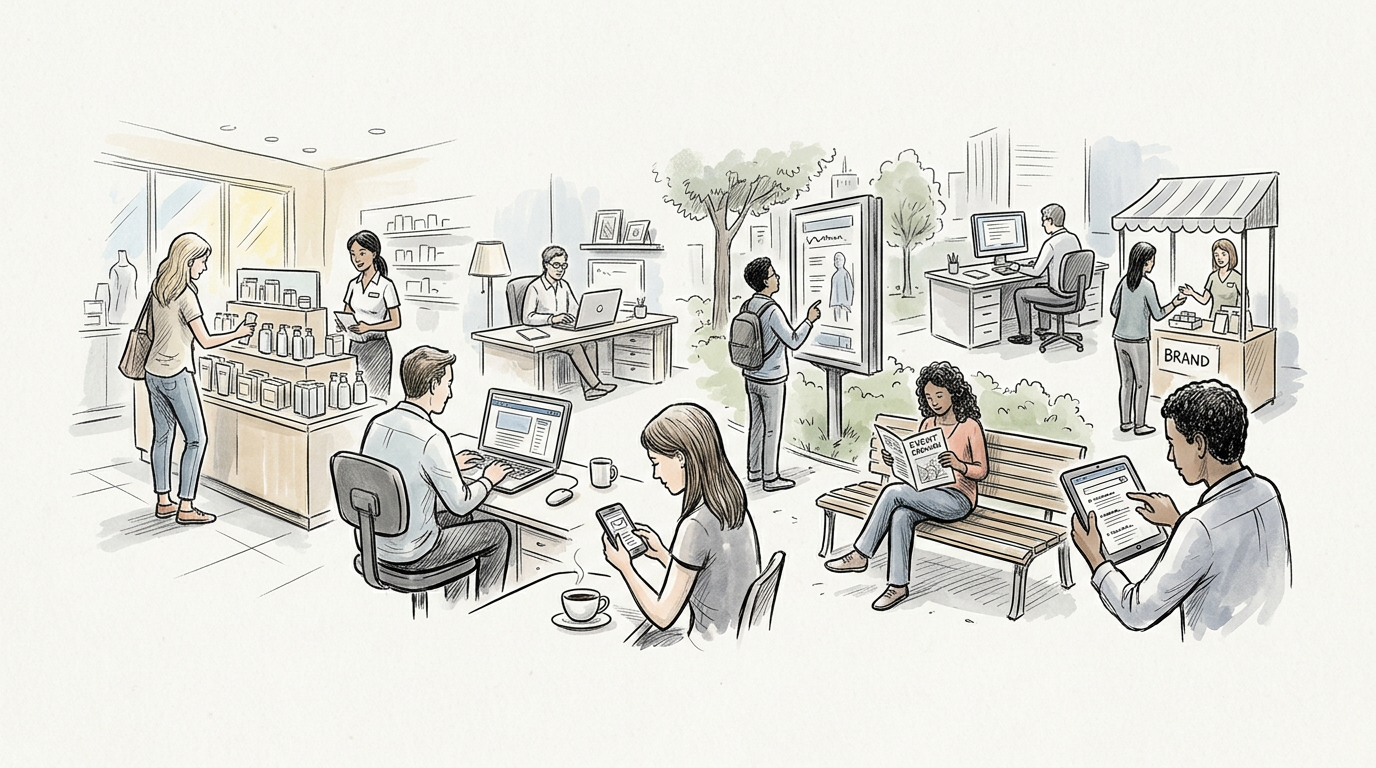
A marketing channel is a route through which an organization reaches, communicates with, sells to, or serves customers. That definition is broader, and more useful, than treating a channel as simply an ad placement or a digital platform. A channel is not just where a message appears. It is a pathway that connects a business and a customer at some point in the customer relationship, whether the goal is awareness, information, purchase, service, retention, or advocacy.
Understanding channels matters because modern marketing is organized around them. Teams build channel strategies, allocate channel budgets, compare channel performance, assign channel owners, and design customer journeys that move across multiple channels. But channel language is also used loosely. Professionals often refer to email, retail, social media, search, television, sales teams, websites, marketplaces, and even packaging as channels, sometimes correctly and sometimes in ways that blur the difference between a true route to market and a tactic used within that route.
A clearer understanding helps organizations make better decisions about planning, investment, measurement, and coordination.
What a marketing channel is, and what it is not
At its core, a marketing channel is a means of access between an organization and an audience or customer. That access may be communicative, commercial, or operational. Some channels are primarily used to deliver messages, such as broadcast television or email. Others are used to enable transactions, such as retail stores, ecommerce sites, distributors, or marketplaces. Many channels do both.
This is why channel should not be confused with tactic.
A channel is the broader route. A tactic is a specific action taken within that route.
For example:
- Email is a channel. A welcome series, abandoned cart reminder, or promotional newsletter is a tactic within that channel.
- Search can be treated as a channel. Bidding on branded keywords or optimizing product pages for organic search are tactics within that channel.
- Retail is a channel. Endcap displays, in-store sampling, shelf signage, and retailer media are tactics used within or around that channel.
- Social media is often treated as a channel. Short-form video ads, creator partnerships, customer service replies, and community management are tactics or activities within it.
This distinction matters because channel decisions are strategic and structural. Tactic decisions are more executional. An organization might decide that retail, ecommerce, email, and paid social are priority channels. It would then choose the specific programs, formats, and creative approaches used inside each.
Channels operate across more than one business function
Marketing professionals sometimes think of channels only as media channels. In practice, the concept reaches further. A channel can help a company:
- Reach people who may not know the brand
- Communicate value, pricing, and brand meaning
- Enable purchase or lead generation
- Deliver products or services
- Provide service and support
- Maintain customer relationships over time
That is why channel planning often crosses multiple departments. Marketing may manage advertising and communications channels. Sales may manage field, reseller, or distribution channels. Ecommerce teams may manage online storefronts and marketplaces. Customer service may manage support channels such as live chat or call centers. Retail or trade marketing teams may manage in-store channels and retail partnerships.
In some organizations, the term channel refers mainly to sales and distribution. In others, it refers mainly to communications media. In many cases, both meanings are relevant, and professionals need to be clear about which one they mean.
Common ways channels are classified
There is no single universal channel taxonomy. Companies classify channels differently depending on industry, operating model, and customer journey. Still, several distinctions are widely used and useful.
Owned, paid, and earned channels
One of the most common ways to organize channels is by the organization’s relationship to access and control.
Owned channels are channels the organization controls directly, at least in large part. Common examples include:
- The company website
- Brand apps
- Email programs
- SMS lists
- Physical stores
- Product packaging
- Loyalty programs
- Brand-managed customer communities
Owned channels are valuable because the organization can shape the experience, collect first-party data within applicable legal and policy limits, and build ongoing customer relationships. They often become especially important for retention, service, and conversion.
Paid channels are channels where the organization pays for access, distribution, visibility, or placement. Examples include:
- Search advertising
- Social advertising
- Display advertising
- Television, radio, and audio advertising
- Out-of-home advertising
- Sponsorships
- Retail media placements
- Paid influencer or creator partnerships
Paid channels are often used to generate reach, demand, traffic, or leads at scale. They can work quickly, but they require continuing investment and are subject to auction dynamics, pricing changes, platform rules, and creative wearout.
Earned channels are channels where exposure, conversation, or recommendation is gained rather than directly purchased or fully controlled. Examples include:
- Unpaid press coverage
- Word of mouth
- Organic social sharing
- Customer reviews
- Independent recommendations
- Unpaid influencer mentions
Earned channels can be highly credible because the message is not coming solely from the brand. They can also be difficult to predict or control. Strong products, service experiences, public relations, community engagement, and customer satisfaction often contribute to earned visibility, but no organization can command it in the way it can buy media or send an email.
These categories are useful, but they are not always cleanly separated. A brand’s social media presence may involve owned content on a platform the brand does not own, paid promotion of that content, and earned sharing by users. The labels still help, but professionals should not force every activity into a rigid box.
Direct and indirect channels
Another important distinction is whether the organization reaches or sells to customers directly or through an intermediary.
Direct channels connect the organization to the customer without a separate selling intermediary. Examples include:
- A company-owned ecommerce site
- Brand retail stores
- Direct mail
- Email and SMS programs
- Direct sales teams
- A call center that takes orders
Direct channels often provide stronger control over brand experience, pricing, customer data, merchandising, and service. They can also require more operational capability.
Indirect channels involve intermediaries such as:
- Retail partners
- Distributors
- Wholesalers
- Resellers
- Dealers
- Online marketplaces
Indirect channels can expand coverage, scale, convenience, and market access. They may also reduce control over pricing, merchandising, customer relationship data, and final presentation.
This distinction is especially important in channel strategy because conflict can emerge when direct and indirect channels compete. A manufacturer selling through both retailers and its own website, for example, must think carefully about pricing, assortment, fulfillment, promotions, and partner relationships.
Digital and offline channels
Digital and offline remain useful categories, but they should be treated as descriptive rather than strategic opposites.
Digital channels include routes enabled primarily through internet-connected devices or digital systems, such as:
- Websites
- Mobile apps
- Search
- Social platforms
- Digital video
- Online marketplaces
- Programmatic advertising
- Digital retail media
Offline channels include routes that do not depend primarily on an internet-based interaction, such as:
- Broadcast television
- Radio
- Direct mail
- Physical retail
- Trade shows
- Out-of-home advertising
- Call centers
- Field sales
The line between digital and offline is increasingly porous. A store visit may be influenced by paid search. A direct mail piece may send customers to a personalized landing page. Connected TV combines traditional viewing behavior with digital delivery and targeting methods. Professionals should think less in terms of digital versus traditional as rival camps and more in terms of how different channels support different stages of the customer relationship.
Retail and non-retail channels
For many consumer brands, retail is not just a place where products happen to be sold. It is a major route to market with its own economics, data, incentives, and marketing practices.
Retail channels can include:
- Mass retail
- Grocery
- Drug
- Specialty retail
- Department stores
- Convenience stores
- Club stores
- Ecommerce retailers
- Marketplaces
A retail channel may involve several different professional functions, including sales, trade marketing, shopper marketing, merchandising, supply chain, and increasingly retail media. The fact that a brand advertises through a retailer’s media network does not make retail media identical to the retail sales channel, but the two are closely connected.
For service businesses or business-to-business organizations, retail may matter less than channels such as direct sales, partner sales, distributors, inside sales, websites, events, or account-based outreach.
Channels are part of customer journeys, not isolated pipes
Customers rarely move through a single channel from awareness to purchase to loyalty. More often, they encounter a sequence of touchpoints across channels.
A prospective customer might:
- See a brand in out-of-home advertising
- Search for reviews online
- Visit the brand’s website
- Sign up for email
- Purchase from a retailer
- Contact customer support through chat
- Post a review or recommendation
Each of those interactions occurs through a different channel or subchannel. The customer does not necessarily experience them as separate internal departments. That is why channel strategy must account for coordination. A strong paid media plan cannot compensate for a weak retail experience. A good ecommerce site cannot fully solve for poor post-purchase service. A brand may generate demand in one channel and lose it in another.
This cross-channel reality is one reason many organizations focus on omnichannel or multichannel planning. The terms are related but not always used identically. Multichannel generally means using multiple channels. Omnichannel often implies a more integrated experience across those channels, especially around data, messaging, service continuity, and customer recognition. The distinction varies by company, but the basic idea is that channel planning should reflect how customers actually move.
How professionals decide which channels to use
Channel choice is not simply a matter of choosing the newest platform or spreading budget evenly. It depends on several practical questions.
Where can the target audience be reached?
A useful channel reaches people who matter to the business. That may sound obvious, but it has implications for media habits, shopping behavior, geography, device usage, professional role, life stage, and category-specific behavior. A business-to-business software company and a packaged food brand may use very different channel mixes because their buying contexts differ fundamentally.
What role should the channel play?
Channels serve different functions. Some are better at broad awareness. Some are better at demand capture. Some are better at education, service, repeat purchase, or loyalty. Professionals should define the role before judging performance.
For example, television, online video, or out-of-home may be used to build broad awareness. Search may capture existing intent. Email may be used for retention. Retail stores may support product trial and immediate availability. A channel should not be criticized for failing at a job it was not selected to do.
What level of control is required?
Owned channels provide more control over message timing, experience design, and customer data than most paid or earned channels. Indirect channels can provide scale but less control. Regulated industries, premium brands, and businesses with complex service requirements may weigh control more heavily than others.
What economics support the channel?
Channel strategy is constrained by cost structure and margin. Selling through a marketplace may expand volume but reduce margin. Direct-to-consumer ecommerce may improve customer access to data but require fulfillment, service, and acquisition costs that are difficult to sustain. Tradeoffs are normal.
What operational capabilities are needed?
A channel is not just a messaging choice. It often requires infrastructure. Email needs list management, consent processes, automation, and deliverability practices. Retail needs distribution, merchandising, inventory coordination, and retailer relationships. Search advertising needs feed quality, bidding discipline, and landing page alignment. A good channel strategy accounts for execution capacity.
Common channel types and how they differ
Because the term can become too abstract, it helps to compare several common channel categories more directly.
Owned channels
Owned channels are often the backbone of relationship marketing because they allow an organization to maintain an ongoing connection after initial acquisition. They are especially important when privacy changes, platform dependence, or paid media inflation make third-party access less reliable. But owned does not mean free. Websites, apps, stores, CRM systems, content operations, and lifecycle programs require significant investment.
Paid channels
Paid channels are typically used for scale, speed, precision, or share of voice. They are central to most demand generation efforts. However, they are rented access, not durable ownership. If spending stops, performance often declines quickly. Paid channels can also create false confidence when organizations focus on media efficiency metrics without strengthening the owned or conversion channels that must complete the journey.
Earned channels
Earned channels can amplify reputation and trust, but they are outcomes as much as inputs. They often reflect the cumulative effect of brand behavior, product quality, service experience, communications relevance, and cultural timing. Professionals should be cautious about treating earned as a channel that can simply be switched on through a campaign brief.
Direct channels
Direct channels are often prized because they bring the brand closer to the customer. They can strengthen data visibility and customer lifetime value management. At the same time, they may shift responsibilities onto the organization that partners once handled, including fulfillment, customer support, credit risk, and returns management.
Retail channels
Retail channels matter not only because they sell products but also because they shape availability, visibility, and shopper behavior at the point of decision. In categories where many purchases are made in-store or through retail ecommerce, channel strategy must account for distribution, shelf presence, search placement within retailer sites, and retailer-specific promotional mechanics.
Digital channels
Digital channels offer speed, targeting flexibility, and fine-grained measurement, but they are not automatically superior. Digital interactions can be overmeasured in some cases and misunderstood in others. Clicks and platform-reported conversions do not always capture incremental value, brand effects, or offline outcomes.
Offline channels
Offline channels remain important in many categories, especially when broad reach, local presence, physical experience, or habitual media use matter. They may be harder to track at the user level, but that does not make them strategically weak. Measurement approaches such as matched market tests, econometric modeling, retail sales analysis, and brand tracking can help evaluate their contribution.
How channel strategy fits into marketing planning
Channel planning usually sits between overall marketing strategy and campaign execution.
A simplified planning sequence might look like this:
- Business and marketing objectives are defined
- Target audiences and priority customer segments are identified
- The customer journey and decision points are mapped
- Channels are selected based on reach, role, economics, and capabilities
- Budgets are allocated across channels
- Tactics and creative are developed for each channel
- Performance is measured and optimized
In practice, this process is rarely linear. Budget limits, retail commitments, technology constraints, seasonality, and prior learning all affect the plan. Still, channel strategy plays a distinct role. It translates high-level objectives into a practical system of customer access.
Who typically works on channel decisions
Channel strategy is interdisciplinary. Depending on the organization, the people involved may include:
- Brand marketers
- Media planners and buyers
- Digital marketing teams
- Ecommerce leaders
- Sales and distribution teams
- Trade and shopper marketers
- CRM and lifecycle marketing teams
- Analytics and insights professionals
- Marketing operations teams
- Agency partners
The relative influence of each group varies. In a consumer packaged goods company, retail and trade considerations may heavily shape channel planning. In a subscription software business, website, search, email, and sales development channels may dominate. In a local service business, call tracking, search, maps, reviews, and field sales may be central.
How channels are measured
There is no single channel metric that answers every important question. Different channels require different indicators, and performance should be judged against the channel’s intended role.
Common channel metrics include:
- Reach: how many people or households were exposed or potentially exposed
- Frequency: how often the audience was exposed
- Traffic: visits, sessions, or store traffic generated
- Engagement: actions such as clicks, views, time spent, shares, or replies
- Lead volume and lead quality: how many potential customers were generated and how likely they are to convert
- Conversion rate: the share of users who completed a desired action
- Sales volume or revenue: direct commercial outcomes
- Customer acquisition cost: cost to gain a customer through a channel
- Retention and repeat purchase: how well a channel supports ongoing value
- Incrementality: the extent to which the channel created outcomes that would not otherwise have happened
Measurement becomes more difficult when channels interact. A customer may see a video ad, read reviews, visit a retailer, then later search the brand name and convert online. Last-click attribution would give all credit to search, even though the sale was likely influenced by earlier channels. That is one reason organizations increasingly use multiple methods, including attribution models, experiments, media mix modeling, customer journey analysis, and brand tracking.
Professionals should also remember that channel metrics often reflect both channel quality and downstream experience. If paid search traffic converts poorly, the issue may be targeting or bidding, but it may also be weak product pages, poor pricing, slow shipping, or an underperforming checkout process.
Common misunderstandings about channels
Several misunderstandings appear frequently in planning conversations.
“A channel is the same thing as a platform.”
Not always. A platform can be part of a channel, but the channel category is often broader. For example, search is a channel, while a specific search engine may be one platform within it.
“A channel is the same thing as a tactic.”
It is usually more useful to treat the tactic as the specific execution within the channel.
“Digital channels have replaced offline channels.”
In some categories, digital is dominant. In many others, offline remains highly influential, especially when physical presence, local scale, mass reach, or retail behavior matter.
“Owned channels are free because the brand controls them.”
Owned channels may avoid media rent, but they still require technology, staffing, content, analytics, and maintenance.
“Earned channels can be planned the same way as paid channels.”
They can be supported and encouraged, but not purchased or controlled in the same way.
“The best channel is the one with the lowest measurable acquisition cost.”
A low apparent acquisition cost can be misleading if the channel mainly captures demand created elsewhere, reaches only existing high-intent users, or brings in low-value customers.
Why channel understanding matters more now
Channel strategy has become more important, not less, as the media and commerce environment has fragmented. Organizations must now navigate changing privacy rules, platform dependence, retail media growth, hybrid purchase behavior, creator ecosystems, and increasing pressure to connect brand building with measurable performance.
A clear channel framework helps marketers avoid two common errors. The first is overgeneralization, where every touchpoint is called a channel without any useful structure. The second is oversimplification, where channels are judged in isolation without regard to journey stage, customer intent, or organizational capabilities.
A marketing channel is best understood as a route of connection between an organization and its customers or prospects. Some channels are owned, some paid, some earned. Some are direct, some indirect. Some are digital, some offline. Some communicate, some transact, some serve, and many do several of these at once. The professional task is not merely to name channels, but to understand what role each plays, what tradeoffs it introduces, how it interacts with other channels, and how it supports the broader marketing system.
When marketers use the term precisely, channel planning becomes more than a budget exercise. It becomes a practical way to design how a business reaches the market and how customers experience the brand across time.
Leave a Reply