
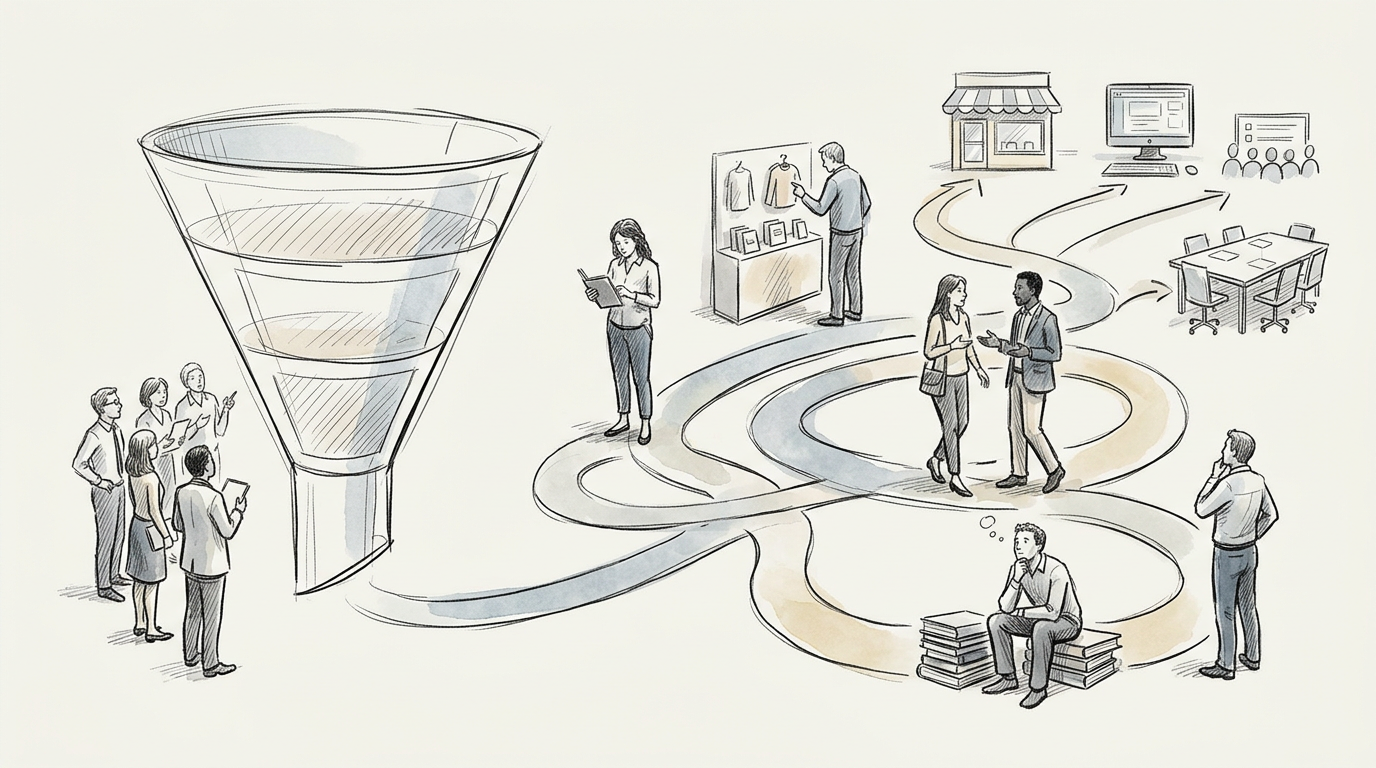
A marketing funnel is a framework used to organize how people move from first exposure to a brand or offer toward some form of action, and in many versions, toward ongoing loyalty or repeat purchase. In practice, the funnel helps marketers structure planning, messaging, channel strategy, and measurement across different stages of audience behavior. It is one of the most common models in marketing because it gives teams a simple way to answer a complicated question: what needs to happen before a person buys, signs up, donates, subscribes, or otherwise does what the organization wants them to do?
That simplicity is also where confusion begins. A funnel is not a literal map of how every customer behaves. People do not reliably move in a straight line from awareness to purchase. They may skip stages, return to earlier ones, compare options for months, buy impulsively, or become loyal without much formal “nurturing” at all. The value of the funnel is not that it predicts every path. Its value is that it helps marketers organize work and make better decisions about audiences, communications, and metrics.
Understanding the funnel matters because it sits at the intersection of strategy, creative development, media planning, customer experience, and measurement. It is often one of the first frameworks professionals encounter, but it remains relevant well beyond entry-level work because so many campaign decisions are still framed in funnel terms.
What the marketing funnel is meant to do
At its core, a marketing funnel is a staged model of audience progression. Different organizations define the stages differently, but many versions include some combination of:
- Awareness: people become aware that the brand, product, service, or issue exists.
- Consideration: people begin evaluating whether it is relevant, credible, or preferable to alternatives.
- Action: people take a desired step such as purchasing, requesting a demo, downloading an app, registering, or contacting sales.
- Retention: people continue the relationship through repeat purchase, renewal, usage, advocacy, or loyalty.
The framework is called a funnel because, in many situations, the number of people decreases from one stage to the next. Many people may see an ad, fewer may click or visit a site, fewer still may start a checkout flow, and a smaller number may complete the purchase. That narrowing shape is directionally useful, especially when marketers need to think about conversion rates, drop-off points, and how much demand is needed at the top to produce a desired result at the bottom.
The funnel also helps teams avoid treating all prospects the same. Someone who has never heard of a brand usually needs a different message than someone who abandoned a cart yesterday. A broad-reach awareness campaign and a retention email program do not have the same job, even if both contribute to revenue over time.
Where funnel thinking comes from
The general idea behind funnel models is older than modern digital marketing. One of the most cited historical predecessors is the AIDA model, commonly described as Attention, Interest, Desire, and Action. The model is often associated with advertising pioneer E. St. Elmo Lewis, although historians note that the exact history and attribution are more complicated than many summaries suggest. Regardless of its precise origin, AIDA helped establish a long-running marketing habit: breaking persuasion and buyer behavior into stages.
Over time, marketers developed many related frameworks. Some emphasize awareness, consideration, and conversion. Others include loyalty, advocacy, trial, preference, intent, or post-purchase experience. Business-to-business marketers may separate lead generation, marketing-qualified leads, sales-qualified leads, opportunity creation, and closed business. E-commerce teams may track product views, cart adds, checkout starts, and completed orders. Subscription businesses often focus heavily on onboarding, activation, renewal, and churn.
These variations do not mean the funnel is wrong. They mean the funnel is a family of models, not a single universal diagram.
Common funnel stages and what happens in each one
While naming conventions vary, the following structure captures the logic behind many funnel models.
Awareness
Awareness is the stage where people first encounter a brand, category, offer, or problem framing. The objective is not usually immediate purchase. It is to create recognition, memory, and enough relevance that the brand enters the person’s mental set.
Typical awareness tactics include broad-reach media such as video, audio, out-of-home, display, influencer exposure, sponsorships, public relations, retail presence, and search visibility around category terms. Creative at this stage often aims to answer simple questions: Who are you? What do you offer? Why should anyone care?
Relevant metrics may include:
- Reach
- Impressions
- Video views or completion rates, depending on format
- Ad recall or awareness lift, when measured through brand studies
- Share of voice or search interest, in some contexts
A key misunderstanding is assuming awareness means mere exposure. Media delivery alone does not guarantee that people noticed, remembered, or understood the message. Awareness metrics often indicate opportunity to see, not confirmed cognitive impact.
Consideration
Consideration begins when people move from noticing to evaluating. They may visit a website, read reviews, compare features, follow the brand on social platforms, watch product demos, search for more information, or discuss options internally.
This is often the stage where marketers help people answer practical and emotional questions: Is this trustworthy? Is it right for me? Is it better than alternatives? Is the price justified? Will it fit my needs?
Common tactics include search marketing, retargeting, comparison content, case studies, testimonials, explainer videos, webinars, email nurturing, product pages, retailer content, and category education. In B2B environments, this stage may also involve sales development, consultations, or account-based marketing efforts.
Relevant metrics may include:
- Website visits and engaged sessions
- Time spent with content, depending on context
- Email opens and clicks, used carefully
- Lead form completions
- Content downloads
- Return visits
- Brand consideration lift in survey-based studies
Consideration is one of the hardest stages to measure cleanly because much of it happens across channels and over time. A person can become more likely to buy without leaving an easily attributable digital signal.
Action
Action is the stage where the audience takes the organization’s defined next step. In consumer marketing, that may be a purchase. In other cases, it may be a quote request, free trial signup, app install, store visit, appointment booking, event registration, or donation.
At this stage, friction matters. Even highly interested customers can fail to convert because of price confusion, weak calls to action, poor mobile experience, limited payment options, slow page load times, inadequate product information, or missing trust signals.
Typical action-stage tactics include conversion-focused landing pages, strong calls to action, paid search for high-intent queries, shopping ads, remarketing, promotional offers, checkout optimization, lead forms, sales outreach, and CRM-triggered follow-up.
Relevant metrics may include:
- Conversions
- Conversion rate
- Cost per acquisition or cost per lead
- Revenue
- Return on ad spend
- Abandonment rates in forms or checkout flows
A common mistake is treating action as the only stage that matters because it is easiest to count. Conversion metrics are essential, but they usually reflect the combined effects of upstream awareness, brand strength, product-market fit, customer experience, and competitive context.
Retention
Many modern funnel models extend beyond the initial action to include retention, loyalty, repeat purchase, or advocacy. This stage reflects an important reality: acquiring a customer is often only part of the economic story.
Retention work includes onboarding, customer support, loyalty programs, lifecycle email, app engagement, subscription renewal, cross-sell and upsell programs, community building, and customer experience improvement. In some categories, especially subscription businesses, retention can be more important than initial acquisition.
Relevant metrics may include:
- Repeat purchase rate
- Customer retention rate
- Churn rate
- Renewal rate
- Customer lifetime value
- Net Promoter Score, when used appropriately
Retention is sometimes left out of simplified funnel diagrams, but omitting it can distort planning. Marketing does not stop when a conversion happens. Post-purchase experience often determines whether acquisition spending was truly worthwhile.
How professionals use funnels in practice
Funnel models are useful because they help teams connect strategy to execution. In most organizations, the funnel is less a rigid doctrine than a planning language shared across functions.
A team might use funnel thinking to:
- Set objectives by clarifying whether the immediate need is awareness, demand generation, conversion improvement, retention, or some combination.
- Segment messaging so creative addresses what the audience is likely to need at a given stage.
- Select channels based on their strengths. Broad-reach video and out-of-home may support awareness, while paid search and CRM programs may support action or retention.
- Sequence communications so audiences receive different messages over time rather than the same message repeatedly.
- Allocate budgets across short-term and long-term work instead of overinvesting in immediately measurable lower-funnel activity.
- Define KPIs that match the job of each campaign component.
- Diagnose performance problems by identifying where audiences are dropping off or where demand is not being created in the first place.
For example, if a company sees weak sales, the solution is not automatically more conversion advertising. The problem might be low awareness, poor product understanding, weak retail availability, a confusing website, or a retention issue that depresses lifetime value. Funnel thinking encourages marketers to ask where the real constraint sits.
Funnels and the relationship between strategy, media, and creative
One reason funnel language persists is that it helps multiple disciplines work from the same basic map.
Strategy teams may use funnel stages to frame audience problems and define communications tasks. Creative teams may develop messages tailored to different levels of familiarity or intent. Media planners may decide how much budget should support reach versus conversion activity. CRM and lifecycle marketers may use funnel logic to automate follow-up after a lead or purchase. Analytics teams may build reporting views that organize performance by stage.
This does not mean every department uses identical terminology. Some teams talk about upper funnel, mid-funnel, and lower funnel. Others use brand, performance, and retention. Still others use channel-specific labels such as prospecting, remarketing, and re-engagement. What matters is not the labels themselves but the underlying logic: different marketing tasks require different messages, channels, and metrics.
Useful terminology around the funnel
Because funnel discussions often blend several concepts, a few distinctions are important.
Awareness vs. consideration
Awareness means people know the brand or offer exists. Consideration means they are actively weighing it as an option. A person can recognize a brand without seriously considering it.
Lead generation vs. conversion
Lead generation usually refers to collecting interest, often before a sale happens. Conversion is broader and means the desired action occurred. In some businesses a lead is the conversion. In others it is only an intermediate step.
Acquisition vs. retention
Acquisition refers to gaining new customers or users. Retention refers to keeping and growing existing ones. Both may sit within the broader funnel, but they are different operational challenges.
Marketing funnel vs. sales funnel
These terms are related but not always identical. A marketing funnel usually describes audience movement through communications and demand-building stages. A sales funnel often focuses on pipeline stages such as qualified lead, meeting, proposal, and closed deal. In B2B organizations, the two often overlap and require close alignment.
Customer journey vs. funnel
A customer journey is usually more specific and behavior-based. It maps actual interactions, touchpoints, decisions, and experiences across time. A funnel is a simplified stage model. The journey is often messier and more detailed than the funnel.
That last distinction matters. Many professionals criticize funnel models not because staged thinking is useless, but because real customer journeys are not linear.
Why funnels remain useful despite their limitations
Funnel models are sometimes dismissed as outdated because digital behavior is fragmented, omnichannel, and nonlinear. That criticism is partly fair. Customers can discover a brand on social media, read reviews on third-party sites, visit a store, forget about it, see a search ad a month later, ask friends for advice, and purchase through a retailer app. That path does not look like a neat downward slide through labeled boxes.
Yet marketers still need a practical way to organize work. A good framework simplifies reality without pretending to replace it. Funnels remain useful because they help answer operational questions such as:
- Are we building enough future demand, or are we trying to harvest demand that does not exist yet?
- Are we measuring awareness activity with the wrong conversion metric?
- Are we sending conversion-focused messages to audiences who are too unfamiliar with the brand?
- Are we overspending on acquisition while ignoring retention?
- Do our creative assets support different audience needs at different moments?
In other words, the funnel is often best understood as a planning and measurement aid, not a behavioral law.
Important limitations and common misuses
The funnel becomes less useful when it is treated too literally or too mechanically.
It can imply a false linear path
Real people move back and forth. They compare alternatives, pause decisions, switch devices, consult others, and revisit brands. Some start with strong intent. Others move from purchase to advocacy very quickly. The funnel should not erase that complexity.
It can overvalue what is easiest to measure
Lower-funnel tactics often generate clearer attribution signals because clicks, leads, and purchases are more visible than memory, preference, or future demand. That can push organizations to underinvest in brand-building and other upper-funnel work that matters but is less immediately traceable.
This issue has been widely discussed in marketing effectiveness research, including work associated with the IPA and the Ehrenberg-Bass Institute, as well as analyses of short-term performance bias in modern marketing measurement. The exact implications vary by category and business model, but the broader lesson is consistent: easy-to-measure activity is not automatically the most valuable activity.
It can create siloed teams
If upper-funnel, lower-funnel, and retention teams operate with separate goals and disconnected data, the customer experience can become fragmented. A person does not experience the organization as a set of internal departments.
It can flatten category differences
A fast-moving consumer packaged goods purchase does not behave like enterprise software procurement, healthcare enrollment, nonprofit giving, or luxury travel. The stages may be conceptually similar, but the timing, stakes, decision-makers, and measurement methods can differ dramatically.
It can encourage stage labels without strategic clarity
Simply calling something “mid-funnel content” does not explain what the communication is trying to do. Good funnel use requires more than sorting tactics into boxes. Teams still need a clear audience, a defined objective, a value proposition, and a credible path to action.
Measurement: what the funnel helps clarify and what it does not
One of the funnel’s most practical uses is measurement discipline. It reminds teams that metrics should match the role of the activity.
An awareness campaign should not be judged solely on last-click purchases. A conversion landing page should not be judged by reach alone. A retention program should not be evaluated only on acquisition volume. Stage-appropriate KPIs help marketers avoid mismatched expectations.
That said, funnel measurement has limits. Not every stage can be cleanly observed. Platform reporting may overcredit some touchpoints and miss others altogether. Privacy changes, cross-device behavior, retailer data gaps, and offline influence all complicate attribution. Metrics often describe signals, not complete causality.
This is why sophisticated organizations use a mix of methods rather than a single funnel dashboard. Depending on the business, that may include web analytics, CRM data, incrementality testing, brand tracking, media mix modeling, customer surveys, sales data, and controlled experiments. The right measurement approach depends on budget, channel mix, data maturity, and buying cycle length.
For readers looking for foundational measurement references, the Association of National Advertisers, the Advertising Research Foundation, and the Mobile Marketing Association publish guidance on topics such as attribution, experimentation, and effectiveness. For digital analytics terminology and implementation details, original platform documentation such as Google Analytics Help can also be useful, though platform-specific metrics should not be mistaken for universal marketing truth.
How funnel models differ from flywheels and customer journey maps
In recent years, some organizations have shifted away from funnel language in favor of alternatives such as the flywheel or full customer journey mapping.
A flywheel emphasizes momentum created by satisfied customers who drive repeat business, referrals, and advocacy. It is often used to counter the funnel’s implication that the relationship ends at purchase.
A customer journey map is usually more granular than a funnel. It traces touchpoints, emotions, needs, barriers, and decision moments across channels. Journey mapping is particularly useful for service design, UX, CRM, and omnichannel planning.
These alternatives do not necessarily replace the funnel. They answer somewhat different questions. A funnel is a high-level planning framework. A journey map is a more detailed representation of experience. A flywheel emphasizes post-purchase growth dynamics. Many organizations use all three in different contexts.
What a practical funnel discussion sounds like inside a marketing team
A healthy funnel conversation is usually less about defending a textbook model and more about diagnosing where marketing effort is needed.
For example, a team might say:
- Awareness is high, but consideration is weak. People know us, but they do not see us as differentiated.
- Traffic is strong, but the conversion rate on product pages is low. The issue may be usability, pricing, or proof.
- Customer acquisition is expensive, but repeat purchase rates are healthy. We may need to expand top-of-funnel demand more efficiently.
- Lower-funnel campaigns are performing well with branded search, but new-customer growth is slowing. We may be overharvesting existing demand.
- Retention is weak after the first purchase. The problem may sit in onboarding or product experience, not media.
This kind of diagnosis is where the funnel becomes professionally useful. It provides a shared vocabulary for identifying where the business challenge lives.
What professionals should remember about funnel models
The marketing funnel endures because it is simple, adaptable, and operationally helpful. It gives marketers a way to organize communications tasks from awareness through action and, in more complete versions, through retention and loyalty. It helps teams align objectives, messages, channels, and metrics. It also helps explain why not all marketing should be judged by the same standards.
Its weakness is the same as its strength. Because it simplifies reality, it can mislead when treated as a literal description of human behavior. Customers do not move through markets in neat, universal sequences, and organizations that rely too heavily on narrow funnel metrics can distort both planning and investment.
Used well, the funnel is a model of decision-making pressure points, not a script that every customer follows. Professionals who understand that distinction can use funnel thinking where it is helpful, challenge it where it becomes reductive, and connect it to richer tools such as journey mapping, experimentation, and lifecycle analysis. That is what makes the funnel less a piece of marketing jargon and more a practical framework for organizing work.
Leave a Reply