
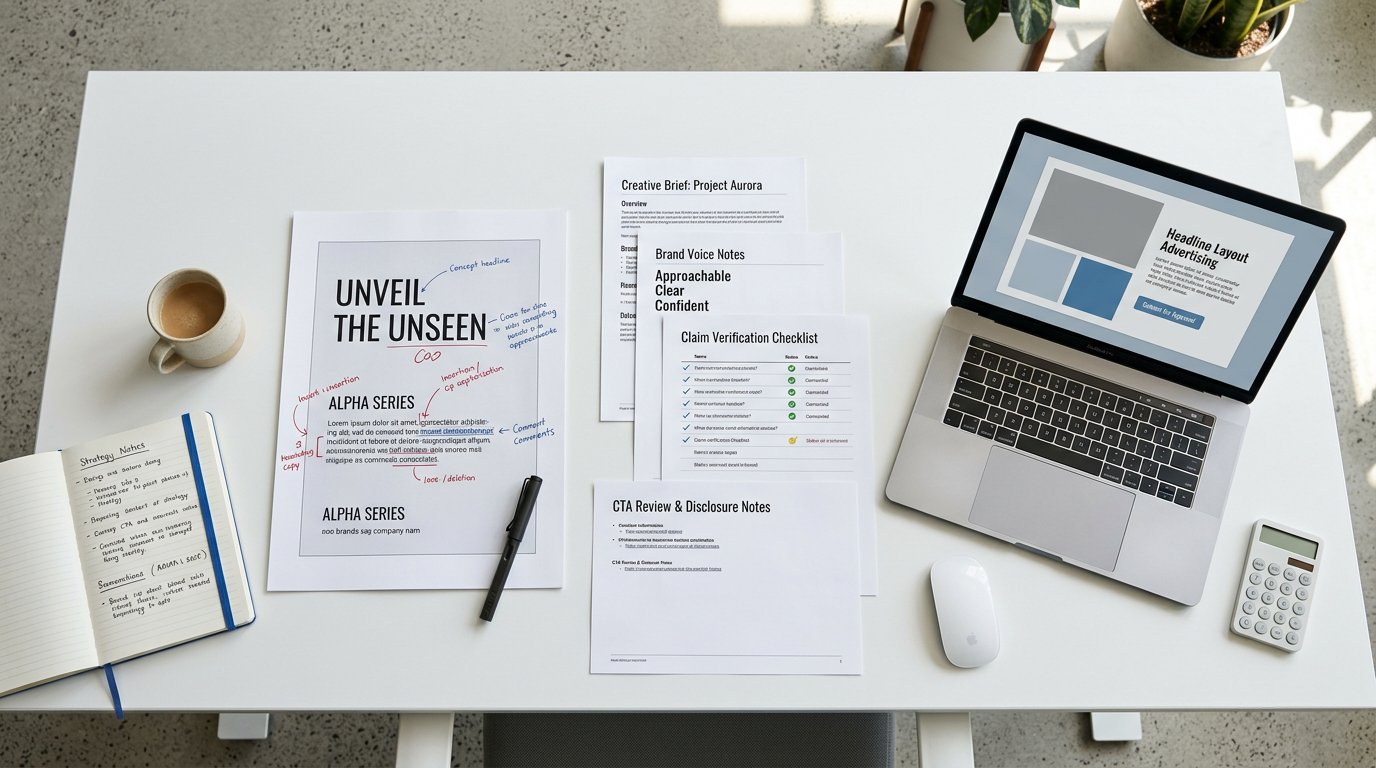
The AAMA Advertising Copy Review Checklist is designed to help marketers, advertisers, copywriters, creative teams, agencies, brands, students, and reviewers evaluate advertising copy before it is approved or published. It can be used for digital ads, print advertising, social media, landing pages, email, video scripts, direct mail, outdoor advertising, product marketing, promotional materials, and other forms of commercial communication.
The checklist focuses on whether the copy is strategically sound, understandable, persuasive, accurate, consistent with the brand, appropriate for the channel, and ready for final approval. It is not a substitute for legal review where one is required, but it can help identify issues early enough to avoid unnecessary revision later.
1. Objective
Is the purpose of the advertising clear?
The reviewer should be able to identify what the advertisement is trying to accomplish. Possible objectives may include awareness, consideration, lead generation, purchase, registration, trial, retention, or another measurable response.
If the copy appears to pursue several unrelated objectives at once, the message may need to be simplified.
Does the copy support the campaign objective?
The message should move the audience toward the intended outcome. Copy written to generate immediate purchases may require a different structure from copy intended to build familiarity or explain a complex product.
The language should reflect the actual communication objective rather than simply sound promotional.
Is the desired audience response clear?
Ask what the audience should think, feel, understand, or do after encountering the advertisement.
If the answer is unclear, the copy may lack a strong strategic center.
2. Audience
Is the intended audience identifiable?
The copy should feel written for a specific audience rather than for everyone.
Review whether the language reflects the audience’s:
- Needs
- Knowledge
- Motivations
- Concerns
- Vocabulary
- Decision-making role
- Familiarity with the category
The message does not need to describe the audience explicitly, but it should demonstrate that the advertiser understands who is receiving it.
Does the copy address something the audience actually cares about?
Advertising becomes weak when it focuses entirely on what the company wants to say rather than what the audience needs to understand.
Look for a meaningful connection between the message and an audience problem, desire, question, risk, opportunity, or goal.
Is the assumed level of knowledge appropriate?
Avoid explaining basic concepts unnecessarily to an expert audience, and avoid using unexplained technical language with an audience unlikely to understand it.
The copy should respect the audience without assuming knowledge they may not have.
3. Primary Message
Can the main message be understood quickly?
The reviewer should be able to identify the central idea without reading the advertisement several times.
If multiple claims, benefits, offers, and messages compete equally for attention, establish a clearer hierarchy.
Is there one dominant idea?
Strong advertising often communicates one primary proposition supported by secondary information.
The advertisement does not need to contain only one sentence or one benefit, but the audience should know which idea matters most.
Does the headline communicate something useful?
A headline should earn attention by providing information, relevance, intrigue, benefit, differentiation, or another legitimate reason to continue.
Avoid headlines that are clever but leave the audience unable to determine what the advertisement is about.
Does the supporting copy reinforce the headline?
Body copy should develop, clarify, prove, or expand the central message.
If the supporting copy introduces an entirely different proposition, determine whether the advertisement is trying to communicate too much.
4. Value Proposition
Is the benefit clear?
The audience should understand what value the product, service, organization, or offer provides.
Features describe what something has or does. Benefits explain why that matters to the audience.
Strong copy can use both.
Does the copy explain why the audience should care?
Avoid assuming that a feature automatically communicates its own value.
For example:
“Includes automated reporting”
may be less meaningful than:
“Automated reporting reduces the time your team spends assembling weekly performance updates.”
The second version connects the feature with a practical consequence.
Is the value proposition specific enough?
Generic language such as:
- Better
- Smarter
- Innovative
- Powerful
- Next-generation
- Best-in-class
often communicates little unless the copy explains what makes the product better, smarter, or more useful.
Specificity generally improves credibility.
5. Positioning & Differentiation
Does the copy reflect the intended positioning?
The message should align with how the organization wants the audience to understand the brand or offer relative to alternatives.
Related AAMA Resource: Positioning & Messaging Framework
Is the differentiation meaningful?
A difference matters only if the audience cares about it.
Avoid emphasizing distinctions that are technically unique but strategically unimportant.
Is the differentiation supportable?
Do not claim uniqueness, superiority, leadership, exclusivity, or comparative advantage without appropriate support.
Words such as:
- Only
- Best
- Fastest
- Leading
- Number one
- Most trusted
may create objective claims that require substantiation.
6. Clarity
Is the language easy to understand?
Advertising should not require the audience to translate corporate jargon into ordinary language.
Look for unnecessary terms such as:
- Synergy
- Ecosystem
- Solutions
- Leverage
- Innovative platform
- Transformative experience
These words are not automatically wrong, but they often hide the actual point.
Are sentences concise without becoming vague?
Shorter copy is not always better, and longer copy is not automatically excessive.
The correct length is whatever is necessary to communicate the message clearly and persuasively for the medium.
Remove words that do not contribute meaning.
Are important terms defined when necessary?
If the audience may not understand an acronym, technical term, or industry concept, provide enough explanation to prevent confusion.
Can anything be misread?
Review the copy for unintended interpretations.
A sentence may be grammatically correct while still allowing two different meanings.
7. Brand Voice
Does the copy sound like the brand?
Review:
- Vocabulary
- Tone
- Formality
- Humor
- Sentence structure
- Perspective
- Personality
The copy should feel consistent with established brand communication.
Related AAMA Resource: Brand Voice Development Guide
Is the tone appropriate for the situation?
A playful brand may still need a more serious tone for:
- Customer complaints
- Safety information
- Sensitive events
- Financial communication
- Legal notices
Brand voice should adapt to context without becoming unrecognizable.
Is humor helping the message?
Humor should support the communication rather than become the only memorable part of it.
If the audience remembers the joke but not the product, offer, or brand, the execution may need adjustment.
8. Credibility
Does the copy sound believable?
Overstatement can reduce trust.
Claims such as:
- Revolutionary
- Life-changing
- Guaranteed
- Effortless
- Perfect
- Unbelievable
should receive particular scrutiny.
Strong evidence is usually more persuasive than exaggerated language.
Is proof provided where appropriate?
Proof may include:
- Research
- Product specifications
- Demonstrations
- Customer data
- Certifications
- Third-party evidence
- Performance results
The level of proof should reflect the importance of the claim.
Are testimonials genuine?
Testimonials should reflect authentic experiences and should not be fabricated, materially altered, or presented in a misleading way.
If a testimonial contains a result that audiences could interpret as typical, determine whether additional context or qualification is needed.
9. Advertising Claims
Are objective claims supportable?
Review every factual or measurable claim.
Examples include:
- Saves 30%
- Works twice as fast
- Rated number one
- Used by 10,000 businesses
- Reduces processing time
- Lasts longer
- Improves conversion
Supporting evidence should exist before publication.
Related AAMA Resource: Advertising Claims Checklist
Have implied claims been considered?
The copy may imply something that is never stated directly.
Review headlines, visuals, comparisons, testimonials, demonstrations, and context for unintended claims.
Are comparisons fair?
If the copy compares the advertiser with a competitor, alternative, previous version, or industry benchmark, confirm that the comparison uses a reasonable basis.
Are statistics presented with enough context?
Avoid using percentages, averages, survey results, or performance figures in ways that exaggerate their meaning.
If the audience needs the baseline or sample information to understand the result, provide appropriate context.
10. Offer
Is the offer clear?
The audience should understand what is being offered.
Confirm important details such as:
- Product
- Service
- Discount
- Trial
- Bonus
- Subscription
- Event
- Registration
- Package
Avoid creating confusion about what the customer actually receives.
Are conditions clear?
Important restrictions should not be hidden.
Review:
- Eligibility
- Expiration
- Minimum purchase
- Subscription requirements
- Geographic restrictions
- Quantity limits
- Renewal
- Additional fees
Material conditions should appear with appropriate prominence.
Is urgency genuine?
If the copy says:
- Limited time
- Ends tonight
- Only a few remaining
- Last chance
confirm that the urgency reflects an actual condition.
False urgency may create both ethical and legal concerns.
11. Pricing
Is the price presented honestly?
The copy should not create a misleading initial impression by hiding unavoidable costs.
Review:
- Required fees
- Shipping
- Activation
- Renewal
- Subscription terms
- Taxes where relevant
- Introductory pricing
Is a discount comparison accurate?
If the advertisement says:
“Save 40%”
confirm what the comparison is based on.
The reference price should be legitimate and relevant.
Are recurring charges obvious?
Subscription and recurring-payment terms should not be obscured.
The customer should understand when a payment repeats and under what conditions.
12. Call to Action
Is the next step obvious?
The audience should know what to do after seeing the advertisement.
Common calls to action include:
- Buy
- Learn More
- Register
- Download
- Request a Demo
- Subscribe
- Contact Us
- Apply
- Donate
The CTA should match the campaign objective.
Is the CTA specific enough?
“Click Here” provides less context than:
“View Membership Options”
or:
“Download the Research Guide.”
Specific calls to action can improve both clarity and accessibility.
Is there unnecessary competition among CTAs?
Multiple calls to action may be appropriate for complex pages, but a small advertisement should generally avoid asking the audience to perform several unrelated actions.
13. Channel Fit
Does the copy fit the medium?
Copy should be reviewed in the environment where it will actually appear.
Consider:
- Available space
- Audience attention
- Device
- Format
- Placement
- Sound
- Motion
- Interaction
A headline that works on a landing page may not work on a billboard.
Does the opening work without additional context?
Social posts, display ads, email subject lines, and search advertisements may be encountered independently.
Make sure the audience does not need to see another piece of the campaign first in order to understand the message.
Is important information visible without extra action?
Do not hide critical offer terms or disclosures behind unnecessary clicks when they are needed to understand the advertisement.
14. Mobile Review
Has the copy been reviewed on a phone?
Check:
- Line breaks
- Truncation
- Button labels
- Headlines
- Disclosures
- Form instructions
- Image overlays
Desktop review alone is not sufficient for mobile-first channels.
Does the most important copy appear early?
Mobile users may see only a small portion of the message before deciding whether to continue.
Prioritize information accordingly.
15. Accessibility
Is the copy understandable without relying on visual cues alone?
Instructions such as:
“Click the green button”
may create problems when color perception differs or layouts change.
Use descriptive language.
Are link labels descriptive?
Prefer:
“Read the Marketing Research Guide”
over:
“Click here.”
Descriptive links are easier to understand and more accessible.
Are abbreviations and unusual language necessary?
Plain language can improve accessibility for audiences with different reading levels, cognitive needs, language backgrounds, and levels of familiarity with the subject.
16. Disclosure Review
Are required disclosures present?
Potential disclosures may involve:
- Sponsorship
- Affiliate relationships
- Material connections
- Pricing
- Offer terms
- Testimonials
- Limitations
- Eligibility
The type of disclosure depends on the advertisement.
Are disclosures easy to notice?
A disclosure that exists but is functionally invisible may not solve the problem.
Review:
- Font size
- Contrast
- Placement
- Duration
- Proximity
- Language
Does the disclosure clarify rather than contradict the headline?
Fine print should not completely reverse the primary claim.
If the qualification materially changes the offer, it may need greater prominence.
17. Influencer & Sponsored Content
Is the commercial relationship clear?
If the content involves an influencer, affiliate, creator, employee, ambassador, or another person with a material connection, confirm that the relationship is disclosed appropriately.
Related AAMA Resource: Influencer & Sponsored Content Disclosure Guide
Is the endorsement authentic?
The individual should not claim an experience, opinion, result, or product use that did not occur.
Are creator claims approved and supportable?
Influencer language can still create advertising claims.
Do not assume an informal social-media tone eliminates the need for substantiation.
18. AI-Assisted Copy
Has AI-generated copy received human review?
AI-assisted copy should be evaluated according to the same professional standards as human-written copy.
Review for:
- Factual errors
- Fabricated evidence
- Unsupported claims
- Generic wording
- Brand inconsistency
- Repetition
- Strange assumptions
- Inappropriate tone
Were any citations or statistics verified?
Never assume an AI-generated citation, statistic, quotation, or source is accurate without checking it directly.
Does the copy contain accidental imitation?
Review whether AI-generated language appears unusually similar to competitor copy, existing campaigns, or recognizable creative work.
Related AAMA Resource: Responsible AI in Advertising & Marketing Guide
19. Grammar & Mechanics
Is the grammar correct?
Review:
- Subject-verb agreement
- Tense
- Pronouns
- Sentence structure
- Punctuation
Intentional stylistic departures should be distinguished from accidental errors.
Is spelling correct?
Check:
- Product names
- Company names
- People
- Locations
- Industry terminology
- Technical terms
Spell-checking software will not catch every error.
Is capitalization consistent?
Follow the brand’s established capitalization standards.
Are numbers formatted consistently?
Confirm:
- Percentages
- Currency
- Dates
- Units
- Decimals
- Ranges
Consistency improves professionalism and reduces ambiguity.
20. Links & Destination Review
Do all links work?
Test every URL before publication.
Broken links waste campaign traffic and can undermine credibility.
Does the destination match the promise?
If the copy says:
“Download the Guide”
the link should not send visitors to a generic homepage.
Message match should continue from advertisement to destination.
Are unnecessary tracking parameters removed from public-facing links where appropriate?
Use clean, intentional URLs whenever possible and preserve only parameters required for legitimate campaign measurement or destination functionality.
Does the destination contain current information?
An accurate advertisement can still create problems when it sends customers to outdated pricing, expired offers, unavailable products, or old terms.
21. Visual & Copy Relationship
Do the words and visuals communicate the same thing?
An image can alter the apparent meaning of copy.
Review the advertisement as a complete communication rather than approving text and visuals separately.
Does the visual create an unsupported claim?
A photograph, chart, demonstration, before-and-after image, or product rendering may imply performance beyond what the copy states.
Is important information duplicated unnecessarily?
The headline, image, subhead, and body copy should work together rather than repeat the same sentence several times.
22. Final Strategic Review
Before approving the copy, ask:
Would the intended audience understand it?
If not, revise for clarity.
Would the intended audience care?
If not, revisit the value proposition.
Would the intended audience believe it?
If not, improve specificity or proof.
Would the intended audience know what to do next?
If not, strengthen the CTA.
These four questions provide a useful final test of the communication itself.
23. Final Approval Checklist
Before publication, confirm:
- Campaign objective is clear
- Intended audience is clear
- Primary message is immediately understandable
- Value proposition is relevant
- Positioning is consistent
- Brand voice is appropriate
- Copy is concise and clear
- Objective claims are substantiated
- Implied claims have been reviewed
- Comparisons are fair
- Statistics have sufficient context
- Testimonials are genuine
- Offer terms are accurate
- Pricing is clear
- Urgency is genuine
- CTA is clear
- Copy fits the channel
- Mobile presentation has been reviewed
- Accessibility has been considered
- Required disclosures are present
- Sponsored relationships are disclosed
- AI-assisted material has been reviewed
- Grammar and spelling are correct
- Names and technical terms are accurate
- Links work
- Destination pages match the advertisement
- Visuals and copy communicate consistently
- Required internal approvals are complete
- Final approved version has been archived
If any critical item remains unresolved, the advertisement is not ready for publication.
Make Review Part of the Process
Copy review works best when it happens throughout campaign development rather than only at the end.
Strategists should review the message before the creative team develops execution. Copywriters should identify claims that may require evidence before relying on them. Account teams should confirm offer details before production. Legal or compliance reviewers should receive enough context to understand the complete communication.
Early review reduces the likelihood that fundamental problems will be discovered after the advertisement has already been designed, produced, trafficked, or scheduled.
Review the Advertisement, Not Just the Words
Advertising copy never exists entirely in isolation.
The final audience encounters the combination of:
- Copy
- Design
- Imagery
- Audio
- Video
- Placement
- Offer
- Timing
- Destination
A sentence that appears acceptable in a document may create a different implication when placed beside a particular image or demonstration.
The final review should always evaluate the advertisement as the audience will actually encounter it.
Related AAMA Resources
Continue reviewing advertising work with the How to Write a Creative Brief guide, Brand Voice Development Guide, Positioning & Messaging Framework, Advertising Ethics Guide, Influencer & Sponsored Content Disclosure Guide, Responsible AI in Advertising & Marketing Guide, Advertising Claims Checklist, Landing Page Evaluation Checklist, Marketing Metrics & KPI Reference, and A/B Testing Guide for Marketers. These resources provide additional guidance for developing, evaluating, substantiating, publishing, and measuring advertising communication.
The AAMA Resource Library will continue expanding with practical review tools, templates, worksheets, and professional checklists designed to help advertising and marketing teams improve the quality of work before it reaches the audience.