
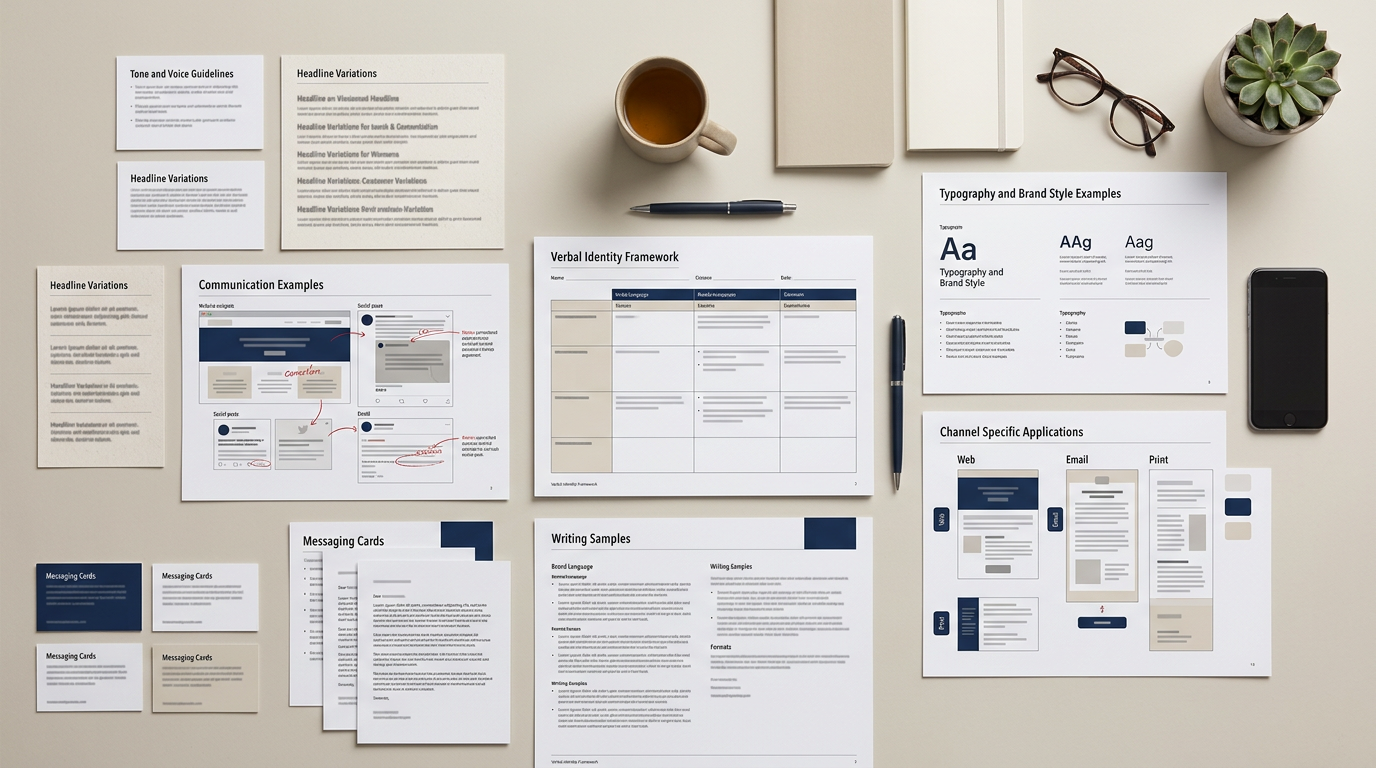
Brand voice is the consistent verbal character an organization uses when it communicates. It influences word choice, sentence structure, level of formality, humor, pacing, attitude, complexity, and the way a brand presents ideas across advertising, websites, email, social media, customer service, sales materials, presentations, and other communications.
The AAMA Brand Voice Development Guide provides a practical framework for defining a voice that is clear, recognizable, adaptable, and useful to the people who actually create communication. It is designed for professionals, agencies, brands, students, academics, entrepreneurs, and organizations developing or refining their verbal identity.
A strong brand voice should create consistency without making every message sound identical. The goal is to establish a recognizable communication style that can adapt to different audiences, channels, and situations while still sounding like the same organization.
Start With the Brand Strategy
Brand voice should not be developed in isolation from the larger brand strategy. The voice should reflect how the organization is positioned, what it values, whom it serves, and what kind of relationship it wants to establish with its audiences.
Before defining voice, clarify:
- Who is the organization trying to reach?
- What does the brand want to be known for?
- What value does it provide?
- What makes it different from relevant alternatives?
- What kind of relationship should audiences have with the brand?
- What expectations already exist around the category?
- What communication problems need to be solved?
Voice should support the strategy rather than becoming a decorative layer added afterward.
Related AAMA Resource: Positioning & Messaging Framework
Define the Audience
Voice is shaped partly by who the organization is speaking to. A brand communicating with senior financial executives may require a different level of formality, terminology, and detail than a brand communicating with first-time college students.
Audience considerations may include:
- Professional experience
- Industry knowledge
- Age or life stage
- Cultural context
- Decision-making role
- Emotional state
- Existing relationship with the brand
- Familiarity with the subject
- Preferred level of detail
The goal is not to stereotype the audience. It is to understand what communication style is most likely to feel appropriate, credible, and useful.
Define the Relationship
Consider what kind of relationship the brand should have with the audience. The answer can help determine how formal, conversational, instructional, authoritative, supportive, or energetic the voice should feel.
Possible relationships might include:
- Expert to professional
- Advisor to client
- Teacher to student
- Peer to peer
- Host to guest
- Specialist to decision-maker
- Advocate to community
- Service provider to customer
The relationship should reflect both the brand’s role and the audience’s expectations.
A medical organization, creative agency, luxury retailer, university, software company, nonprofit, and entertainment brand may all communicate differently because their relationships with audiences are different.
Identify Existing Voice Patterns
Before creating a new voice from scratch, review how the organization already communicates. Existing websites, email campaigns, presentations, advertisements, customer-service responses, social posts, sales materials, and internal documents may reveal patterns that are already working.
Look for:
- Repeated vocabulary
- Typical sentence length
- Formality
- Humor
- Technical language
- Emotional language
- Confidence level
- Use of contractions
- Use of first person
- Calls to action
- Common phrases
- Inconsistencies
The goal is to identify which existing characteristics should be preserved, refined, or removed.
Identify the Desired Brand Characteristics
Choose a small number of characteristics that describe how the brand should sound. Three to five meaningful traits are usually more useful than a long list.
Possible characteristics might include:
- Clear
- Confident
- Practical
- Sophisticated
- Warm
- Direct
- Curious
- Authoritative
- Energetic
- Reassuring
- Academic
- Approachable
- Bold
- Thoughtful
- Playful
- Precise
Do not choose words simply because they sound positive. Each characteristic should create a meaningful communication decision.
For example, almost every organization wants to be “professional.” That word is too broad unless the organization defines what professionalism actually means in its communication.
Define Each Trait
Each voice characteristic should include an explanation of what it means in practice.
For example:
Clear
Use straightforward language, short explanations where possible, and concrete examples. Avoid unnecessary jargon, vague corporate language, and sentences that make simple ideas harder to understand.
Confident
State ideas directly and support claims with evidence. Avoid excessive qualifiers, exaggerated promises, or language that sounds uncertain without reason.
Approachable
Use natural language and explain technical concepts when needed. Avoid sounding overly formal, distant, or unnecessarily complex.
Definitions like these give writers practical direction.
Add “But Not” Boundaries
One of the most useful ways to define brand voice is to explain what each trait should not become.
For example:
Confident, but not arrogant
Friendly, but not overly familiar
Sophisticated, but not inaccessible
Energetic, but not frantic
Academic, but not dry
Direct, but not rude
Playful, but not childish
These boundaries help prevent writers from pushing a characteristic too far.
Define the Level of Formality
Establish how formal or conversational the brand should sound in normal communication.
Consider:
- Use of contractions
- Use of first person
- Use of second person
- Sentence length
- Technical vocabulary
- Greetings and sign-offs
- Humor
- Idioms
- Slang
- Exclamation points
- Conversational phrasing
A brand does not need to choose between completely formal and completely casual. Most voices operate somewhere between the two.
The important thing is to define the normal range.
Define Vocabulary Preferences
Identify words and phrases the brand prefers, avoids, or uses carefully. This is particularly useful when several people write on behalf of the organization.
The vocabulary guide might include:
Preferred Language
Words and phrases that reflect the brand’s positioning and values.
Avoid
Language that feels inconsistent, vague, outdated, overly promotional, insensitive, or unnecessarily technical.
Use Carefully
Terms that are appropriate only in certain contexts or require explanation.
Vocabulary guidance can also establish preferred terminology for products, services, audiences, departments, and industry concepts.
Define Sentence Style
Sentence structure contributes significantly to how a brand sounds. Some brands benefit from short, direct sentences, while others require more developed explanations and a more measured rhythm.
Consider:
- Typical sentence length
- Use of active voice
- Complexity
- Paragraph length
- Questions
- Lists
- Fragments
- Repetition
- Rhetorical devices
The goal is not to impose a rigid formula. It is to help writers understand the natural rhythm of the brand.
Define the Use of Jargon
Industry terminology can communicate expertise, but excessive jargon can make communication difficult or exclusionary.
Establish when technical language is appropriate and when it should be explained.
A useful rule might be:
“Use established industry terminology when communicating with professional audiences, but define unfamiliar terms when writing for broader audiences.”
The right approach depends on the brand and audience.
Define Humor
Humor can be an important part of brand voice, but it should be intentional rather than automatic.
If humor is appropriate, define:
- How often it should appear
- What kind of humor fits
- What topics should not be joked about
- Whether humor should appear in customer service
- Whether sarcasm is appropriate
- Whether cultural references are appropriate
- How the brand should behave during serious situations
A brand that uses humor in advertising may still need a very different tone when responding to complaints, emergencies, or sensitive issues.
Define Point of View
Decide how the organization refers to itself and the audience.
Common approaches include:
First-person plural:
“We help organizations…”
Brand name:
“Example Company helps organizations…”
Second person:
“You can…”
Point of view should remain consistent unless there is a deliberate reason to change it.
Organizations should also decide how individual employees, executives, experts, or spokespeople differ from the institutional voice.
Define Voice Across Channels
A consistent brand voice should be recognizable across channels, but the expression should adapt to the environment.
Website
Website copy may require clear explanation, navigation language, product detail, and stronger information hierarchy.
Advertising
Advertising often requires more compression. Voice may become more direct, memorable, emotional, or persuasive while remaining consistent with the brand.
Email can often support a more conversational tone because communication feels more direct and personal.
Social Media
Social platforms may allow more immediacy and informality, but the brand should not imitate platform slang or trends simply to appear current.
Customer Service
Customer-service communication should prioritize clarity, empathy, accuracy, and problem resolution.
Sales Materials
Sales communication may require more detail, evidence, comparison, and objection handling.
Internal Communication
Internal communication can be more direct or operational while still reflecting the organization’s overall values and communication style.
Understand Voice Versus Tone
Voice is relatively consistent. Tone changes according to context.
A brand may have a confident, practical, and approachable voice while adjusting tone for different situations.
For example:
Product Launch: Energetic and optimistic
Customer Complaint: Calm and helpful
Industry Report: Analytical and authoritative
Event Invitation: Welcoming and enthusiastic
Service Interruption: Clear, direct, and reassuring
The brand should still sound recognizable in each situation.
Build a Tone Matrix
A tone matrix helps teams understand how the voice changes across common situations.
A simple structure might include:
| Situation | Desired Tone | Emphasize | Avoid |
|---|---|---|---|
| Product Launch | Energetic | Benefits, opportunity | Exaggeration |
| Customer Support | Reassuring | Clarity, resolution | Humor at customer’s expense |
| Thought Leadership | Authoritative | Evidence, insight | Empty certainty |
| Social Media | Conversational | Relevance, interaction | Forced slang |
| Crisis Communication | Direct | Facts, action | Promotional language |
The matrix can be expanded as the organization encounters additional communication situations.
Create Before-and-After Examples
Examples are one of the most effective ways to make voice guidance practical.
For example:
Too Corporate
“Our innovative solutions enable organizations to leverage best-in-class capabilities to optimize their marketing initiatives.”
On Voice
“See which marketing efforts are working, where budget is being wasted, and what to improve next.”
The second example communicates more clearly because it translates abstract claims into concrete value.
Another example:
Too Casual
“Hey! We totally get how annoying reporting can be.”
On Voice
“Marketing reporting should make decisions easier, not create another problem to solve.”
Examples help writers understand the difference between the intended voice and nearby styles that do not fit.
Define Writing Mechanics
Brand voice guidelines can also include practical writing conventions that improve consistency.
These may address:
- Capitalization
- Headlines
- Numbers
- Dates
- Abbreviations
- Acronyms
- Punctuation
- Contractions
- Product names
- Titles
- Calls to action
- Link language
These rules should support readability rather than becoming an unnecessarily complicated internal style manual.
Establish Headline Style
Headlines often carry more personality than body copy, so define how they should work.
Consider whether headlines should generally be:
- Direct
- Benefit-led
- Question-based
- Instructional
- Provocative
- Descriptive
- Short
- Editorial
- Conversational
Provide examples of acceptable and unacceptable headline styles.
Avoid creating a headline formula so rigid that every page or campaign sounds the same.
Establish Call-to-Action Style
Calls to action should reflect both the brand voice and the level of commitment being requested.
Examples might include:
- Learn More
- Explore the Guide
- Compare Options
- Download the Resource
- Request Information
- Schedule a Consultation
- Join
- Buy Now
The language should be clear about what happens next.
Avoid vague calls to action when a more specific instruction would be more useful.
Define Sensitive Communication Standards
Some situations require additional care regardless of the brand’s normal voice.
These can include:
- Customer complaints
- Emergencies
- Legal matters
- Privacy incidents
- Safety issues
- Layoffs
- Public controversies
- Sensitive personal information
- Crisis communication
In these situations, accuracy, clarity, respect, and usefulness should take priority over personality.
The brand should not force humor, enthusiasm, or promotional language into situations where it would feel inappropriate.
Consider Accessibility & Comprehension
Brand voice should support comprehension. A sophisticated voice does not require complicated writing, and an authoritative voice does not require jargon.
Where appropriate:
- Use plain language
- Explain unfamiliar terminology
- Avoid unnecessarily long sentences
- Use descriptive links
- Provide context for acronyms
- Organize information clearly
- Avoid language that depends on visual presentation alone
Accessible communication can strengthen both brand consistency and audience understanding.
Create a Brand Voice Statement
Once the major decisions are established, summarize the voice in a short statement.
For example:
“Our voice is clear, confident, and practical. We explain complex subjects without making them feel simplistic, use professional language without unnecessary jargon, and communicate directly without sounding cold or overly promotional.”
The statement should be short enough for writers to remember and specific enough to be useful.
Create the Brand Voice Chart
A simple voice chart can summarize the core traits.
| Trait | What It Means | What It Does Not Mean |
|---|---|---|
| Clear | Straightforward, understandable communication | Oversimplified |
| Confident | Direct claims supported by evidence | Arrogant |
| Practical | Useful, actionable information | Dry or purely functional |
| Approachable | Natural, accessible language | Overly casual |
This becomes a fast reference for anyone writing on behalf of the organization.
Build a Vocabulary Guide
Create a short list of preferred, avoided, and context-dependent terms.
For example:
Prefer:
Customers, members, professionals, practical, useful, clear
Avoid:
Users, consumers, disruptive, revolutionary, best-in-class
Use Carefully:
Innovative, premium, expert, guaranteed
The specific terms should reflect the organization’s strategy and industry rather than following a universal list.
Build a Voice Example Library
Maintain examples of successful brand communication over time. These can include:
- Headlines
- Email introductions
- Calls to action
- Product descriptions
- Social posts
- Customer-service responses
- Campaign copy
- Executive statements
Real examples make voice guidelines easier to apply than abstract instructions alone.
The example library can evolve as the organization develops new communications.
Train the People Who Use the Voice
Brand voice is only useful when the people responsible for communication understand it.
Relevant participants may include:
- Marketing teams
- Copywriters
- Agencies
- Social media teams
- Customer-service teams
- Sales teams
- Public relations teams
- Executives
- Freelancers
- Internal communications teams
Provide the guidelines, explain the reasoning behind them, and use examples to demonstrate how the voice works.
Training should focus on judgment rather than memorization.
Review Voice Consistency
Periodically review communications across channels to determine whether the intended voice is being applied consistently.
Look for:
- Unexplained differences in formality
- Inconsistent terminology
- Excessive jargon
- Forced humor
- Generic corporate language
- Different personalities across channels
- Changes introduced by agencies or vendors
- Communication that no longer reflects the brand strategy
The goal is not perfect uniformity. It is recognizable consistency.
Evolve the Voice Deliberately
Brand voice can evolve as the organization, audience, market, and culture change. Changes should be intentional rather than occurring gradually because different writers introduce different habits.
Review the voice when there are significant changes in:
- Brand positioning
- Audience
- Leadership
- Product portfolio
- Market expectations
- Geographic expansion
- Customer relationships
- Communication channels
Evolution should preserve recognizable characteristics unless the brand strategy itself has changed substantially.
Recommended Brand Voice Framework
A practical brand voice document can include:
- Brand Strategy Context
- Primary Audience
- Audience Relationship
- Voice Statement
- Three to Five Core Voice Traits
- “But Not” Boundaries
- Formality
- Vocabulary Preferences
- Sentence Style
- Jargon Guidance
- Humor Guidance
- Point of View
- Channel Adaptation
- Tone Matrix
- Headline Style
- Call-to-Action Style
- Writing Mechanics
- Sensitive Communication Standards
- Before-and-After Examples
- Approved Examples
The document should be detailed enough to guide decisions while remaining practical enough for teams to use regularly.
A Voice Guide Should Help Writers Decide
The real test of a brand voice guide is whether it helps someone answer a writing question.
Should this headline be more direct? Is this joke appropriate? Should this email sound formal? Is this technical term necessary? Does this response sound too promotional? Would the organization actually say this?
If the guide cannot help answer questions like these, it probably needs more specific guidance and examples.
A strong voice system does not eliminate judgment. It gives people a shared standard for making better communication decisions.
Related AAMA Resources
Continue developing your brand communication with the Positioning & Messaging Framework, How to Write a Creative Brief, AAMA Brand Voice Worksheet, Advertising Copy Review Checklist, Campaign Planning Framework, and Marketing & Advertising Glossary. These resources provide additional guidance for defining what a brand should communicate, translating strategy into creative direction, and evaluating whether finished communication remains aligned.
The AAMA Resource Library will continue expanding with practical brand-development tools, worksheets, checklists, and professional references designed to support clear and consistent communication.