
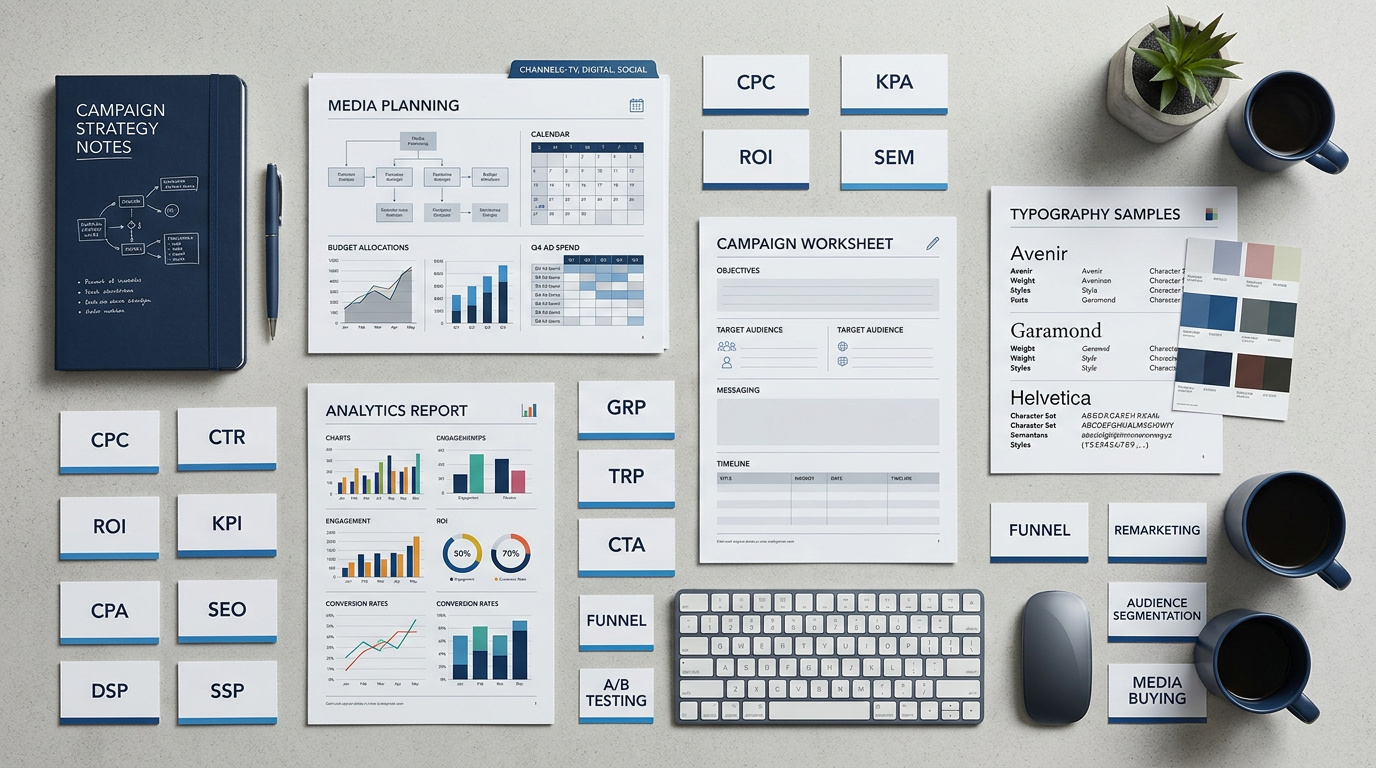
Advertising and marketing professionals use an enormous number of acronyms across strategy, media, digital marketing, research, analytics, sales, branding, technology, and customer experience. The AAMA Advertising & Marketing Acronyms Guide provides a practical reference for commonly used abbreviations and explains what they mean in professional practice.
This guide is designed for professionals, agencies, brands, students, academics, media professionals, researchers, and anyone who needs to quickly identify an acronym encountered in a report, campaign plan, meeting, platform, presentation, or industry publication. Because some acronyms have multiple meanings depending on context, the definitions below focus on their most common uses in advertising and marketing.
A
A/B
A/B Testing
A/B testing compares two versions of an advertisement, webpage, email, message, or other marketing element to determine which performs better against a defined objective. The method is commonly used in conversion optimization, creative testing, email marketing, paid media, and product development.
Related AAMA Resource: A/B Testing Guide for Marketers
ABM
Account-Based Marketing
Account-based marketing is a business-to-business strategy that focuses marketing and sales activity on specific high-value accounts or groups of accounts. ABM often combines personalized messaging, targeted advertising, sales coordination, content, and relationship development.
AOV
Average Order Value
Average order value measures the average amount spent in each transaction.
Formula: AOV = Revenue ÷ Number of Orders
Related AAMA Resource: Common Marketing Formulas
API
Application Programming Interface
An application programming interface allows software systems to communicate with one another according to defined rules. Marketing platforms commonly use APIs to exchange data among advertising systems, analytics tools, customer databases, ecommerce platforms, and other applications.
AR
Augmented Reality
Augmented reality places digital information or visual elements into a user’s view of the physical environment. Marketing applications can include virtual product demonstrations, interactive packaging, location-based experiences, and product visualization.
B
B2B
Business-to-Business
Business-to-business describes commercial activity in which an organization markets or sells products and services to another organization. B2B marketing often involves multiple decision-makers, longer sales cycles, and more complex purchasing processes.
B2C
Business-to-Consumer
Business-to-consumer describes commercial activity in which an organization markets or sells products and services directly to individual consumers. B2C marketing frequently emphasizes convenience, price, experience, preference, emotion, and consumer needs.
BANT
Budget, Authority, Need, Timeline
BANT is a traditional lead-qualification framework used to evaluate whether a prospective customer has the budget, decision-making authority, need, and appropriate purchase timeline for a product or service.
BOFU
Bottom of Funnel
Bottom of funnel describes the later stages of a simplified marketing funnel, where prospective customers are closer to taking a purchase or conversion action. BOFU tactics commonly focus on evaluation, proof, offers, sales support, and conversion.
C
CAC
Customer Acquisition Cost
Customer acquisition cost measures the average cost required to acquire a new customer.
Formula: CAC = Customer Acquisition Costs ÷ New Customers Acquired
Related AAMA Resource: Customer Acquisition Cost Calculator
CDP
Customer Data Platform
A customer data platform collects and organizes customer information from multiple sources to create unified customer profiles that can be used for analytics, segmentation, personalization, and marketing activation.
CES
Customer Effort Score
Customer effort score measures how easy or difficult customers report finding a particular interaction or task. It is commonly used to evaluate customer service, onboarding, purchasing, and account-management experiences.
CLV
Customer Lifetime Value
Customer lifetime value estimates the economic value a customer is expected to generate during the relationship with an organization. CLV is frequently used interchangeably with LTV.
Related AAMA Resource: Customer Lifetime Value Calculator
CMS
Content Management System
A content management system is software used to create, organize, edit, manage, and publish digital content. Websites commonly use CMS platforms to manage webpages, articles, media, navigation, and other content.
CPA
Cost per Acquisition
Cost per acquisition measures the average marketing or advertising cost required to generate a defined acquisition.
Formula: CPA = Campaign Cost ÷ Acquisitions
Related AAMA Resource: CPA Calculator
CPC
Cost per Click
Cost per click measures the average advertising cost associated with each recorded click.
Formula: CPC = Advertising Cost ÷ Clicks
Related AAMA Resource: CPC Calculator
CPL
Cost per Lead
Cost per lead measures the average marketing cost required to generate a lead.
Formula: CPL = Marketing Cost ÷ Leads Generated
CPM
Cost per Mille
Cost per mille measures the cost of 1,000 advertising impressions.
Formula: CPM = Advertising Cost ÷ Impressions × 1,000
Related AAMA Resource: CPM Calculator
CRM
Customer Relationship Management
Customer relationship management refers to the processes and systems organizations use to manage interactions with customers and prospects. CRM software commonly stores contact information, sales activity, customer history, communications, and other relationship data.
CRO
Conversion Rate Optimization
Conversion rate optimization is the process of improving websites, landing pages, offers, forms, or other digital experiences to increase the percentage of users completing a desired action.
CSAT
Customer Satisfaction
Customer satisfaction is a metric used to evaluate how satisfied customers report being with a product, service, interaction, or overall experience. CSAT is commonly measured through surveys using a rating scale.
CTA
Call to Action
A call to action encourages an audience to complete a specific next step. Common CTAs include Buy Now, Learn More, Register, Subscribe, Contact Us, Download, and Apply.
CTR
Click-Through Rate
Click-through rate measures the percentage of impressions or delivered messages that generate a click.
Formula: CTR = Clicks ÷ Impressions × 100
Related AAMA Resource: CTR Calculator
CTOR
Click-to-Open Rate
Click-to-open rate compares email clicks with recorded email opens.
Formula: CTOR = Clicks ÷ Opens × 100
Because the calculation depends on open data, limitations in email open tracking also affect the interpretation of CTOR.
D
DAM
Digital Asset Management
Digital asset management refers to systems used to organize, store, manage, search, distribute, and control digital files such as photographs, videos, logos, advertisements, presentations, and other creative assets.
DMP
Data Management Platform
A data management platform is a system used to collect, organize, analyze, and activate audience data, traditionally including data used for digital advertising and audience targeting.
DOOH
Digital Out-of-Home
Digital out-of-home advertising uses digital displays in public or commercial environments. Examples include digital billboards, transit displays, retail screens, airport displays, and digital street furniture.
DSP
Demand-Side Platform
A demand-side platform is technology that allows advertisers or agencies to purchase digital advertising inventory through automated systems. DSPs are commonly used in programmatic advertising.
E
ESP
Email Service Provider
An email service provider is a platform used to create, distribute, automate, and measure email communications. ESPs commonly provide tools for list management, segmentation, templates, campaign reporting, and deliverability.
eCPM
Effective Cost per Mille
Effective CPM represents advertising revenue or cost normalized to a rate per 1,000 impressions. It can be useful for comparing campaigns or inventory purchased under different pricing models.
Formula: eCPM = Revenue or Cost ÷ Impressions × 1,000
F
FMCG
Fast-Moving Consumer Goods
Fast-moving consumer goods are products that are purchased frequently, sold relatively quickly, and generally have high inventory turnover. Examples commonly include packaged food, beverages, household products, and personal-care products.
FOMO
Fear of Missing Out
Fear of missing out describes anxiety or concern that others may be experiencing something desirable that one is not participating in. Marketers sometimes use scarcity, limited availability, exclusivity, or time-sensitive offers to activate this psychological response.
G
GA
Google Analytics
Google Analytics is a web and application analytics platform used to measure traffic, user behavior, acquisition sources, conversions, and other digital activity. When the specific generation matters, marketers may identify the product more precisely.
GA4
Google Analytics 4
Google Analytics 4 is Google’s current generation of its analytics platform. It uses an event-based measurement model for websites and applications.
GDPR
General Data Protection Regulation
The General Data Protection Regulation is a European Union data-protection framework that establishes requirements governing the collection, processing, storage, and use of personal data. It can affect marketing activities involving individuals covered by the regulation.
GEO
Generative Engine Optimization
Generative engine optimization refers to efforts to improve the likelihood that information, brands, or sources are accurately represented or cited within generative artificial-intelligence search and answer experiences. Practices and terminology in this area continue to evolve.
I
ICP
Ideal Customer Profile
An ideal customer profile describes the type of customer or organization considered the strongest fit for a product or service. ICPs are particularly common in business-to-business marketing and may include industry, company size, geography, technology, needs, budget, or other characteristics.
IMC
Integrated Marketing Communications
Integrated marketing communications coordinates messages and activities across advertising, public relations, digital marketing, sales promotion, content, social media, events, and other channels to create a more coherent audience experience.
IoT
Internet of Things
The Internet of Things refers to physical devices connected to networks that can collect, exchange, or act on data. Marketing applications can include connected products, retail technology, measurement systems, and customer experiences.
K
KPI
Key Performance Indicator
A key performance indicator is a metric selected because it reflects progress toward an important objective. KPIs should be connected to decisions or outcomes rather than selected simply because data is available.
Related AAMA Resource: Marketing Metrics & KPI Reference
L
LTV
Lifetime Value
Lifetime value estimates the value a customer generates over the duration of the customer relationship. The term is frequently used interchangeably with CLV.
Related AAMA Resource: Customer Lifetime Value Calculator
LTV:CAC
Lifetime Value to Customer Acquisition Cost Ratio
The LTV:CAC ratio compares estimated customer lifetime value with the cost required to acquire that customer.
Formula: LTV:CAC = Customer Lifetime Value ÷ Customer Acquisition Cost
Related AAMA Resource: LTV:CAC Ratio Calculator
M
MAP
Marketing Automation Platform
A marketing automation platform helps organizations automate and manage activities such as email campaigns, lead nurturing, audience segmentation, customer journeys, scoring, and campaign workflows.
MQL
Marketing-Qualified Lead
A marketing-qualified lead is a prospect that meets predefined marketing criteria indicating stronger potential interest or fit. Criteria may include engagement, demographic or firmographic information, behavior, product interest, or lead scoring.
MMM
Marketing Mix Modeling
Marketing mix modeling uses statistical analysis to estimate how different marketing activities and external factors contribute to business outcomes. MMM is commonly used to evaluate media investment and budget allocation across channels.
MMP
Mobile Measurement Partner
A mobile measurement partner provides technology used to measure mobile application advertising, attribution, installs, engagement, and campaign performance across marketing channels.
MOFU
Middle of Funnel
Middle of funnel describes the portion of a simplified marketing funnel between initial awareness and final conversion. MOFU strategies often emphasize education, comparison, consideration, nurturing, and qualification.
N
NPS
Net Promoter Score
Net Promoter Score is a customer-experience metric based on responses to a likelihood-to-recommend question. Respondents are grouped into promoters, passives, and detractors.
Formula: NPS = Percentage of Promoters – Percentage of Detractors
O
OOH
Out-of-Home
Out-of-home advertising reaches audiences in public or commercial environments outside the home. Examples include billboards, transit advertising, street furniture, airport advertising, and place-based media.
OTT
Over-the-Top
Over-the-top refers to video or other media delivered through the internet rather than through traditional broadcast, cable, or satellite distribution. OTT advertising commonly appears within streaming services and connected-media environments.
P
PPC
Pay per Click
Pay per click is an advertising pricing model in which the advertiser pays when an advertisement generates a click. Paid search is one of the most common applications of PPC advertising.
PR
Public Relations
Public relations involves managing communication and relationships between an organization and its audiences, including customers, employees, media, communities, investors, and other stakeholders. PR can include media relations, reputation management, events, crisis communication, and public affairs.
PII
Personally Identifiable Information
Personally identifiable information refers to information that can identify or reasonably be connected with a particular individual. Definitions vary by jurisdiction and regulatory framework, so organizations should use appropriate legal and privacy guidance when handling personal information.
POS
Point of Sale
Point of sale refers to the location, system, or moment at which a purchase transaction occurs. POS data can provide marketers with information about sales volume, products, pricing, promotions, timing, and customer behavior.
Q
QR
Quick Response
A QR code is a two-dimensional barcode that can be scanned by compatible devices to access digital information. Marketing applications include linking physical advertising, packaging, signage, events, and printed materials to websites, offers, forms, applications, or other digital experiences.
R
RFM
Recency, Frequency, Monetary Value
RFM is a customer-segmentation framework that evaluates how recently a customer purchased, how frequently the customer purchases, and how much the customer spends. It can be used to identify valuable customer groups and support retention or direct-marketing strategies.
ROAS
Return on Ad Spend
Return on ad spend compares revenue attributed to advertising with the amount spent on that advertising.
Formula: ROAS = Attributed Revenue ÷ Advertising Spend
Related AAMA Resources: ROAS Calculator and Break-Even ROAS Calculator
ROI
Return on Investment
Return on investment compares the financial return generated by an investment with the cost of that investment. Marketing ROI should clearly identify the costs, returns, and attribution assumptions included in the calculation.
Related AAMA Resource: Marketing ROI Calculator
RFP
Request for Proposal
A request for proposal is a formal document inviting vendors, agencies, consultants, or other providers to propose a solution to a defined need. RFPs commonly describe project objectives, scope, requirements, evaluation criteria, timelines, and submission expectations.
RFQ
Request for Quote
A request for quote is a formal request for pricing from a vendor or service provider. RFQs are generally most useful when the product, service, quantity, or scope is already clearly defined.
S
SaaS
Software as a Service
Software as a service is a model in which software is accessed through a subscription or other recurring arrangement rather than being purchased as a traditional standalone product. SaaS businesses frequently use metrics such as CAC, LTV, churn, recurring revenue, and retention.
SEM
Search Engine Marketing
Search engine marketing refers to marketing activity designed to increase visibility within search engines. The term is frequently used specifically for paid search advertising, although some organizations use it more broadly.
SEO
Search Engine Optimization
Search engine optimization is the practice of improving website content, structure, performance, and discoverability to increase useful visibility in unpaid search results.
SERP
Search Engine Results Page
A search engine results page is the page or interface displaying results in response to a search query. SERPs may contain organic listings, advertisements, maps, images, videos, shopping results, answer features, and other search elements.
SMM
Social Media Marketing
Social media marketing uses social platforms to communicate with audiences, distribute content, support communities, generate leads, provide customer service, promote products, and achieve other marketing objectives.
SMS
Short Message Service
Short Message Service is the technology commonly used for standard text messaging. SMS marketing can be used for promotions, reminders, alerts, customer service, authentication, and other communications subject to applicable consent and messaging requirements.
SOP
Standard Operating Procedure
A standard operating procedure documents the steps required to perform a recurring process consistently. Marketing teams may use SOPs for campaign launches, content production, approvals, reporting, lead handling, brand management, and other recurring activities.
SQL
Sales-Qualified Lead
A sales-qualified lead is a prospect that has met predefined criteria indicating readiness for direct sales engagement. The definition should reflect the organization’s actual qualification and sales process.
SSP
Supply-Side Platform
A supply-side platform is technology used by publishers and media owners to manage, sell, and optimize digital advertising inventory through automated advertising marketplaces.
SWOT
Strengths, Weaknesses, Opportunities, Threats
SWOT is a planning framework used to evaluate internal strengths and weaknesses alongside external opportunities and threats. It is commonly used in strategic planning, competitive analysis, marketing plans, and organizational assessments.
T
TAM
Total Addressable Market
Total addressable market estimates the total potential demand or revenue opportunity available if an offering could capture the entire relevant market. TAM is often considered alongside narrower measures such as serviceable available market and serviceable obtainable market.
TOFU
Top of Funnel
Top of funnel describes the early stages of a simplified marketing funnel, where audiences first become aware of a problem, need, category, brand, or offering. TOFU activity commonly emphasizes reach, awareness, education, discovery, and initial engagement.
U
UI
User Interface
User interface refers to the visible and interactive elements through which a person interacts with a digital product or system. UI design can influence usability, comprehension, conversion, accessibility, and customer experience.
URL
Uniform Resource Locator
A uniform resource locator is the address used to locate a resource on the internet. Marketers frequently work with URLs when managing websites, advertising destinations, campaign tracking, analytics, redirects, and search optimization.
USP
Unique Selling Proposition
A unique selling proposition expresses the distinctive reason a customer should choose a particular product, service, or brand over relevant alternatives. A strong USP communicates meaningful value rather than simply identifying a difference.
UTM
Urchin Tracking Module
UTM commonly refers to tracking parameters added to URLs to identify characteristics such as campaign source, medium, and campaign name within analytics systems.
Related AAMA Resource: UTM Naming Convention Guide
UX
User Experience
User experience encompasses the overall experience a person has when interacting with a product, service, system, website, application, or organization. UX can be influenced by usability, accessibility, information architecture, design, speed, clarity, content, and customer expectations.
V
VCR
Video Completion Rate
Video completion rate measures the percentage of video starts or impressions that reach the end of a video.
Formula: VCR = Completed Video Views ÷ Video Starts × 100
VR
Virtual Reality
Virtual reality uses technology to create an immersive digital environment that can simulate physical spaces, objects, or experiences. Marketing applications can include demonstrations, events, entertainment, education, training, and experiential campaigns.
W
WOM
Word of Mouth
Word of mouth refers to people communicating opinions, recommendations, experiences, or information about products, services, organizations, or brands to one another. WOM can occur through personal conversation, online reviews, social media, communities, and other interpersonal channels.
WOMM
Word-of-Mouth Marketing
Word-of-mouth marketing includes strategies intended to encourage discussion, recommendations, referrals, advocacy, or sharing among audiences. Effective WOMM depends on genuine audience motivation and should not disguise paid promotion as independent recommendation.
Common Funnel Acronyms
Several acronyms in marketing describe stages of the traditional funnel model. TOFU refers to top of funnel, where awareness and discovery typically occur. MOFU refers to middle of funnel, where audiences may research, compare, evaluate, or become more qualified, while BOFU refers to bottom of funnel, where activity is generally closer to conversion or purchase.
These terms can be useful shorthand for planning, but real customer journeys are often more complicated than a simple linear funnel. People may move between stages, use multiple channels, delay decisions, repeat research, or enter the journey with substantial prior knowledge.
Acronyms Can Change With Context
Acronyms should always be interpreted within the context in which they appear. The same abbreviation may have different meanings across advertising, technology, finance, research, sales, and other professional disciplines, and some organizations develop their own internal shorthand.
When using acronyms in client documents, public communications, educational materials, or presentations, define an unfamiliar acronym the first time it appears. Clear communication is generally more important than demonstrating familiarity with industry shorthand.
Related AAMA Resources
Continue exploring the AAMA Resource Library with the Marketing & Advertising Glossary, Marketing Metrics & KPI Reference, Common Marketing Formulas, Marketing Channels Reference Guide, Media Planning Fundamentals, and AAMA Calculators & Tools. These resources provide deeper explanations, formulas, measurement guidance, and practical tools for many of the concepts represented by the acronyms in this guide.
AAMA will continue expanding this reference as advertising, marketing, technology, media, analytics, and professional practices introduce new terminology and widely adopted abbreviations.