
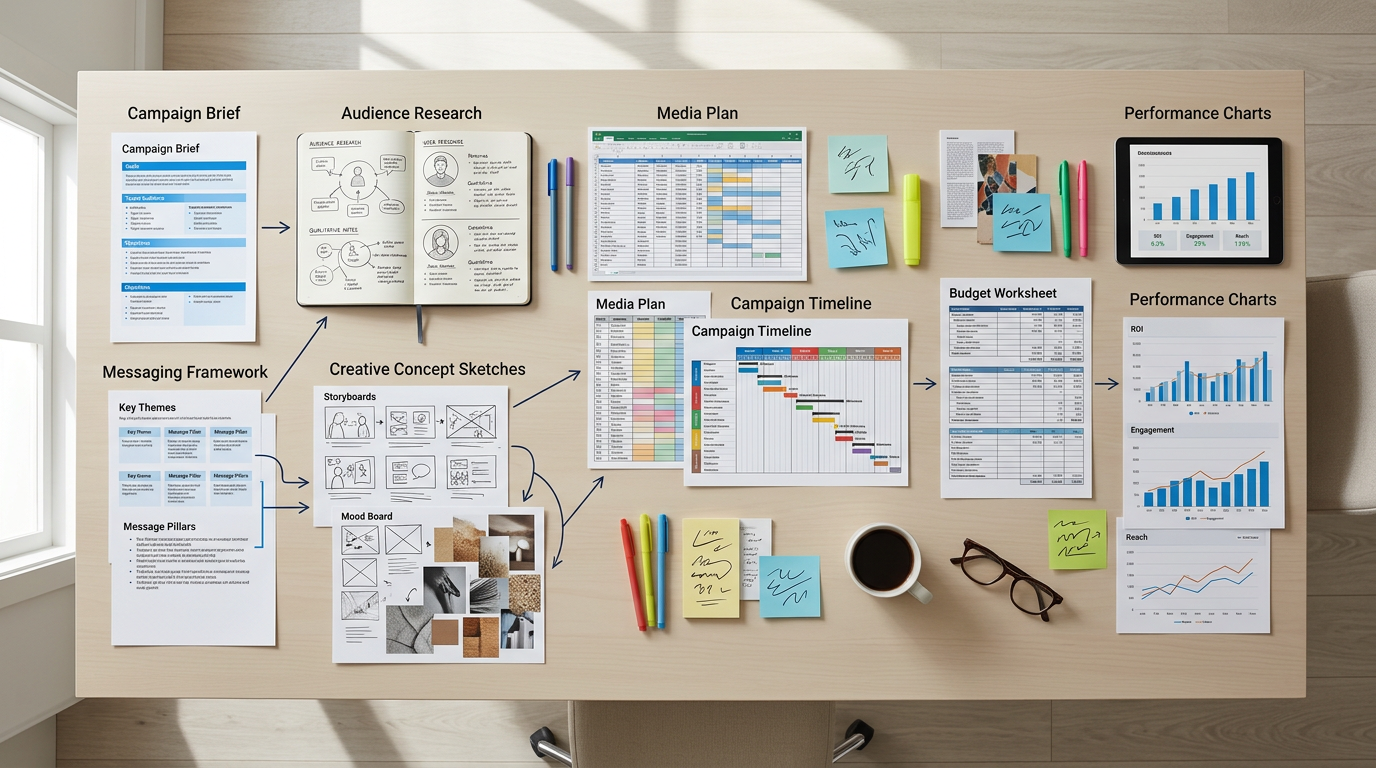
A strong campaign begins with a clear problem, objective, audience, and strategy before creative development or media buying begins. The AAMA Campaign Planning Framework provides a practical structure for organizing the decisions required to move from an initial marketing need to coordinated execution and meaningful measurement.
This framework is designed for professionals, agencies, brands, students, academics, and organizations planning advertising or marketing campaigns of any size. It can be adapted for product launches, awareness campaigns, lead generation, customer acquisition, promotions, events, advocacy, retention, and other campaign types.
The framework is intentionally flexible. Not every campaign requires the same level of complexity, but every campaign should establish a clear connection among the objective, audience, message, execution, budget, and measurement approach.
1. Define the Campaign Problem
Begin by identifying the specific problem or opportunity the campaign is intended to address. This should be more precise than a general desire to increase awareness, generate sales, or improve marketing.
A useful problem statement explains the current situation and why marketing action is needed. It should provide enough context to guide the rest of the planning process without attempting to summarize the entire business.
Consider questions such as:
- What is happening now?
- What needs to change?
- Why does the issue matter?
- What evidence supports the need for a campaign?
- What would happen if no action were taken?
A clearly defined problem helps prevent teams from jumping prematurely into tactics that may not address the actual need.
2. Establish the Campaign Objective
The campaign objective defines the primary outcome the campaign is expected to produce. It should be specific enough to guide planning and measurable enough to determine whether the campaign succeeded.
Campaign objectives may relate to awareness, consideration, lead generation, customer acquisition, sales, registrations, product adoption, retention, traffic, engagement, fundraising, or another meaningful outcome.
Avoid objectives that simply describe an activity. “Run a social media campaign” identifies a tactic, while “Increase qualified registrations among first-time customers by 15% during the campaign period” identifies an outcome.
Where possible, define:
- The desired result
- The audience affected
- The amount of change expected
- The measurement period
- Any important cost or efficiency constraint
The campaign should have one clear primary objective, even when secondary objectives are also included.
3. Identify the Target Audience
Define the people or organizations whose behavior, perception, or decision-making the campaign is intended to influence. Audience selection should be based on characteristics relevant to the campaign objective rather than broad assumptions or unnecessary demographic detail.
Relevant characteristics may include needs, behaviors, motivations, geography, purchasing patterns, category involvement, decision-making authority, product usage, interests, attitudes, or organizational characteristics.
Primary Audience
The primary audience is the group most important to achieving the campaign objective. Creative strategy, media investment, and messaging should generally prioritize this group.
Secondary Audience
A secondary audience may influence the primary audience, participate in the decision process, or represent an additional opportunity. Secondary audiences should only be included when they have a clear role in campaign success.
Audience Insight
An audience insight identifies something meaningful about the audience that can influence the campaign strategy. It should reveal more than a descriptive characteristic and help explain what motivates, concerns, frustrates, or influences the audience.
A strong audience insight creates a useful bridge between research and creative strategy.
4. Define the Desired Audience Response
Determine what the audience should think, feel, understand, or do after encountering the campaign. This makes the intended effect of the communication explicit.
The desired response may include:
- Recognize a new brand or product
- Understand a particular benefit
- Reconsider an existing perception
- Visit a website
- Request information
- Register for an event
- Make a purchase
- Renew a membership
- Recommend a product or service
- Take another defined action
The desired response should connect directly to the campaign objective.
5. Establish the Positioning
Positioning defines how the offering, brand, product, service, or idea should be understood relative to relevant alternatives. It establishes the strategic space the campaign intends to occupy in the audience’s mind.
Useful positioning should clarify:
- Who the offering is for
- What need or problem it addresses
- What category or competitive frame it belongs to
- What makes it meaningfully valuable or different
- Why the audience should believe the claim
Positioning provides a foundation for the messages and creative work that follow.
Related AAMA Resource: Positioning & Messaging Framework
6. Develop the Core Message
The core message is the most important idea the audience should understand or remember from the campaign. It should be focused enough to guide creative development across different channels and formats.
A strong core message is not necessarily the final advertising copy. It is the strategic idea that the advertising copy, visual concept, video, landing page, email, or other creative execution needs to communicate.
The message should reflect the audience insight, positioning, and desired response established earlier in the framework.
7. Identify Supporting Messages
Supporting messages provide additional information that strengthens or explains the core message. They may address benefits, features, proof, objections, pricing, availability, credibility, or other information audiences need during the decision process.
Avoid including every possible selling point simply because it exists. Supporting messages should reinforce the central idea rather than compete with it.
Different channels may emphasize different supporting messages while maintaining the same overall campaign strategy.
8. Establish Reasons to Believe
Reasons to believe provide evidence supporting the campaign’s claims. They help audiences understand why the organization, product, service, or offering deserves credibility.
Potential reasons to believe may include:
- Product performance
- Research findings
- Demonstrations
- Customer results
- Experience
- Credentials
- Certifications
- Guarantees
- Testimonials
- Independent reviews
- Technical capabilities
- Data or statistics
Claims should be supported appropriately and reviewed for accuracy before they are used in advertising or marketing communications.
9. Define the Call to Action
The call to action identifies what the audience should do next. It should be clear, realistic, and appropriate for the audience’s position in the decision process.
Examples may include:
- Learn more
- Request information
- Register
- Buy now
- Schedule a consultation
- Visit a location
- Download a resource
- Subscribe
- Apply
- Contact the organization
Campaigns can contain different calls to action across stages or channels, but the relationship among them should remain clear.
10. Develop the Creative Strategy
The creative strategy translates the campaign’s strategic decisions into direction for creative development. It establishes what the creative work needs to accomplish without unnecessarily dictating the final idea.
Creative strategy may address:
- Communication objective
- Audience
- Core message
- Tone
- Desired response
- Required information
- Mandatory elements
- Deliverables
- Brand considerations
- Legal or regulatory requirements
The creative strategy should create enough focus to align teams while leaving room for creative problem-solving.
Related AAMA Resources: How to Write a Creative Brief and AAMA Creative Brief Template
11. Select the Campaign Channels
Choose the channels most appropriate for reaching the intended audience and supporting the campaign objective. Channel selection should reflect audience behavior, communication needs, cost, timing, creative requirements, targeting capability, and measurement.
Potential channels may include:
- Paid search
- Paid social media
- Display advertising
- Television
- Radio
- Out-of-home advertising
- Direct mail
- Websites and landing pages
- Content marketing
- Public relations
- Influencer marketing
- Events
- Partnerships
- Retail marketing
- Other relevant channels
The plan should explain the role each channel plays within the campaign rather than simply listing every platform that might be used.
Related AAMA Resource: Marketing Channels Reference Guide
12. Define the Media Strategy
When paid media is involved, establish how the campaign will use media to reach the audience. Media strategy should connect the audience, objective, budget, geography, timing, and communication requirements.
Key considerations can include:
- Geographic coverage
- Audience targeting
- Reach
- Frequency
- Timing
- Media mix
- Placement
- Format
- Budget allocation
- Optimization approach
Media decisions should support the larger campaign strategy rather than operating as a separate planning exercise.
Related AAMA Resource: Media Planning Fundamentals
13. Develop the Campaign Deliverables
Identify everything that needs to be created, approved, produced, distributed, or configured before and during the campaign. A clear deliverables list helps prevent production gaps and makes responsibilities easier to assign.
Deliverables may include:
- Advertisements
- Videos
- Photography
- Landing pages
- Email campaigns
- Social content
- Print materials
- Media files
- Sales materials
- Event materials
- Tracking links
- Reports
- Research instruments
- Promotional materials
Each deliverable should have an owner, deadline, approval process, and final format where appropriate.
14. Establish the Campaign Timeline
The campaign timeline organizes planning, production, approval, launch, optimization, and reporting activities. It should account for dependencies and allow enough time for review, production, trafficking, testing, and corrections.
Important milestones may include:
- Research completion
- Strategy approval
- Creative brief approval
- Concept presentation
- Creative approval
- Production
- Media booking
- Technical setup
- Tracking implementation
- Campaign launch
- Optimization reviews
- Campaign end
- Final reporting
A timeline should identify when decisions need to happen, not just when the campaign goes live.
15. Build the Campaign Budget
The campaign budget should account for the full cost of execution rather than media spending alone. Costs can include strategy, creative development, production, media, technology, research, events, vendors, talent, printing, shipping, and other campaign expenses.
Budget categories should be detailed enough to support decision-making and performance analysis. The structure should also make it possible to compare planned spending with actual spending after the campaign.
When appropriate, include contingency funds for unexpected production or media requirements.
16. Assign Roles & Responsibilities
Identify who owns each major area of the campaign. Responsibilities may be distributed among internal teams, agencies, vendors, consultants, media partners, and other participants.
For each major task, clarify:
- Owner
- Supporting participants
- Approval authority
- Deadline
- Dependencies
- Required resources
Clear responsibility helps reduce delays, duplicated effort, and confusion during execution.
17. Establish Tracking & Measurement
Define how campaign performance will be measured before the campaign launches. Measurement should connect directly to the campaign objective and provide information that can support decisions during and after execution.
Potential metrics may include:
- Reach
- Frequency
- Impressions
- CPM
- CPC
- CTR
- Conversion rate
- CPA
- CAC
- ROAS
- Revenue
- Leads
- Brand awareness
- Registrations
- Engagement
- Retention
- Other campaign-specific measures
Avoid selecting metrics simply because they are available. Choose the measurements that best indicate whether the campaign is accomplishing its intended purpose.
Related AAMA Resources: Marketing Metrics & KPI Reference, Common Marketing Formulas, and AAMA Calculators & Tools
18. Establish Benchmarks & Targets
Benchmarks provide a point of comparison, while targets define the performance the campaign is expected to achieve. Both help make campaign evaluation more meaningful.
Benchmarks may come from:
- Previous campaigns
- Historical organizational data
- Industry research
- Media performance
- Competitive information
- Existing customer behavior
- Testing results
Targets should be realistic enough to guide decision-making but ambitious enough to reflect the campaign objective.
19. Plan Testing & Optimization
Identify which parts of the campaign can be tested and how changes will be evaluated. Potential test variables may include creative, headlines, offers, audiences, placements, landing pages, calls to action, formats, or timing.
Testing should be deliberate. Changing several important variables simultaneously can make it difficult to determine what caused a difference in performance.
Optimization should also preserve the campaign’s strategic intent. A short-term improvement in a platform metric does not automatically justify abandoning the larger objective.
Related AAMA Resource: A/B Testing Guide for Marketers
20. Review Campaign Risks
Identify factors that could materially affect campaign execution or results. Risks may involve timing, inventory, supply, budget, production, technology, reputation, legal requirements, platform policies, competitive response, or data availability.
Where a meaningful risk exists, document the response or contingency plan. The purpose is to prepare for plausible problems rather than attempting to predict every possible outcome.
21. Complete the Pre-Launch Review
Before launch, review the campaign as a complete system rather than evaluating individual components separately. Confirm that the strategy, creative, media, technical setup, tracking, timing, and approvals are aligned.
A pre-launch review should confirm:
- Objectives are clear
- Audience targeting is correct
- Creative files are final
- Claims and required disclosures are approved
- URLs and landing pages work
- Tracking is functioning
- Budgets and schedules are correct
- Media placements are confirmed
- Internal teams are prepared
- Reporting systems are ready
Small errors are significantly easier to correct before a campaign launches than after media spending begins.
22. Monitor the Campaign
Once the campaign is active, monitor delivery, performance, technical issues, audience response, and spending. The reporting frequency should reflect the scale and speed of the campaign.
Some campaigns may require daily monitoring, while others may be reviewed weekly or at predetermined milestones. Monitoring should focus on meaningful changes rather than reacting to every short-term fluctuation.
Document significant optimizations so their effect can be evaluated later.
23. Conduct the Post-Campaign Analysis
After the campaign ends, evaluate performance against the original objectives, targets, budget, and strategic assumptions. The purpose of post-campaign analysis is not only to determine whether the campaign succeeded, but also to identify what should be repeated, changed, tested, or avoided in future campaigns.
A useful review should examine:
- Objective performance
- Channel performance
- Creative performance
- Audience performance
- Budget performance
- Conversion behavior
- Revenue or other business outcomes
- Testing results
- Operational issues
- Unexpected outcomes
- Key lessons
Campaign learning should be documented and carried forward into future planning rather than disappearing after the final report is delivered.
Related AAMA Resource: AAMA Post-Campaign Analysis Template
Recommended Campaign Planning Structure
A complete campaign plan can follow this sequence:
- Campaign Problem
- Campaign Objective
- Target Audience
- Audience Insight
- Desired Audience Response
- Positioning
- Core Message
- Supporting Messages
- Reasons to Believe
- Call to Action
- Creative Strategy
- Campaign Channels
- Media Strategy
- Deliverables
- Timeline
- Budget
- Roles & Responsibilities
- Measurement
- Benchmarks & Targets
- Testing & Optimization
- Risks
- Pre-Launch Review
- Post-Campaign Analysis
Smaller campaigns may combine several sections, while larger campaigns may require additional planning detail. The value of the framework comes from making the important decisions explicit and ensuring that each stage connects logically to the next.
Keep Strategy & Execution Connected
Campaign planning often becomes fragmented when strategy, creative, media, production, and measurement are treated as separate activities. A strong framework keeps those disciplines connected around the same objective and audience.
Creative work should reflect the positioning and message. Media should reach the intended audience in environments appropriate to the objective, while measurement should evaluate the outcome the campaign was designed to produce.
When those elements remain aligned, campaign planning becomes more than a production schedule. It becomes a coordinated decision-making process that gives teams a shared understanding of what they are doing, why they are doing it, and how they will know whether it worked.
Related AAMA Resources
Continue planning with How to Build a Marketing Plan, Positioning & Messaging Framework, How to Write a Creative Brief, AAMA Creative Brief Template, Marketing Channels Reference Guide, Media Planning Fundamentals, Marketing Metrics & KPI Reference, Common Marketing Formulas, A/B Testing Guide for Marketers, and AAMA Calculators & Tools. These resources provide additional guidance for the strategic, creative, media, and measurement decisions contained within the campaign planning process.
The AAMA Resource Library will continue expanding with templates, worksheets, checklists, calculators, and planning tools designed to support campaign development from initial strategy through final evaluation.