
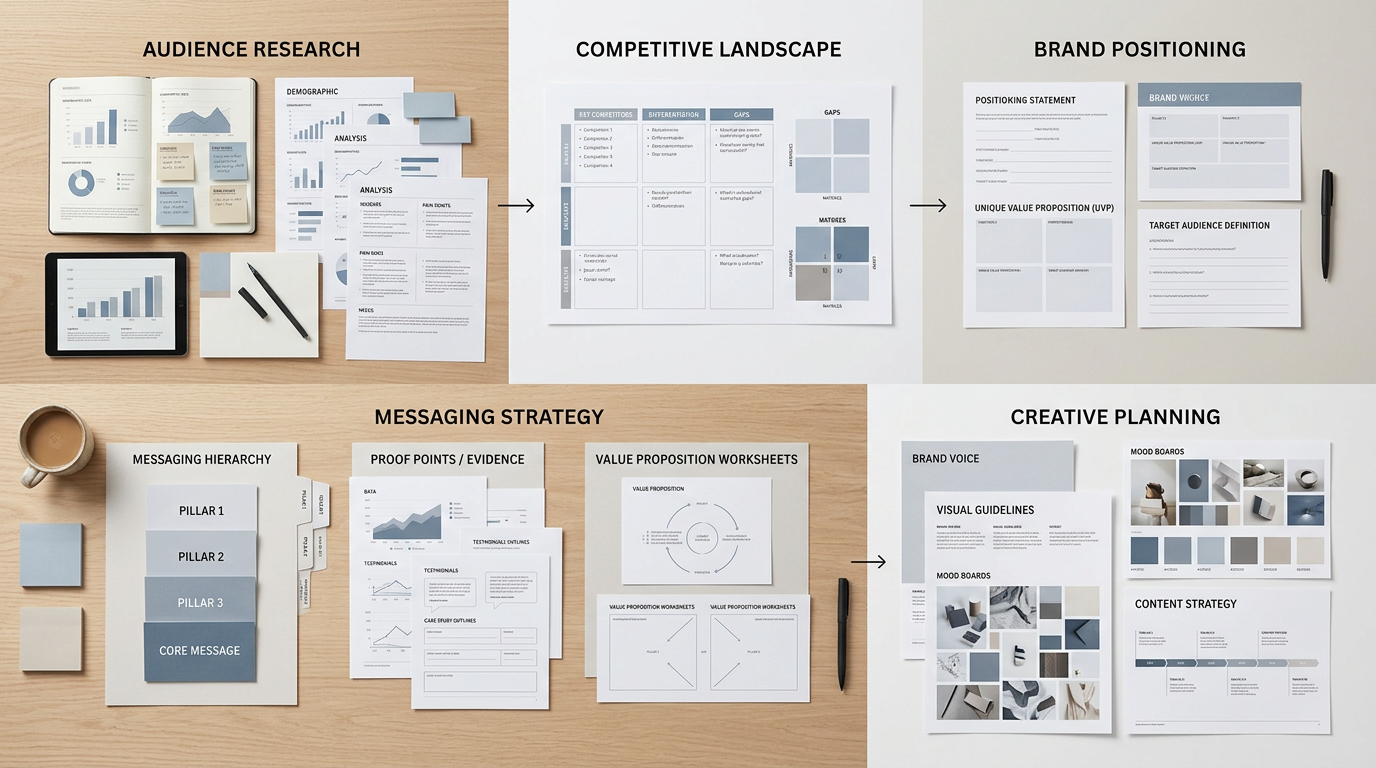
Positioning defines how a brand, product, service, organization, or idea should be understood relative to relevant alternatives. Messaging translates that position into the ideas, claims, proof, and language used to communicate with audiences.
The AAMA Positioning & Messaging Framework provides a practical structure for developing both. It is designed for professionals, agencies, brands, students, academics, entrepreneurs, and organizations that need a clear strategic foundation before creating campaigns, websites, sales materials, advertising, presentations, or other communications.
Strong positioning creates focus. Strong messaging makes that focus usable. When the two are aligned, organizations are better able to communicate consistently across channels without repeating the exact same words everywhere.
1. Define the Audience
Positioning begins with a clear understanding of who the offering is intended to serve. A broad description such as “consumers,” “businesses,” or “professionals” is rarely specific enough to guide meaningful positioning.
Audience definition should focus on characteristics that influence the decision being made. Depending on the situation, these may include needs, behaviors, motivations, geography, industry, company size, purchasing authority, product usage, attitudes, experience level, or other relevant factors.
A useful audience definition should help answer:
- Who is most likely to need or value the offering?
- Who has the problem being addressed?
- Who participates in the decision?
- Which audience matters most to the business objective?
- Are there meaningful secondary audiences?
- What characteristics actually influence the purchase or adoption decision?
The audience should be specific enough to guide strategy without becoming unnecessarily narrow.
2. Identify the Audience Need
Determine what the audience is trying to accomplish, avoid, improve, understand, or solve. This need provides the foundation for the value the offering must communicate.
The need may be functional, emotional, social, financial, professional, or a combination of several factors.
Examples can include:
- Save time
- Reduce risk
- Increase revenue
- Improve performance
- Simplify a difficult process
- Gain confidence
- Avoid mistakes
- Demonstrate status
- Gain control
- Make a better decision
The strongest positioning connects the offering to a need that is both meaningful and relevant to the intended audience.
3. Identify the Audience Insight
An audience insight explains something meaningful about why the audience behaves, believes, hesitates, chooses, or responds the way it does. It goes beyond basic description and provides a useful strategic observation.
For example:
“Small-business owners do not necessarily want more marketing tools. They want fewer systems to manage and clearer evidence that the tools they already use are producing results.”
That statement provides more strategic direction than simply stating that the audience consists of small-business owners.
A useful insight should help influence positioning, messaging, creative direction, or channel strategy.
4. Define the Competitive Frame
The competitive frame identifies the category, alternatives, or existing behaviors against which the audience will evaluate the offering.
Competition may include:
- Direct competitors
- Substitute products or services
- Internal solutions
- Doing the work manually
- Delaying the decision
- Doing nothing
- Existing habits or behaviors
The real competitor is not always another brand. In many situations, inertia, familiarity, cost, or an existing process may be the strongest alternative.
Understanding the competitive frame helps determine what the positioning actually needs to overcome.
5. Define the Offering
Describe clearly what is being positioned. This may be a company, brand, product, service, program, event, membership, idea, or individual offering.
The description should be straightforward rather than promotional. Before deciding how something should be positioned, teams should agree on what it actually is.
Clarify:
- What is the offering?
- What does it provide?
- How does it work?
- Where does it fit within the market or category?
- What problem is it designed to address?
Clarity at this stage prevents messaging from attempting to compensate for an unclear product or service definition.
6. Identify the Primary Benefit
The primary benefit is the most important value the offering provides to the intended audience. It should describe the outcome or advantage that matters to the audience rather than simply listing a product feature.
For example:
Feature: Automated reporting dashboard
Benefit: Reduces the time required to understand campaign performance
The benefit answers the audience’s implicit question: “Why should I care?”
An offering may provide several benefits, but positioning should identify which benefit deserves priority.
7. Identify Supporting Benefits
Supporting benefits strengthen the primary benefit by adding additional value, context, or reasons for consideration.
These might include:
- Convenience
- Speed
- Reliability
- Flexibility
- Cost savings
- Expertise
- Access
- Quality
- Simplicity
- Customization
- Reduced risk
Supporting benefits should reinforce the primary position rather than compete with it.
8. Establish the Point of Difference
The point of difference identifies what makes the offering meaningfully distinct from relevant alternatives. A difference only matters when the audience values it.
Effective differentiation may come from:
- Product capabilities
- Service model
- Expertise
- Distribution
- Price
- Quality
- Customer experience
- Technology
- Access
- Specialization
- Brand reputation
- Process
- Convenience
- Business model
Avoid relying on generic claims such as “better service,” “higher quality,” or “innovative solutions” unless those claims can be made specific and supported.
A point of difference should help explain why the audience should choose this offering instead of another available option.
9. Identify Reasons to Believe
Reasons to believe provide evidence supporting the positioning. They help transform claims into credible propositions.
Useful proof may include:
- Product performance
- Research
- Demonstrations
- Data
- Customer outcomes
- Experience
- Credentials
- Certifications
- Independent testing
- Reviews
- Guarantees
- Case studies
- Proprietary capabilities
The strength of the proof should match the strength of the claim being made.
Reasons to believe should also be reviewed carefully when claims involve regulated, technical, health-related, financial, or otherwise sensitive subjects.
10. Define the Brand or Offering Personality
Personality helps determine how the positioning should feel when communicated. It influences voice, tone, creative direction, visual decisions, and audience expectations.
Useful personality characteristics might include:
- Authoritative
- Practical
- Sophisticated
- Friendly
- Direct
- Innovative
- Reassuring
- Energetic
- Academic
- Premium
- Accessible
- Bold
Avoid creating a long list of contradictory characteristics. Three to five meaningful traits are usually more useful than a dozen vague adjectives.
Each trait should have an implication for how the organization communicates.
11. Develop the Positioning Statement
A positioning statement is an internal strategic tool that summarizes the major positioning decisions. It is not necessarily intended to appear directly in advertising.
A common structure is:
For [target audience], [brand or offering] is the [category or frame of reference] that [primary benefit or point of difference] because [reason to believe].
For example:
“For independent retailers that need clearer insight into campaign performance, Example Platform is a marketing analytics tool that turns complex advertising data into practical decision-making information because it combines campaign reporting, customer data, and channel performance in one simplified system.”
The formula is useful as a starting point, but the final statement should prioritize clarity over mechanically filling in a template.
A strong positioning statement should answer four questions:
- Who is this for?
- What is it?
- Why does it matter?
- Why should the audience believe it?
12. Test the Positioning
Before building messaging around a position, evaluate whether it is strategically useful.
Ask:
- Is it relevant to the intended audience?
- Is it meaningfully different?
- Is it credible?
- Can the organization consistently deliver it?
- Is it specific enough to guide decisions?
- Is it broad enough to support future marketing activity?
- Can competitors easily make the same claim?
- Does it reflect an actual audience need?
- Does it support the business objective?
A position does not need to be completely unique in every respect, but it should create a clear and defensible reason for the audience to understand the offering in a particular way.
13. Define the Core Message
The core message translates the strategic position into the primary idea the audience should understand or remember.
It should answer:
“What is the most important thing we want this audience to understand?”
The core message should be focused enough to guide advertising, websites, presentations, sales materials, and other communications without becoming a slogan that must appear word-for-word everywhere.
For example:
Positioning: The platform simplifies fragmented campaign data for small marketing teams.
Core Message: Understand what your marketing is doing without spending hours assembling reports.
The message makes the strategic position more usable in communication.
14. Develop Supporting Messages
Supporting messages explain or reinforce the core message. They may address benefits, features, proof, objections, use cases, price, service, or other information needed to support the audience’s decision.
A useful messaging hierarchy might include:
Core Message:
The central idea the audience should remember.
Supporting Message 1:
The strongest additional benefit.
Supporting Message 2:
A second important benefit or differentiator.
Supporting Message 3:
Proof, reassurance, or another decision-making consideration.
The hierarchy prevents every message from receiving equal emphasis.
15. Develop Proof Points
Proof points provide specific evidence supporting the messages. They should be concrete enough to strengthen credibility.
Proof points may include:
- Performance statistics
- Product features
- Customer results
- Research findings
- Experience
- Certifications
- Awards
- Testimonials
- Demonstrations
- Independent verification
- Case-study outcomes
Avoid using proof that sounds impressive but does not actually support the claim being made.
16. Identify Audience Objections
Messaging should account for the concerns that may prevent the audience from acting. Common objections can relate to price, complexity, risk, trust, switching costs, timing, compatibility, effort, or uncertainty.
Identify the objections most likely to influence the decision and determine which messages or proof points can address them.
For example:
Objection: “Switching platforms will take too much time.”
Response: “Import existing campaign data and begin reporting without rebuilding your historical records.”
The response should address a genuine concern rather than simply repeat the primary sales message.
17. Develop Calls to Action
Calls to action translate communication into a desired next step. Different stages of the customer journey may require different levels of commitment.
Examples include:
Low Commitment
- Learn More
- Explore Features
- Read the Guide
- Watch the Demonstration
Moderate Commitment
- Download
- Register
- Request Information
- Compare Options
Higher Commitment
- Start a Trial
- Schedule a Consultation
- Apply
- Buy Now
The call to action should reflect what the audience is realistically prepared to do at that stage of the decision process.
18. Define Voice & Tone
Voice describes the consistent character of communication, while tone adjusts according to audience, situation, and context.
For example, an organization might maintain a knowledgeable and direct voice while using a more reassuring tone in customer-support communication and a more energetic tone during a product launch.
Voice and tone guidance should help writers make decisions rather than simply listing adjectives.
Related AAMA Resources: Brand Voice Development Guide and AAMA Brand Voice Worksheet
19. Build the Messaging Hierarchy
A messaging hierarchy organizes communication according to priority so audiences encounter the most important information first.
A practical hierarchy can include:
- Positioning
- Core Message
- Primary Benefit
- Supporting Benefits
- Point of Difference
- Proof Points
- Objection Responses
- Calls to Action
The hierarchy can then be adapted for different channels.
A landing page may use nearly the entire structure, while a display advertisement may only communicate the core message and call to action.
20. Adapt Messaging by Audience
Organizations with multiple audiences may need different versions of the same core positioning.
For example, a software platform may need to communicate differently with:
- End users
- Department managers
- Procurement teams
- Executives
- Technology teams
The underlying position can remain consistent while the benefits, proof, language, and calls to action change according to what matters to each audience.
Avoid creating completely unrelated messages for every audience unless there is a genuine strategic reason to do so.
21. Adapt Messaging by Channel
Different channels impose different communication constraints.
A website may provide space for explanation and proof, while search advertising requires concise language tied closely to intent. Social media may emphasize a specific benefit or idea, while a sales presentation can address more complex objections and supporting evidence.
Messaging adaptation should consider:
- Available space
- Audience context
- Stage of the customer journey
- Communication format
- Required action
- Level of existing awareness
- Creative environment
Consistency does not require identical wording. It requires the same underlying strategic meaning.
22. Build the Message Matrix
A message matrix can help organize communication across audiences, benefits, proof, objections, and channels.
A basic matrix might include:
| Audience | Primary Need | Core Message | Supporting Benefit | Proof | Call to Action |
|---|---|---|---|---|---|
| [Audience 1] | [Need] | [Message] | [Benefit] | [Proof] | [CTA] |
| [Audience 2] | [Need] | [Message] | [Benefit] | [Proof] | [CTA] |
| [Audience 3] | [Need] | [Message] | [Benefit] | [Proof] | [CTA] |
The message matrix should help teams maintain consistency without forcing every audience to receive identical communication.
23. Test the Messaging
Messaging should be evaluated before it becomes fixed across major campaigns or brand materials.
Testing can include:
- Customer interviews
- Surveys
- Focus groups
- A/B testing
- Sales-team feedback
- Search behavior
- Landing-page performance
- Advertising response
- Qualitative research
- Message-comprehension testing
Testing should focus on more than preference. A message can be well liked while still failing to communicate the intended idea.
Useful questions include:
- Do people understand it?
- Is it relevant?
- Is it believable?
- Is the benefit clear?
- Is the distinction clear?
- Does it create the intended response?
- Does it introduce confusion or unintended interpretations?
Related AAMA Resource: A/B Testing Guide for Marketers
24. Document the Final Framework
Once the positioning and messaging decisions are established, document them in a format that can be used by marketing, creative, sales, communications, agencies, leadership, and other relevant teams.
A complete framework may include:
- Target Audience
- Audience Need
- Audience Insight
- Competitive Frame
- Offering Definition
- Primary Benefit
- Supporting Benefits
- Point of Difference
- Reasons to Believe
- Personality
- Positioning Statement
- Core Message
- Supporting Messages
- Proof Points
- Audience Objections
- Objection Responses
- Calls to Action
- Voice & Tone
- Audience Variations
- Channel Variations
The framework should be detailed enough to guide communication while remaining easy enough for teams to actually use.
Positioning Is a Strategic Choice
Positioning is not simply a description of everything an organization does. It requires deciding what matters most.
Trying to position an offering as the fastest, cheapest, highest quality, easiest, most sophisticated, most innovative, and most comprehensive option usually produces weak communication because no clear priority emerges.
Strong positioning makes choices. It identifies which audience matters, which need matters, which value deserves emphasis, and what the organization wants to be known for.
Those choices give messaging its direction.
Messaging Is Not Copywriting
Messaging and copywriting are related but different disciplines. Messaging determines what needs to be communicated and why it matters. Copywriting determines how those ideas are expressed within a particular advertisement, webpage, email, presentation, video, or other execution.
A strong messaging framework gives copywriters and creative teams strategic freedom because the core decisions have already been made. They can explore different expressions without losing the intended position.
Review Positioning Over Time
Positioning should be durable enough to guide long-term communication, but it should not be treated as permanent when the market changes materially.
Review positioning when there are significant changes in:
- Audience needs
- Competitive conditions
- Product capabilities
- Customer behavior
- Technology
- Distribution
- Pricing
- Business strategy
- Market perception
Frequent unnecessary repositioning can create confusion, but ignoring meaningful changes can make a once-effective position increasingly irrelevant.
Related AAMA Resources
Continue developing your strategy with How to Build a Marketing Plan, Campaign Planning Framework, Marketing Channels Reference Guide, Brand Voice Development Guide, How to Write a Creative Brief, Marketing Research Methods Guide, and A/B Testing Guide for Marketers. These resources provide additional guidance for understanding audiences, developing strategy, translating messaging into creative direction, and evaluating how communication performs.
The AAMA Resource Library will continue expanding with templates, worksheets, planning tools, and professional references designed to help organizations turn strategy into clear and effective communication.