
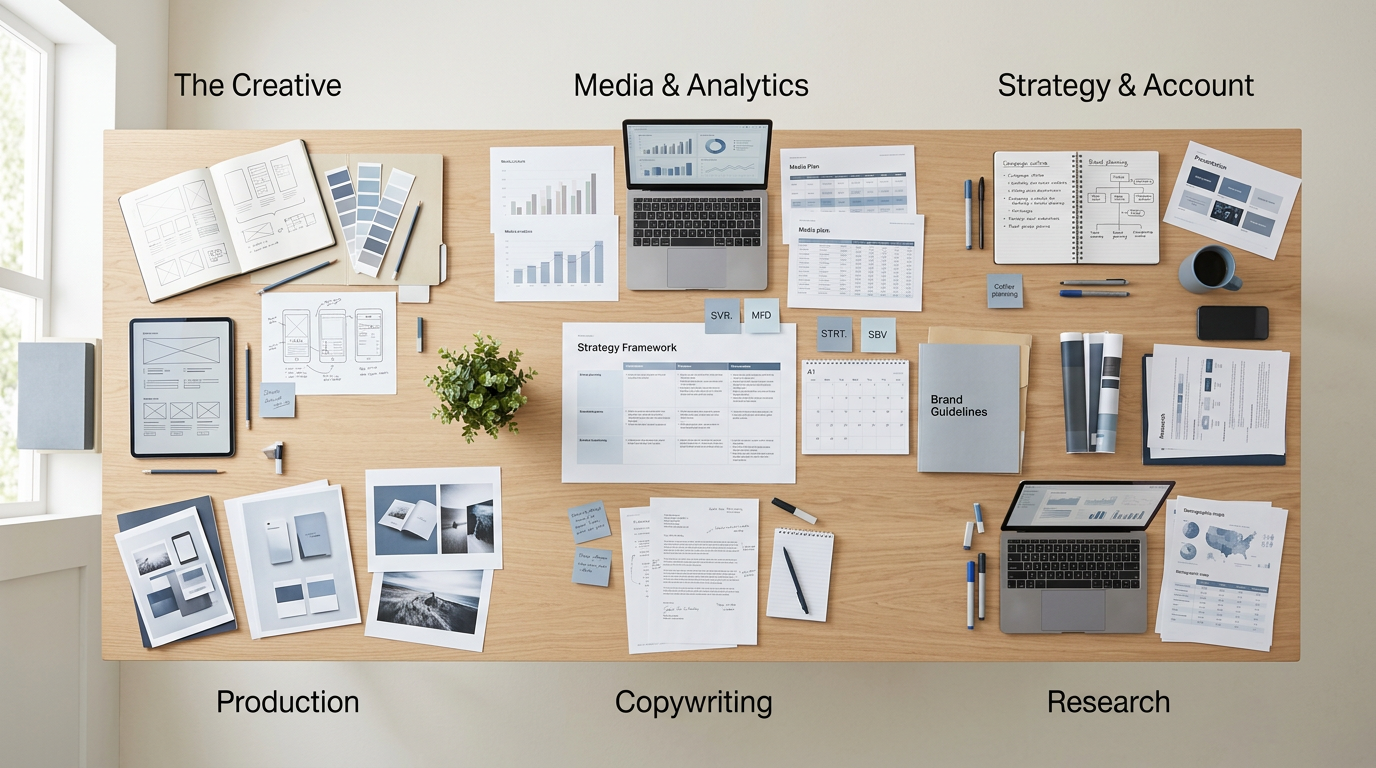
Advertising and marketing encompass a wide range of careers spanning strategy, creative development, media, research, analytics, technology, communications, client service, sales, production, brand management, and leadership. There is no single path into the industry, and many professionals move among specialties as their experience, interests, and responsibilities develop.
The AAMA Advertising & Marketing Career Paths Guide provides an overview of major career areas, common responsibilities, transferable skills, and possible progression within the profession. It is designed for students, early-career professionals, experienced practitioners considering a change in specialization, educators, and anyone trying to better understand how advertising and marketing careers fit together.
Job titles vary substantially among employers. A strategist at one organization may perform work similar to a marketing manager, account planner, brand strategist, or insights manager elsewhere. For that reason, career planning should focus on responsibilities and capabilities as much as titles.
Marketing Strategy & Management
Marketing strategy professionals help determine how organizations identify opportunities, reach audiences, position offerings, allocate resources, and achieve business objectives through marketing.
Responsibilities may include:
- Marketing planning
- Market analysis
- Audience strategy
- Positioning
- Campaign strategy
- Budget allocation
- Channel strategy
- Performance evaluation
- Cross-functional coordination
Common roles can include:
- Marketing Coordinator
- Marketing Specialist
- Marketing Manager
- Senior Marketing Manager
- Director of Marketing
- Vice President of Marketing
- Chief Marketing Officer
Strategic marketing roles often require a broad understanding of several disciplines because the work involves coordinating specialists rather than operating within only one channel.
Useful Skills
Professionals in this path benefit from:
- Strategic thinking
- Marketing planning
- Research interpretation
- Budget management
- Communication
- Project management
- Analytics
- Presentation skills
- Business judgment
Senior positions increasingly require the ability to connect marketing activity with broader organizational outcomes.
Brand Management
Brand professionals oversee how a brand is positioned, presented, experienced, and developed over time. The work often combines strategy, research, creative development, product knowledge, campaign management, and organizational coordination.
Responsibilities may include:
- Brand strategy
- Positioning
- Audience research
- Product launches
- Campaign development
- Brand standards
- Agency management
- Competitive analysis
- Portfolio management
- Performance tracking
Common roles may include:
- Assistant Brand Manager
- Associate Brand Manager
- Brand Manager
- Senior Brand Manager
- Brand Director
- Vice President of Brand
- Chief Brand Officer
Brand management is especially common in consumer packaged goods, retail, hospitality, technology, financial services, healthcare, entertainment, and other sectors where long-term brand development is central to competition.
Product Marketing
Product marketing connects product development with customer understanding, positioning, communication, sales, and market adoption.
Product marketers often work closely with product management, sales, research, customer success, and marketing teams.
Responsibilities may include:
- Market research
- Product positioning
- Messaging
- Competitive intelligence
- Go-to-market planning
- Sales enablement
- Product launches
- Customer research
- Adoption strategy
- Pricing support
Common roles can include:
- Product Marketing Specialist
- Product Marketing Manager
- Senior Product Marketing Manager
- Director of Product Marketing
- Vice President of Product Marketing
This path is particularly common in technology and business-to-business organizations, although product-marketing responsibilities exist across many industries.
Advertising Account Management
Account-management professionals serve as a bridge between clients and agency teams. They help translate client needs into organized agency assignments while managing communication, budgets, schedules, expectations, and relationships.
Responsibilities may include:
- Client communication
- Project coordination
- Brief development
- Budget management
- Timeline management
- Presentations
- Internal coordination
- Scope management
- Campaign oversight
Common agency roles include:
- Account Coordinator
- Assistant Account Executive
- Account Executive
- Senior Account Executive
- Account Supervisor
- Account Director
- Group Account Director
- Vice President, Account Management
Successful account professionals need strong communication and organizational skills along with enough strategic and creative understanding to help different disciplines work together.
Account Planning & Brand Strategy
Account planning and brand strategy focus on understanding audiences, markets, culture, and human behavior to guide advertising and communication strategy.
Strategists may work within agencies, consultancies, research organizations, or internal marketing teams.
Responsibilities may include:
- Audience research
- Consumer insight
- Competitive analysis
- Cultural analysis
- Positioning
- Creative strategy
- Brief development
- Qualitative research
- Campaign strategy
- Concept evaluation
Common roles may include:
- Junior Strategist
- Account Planner
- Brand Strategist
- Communications Strategist
- Senior Strategist
- Strategy Director
- Group Strategy Director
- Head of Strategy
- Chief Strategy Officer
The strongest strategists combine research discipline with the ability to identify useful ideas that can guide creative and business decisions.
Creative Direction
Creative directors oversee the development of advertising, branding, campaigns, and other creative communication. They help establish the creative idea, evaluate execution, guide teams, and ensure work supports the underlying strategy.
Creative leadership may emerge from copywriting, art direction, design, production, or other creative specialties.
Common progression may include:
- Copywriter or Art Director
- Senior Copywriter or Senior Art Director
- Associate Creative Director
- Creative Director
- Group Creative Director
- Executive Creative Director
- Chief Creative Officer
Creative leadership requires more than producing strong individual work. Senior creative professionals must also provide direction, evaluate ideas, communicate with clients and stakeholders, mentor teams, and connect creative decisions with strategy.
Copywriting
Copywriters develop verbal communication for advertisements, websites, campaigns, video, social media, email, brand platforms, product materials, and other marketing environments.
Responsibilities may include:
- Headlines
- Advertising copy
- Scripts
- Campaign concepts
- Website copy
- Social content
- Brand messaging
- Naming
- Presentation development
Common roles include:
- Junior Copywriter
- Copywriter
- Senior Copywriter
- Associate Creative Director
- Creative Director
- Executive Creative Director
Copywriters frequently collaborate closely with art directors and designers.
Strong copywriting requires an understanding of audience, strategy, tone, medium, and persuasion in addition to writing ability.
Art Direction
Art directors develop the visual direction of advertising and campaign concepts. They work closely with copywriters, designers, photographers, directors, illustrators, producers, and other creative specialists.
Responsibilities may include:
- Advertising concepts
- Visual direction
- Campaign development
- Photography direction
- Design oversight
- Video concepts
- Layout
- Presentation development
- Production supervision
A common career progression may include:
- Junior Art Director
- Art Director
- Senior Art Director
- Associate Creative Director
- Creative Director
- Executive Creative Director
Art direction differs from graphic design, although the two disciplines overlap extensively in many organizations.
Graphic & Communication Design
Design professionals translate ideas and information into visual communication across digital, print, environmental, packaging, identity, and other formats.
Responsibilities may include:
- Brand identity
- Layout
- Typography
- Digital design
- Presentation design
- Advertising
- Social graphics
- Packaging
- Publications
- Environmental graphics
Common roles include:
- Junior Designer
- Graphic Designer
- Visual Designer
- Senior Designer
- Design Director
- Creative Director
Design careers may also branch into specialized areas such as motion design, user-interface design, information design, experiential design, and packaging.
Content Marketing
Content marketing professionals develop and distribute useful or relevant material intended to attract, inform, engage, or retain audiences.
Content may include:
- Articles
- Guides
- Videos
- Podcasts
- Reports
- Newsletters
- Case studies
- Webinars
- Social content
- Research
Common roles may include:
- Content Coordinator
- Content Specialist
- Content Writer
- Content Strategist
- Content Marketing Manager
- Editorial Director
- Director of Content
- Head of Content
The field often overlaps with editorial strategy, search marketing, social media, brand communication, and public relations.
Social Media Marketing
Social media professionals manage brand communication and audience engagement across social platforms.
Responsibilities may include:
- Content planning
- Publishing
- Community management
- Social advertising
- Audience engagement
- Reporting
- Influencer coordination
- Social listening
- Campaign development
- Platform strategy
Common roles include:
- Social Media Coordinator
- Social Media Specialist
- Community Manager
- Social Media Manager
- Social Strategist
- Director of Social Media
- Head of Social
Professionals in this field should understand both the communication culture of individual platforms and the larger marketing objectives the activity is intended to support.
Search Engine Optimization
Search engine optimization professionals improve how digital content is discovered through search.
Responsibilities may include:
- Keyword research
- Search-intent analysis
- Technical SEO
- Content optimization
- Site architecture
- Internal linking
- Performance monitoring
- Competitive research
- Search reporting
Common roles may include:
- SEO Specialist
- SEO Analyst
- SEO Strategist
- SEO Manager
- Director of SEO
- Head of Organic Growth
SEO increasingly intersects with content strategy, website development, analytics, digital public relations, ecommerce, and emerging search interfaces.
Paid Search
Paid-search professionals plan, manage, and optimize advertising that appears within search environments.
Responsibilities may include:
- Keyword strategy
- Campaign structure
- Bidding
- Budget management
- Ad development
- Landing-page coordination
- Conversion tracking
- Testing
- Performance analysis
Common roles include:
- Paid Search Specialist
- PPC Specialist
- Search Analyst
- Paid Search Manager
- Search Director
- Performance Marketing Director
The discipline requires analytical ability as well as an understanding of audience intent, messaging, conversion, and economics.
Performance Marketing
Performance marketing focuses on measurable customer actions and financial outcomes. Professionals often work across paid search, paid social, affiliate marketing, display, retargeting, landing pages, and conversion optimization.
Responsibilities may include:
- Customer acquisition
- Campaign optimization
- Budget allocation
- CPA management
- CAC analysis
- ROAS analysis
- Conversion testing
- Attribution
- Forecasting
Common roles may include:
- Performance Marketing Specialist
- Growth Marketing Manager
- Acquisition Manager
- Performance Marketing Manager
- Director of Performance Marketing
- Vice President of Growth
These roles frequently combine media buying, analytics, experimentation, and financial decision-making.
Growth Marketing
Growth marketing focuses on identifying and testing ways to improve acquisition, activation, retention, revenue, and referral across the customer lifecycle.
Responsibilities may include:
- Experimentation
- Customer acquisition
- Funnel analysis
- Conversion optimization
- Retention
- Lifecycle communication
- Product collaboration
- Analytics
- Marketing automation
Common titles vary substantially and may include:
- Growth Marketer
- Growth Marketing Manager
- Growth Lead
- Director of Growth
- Vice President of Growth
Growth roles often sit between traditional marketing, product, analytics, and technology teams.
Email & Lifecycle Marketing
Lifecycle marketing professionals develop communications that support customers or prospects through different stages of their relationship with an organization.
Responsibilities may include:
- Email campaigns
- Automated journeys
- Customer onboarding
- Lead nurturing
- Retention campaigns
- Re-engagement
- Segmentation
- Personalization
- Testing
- Performance analysis
Common roles include:
- Email Marketing Specialist
- CRM Specialist
- Lifecycle Marketing Manager
- Marketing Automation Manager
- CRM Manager
- Director of Lifecycle Marketing
This path often involves close work with customer data, marketing technology, sales, ecommerce, and customer-success teams.
Media Planning
Media planners determine how advertising budgets should be distributed across channels, audiences, markets, and time periods to support campaign objectives.
Responsibilities may include:
- Audience analysis
- Channel strategy
- Reach and frequency planning
- Budget allocation
- Media research
- Schedule development
- Vendor evaluation
- Performance reporting
Common agency roles may include:
- Assistant Media Planner
- Media Planner
- Senior Media Planner
- Media Supervisor
- Media Director
- Group Media Director
- Head of Media
Media planning increasingly combines traditional and digital channels within integrated plans.
Related AAMA Resource: Media Planning Fundamentals
Media Buying
Media buyers negotiate, purchase, manage, and optimize advertising inventory.
Depending on the medium, responsibilities may include:
- Vendor negotiation
- Inventory purchasing
- Campaign setup
- Budget management
- Placement
- Trafficking
- Optimization
- Performance monitoring
- Reconciliation
Common roles include:
- Assistant Media Buyer
- Media Buyer
- Senior Media Buyer
- Investment Manager
- Media Supervisor
- Media Director
The boundaries between planning and buying vary among organizations, and many roles combine elements of both.
Programmatic Advertising
Programmatic specialists manage automated digital media buying using advertising technology platforms and data-driven targeting systems.
Responsibilities may include:
- Campaign setup
- Audience targeting
- Demand-side platform management
- Inventory selection
- Bidding strategy
- Optimization
- Brand-safety controls
- Fraud monitoring
- Reporting
Common roles may include:
- Programmatic Analyst
- Programmatic Trader
- Programmatic Specialist
- Programmatic Manager
- Programmatic Director
The path requires familiarity with digital advertising technology, measurement, audience data, and media economics.
Marketing Analytics
Marketing analysts use data to evaluate marketing performance and support decision-making.
Responsibilities may include:
- Campaign reporting
- Data analysis
- Dashboard development
- Customer analysis
- Forecasting
- Attribution
- Performance measurement
- Testing analysis
- Data visualization
Common roles include:
- Marketing Analyst
- Digital Analyst
- Senior Marketing Analyst
- Analytics Manager
- Marketing Analytics Director
- Vice President of Analytics
Strong analysts combine technical skill with the ability to explain what the data means for marketing decisions.
Marketing Research & Consumer Insights
Marketing research and insights professionals study audiences, customers, markets, brands, products, and behavior.
Responsibilities may include:
- Research design
- Surveys
- Interviews
- Focus groups
- Data analysis
- Brand tracking
- Segmentation
- Concept testing
- Customer research
- Competitive analysis
Common roles include:
- Research Assistant
- Market Research Analyst
- Consumer Insights Analyst
- Research Manager
- Insights Manager
- Director of Consumer Insights
- Vice President of Insights
Professionals may work for brands, agencies, research firms, consultancies, academic institutions, media organizations, or specialized research providers.
Related AAMA Resource: Marketing Research Methods Guide
Market Intelligence
Market-intelligence professionals analyze markets, competitors, customers, categories, and business conditions to support strategic decisions.
Responsibilities may include:
- Competitive intelligence
- Market sizing
- Trend analysis
- Industry research
- Opportunity assessment
- Pricing research
- Strategic analysis
Roles may include:
- Market Intelligence Analyst
- Competitive Intelligence Analyst
- Market Intelligence Manager
- Strategy Manager
- Director of Market Intelligence
This work often overlaps with strategic planning, product marketing, research, and business development.
Public Relations
Public-relations professionals manage communication between organizations and external audiences through media relations, corporate communications, events, thought leadership, reputation management, and other activities.
Responsibilities may include:
- Media relations
- Press materials
- Executive communication
- Reputation management
- Crisis communication
- Events
- Publicity
- Thought leadership
- Communications strategy
Common roles include:
- PR Coordinator
- Account Executive
- Public Relations Specialist
- PR Manager
- Communications Director
- Vice President of Communications
- Chief Communications Officer
Agency and corporate career structures can differ substantially.
Influencer Marketing
Influencer-marketing professionals develop collaborations between brands and creators, public figures, subject-matter experts, or other influential individuals.
Responsibilities may include:
- Creator research
- Partnership development
- Campaign management
- Contracts
- Briefing
- Content review
- Disclosure compliance
- Measurement
- Relationship management
Common roles include:
- Influencer Marketing Coordinator
- Influencer Specialist
- Creator Partnerships Manager
- Influencer Marketing Manager
- Director of Influencer Marketing
The field combines elements of media, public relations, social strategy, talent management, and partnership marketing.
Partnerships & Sponsorships
Partnership professionals develop marketing relationships with organizations, events, media properties, creators, associations, and other partners.
Responsibilities may include:
- Partner identification
- Negotiation
- Sponsorship development
- Activation planning
- Co-marketing
- Relationship management
- Measurement
Common roles may include:
- Partnerships Coordinator
- Partnership Marketing Manager
- Sponsorship Manager
- Strategic Partnerships Director
- Vice President of Partnerships
Strong partnership professionals combine relationship development with strategic and commercial judgment.
Experiential & Event Marketing
Experiential marketers create in-person or hybrid experiences intended to build awareness, engagement, consideration, or customer relationships.
Responsibilities may include:
- Event strategy
- Activation planning
- Trade shows
- Sponsorship activation
- Product demonstrations
- Experiential design
- Logistics
- Vendor management
- Measurement
Common roles may include:
- Event Coordinator
- Experiential Marketing Specialist
- Event Marketing Manager
- Experiential Producer
- Director of Experiential Marketing
These careers often require strong project-management and production abilities.
Advertising Production
Production professionals turn approved creative concepts into finished advertising assets.
The work may involve:
- Video
- Photography
- Audio
- Digital
- Animation
- Post-production
- Talent
- Locations
- Vendors
Common roles include:
- Production Coordinator
- Agency Producer
- Integrated Producer
- Senior Producer
- Executive Producer
- Head of Production
Producers must balance creative ambition, schedules, budgets, technical requirements, and practical execution.
Marketing Operations
Marketing operations professionals build and manage the processes, systems, data, technology, and workflows that allow marketing teams to function efficiently.
Responsibilities may include:
- Marketing technology
- Workflow development
- CRM systems
- Lead management
- Campaign operations
- Data governance
- Automation
- Reporting infrastructure
- Budget processes
Common roles include:
- Marketing Operations Specialist
- Marketing Operations Manager
- Marketing Technology Manager
- Director of Marketing Operations
- Vice President of Marketing Operations
This career path has grown as marketing organizations have become increasingly dependent on integrated technology and data systems.
Marketing Technology
Marketing technology, often called martech, sits at the intersection of marketing, data, software, and operations.
Professionals may work with:
- CRM platforms
- Marketing automation
- Analytics systems
- Customer-data platforms
- Content-management systems
- Advertising technology
- Personalization
- Ecommerce systems
Common roles include:
- Marketing Technology Specialist
- Martech Analyst
- Marketing Systems Manager
- Marketing Technology Director
- Martech Architect
The field can be a strong fit for professionals interested in both marketing strategy and technical systems.
Ecommerce Marketing
Ecommerce marketers focus on generating and converting demand through digital commerce environments.
Responsibilities may include:
- Merchandising
- Promotions
- Customer acquisition
- Paid media
- Conversion optimization
- Retention
- Marketplace management
- Product-page optimization
- Revenue analysis
Common roles include:
- Ecommerce Specialist
- Ecommerce Marketing Manager
- Ecommerce Manager
- Director of Ecommerce
- Vice President of Ecommerce
Ecommerce positions frequently combine marketing, merchandising, analytics, technology, and operations.
Retail Marketing
Retail marketing supports customer acquisition, traffic, merchandising, promotion, brand experience, and sales within physical or digital retail environments.
Responsibilities may include:
- Promotional planning
- Store marketing
- Retail media
- Point-of-sale communication
- Merchandising
- Local marketing
- Loyalty programs
- Shopper marketing
Career paths vary depending on whether the professional works for a retailer, manufacturer, agency, or retail-media network.
Shopper Marketing
Shopper marketing focuses specifically on understanding and influencing people within the shopping and purchase process.
The discipline may involve:
- Retail promotions
- In-store communication
- Merchandising
- Ecommerce
- Customer research
- Retail media
- Point-of-sale marketing
It is particularly common in consumer packaged goods and retail organizations.
Customer Experience
Customer-experience professionals examine and improve interactions throughout the customer journey.
Responsibilities may include:
- Journey mapping
- Customer research
- Satisfaction measurement
- Experience design
- Voice-of-customer programs
- Service improvement
- Cross-functional coordination
Common roles include:
- Customer Experience Analyst
- CX Manager
- Customer Journey Manager
- Director of Customer Experience
- Chief Customer Officer
Customer-experience careers often intersect with marketing, research, product, customer service, and operations.
Conversion Rate Optimization
Conversion rate optimization professionals use research, analytics, experimentation, and user-experience improvement to increase the percentage of people completing desired actions.
Responsibilities may include:
- Funnel analysis
- Landing-page optimization
- Testing
- User research
- Analytics
- Form optimization
- Experiment design
Common titles can include:
- CRO Specialist
- Optimization Analyst
- Experimentation Manager
- Conversion Optimization Manager
The field combines marketing, research, analytics, and user-experience principles.
Sales Enablement
Sales-enablement professionals help sales teams communicate and sell more effectively by providing information, content, systems, and tools.
Responsibilities may include:
- Sales presentations
- Case studies
- Competitive materials
- Product messaging
- Training
- CRM support
- Sales content
- Lead-stage communication
The role often sits between marketing, product marketing, and sales.
Agency New Business
New-business professionals help advertising, marketing, media, public-relations, and creative agencies acquire clients.
Responsibilities may include:
- Prospecting
- Agency positioning
- Requests for proposals
- Pitch development
- Presentations
- Relationship development
- Case-study preparation
- Competitive research
Possible titles include:
- New Business Coordinator
- Business Development Manager
- New Business Director
- Chief Growth Officer
This path rewards professionals who understand both the agency’s capabilities and the business needs of prospective clients.
Academic Careers in Advertising & Marketing
Advertising and marketing also offer academic career paths in research, teaching, administration, and scholarship.
Academic roles may include:
- Graduate Assistant
- Research Assistant
- Lecturer
- Instructor
- Assistant Professor
- Associate Professor
- Professor
- Department Chair
- Research Center Director
Academic professionals may specialize in areas such as consumer behavior, advertising, branding, marketing strategy, analytics, communications, digital media, ethics, or marketing history.
Requirements vary by institution and position, with research-oriented university careers commonly requiring doctoral study.
Consulting
Marketing and advertising consultants provide specialized expertise to organizations without necessarily becoming permanent members of the internal team.
Consulting may focus on:
- Strategy
- Branding
- Research
- Media
- Analytics
- Digital marketing
- Creative
- Customer experience
- Marketing operations
- Growth
- Organizational design
Consultants may work independently, within boutique firms, or for large consulting organizations.
A consulting career typically requires deep expertise, strong communication, disciplined project management, and the ability to understand unfamiliar organizations quickly.
Freelance Careers
Many advertising and marketing disciplines support freelance or independent work.
Common freelance specialties include:
- Copywriting
- Graphic design
- Art direction
- Photography
- Video production
- Social media
- Media buying
- Search marketing
- Strategy
- Research
- Consulting
- Web development
Freelancing requires not only professional skill but also business development, pricing, contracts, scheduling, financial management, and client communication.
Agency, Brand, Media Company or Consultancy?
Advertising and marketing professionals can work in several organizational environments.
Agencies
Agencies provide services to multiple clients. Professionals may gain exposure to several industries and brands while developing specialized expertise.
Brands & Internal Marketing Teams
In-house teams focus on one organization or portfolio of brands. Professionals may gain deeper knowledge of the business, customers, products, and long-term strategy.
Media Companies
Media organizations employ professionals in advertising sales, audience development, branded content, research, media strategy, partnerships, and marketing.
Consultancies
Consultancies often focus on strategic, organizational, analytical, technological, or transformation work.
Research Firms
Research organizations specialize in data collection, analysis, consumer insight, measurement, and advisory services.
No environment is inherently better. The best fit depends on the type of work, pace, specialization, client exposure, and organizational context a professional prefers.
Specialist Versus Generalist Careers
Some professionals build deep expertise within one discipline, while others develop broad capabilities across several areas.
A specialist might focus primarily on:
- Paid search
- Programmatic advertising
- Consumer research
- Copywriting
- SEO
- Analytics
A generalist might oversee:
- Strategy
- Campaigns
- Media
- Creative
- Research
- Budgets
- Agencies
Both approaches can lead to senior careers. Specialists often become recognized subject-matter experts, while generalists may move toward broader management and leadership responsibilities.
Many successful careers combine both: deep expertise in one area supported by working knowledge of adjacent disciplines.
Career Paths Are Not Always Linear
Advertising and marketing careers rarely follow one fixed sequence.
A professional might move from:
- Copywriting into strategy
- Media planning into analytics
- Research into brand management
- Sales into product marketing
- Social media into content strategy
- Account management into marketing leadership
- Design into creative direction
- Marketing operations into marketing technology
Skills gained in one discipline often transfer to another.
Career progression should be evaluated according to the work a person wants to do and the capabilities they need to develop, not simply the title above their current position.
Build Transferable Skills
Certain capabilities are valuable across nearly every advertising and marketing discipline.
These include:
- Clear writing
- Presentation
- Research
- Data interpretation
- Strategic thinking
- Creative problem-solving
- Project management
- Collaboration
- Budget awareness
- Business understanding
- Technology literacy
- Professional communication
Early-career professionals who develop these foundational capabilities can move more easily among specialties as opportunities emerge.
Learn to Interpret Data
Even creative and relationship-oriented roles increasingly require the ability to understand marketing performance.
Professionals should be comfortable interpreting common measures such as:
- Reach
- Impressions
- CTR
- Conversion rate
- CPM
- CPC
- CPA
- CAC
- ROAS
- Revenue
- Retention
Not every marketer needs to become a data scientist, but every marketer benefits from understanding how performance is measured.
Related AAMA Resources: Marketing Metrics & KPI Reference and Common Marketing Formulas
Learn the Business Behind the Marketing
Advertising and marketing exist to support organizations, customers, and markets. Professionals who understand the business context behind their work can make stronger strategic decisions.
Develop familiarity with:
- Revenue
- Costs
- Margins
- Pricing
- Sales
- Customer acquisition
- Retention
- Product economics
- Competition
- Market structure
Understanding the commercial implications of marketing becomes increasingly important as careers advance.
Build a Portfolio of Evidence
A professional portfolio should demonstrate what a person can do rather than simply list responsibilities.
Depending on the discipline, portfolio evidence might include:
- Campaigns
- Creative work
- Research
- Strategy presentations
- Media plans
- Writing samples
- Analytics projects
- Case studies
- Experiments
- Brand systems
- Production work
Whenever confidentiality allows, explain the problem, role, reasoning, execution, and outcome.
Related AAMA Resource: How to Build a Marketing Portfolio
Seek Experience, Not Only Titles
Early in a career, the quality of the work and learning opportunities may matter more than small differences in job title.
Look for opportunities to:
- Work with experienced professionals
- Participate in real campaigns
- Present ideas
- Analyze results
- Develop strategy
- Work across disciplines
- Interact with clients or stakeholders
- Take responsibility for deliverables
A title can describe where someone sits in an organization. Experience determines what that person is prepared to do next.
Evaluate Job Descriptions Carefully
Titles in advertising and marketing are not standardized. Two positions with the same title can involve very different work, while two positions with different titles may be nearly identical.
When evaluating a role, examine:
- Actual responsibilities
- Reporting structure
- Team composition
- Client exposure
- Budget responsibility
- Decision authority
- Required tools
- Expected outcomes
- Opportunities to learn
- Advancement possibilities
The responsibilities usually reveal more about the career opportunity than the title alone.
Related AAMA Resource: Advertising & Marketing Job Titles Guide
Build a Career Around Capabilities
A sustainable advertising or marketing career is built through accumulating useful capabilities rather than collecting titles.
As professionals advance, employers increasingly evaluate whether they can:
- Solve problems
- Make decisions
- Lead projects
- Interpret evidence
- Communicate clearly
- Manage resources
- Develop people
- Work across disciplines
- Produce measurable outcomes
Career planning becomes more useful when framed around which capabilities need to be developed next.
Related AAMA Resources
Continue exploring professional development with the Advertising & Marketing Job Titles Guide, How to Build a Marketing Portfolio, Advertising & Marketing Internship Guide, AAMA Client Discovery Questionnaire, Marketing Metrics & KPI Reference, Marketing Research Methods Guide, Media Planning Fundamentals, and Marketing Channels Reference Guide. These resources provide additional guidance for understanding industry roles, developing practical skills, evaluating career opportunities, and building professional experience.
The AAMA Resource Library will continue expanding with professional-development guides, templates, career resources, academic references, and practical tools designed to support advertising and marketing professionals throughout their careers.