
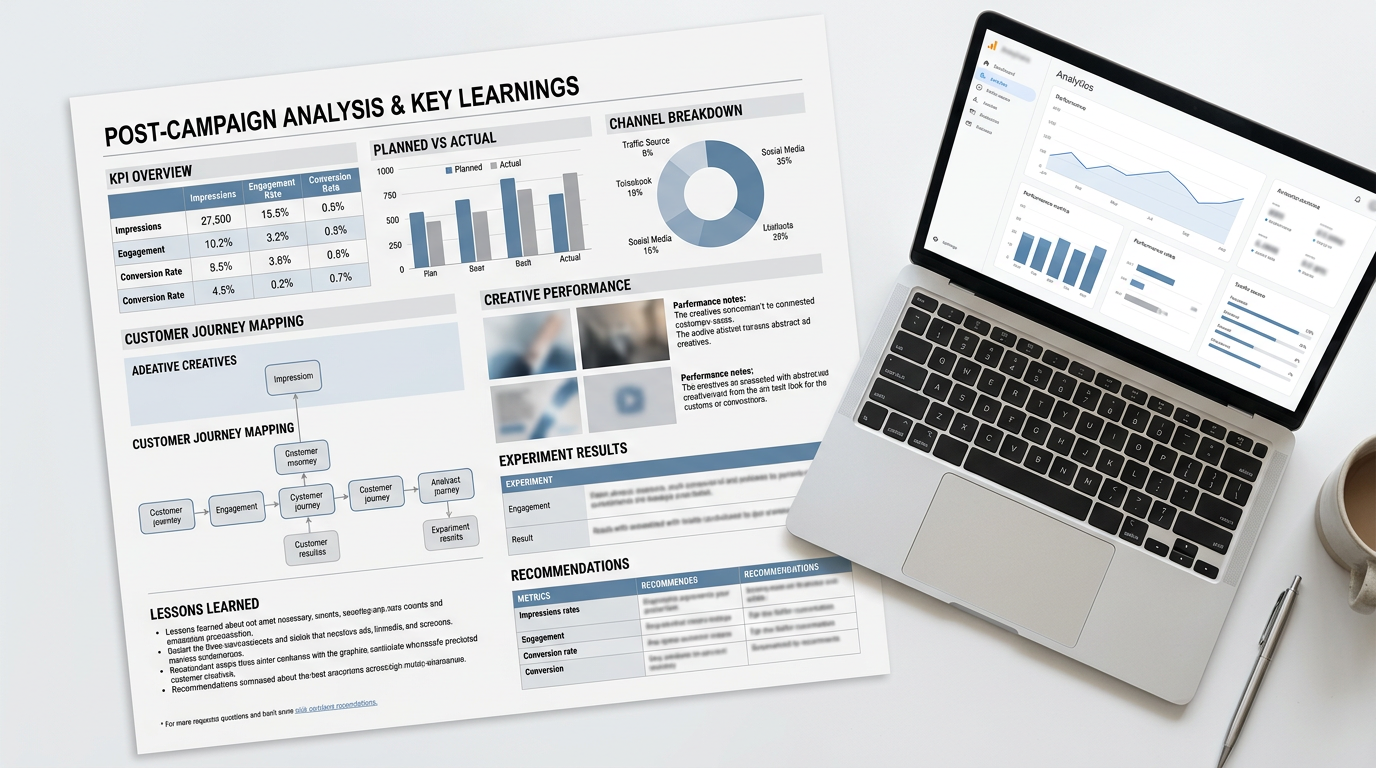
Turn completed campaign results into useful organizational learning with the AAMA Post-Campaign Analysis Template. This editable professional template helps marketers, agencies, organizations, consultants, students, and academic teams evaluate what happened, understand why performance differed from expectations, document what was learned, and translate those findings into better decisions for the next campaign.
A post-campaign analysis should do more than repeat numbers from a dashboard or performance report. It should compare results with the objectives established before launch, distinguish execution problems from strategic problems, separate evidence from assumptions about cause, identify what should be repeated or changed, and preserve knowledge that can improve future planning.
Download the Post-Campaign Analysis Template
The AAMA Post-Campaign Analysis Template is provided as an editable Microsoft Word document. Replace the bracketed instructions and placeholder content with campaign-specific information, expand working areas when additional detail is required, and remove sections that do not apply to the campaign.
The document uses a neutral professional format that can be adapted to an organization, agency, client, course, campaign, or consulting engagement. Replace the included performance-summary, channel-analysis, and learning-agenda placeholders with approved charts, dashboards, experiment results, or other supporting evidence before distributing the completed analysis.
What the Template Helps You Analyze
The template is designed to move from results to explanation and then from explanation to action. It reviews objectives and targets, campaign delivery, budget, channels, audiences, creative, the customer journey, attribution, experiments, assumptions, recommendations, and the knowledge that should be carried into future campaigns.
The completed analysis should answer three fundamental questions. Did the campaign accomplish what it was intended to accomplish, what evidence best explains the result, and what should the organization do differently because of what it learned?
What’s Included
The template contains sections for the Executive Summary; Objectives, Targets & Final Results; Delivery, Budget & Execution Review; Performance by Channel, Audience & Creative; Customer Journey & Funnel Analysis; Why Did the Campaign Perform This Way?; Tests, Experiments & Learning Agenda; What Worked, What Did Not & What Remains Unknown; Recommendations & Next-Campaign Decisions; Institutional Learning & Knowledge Transfer; Final Post-Campaign Review; and Approval & Closeout.
Each section includes guided prompts, comparison tables, evidence fields, decision frameworks, or replaceable visual placeholders that can be edited directly in Word.
Begin With the Executive Summary
The Executive Summary gives senior decision-makers the essential conclusion without requiring them to read the complete analysis. It asks for the campaign objective, primary KPI and target, actual result, overall assessment, most important finding, most important recommendation, and confidence in the conclusion.
This section should be completed after the deeper analysis has been performed even though it appears near the beginning of the document. The summary should reflect the evidence contained in the analysis rather than becoming an early narrative that the rest of the document is expected to justify.
Compare Results With Pre-Launch Targets
Campaign results become more meaningful when they are compared with the objectives and success criteria established before launch. The template therefore includes a structured comparison of objective, KPI, baseline, target, actual result, variance, and final assessment.
This protects the analysis from redefining success after the results are already known. Supporting metrics can still provide important information, but they should not quietly replace the original primary objective simply because another number performed well.
Consider Result Maturity
Not every campaign result is complete when the media stops running. Conversions may arrive after the campaign ends, sales data may require reconciliation, offline outcomes may be delayed, and some results may rely on modeled or incomplete information.
The template therefore asks whether each important result is final, lagging, modeled, partial, or otherwise limited. Teams can also document when the result is expected to become sufficiently mature for a stronger conclusion.
Review Delivery Before Judging Strategy
A campaign cannot be evaluated responsibly without understanding whether it was executed as planned. Media may have under-delivered, creative may have launched late, spending may have changed, inventory may have been unavailable, tracking may have failed, or operational capacity may have limited the campaign’s ability to produce the expected outcome.
The Delivery, Budget & Execution Review compares planned and actual conditions before the analysis assigns performance differences to the strategy itself. It also documents execution problems, their impact, supporting evidence, and how similar issues should be prevented in the future.
Separate Under-Spending From Efficiency
A campaign that spends less than planned is not automatically more efficient. Under-spending may reflect lower media costs, but it can also result from limited inventory, delayed approval, poor delivery, technical problems, or an inability to scale.
Likewise, spending more than planned is not automatically evidence of failure when additional investment was intentionally approved because performance justified expansion. Budget variance should be interpreted in context rather than classified as positive or negative by itself.
Compare Channels, Audiences & Creative
Campaign averages can hide important differences. One channel may generate strong results while another underperforms, a particular audience may respond differently from the overall population, or one message may perform substantially better under otherwise similar conditions.
The template includes a comparison framework for channel or placement, audience or segment, creative or message, offer or call to action, and landing or customer experience. Teams should document the key performance difference and the evidence that may explain it.
Avoid Confusing Correlation With Cause
A high-performing creative execution is not automatically the reason a campaign succeeded. That creative may have received better placements, more favorable audiences, additional budget, different timing, or another advantage unrelated to the creative itself.
The analysis should distinguish observed differences from causal conclusions. Where the campaign design cannot determine cause confidently, the finding should be treated as a hypothesis that can inform future testing.
Analyze the Customer Journey
Campaign success can break down at different points in the customer journey. Strong awareness does not guarantee consideration, high traffic does not guarantee conversion, and successful acquisition does not guarantee satisfactory onboarding, retention, or advocacy.
The Customer Journey & Funnel Analysis compares expected and observed behavior across awareness, consideration, decision, onboarding or use, and retention or advocacy. It also identifies the most important drop-off and asks what evidence explains the friction.
Identify the Critical Drop-Off
Not every stage deserves equal attention. The most important problem may exist where the largest number of qualified customers leave the process, where high-value prospects fail to progress, or where the experience contradicts the promise made by the campaign.
Identifying this point helps the organization decide whether the next improvement belongs in media, creative, messaging, offer design, landing experience, sales, onboarding, service, or another part of the customer journey.
Ask Why the Campaign Performed This Way
Performance reporting establishes what happened. Post-campaign analysis should investigate why.
The template includes a structured hypothesis table that separates the observed result, possible explanation, evidence supporting that explanation, conflicting or missing evidence, and confidence in the conclusion. This keeps interpretation transparent and makes it easier for another reviewer to challenge or validate the reasoning.
Separate Attribution From Incrementality
Attribution answers which observed interaction receives credit for a conversion or outcome. Incrementality asks whether the campaign actually created additional outcomes that would not otherwise have occurred.
Those questions should not be treated as interchangeable. A platform can legitimately attribute a conversion according to its reporting methodology without proving that the advertisement caused the customer to act.
The template therefore includes a dedicated attribution and incrementality review. Teams can document the methodology used, what conclusions it reasonably supports, and the important limitations that remain.
Review Tests & Experiments
Campaign experiments should produce decisions rather than simply producing statistical output. The Tests, Experiments & Learning Agenda section documents the hypothesis or question, tested variable, result, confidence, and the business decision or learning that follows.
This can include formal A/B tests, holdouts, matched-market experiments, creative variations, audience tests, landing-page experiments, offer tests, or other meaningful comparisons. The appropriate level of rigor depends on the decision being made and the evidence required to support it.
Document Directional Learning Carefully
Not every campaign generates enough data for a definitive experimental conclusion. Smaller campaigns may still produce directional evidence that is useful for generating better hypotheses.
Directional findings should be labeled according to the strength of the evidence. A promising pattern can justify another test without being presented as an established universal rule.
Identify What Worked
Post-campaign reviews often concentrate disproportionately on problems. Successful campaigns also create valuable information about strategies, audiences, messages, media choices, experiences, or operating practices that should be preserved.
The template asks what worked, what evidence supports the finding, under what conditions it worked, and how the organization should use that information in the future. A useful conclusion should be specific enough that another team can understand what should actually be repeated.
Identify What Did Not Work
Poor performance should also be documented with evidence and context. A tactic may fail because the strategy was weak, because execution was poor, because the audience was wrong, because the offer did not create sufficient value, or because circumstances changed after the plan was approved.
The analysis should avoid labeling an entire channel, audience, or creative approach ineffective when the evidence applies only to one implementation. Future teams need to know both what happened and the conditions under which it happened.
Document What Remains Unknown
A strong analysis does not pretend that every question has been answered. Some results remain ambiguous because the data is incomplete, the campaign did not include a control, the sample is too small, several variables changed simultaneously, or the available measurement cannot distinguish between competing explanations.
The template provides a dedicated area for unresolved questions. Each unknown can become a research or testing priority for future campaigns rather than disappearing when the current project closes.
Record Unexpected Results
Some of the most valuable campaign learning comes from results that the team did not anticipate. A supposedly secondary audience may perform exceptionally well, an expensive channel may deliver higher-value customers, or a message expected to perform strongly may generate little response.
Unexpected findings should be investigated rather than dismissed because they conflict with the original strategy. They may reveal a flawed assumption, an emerging opportunity, or an important question that deserves a dedicated experiment.
Identify Assumptions Proven Wrong
Campaign plans necessarily contain assumptions about audiences, messages, channels, timing, behavior, offers, and measurement. Some of those assumptions will turn out to be incorrect.
The template includes a specific section for documenting the original assumption, what the campaign evidence showed, and what should change as a result. This prevents incorrect beliefs from quietly reappearing in the next planning cycle.
Convert Findings Into Recommendations
A post-campaign report creates limited value when its recommendations remain vague. “Improve targeting,” “optimize creative,” or “increase engagement” does not tell a future team what action should actually be taken.
The Recommendations & Next-Campaign Decisions section requires the recommended action, supporting evidence, priority, owner, timing, and status. This makes the analysis actionable rather than archival.
Decide What to Preserve, Change, Stop or Test
The template includes a practical decision matrix across strategy, audience and targeting, media, creative and messaging, offer and call to action, landing or customer experience, and measurement.
Each area can be classified according to whether it should be preserved, changed, stopped, or tested next. This provides a concise handoff from the completed campaign to the next planning cycle.
Preserve Institutional Learning
Campaign knowledge frequently disappears after the final presentation. Team members move on, agencies change, dashboards become inaccessible, and future planners unknowingly repeat earlier mistakes or experiments.
The Institutional Learning & Knowledge Transfer section records what was learned, where that knowledge should be reused, who owns it, and where the supporting evidence is stored. This turns individual campaign experience into organizational knowledge.
Preserve Valuable Assets & Evidence
Certain campaign materials may be especially useful later. Examples include high-performing creative, research, audience findings, experiment results, approved dashboards, measurement documentation, customer insights, or operational procedures.
The template includes a dedicated record for identifying these assets and documenting where they are stored. This can make future planning faster and reduce the need to recreate work that already exists.
Complete the Final Post-Campaign Review
The final review confirms that the analysis is based on the correct evidence and produces a usable conclusion. It checks whether the primary objective has been evaluated against the pre-launch target, execution differences have been separated from strategic performance, causal claims are appropriately qualified, data limitations are documented, experiments are connected with decisions, and future research priorities have been identified.
The review also confirms that recommendations are specific enough to implement and that reusable learning has an owner and storage location. This creates a clear standard for when the analysis is actually complete.
Establish the Final Campaign Disposition
The Final Disposition section records the overall campaign outcome as exceeded, met, near, missed, or inconclusive. It also identifies the primary lesson, primary decision, next owner, and next review date.
This concise conclusion can be particularly useful when the full document is archived with other campaign records. Future teams can understand the central outcome quickly and then review the deeper evidence when needed.
Close Out the Campaign Record
The template includes an optional Approval & Closeout section for organizations that require formal acknowledgement from marketing, analytics, media, creative, experience, business, or executive stakeholders.
Formal approval is not necessary for every campaign, but documenting ownership can be useful when recommendations affect budgets, strategy, customer experience, or future operating processes. The completed analysis should be stored with the campaign plan, measurement framework, performance report, creative materials, and other relevant records.
Use It With the Campaign Performance Report
The AAMA Campaign Performance Report Template and the AAMA Post-Campaign Analysis Template serve different purposes.
The performance report is primarily a quantitative reporting workbook for KPIs, media channels, audiences, creative, costs, conversions, revenue, and campaign efficiency. The post-campaign analysis uses those results as evidence and concentrates on interpretation, causality, learning, recommendations, and what should change next.
Using both creates a stronger campaign closeout than attempting to force raw reporting and strategic analysis into the same document.
Customize the Template
All bracketed text contains instructions or placeholder content and should be replaced or removed before the completed document is shared. Tables, journey stages, comparison areas, test fields, recommendations, approval roles, and visual placeholders can be expanded or modified according to the campaign and organization.
The included visual placeholders use descriptive AAMA filenames so they remain easy to identify when the document or its embedded media assets are inspected. They are working placeholders only and should be replaced with campaign-specific evidence in the finished analysis.
Use It With the AAMA Planning & Measurement Resources
Use the template alongside the Campaign Measurement Framework, AAMA Campaign Performance Report Template, Campaign Planning Framework, AAMA Campaign Planning Workbook, A/B Testing Guide for Marketers, AAMA Media Plan Template, AAMA Marketing Budget Template, Marketing Metrics & KPI Reference, and the AAMA Marketing & Advertising Calculator Hub.
Together, these resources create a continuous system from campaign planning and measurement design through execution, performance reporting, analysis, institutional learning, and the next round of strategic decisions.