
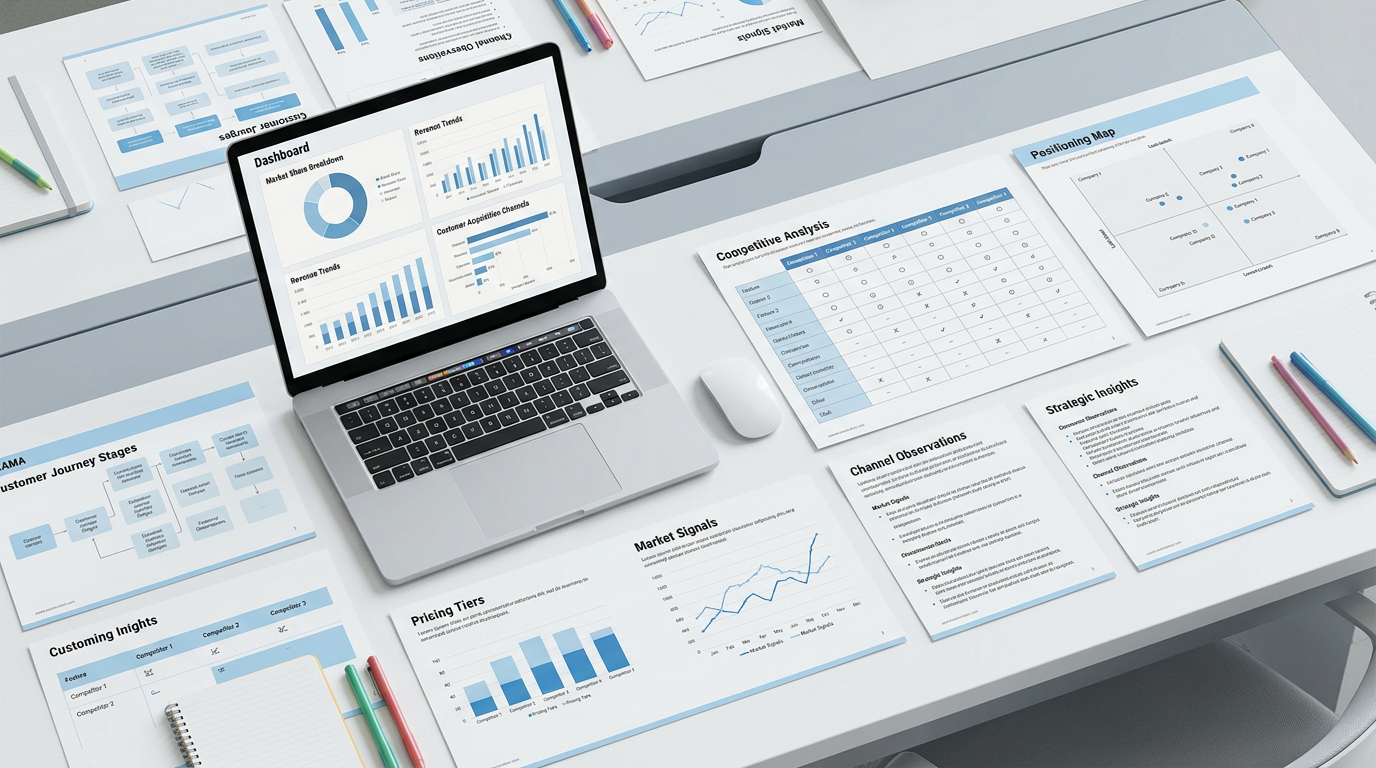
Turn competitive research into useful strategic decisions with the AAMA Competitive Analysis Worksheet. This editable professional worksheet helps marketers, agencies, organizations, consultants, students, and academic teams compare competitors and customer alternatives using evidence rather than assumptions, then translate those findings into implications for positioning, pricing, messaging, channels, customer experience, and market strategy.
Competitive analysis should do more than collect screenshots, feature lists, and competitor claims. A useful analysis identifies the alternatives customers actually consider, determines the dimensions on which those alternatives compete, distinguishes meaningful advantages from superficial differences, and clarifies what the organization should do because of what the evidence reveals.
Download the Competitive Analysis Worksheet
The AAMA Competitive Analysis Worksheet is provided as an editable Microsoft Word document. Replace the bracketed instructions and placeholder content with market-specific information, expand the working areas when additional detail is required, and remove sections that do not apply to the analysis.
The document uses a neutral professional format that can be adapted to an organization, agency, client, course, research project, or strategic planning process. Replace the included competitor-evidence, positioning-map, and market-signal placeholders with your own research, market data, screenshots, charts, perceptual maps, or other useful evidence before distributing the completed analysis.
What the Worksheet Helps You Analyze
A useful competitive analysis begins with a decision rather than with a list of companies. The worksheet therefore asks what business or marketing question the analysis is intended to answer, which market or customer context matters, what evidence is available, and where important gaps remain.
From there, the worksheet examines the competitive set, offers, pricing, positioning, messages, channels, customer experience, strengths, weaknesses, defensibility, market changes, and strategic implications. The final sections require teams to identify the decisions that should change because of what the analysis reveals.
What’s Included
The worksheet contains ten primary working sections:
- Define the Competitive Question
- Identify the Real Competitive Set
- Competitor Profiles
- Offer, Pricing & Value Comparison
- Positioning & Messaging Landscape
- Channels, Content & Customer Experience
- Competitive Strengths, Weaknesses & Defensibility
- Market Signals & Change
- Strategic Implications & Action Summary
- Final Competitive Analysis Review
Each section includes guided prompts, comparison tables, evidence fields, or visual placeholders that can be edited directly in Word.
Begin With the Decision
Competitive research can expand indefinitely when the organization does not define what it is trying to learn. The worksheet begins by asking what decision the analysis should help make and what market, category, audience, geography, or use case belongs inside the scope.
An organization considering a pricing change may need different competitive information from one developing a new positioning strategy. Likewise, a company evaluating media investment may care more about competitors’ audience access and channel behavior than about minor differences in product features.
Build the Analysis From Evidence
The worksheet includes a structured evidence log for documenting sources, findings, dates, confidence levels, and ownership. Evidence may come from public competitor materials, customer research, analytics, market studies, sales observations, service interactions, industry data, or other lawful and appropriate sources.
Competitive information can become outdated quickly. Prices change, products evolve, campaigns end, new partnerships appear, and companies alter their positioning. Recording dates and evidence sources helps distinguish a current finding from information that may no longer represent the market.
Identify the Real Competitive Set
A customer does not always choose between two companies selling nearly identical products. The alternative may be a substitute category, an internal solution, an existing process, a workaround, a delayed purchase, or simply doing nothing.
The worksheet therefore separates direct competitors from substitutes, internal solutions, status-quo alternatives, and other forms of competition. This can reveal that the organization’s most important competitive problem is not necessarily the company it discusses most often internally.
Prioritize the Competitors That Matter
Not every company in a market deserves equal analytical attention. Some competitors may overlap only superficially, operate against different audiences, serve another use case, or rarely appear in actual customer decisions.
The worksheet asks teams to identify the priority competitive set and explain why those alternatives deserve closer attention. It also provides space to identify frequently mentioned organizations that should not influence the current decision.
Build Factual Competitor Profiles
The Competitor Profiles section documents observable information about each priority competitor or alternative, including its offer, customer, value proposition, business or revenue model, capabilities, and limitations.
The worksheet deliberately discourages speculation about internal strategy, profitability, motivations, or business conditions that cannot be reasonably supported. Public visibility should not be confused with knowledge of what is happening inside another organization.
Compare Offers & Value
Feature lists often produce large comparison tables without revealing why customers actually choose one option over another. The worksheet instead connects the offer with pricing, included value, customer tradeoffs, and supporting evidence.
This can reveal whether competitors are competing primarily on price, convenience, expertise, service, simplicity, access, performance, risk reduction, customization, reputation, or another dimension that matters to customers.
Analyze Pricing in Context
Price should not be evaluated as an isolated number. A higher-priced alternative may include additional service, reduce perceived risk, offer stronger guarantees, simplify implementation, or create another form of value that changes how customers interpret the cost.
The worksheet therefore asks how pricing affects customer perception, accessibility, comparison, risk, switching, and timing. It also creates space to identify value gaps where customers may be underserved, over-served, confused, or forced into unattractive tradeoffs.
Map the Positioning Landscape
The Positioning & Messaging Landscape compares the frame of reference, primary benefit, supporting proof, tone, message pattern, and calls to action used by competitors.
This can help teams identify claims that are so common they provide little meaningful differentiation. If every company describes itself as innovative, trusted, customer-focused, or high quality, repeating those phrases without stronger evidence or context may add very little strategic value.
Identify Open Positioning Space Carefully
An apparently unused message is not automatically an opportunity. A competitor may avoid a particular position because customers do not value it, the promise is difficult to support, or the position conflicts with category expectations.
The worksheet therefore treats open positioning space as a hypothesis that should be supported by customer evidence. Differentiation becomes strategically useful when it is both distinctive and meaningful to the audience.
Compare Channels & Discovery
Competitors also influence the market through where and how they become visible. The Channels, Content & Customer Experience section asks how customers discover alternatives, what educational content is available, what the conversion experience is like, and how competitors support or retain customers.
This can reveal strategic differences that are not visible in product comparisons. A competitor may win because it is easier to find, easier to understand, easier to evaluate, easier to buy from, or easier to continue using.
Evaluate the Customer Experience
Competitive advantage can exist beyond advertising and product features. Onboarding, sales interaction, support, fulfillment, documentation, membership experience, billing, returns, renewal, and other customer interactions can materially affect customer choice and retention.
The worksheet asks where competitors create trust, friction, differentiation, or vulnerability throughout the experience. This helps prevent marketing teams from assuming that every competitive problem should be solved with a stronger advertisement.
Separate Visibility From Strength
A large advertising presence, polished website, strong social following, or frequent press coverage can create visibility without necessarily establishing a durable competitive advantage.
The Strengths, Weaknesses & Defensibility section asks what evidence supports a claimed strength and how difficult that advantage would be for another organization to reproduce. Distribution, proprietary technology, customer relationships, network effects, operational capability, intellectual property, reputation, data, switching costs, or specialized expertise may be more defensible than a temporary creative or promotional advantage.
Consider Competitive Response
Strategy does not happen in a static market. Competitors may react when an organization changes price, expands distribution, increases media investment, enters a new market, modifies its positioning, or introduces a new product.
The worksheet includes space for considering realistic competitive responses. This is not an invitation to predict exact competitor behavior, but it can help teams evaluate whether an apparent opportunity would remain attractive after other market participants respond.
Know What Not to Copy
Competitive research can create pressure to imitate whatever appears successful elsewhere. That can lead organizations to reproduce another company’s channels, language, offers, design conventions, promotions, or business practices without understanding why those choices work in the original context.
The worksheet asks teams to identify competitor practices that may look attractive but would be strategically inappropriate, difficult to reproduce, inconsistent with the organization’s capabilities, or irrelevant to its audience.
Track Market Signals
Competitive analysis should capture movement rather than only a single snapshot. The Market Signals & Change section provides a structured way to document changes in demand, pricing, partnerships, distribution, products, technology, regulation, messaging, customer expectations, or other market conditions.
Each signal includes a source, date, observed change, possible meaning, confidence level, and an indication of what should be watched next. This helps separate the fact that something changed from the interpretation of what that change might mean.
Distinguish Signals From Conclusions
A new product launch is an observable event. The claim that the launch proves a competitor is abandoning another market may be an interpretation requiring additional evidence.
The worksheet keeps observed change and possible meaning in separate fields for this reason. Competitive intelligence becomes more credible when teams are explicit about the difference between evidence and inference.
Translate Findings Into Strategy
The Strategic Implications & Action Summary is designed to prevent the analysis from ending with observations. Each major finding is connected with supporting evidence, a strategic implication, a recommended action, ownership, and priority.
A useful finding should change something. It may affect positioning, pricing, product development, media, creative, distribution, customer experience, sales strategy, research priorities, market entry, investment, or another decision.
Identify Research Priorities
Competitive analysis often exposes questions that cannot be answered from public information alone. In many cases, customer research is more useful than continuing to collect competitor information.
The worksheet therefore includes a section for research priorities. An organization may discover that it understands competitor claims very well but still does not know which of those claims customers actually believe or care about.
Establish a Review Cadence
Competitive analysis becomes less useful as conditions change. The worksheet asks teams to identify when the analysis should be refreshed and what signals should trigger an earlier review.
A major competitor launch, significant price change, acquisition, regulatory shift, new distribution agreement, technological change, or change in customer behavior may justify reviewing the analysis before the scheduled date.
Complete an Evidence-Quality Review
The final section checks whether the competitive question is clearly defined, the correct alternatives have been included, major claims have identifiable evidence, pricing data is current, facts are separated from assumptions, meaningful differentiation has been identified, market uncertainty is documented, and conclusions lead to specific decisions.
It also includes an explicit check against including sensitive, confidential, or improperly obtained information. Competitive intelligence should support better market understanding while remaining lawful and professionally responsible.
Use Competitive Analysis Ethically
Useful competitive intelligence usually comes from customers, public information, market research, observable activity, lawful data sources, and professional analysis. It should not depend on deception, unauthorized access, confidential information, trade secrets, or improperly obtained materials.
The purpose of the worksheet is to help organizations understand customer choices and market conditions. It is not intended to facilitate intrusive or unethical investigation of competitors.
Customize the Worksheet
All bracketed text contains instructions or placeholder content and should be replaced or removed before the completed worksheet is shared. Tables, comparison criteria, competitors, evidence fields, response areas, and visual placeholders can be expanded or modified according to the market and strategic question.
The included placeholder images use descriptive AAMA filenames so they remain easy to identify when the document or its embedded media assets are inspected. They are working placeholders only and should be replaced with organization-specific research or planning visuals in the finished document.
Use It With the AAMA Strategy & Research Resources
Use the worksheet alongside the Marketing Research Methods Guide, AAMA Customer Persona Worksheet, Positioning & Messaging Framework, Brand Voice Development Guide, Campaign Planning Framework, AAMA Campaign Planning Workbook, Marketing Channels Reference Guide, and How to Build a Marketing Plan.
Together, these resources help move from market evidence and customer understanding to positioning, communication, channel decisions, campaign planning, and broader marketing strategy.