
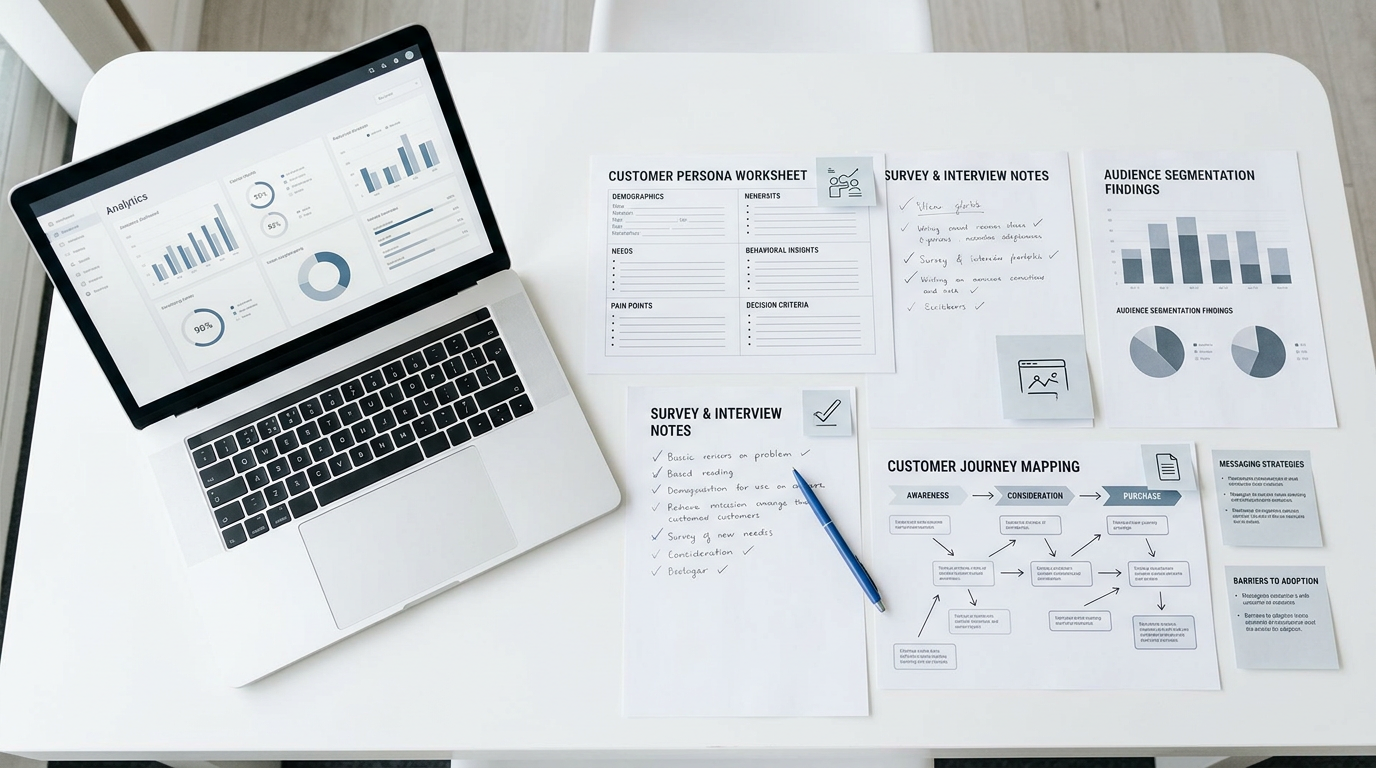
Turn audience research into useful marketing decisions with the AAMA Customer Persona Worksheet. This editable professional worksheet helps marketers, agencies, organizations, consultants, students, and academic teams organize evidence about an audience and translate it into implications for positioning, messaging, creative development, channels, offers, customer experience, and measurement.
The worksheet is deliberately designed to avoid the common problem of creating elaborate fictional customer biographies that add personality without improving strategy. Instead, it focuses on the behaviors, needs, goals, barriers, decision criteria, information sources, journey stages, and evidence that can materially affect marketing decisions.
Download the Customer Persona Worksheet
The AAMA Customer Persona Worksheet is provided as an editable Microsoft Word document. Replace the bracketed instructions and placeholder content with audience-specific information, expand the working areas when additional detail is required, and remove sections that do not apply to the assignment.
The document uses a neutral professional format that can be adapted to the organization, agency, client, course, research project, or campaign using it. Replace the included research and journey placeholders with your own audience evidence, survey findings, analytics, interview themes, journey maps, or other useful planning materials before distributing the completed worksheet.
What the Worksheet Helps You Understand
A useful customer persona should help answer practical questions about how an organization should market, communicate, sell, serve, or design an experience for a meaningful audience segment. It should clarify what the audience is trying to accomplish, what influences its decisions, what creates friction, and what evidence supports those conclusions.
The AAMA worksheet is organized around those decisions rather than around fictional details. It encourages teams to distinguish what they know from what they assume and to identify where additional research is necessary.
What’s Included
The worksheet contains nine primary working sections:
- Build the Persona From Evidence
- Persona Overview
- Goals, Needs & Jobs to Be Done
- Behavior & Decision Context
- Barriers, Objections & Friction
- Journey & Touchpoints
- Messaging & Experience Implications
- Evidence, Confidence & Bias Check
- Persona Action Summary
Each section contains guided prompts, working tables, or evidence fields that can be edited directly in Word.
Start With Evidence
The first section asks teams to document the information sources supporting the persona. These may include customer research, surveys, interviews, analytics, CRM data, sales observations, service interactions, market research, third-party studies, experiments, or other relevant evidence.
The worksheet also records the date, confidence level, and source associated with important findings. This makes it easier to distinguish a current, well-supported conclusion from an assumption that has been repeated internally for years without validation.
Separate Evidence From Assumption
Personas can become misleading when internal beliefs are presented as customer facts. A sales team may believe customers choose primarily on price, for example, while research shows that reliability, risk reduction, or convenience carries greater weight.
The worksheet therefore includes specific areas for research gaps, confidence levels, and validation needs. When evidence is weak, the appropriate response is to label the uncertainty and investigate it rather than disguise it with a polished persona profile.
Use Descriptive Persona Names
The template encourages descriptive segment names rather than invented identities. A working label such as First-Time Small-Business Buyer, Renewal-Risk Member, or Enterprise Marketing Decision-Maker can communicate more useful information than giving the persona an arbitrary first name and stock photograph.
A descriptive name also keeps the team’s attention on the characteristics that make the audience strategically distinct. The persona is a model of a meaningful group, not an imaginary individual.
Define Why the Persona Matters
Not every possible audience segment requires its own persona. A persona becomes useful when differences in needs, behavior, decision-making, barriers, or value perception are significant enough to change what the organization should do.
The Persona Overview section therefore asks teams to identify why the segment matters and what marketing or business decisions the persona is intended to improve. If the completed persona does not change any decisions, the segmentation may not be strategically useful.
Focus on Goals & Jobs to Be Done
Customers rarely begin their decision process by thinking about a marketer’s campaign objective. They are usually trying to accomplish something in their own lives, organizations, roles, or situations.
The worksheet asks teams to identify the audience’s primary goal, functional needs, relevant emotional or social needs, current solutions, and desired outcome. These areas help shift planning from a product-centered view toward the problem or progress the customer is actually trying to achieve.
Identify the Decision Trigger
Customer decisions often begin with a trigger. A deadline, new problem, change in circumstances, failed existing solution, recommendation, organizational requirement, life event, or emerging opportunity may cause the audience to begin searching for alternatives.
Understanding that trigger can improve timing, targeting, messaging, content, and channel strategy. It can also help distinguish people who technically fit a demographic profile from people who are actually entering a relevant decision process.
Document Decision Criteria
The Behavior & Decision Context section asks teams to identify the factors the audience uses to evaluate alternatives. Depending on the market, these may include price, quality, convenience, trust, speed, expertise, compatibility, reputation, service, risk, performance, or another consideration.
The worksheet also asks how important each factor is and what a satisfactory outcome looks like from the audience’s perspective. This can reveal where the organization is competing on criteria that matter to customers and where internal priorities may not match the actual buying decision.
Include Real Alternatives
A competitor is not always another company selling a similar product. Customers may choose an internal solution, postpone the decision, continue using an existing approach, substitute another category, or decide that solving the problem is not worth the effort.
The worksheet therefore includes alternatives considered and reasons not to act. Understanding the status quo can sometimes be more useful than creating a conventional list of direct competitors.
Understand Information Sources
Different audiences gather information in different ways. Some may rely heavily on search, professional publications, peer recommendations, reviews, communities, industry events, sales representatives, social media, comparison tools, academic research, or existing relationships.
Channel recommendations should be supported by observed audience behavior rather than assumptions about what a demographic group supposedly prefers. The worksheet asks teams to connect information sources and channels with actual evidence whenever possible.
Map Barriers & Objections
Interest does not automatically become action. Customers may encounter uncertainty, cost concerns, switching difficulty, lack of trust, internal approval requirements, complexity, risk, poor information, technical problems, or other forms of friction.
The worksheet separates the barrier from its underlying cause and asks teams to consider what might reduce it. This can help determine whether the correct response involves advertising, education, evidence, product design, pricing, customer service, onboarding, sales support, or another part of the experience.
Identify Trust Requirements
Some decisions require more reassurance than others. An audience may need demonstrations, credentials, reviews, testimonials, guarantees, case studies, research, policies, clear pricing, security information, or another form of proof before it is comfortable acting.
Documenting these trust requirements can improve creative briefs, landing pages, sales materials, customer communications, and campaign strategy. It also helps prevent teams from assuming that a stronger promotional claim will solve what is actually a credibility problem.
Map the Customer Journey
The Journey & Touchpoints section follows the audience through awareness, consideration, decision, onboarding or use, and retention or advocacy. Teams can document the questions the audience is asking, likely touchpoints, useful content or experiences, and the desired next step at each stage.
The goal is not to pretend that every customer follows a perfectly linear funnel. The framework provides a practical way to identify where important interactions occur and where marketing can help the audience make progress.
Find the Critical Moment
Not every stage of the journey carries equal importance for every marketing problem. One organization may struggle to generate awareness, while another has strong awareness but loses prospects during comparison, purchase, onboarding, or renewal.
The worksheet asks teams to identify the critical moment that has the greatest influence on the problem the persona is intended to help solve. This can focus resources on the point where improved communication or experience is most likely to matter.
Translate the Persona Into Messaging
A persona should influence communication strategy. The Messaging & Experience Implications section provides working areas for the primary value proposition, core message, supporting points, proof, offer, call to action, tone, and content needs.
These recommendations should follow from the evidence documented earlier in the worksheet. They should not be based on stereotypes about how a particular age group, profession, gender, location, or other category supposedly wants brands to communicate.
Translate the Persona Into Experience
Some customer problems cannot be solved by changing the advertisement. A compelling campaign can still fail when the landing page is confusing, the purchase process is difficult, the sales experience creates friction, onboarding is weak, or customer service fails to provide the reassurance the audience requires.
The worksheet therefore includes experience implications alongside messaging. This helps prevent marketing teams from treating every audience problem as a communications problem.
Review Evidence Confidence
Not every persona statement deserves the same level of confidence. Some conclusions may come directly from customer research or observed behavior, while others may be reasonable inferences that still need validation.
The Evidence, Confidence & Bias Check asks teams to classify key conclusions and determine whether they are ready to use, should be validated, or require additional research. This creates a more honest representation of what the organization actually knows.
Avoid Demographic Stereotypes
Demographic information can be strategically useful when it genuinely affects the market, product, media environment, accessibility requirements, purchasing ability, or another relevant decision. It becomes harmful when teams use demographic categories as shortcuts for assumed motivations, intelligence, values, technology comfort, culture, or purchasing behavior without evidence.
The worksheet includes a specific bias and stereotype review so teams can remove irrelevant demographic details and challenge unsupported conclusions. Personas should clarify customer behavior, not formalize stereotypes.
Avoid Fictional Research Quotes
A persona template sometimes includes a memorable quotation supposedly representing the customer. These can be useful when the quotation comes from actual research, but they become misleading when a team invents a sentence and presents it with the appearance of customer evidence.
The AAMA worksheet does not require fictional quotes. If direct customer language is useful, teams should use genuine research quotations or clearly label synthesized statements as internal summaries.
Use Personas as Living Planning Tools
Markets, behaviors, technology, customer expectations, organizational capabilities, and competitive conditions change. A persona built several years ago may no longer represent the audience accurately.
The final section therefore includes a persona review date and asks teams when the profile should be refreshed, divided, combined, or retired. Personas should evolve when the evidence changes.
Turn the Persona Into Decisions
The Persona Action Summary is designed to prevent the worksheet from becoming a document that is completed once and then ignored. It asks teams to state the implications for positioning, messaging, creative, channels, offers, conversion experiences, sales or service, and measurement.
The section ends by identifying the three most important actions the organization should take because of what the persona reveals. That translation from research to decision is the real purpose of the exercise.
Customize the Worksheet
All bracketed text contains instructions or placeholder content and should be replaced or removed before the completed worksheet is shared. Tables, response fields, journey stages, and evidence areas can be expanded, shortened, replaced, or removed according to the needs of the organization and research assignment.
The included visual placeholders use descriptive AAMA filenames so they remain easy to identify when the document or its embedded media assets are inspected. They are working placeholders only and should be replaced with organization-specific evidence or planning visuals in the finished document.
Use It With the AAMA Planning & Research Resources
Use the worksheet alongside the Marketing Research Methods Guide, How to Design a Marketing Survey, Positioning & Messaging Framework, Brand Voice Development Guide, How to Write a Creative Brief, AAMA Creative Brief Template, Campaign Planning Framework, and AAMA Campaign Planning Workbook.
Together, these resources help move from audience evidence to segmentation, strategy, communication, execution, customer experience, and measurement.