
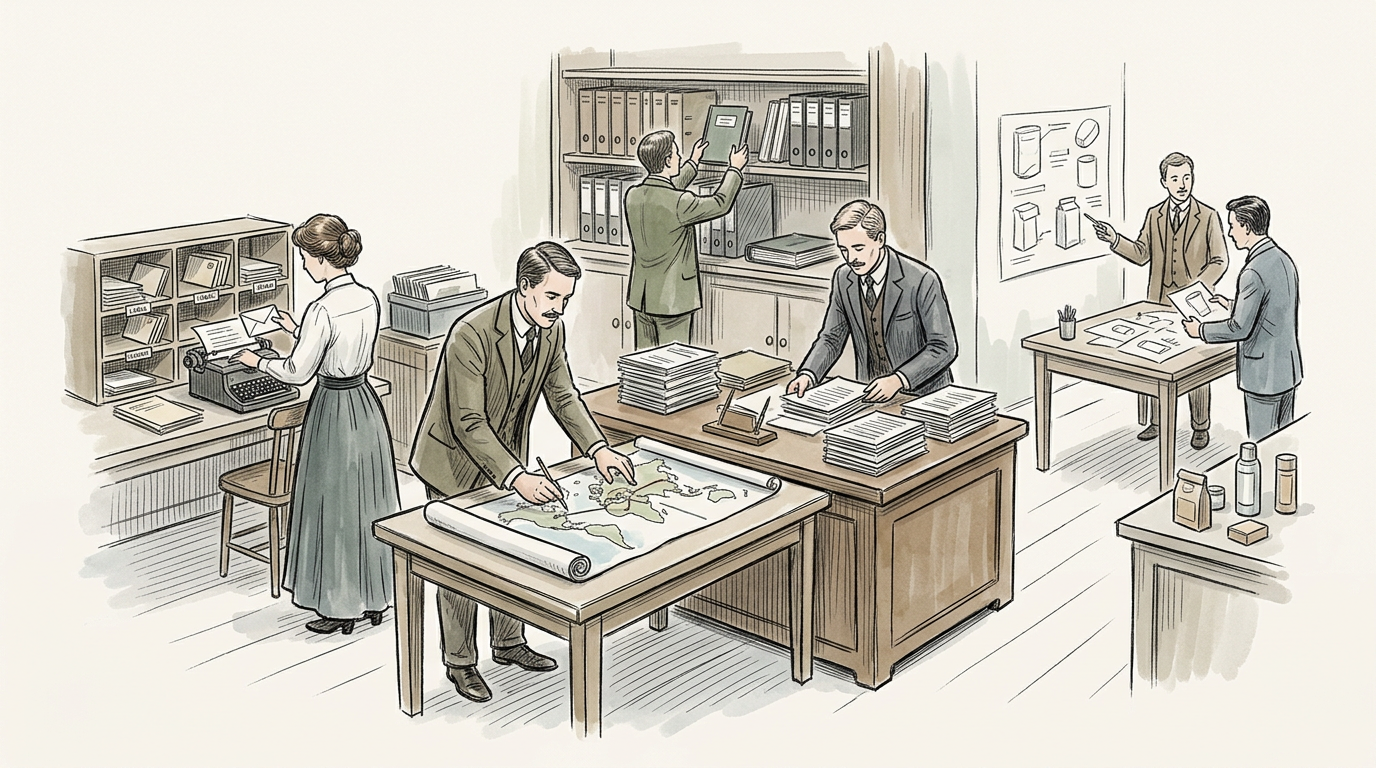
Marketing did not begin as a neatly bounded department. For most of the nineteenth century, the activities now grouped under marketing were dispersed across manufacturing, wholesaling, retailing, sales management, transportation, and advertising. Producers worried about output, merchants about moving goods, and retailers about local demand. Only gradually, as firms confronted larger markets, more complex distribution systems, national brands, and growing amounts of market information, did it become useful to treat marketing as a distinct business responsibility.
That change matters because modern marketing did not simply emerge when companies started advertising more aggressively. It developed when businesses needed a coordinated way to connect production to demand across distance, scale, and time. The discipline took shape in response to industrial growth, new retail forms, transportation and communication advances, and the administrative demands of serving mass markets.
Before “marketing” became a function
In the early and mid-nineteenth century, many firms operated in regional markets where personal selling, merchant relationships, and local reputation mattered more than formal market strategy. Producers often sold through jobbers, wholesalers, commission agents, and independent retailers. The tasks now associated with marketing were present, but they were not consolidated. Pricing might be set by owners or sales managers. Packaging might be handled as a production issue. Customer knowledge came through traveling salesmen, retailers, and wholesalers rather than through dedicated research teams.
This arrangement fit the structure of the economy. Transportation was improving, but national distribution was still limited. Consumer goods markets were fragmented. Many products were sold in bulk or under retailer control rather than as manufacturer-defined brands. In that setting, a separate marketing department would have had limited practical value.
The conditions began to change in the late nineteenth century. Railroads created broader distribution networks. Telegraphy accelerated commercial communication. Urbanization concentrated consumers. Mass production lowered unit costs and encouraged firms to seek larger markets. Packaging improvements and trademark protection helped manufacturers identify products consistently across regions. As output expanded, firms needed more systematic ways to move goods, shape demand, manage intermediaries, and distinguish one offering from another.
Distribution came first
One of the earliest foundations of marketing as a discipline was the problem of distribution. Long before marketing became a standard corporate department, business leaders and economists were trying to understand how goods moved from producer to consumer and why those channels mattered.
The rise of national markets made distribution a managerial issue rather than a purely logistical one. Manufacturers had to decide whether to rely on wholesalers, build their own sales forces, use brokers, or deal more directly with retailers. These were not merely operational questions. They involved control, margins, customer knowledge, and competitive position.
Mail-order firms made this especially clear. Aaron Montgomery Ward’s business, founded in 1872, and Sears, Roebuck and Co., established in the 1890s, showed that reaching consumers directly could be a marketing system, not just a sales tactic. Catalogs combined assortment, pricing, merchandising, copy, customer service, and distribution into an integrated market-making apparatus. They also generated valuable knowledge about demand by geography, season, and product category.
Department stores played a comparable role in urban markets. Their merchandising methods, private labels, display techniques, price strategies, and customer services helped make market demand something to be studied and managed. By the late nineteenth and early twentieth centuries, retailers were not just selling goods. They were organizing consumer choice.
The academic field emerged before the modern department
The word “marketing” began to gain institutional standing in the early twentieth century, especially in American universities. Courses related to distributive trades and market methods appeared before a consensus existed about what the field should include. The University of Michigan, the University of Wisconsin, Harvard, and the University of Pennsylvania were among the institutions where early teaching on marketing-related subjects appeared in the first decade of the twentieth century.
These early courses often focused less on brand strategy than on channels, trade practices, wholesaling, retailing, and agricultural marketing. That emphasis reflected business reality. Distribution was the problem that industrial expansion had made visible.
A key figure in academic legitimation was Ralph Starr Butler, whose teaching materials at the University of Wisconsin are frequently cited in accounts of the field’s formation. Arch Wilkinson Shaw at Harvard also helped define the study of market distribution and business policy. In the 1910s and 1920s, scholars such as Paul D. Converse, Melvin T. Copeland, and others contributed to the development of marketing as a recognized area of business education.
Professional organization followed. The National Association of Teachers of Advertising was formed in 1915 and became the National Association of Teachers of Marketing and Advertising in 1933, reflecting the widening scope of the field. In 1936, the American Marketing Society and the National Association of Marketing Teachers merged to form the American Marketing Association, a signal moment in the profession’s institutional history. The creation of journals, textbooks, academic associations, and business-school courses did not merely describe a business function. They helped standardize it.
Why large firms needed coordination
As the twentieth century advanced, the case for dedicated marketing responsibility became stronger inside large corporations. Mass production had created an abundance problem as well as an efficiency problem. Producing at scale was no longer enough. Firms had to forecast demand, manage product lines, coordinate sales territories, support dealers, stabilize distribution, and maintain brand presence across expanding markets.
This was especially important in packaged goods, branded household products, food, tobacco, and pharmaceuticals. National brands increasingly depended on more than manufacturing quality. They needed reliable distribution, recognizable packaging, sales support, retailer cooperation, pricing discipline, and some continuity in consumer appeal.
At many companies, sales departments initially carried much of this burden. Early corporate organization often treated market-facing activity as “sales” rather than “marketing.” But as businesses became more complex, sales alone could not absorb all the functions involved. Sales managers were responsible for quotas, territories, and personnel. They were not always structurally equipped to oversee long-range product policy, market analysis, package changes, merchandising support, and cross-channel coordination.
The emergence of marketing was therefore partly an administrative response. Firms needed a unit that could connect market intelligence, product planning, sales support, distribution policy, and promotional strategy. In other words, marketing became useful when the market itself became too complex to manage informally.
Brands, product lines, and the rise of managerial specialization
Branding helped drive this shift. In the late nineteenth and early twentieth centuries, manufacturers increasingly used trademarks, branded packaging, and standardized presentation to build trust in markets where buyers and sellers were no longer face to face. National brands such as Ivory Soap, Quaker Oats, and Uneeda Biscuit were products of manufacturing and distribution systems as much as of promotion.
As firms built portfolios rather than single products, organizational strain increased. Managing one branded good was different from managing many. Questions of line extension, package differentiation, trade support, pricing position, and customer segmentation grew more complicated.
A well-known milestone came at Procter & Gamble in 1931, when Neil H. McElroy wrote the internal memo that outlined a more systematic brand management approach. The memo did not invent marketing, and it should not be treated as the single origin of modern practice. But it did capture an important organizational development: the need to assign responsibility for individual brands to managers who could monitor performance, study competition, coordinate sales and promotion, and recommend product improvements. Brand management became one of the most influential ways that marketing work was structured inside consumer goods firms.
This development was historically specific. It emerged in companies with multiple branded products, national distribution, and sufficient scale to support managerial specialization. Smaller firms and many industrial businesses continued to organize market responsibilities differently.
Market research turned demand into something measurable
Another major force in the rise of marketing as a discipline was the growth of market research. Businesses had always collected information from customers and intermediaries, but the early twentieth century saw more formal efforts to gather, classify, and analyze market data.
Charles Coolidge Parlin, working for Curtis Publishing beginning in 1911, is often identified as an early practitioner of systematic commercial research in the United States. His studies of industries and distribution patterns were designed to help advertisers and publishers understand markets in a more empirical way. Over time, survey research, retail audits, panels, and audience measurement expanded what firms could know about consumer behavior and channel performance.
Research did not immediately produce modern precision. Early methods had limitations in sampling, standardization, and inference. Still, they changed business expectations. Executives could begin to ask not only whether sales were rising or falling, but where, among whom, through which outlets, and against which competitors.
That shift strengthened the case for marketing departments. Once a company generated specialized data about customers, products, territories, and channels, someone needed to interpret it and translate it into decisions about pricing, product features, promotion, and distribution. Research made marketing more analytical, but it also made it more organizationally necessary.
The interwar and postwar corporation made marketing visible
Between the 1920s and the decades after World War II, marketing became more recognizable as a formal business function. Several developments converged.
First, consumer goods markets matured. Many categories became crowded with near substitutes, making product differentiation and channel strategy more important. Second, chain stores and supermarkets altered retail power, forcing manufacturers to negotiate more systematically with large intermediaries. Third, national media increased the scale of brand communication, but mass communication worked best when aligned with distribution and merchandising. Fourth, managerial capitalism favored departmental specialization and planning.
By the mid-twentieth century, the language of “marketing” was spreading in boardrooms, trade journals, and business schools. Titles such as marketing manager, director of marketing, and vice president of marketing became more common, though not universal. In some firms, marketing remained subordinate to sales; in others, it began to absorb sales planning, product planning, research, merchandising, and advertising coordination.
This was also the period when the field’s academic identity broadened. Marketing scholars moved beyond channels and commodity distribution toward consumer behavior, management decision-making, and strategy. Textbooks increasingly presented marketing as a general managerial function rather than only a study of trade institutions.
The marketing concept and its limits
In the postwar decades, one influential idea was the “marketing concept,” generally associated with the argument that firms should begin with customer needs and coordinate business activity around serving them profitably. The concept did not appear in a single definitive moment, nor was it practiced uniformly. But in the 1950s and 1960s it became an important way to describe the difference between a production-centered company and a market-oriented one.
Writers such as Peter Drucker emphasized that the purpose of business was to create a customer, while Theodore Levitt’s 1960 Harvard Business Review article “Marketing Myopia” warned firms against defining themselves too narrowly by product rather than customer need. These arguments were influential not because they created marketing departments by themselves, but because they gave intellectual justification to a function already expanding inside large organizations.
Later textbook culture often simplified the marketing concept into a managerial slogan. Historically, its significance was more specific. It reflected a period in which many firms had achieved manufacturing competence and now faced competitive markets in which growth depended on understanding demand, coordinating functions, and adapting offerings. It was both a theory of management and a response to mature mass markets.
Frameworks, planning, and the professionalization of the field
As marketing gained standing, it also gained formal tools. Segmentation, product life cycle thinking, portfolio analysis, and the marketing mix were attempts to make complex market decisions manageable.
The “marketing mix” is often reduced today to the “4 Ps,” popularized by E. Jerome McCarthy in 1960. But the underlying idea came out of earlier efforts to classify managerial variables. Neil Borden had discussed the marketer’s “mix of ingredients” in the 1950s, drawing on earlier teaching traditions. These frameworks were not timeless laws. They were mid-twentieth-century efforts to codify an expanding managerial field.
Such codification mattered organizationally. Once marketing could be taught as a body of concepts, measured through performance indicators, and represented through planning systems, it became easier for firms to justify dedicated staff, budgets, and executive authority. Marketing was becoming not just a cluster of tasks, but a profession with methods, language, and career paths.
Business schools reinforced that shift. So did consulting firms, trade publications, professional associations, and research suppliers. By the late twentieth century, marketing had become a standard corporate function, even though its boundaries still varied widely by industry and company structure.
Technology kept changing what the function included
The history of marketing as a discipline is also a history of changing information systems. In the direct mail era, customer lists and response measurement expanded the role of database thinking. In consumer packaged goods, scanner data and syndicated retail measurement changed category management. In services, loyalty programs and customer relationship management linked marketing to retention as well as acquisition. Digital platforms later accelerated measurement, targeting, experimentation, and automation.
These developments did not create marketing from nothing. They enlarged a function that already existed by giving firms more ways to observe, segment, and influence markets. They also reopened old boundary disputes. In some organizations, ecommerce, pricing, analytics, product, sales enablement, and customer experience sit inside marketing. In others, they are separate. That variation is historically consistent with marketing’s origins in formerly scattered responsibilities.
Why marketing became indispensable
Marketing became a business discipline because industrial economies produced a coordination problem. As production scaled up and markets spread out, firms could no longer rely on informal selling relationships alone. They needed ways to organize distribution, understand demand, manage brands, coordinate channels, support retailers, gather market intelligence, and align product decisions with customer response.
The rise of marketing departments was not inevitable, and it did not happen all at once. It appeared unevenly across industries, shaped by product type, company size, retail structure, technology, and competition. In some settings, sales remained dominant. In others, brand management or market research led the way. Academic marketing also developed in stages, beginning with distribution and only later embracing consumer behavior, strategy, and managerial planning.
That history remains useful because it clarifies what marketing actually is. It is not synonymous with advertising, nor is it reducible to promotion. Marketing became a discipline when businesses recognized that serving markets required coordinated decisions about products, prices, channels, information, and customer relationships. Modern marketing departments, however digitally equipped, still perform versions of that same integrative task.
Leave a Reply