
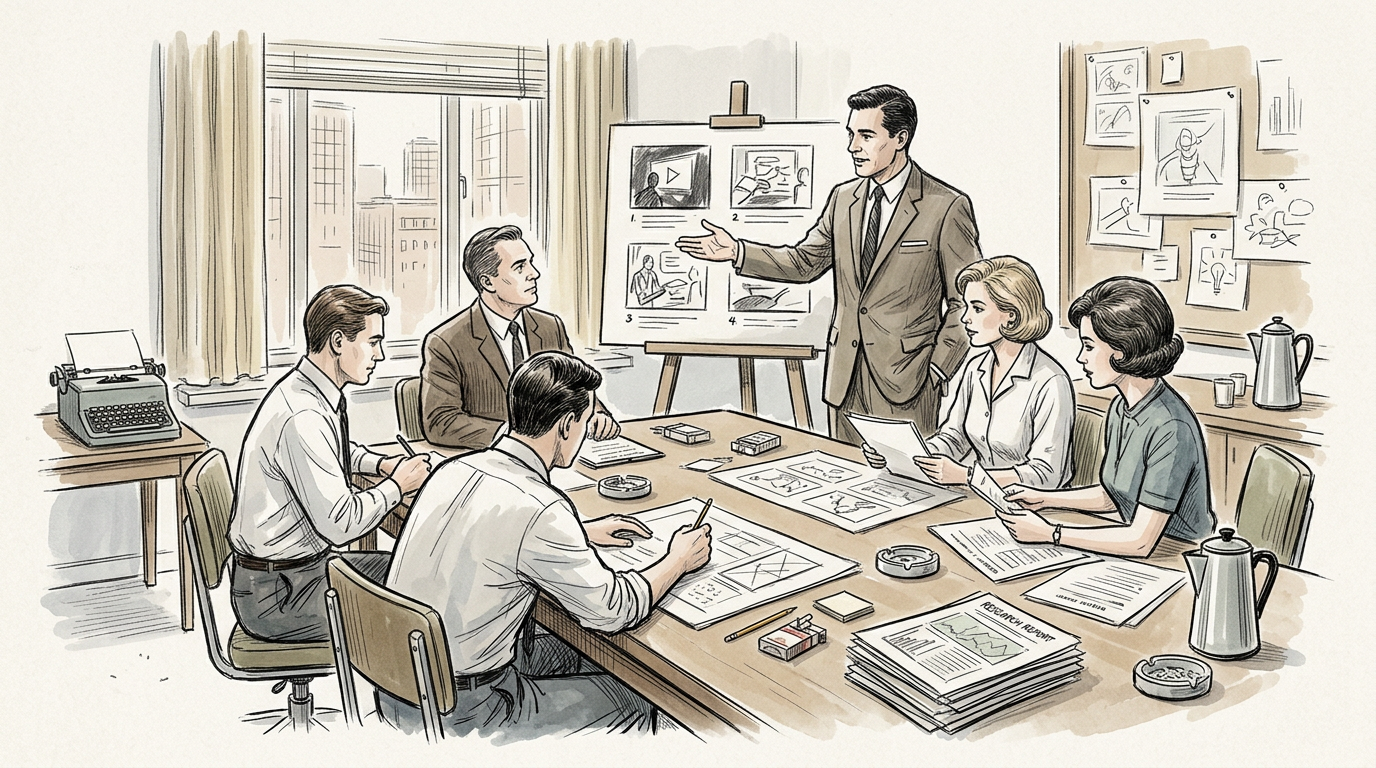
Account management is so familiar within modern agencies that it can seem timeless. Most agency organizations today assume some version of the role: a client-facing professional who translates business problems into agency work, coordinates internal specialists, manages expectations, and protects the relationship that keeps the agency in business. But the account executive was not present in the earliest forms of advertising. The function emerged gradually as agencies moved from selling media space to organizing increasingly complex campaigns for national advertisers.
That history matters because account management sits at the intersection of nearly every major change in advertising. The discipline took shape as advertisers expanded beyond local markets, as mass-circulation magazines and newspapers created national media opportunities, as agencies added copywriters, artists, researchers, and media specialists, and as clients demanded more than simple space buying. The account executive became necessary not because agencies wanted another layer of management, but because advertising itself had become too complicated to run as a direct transaction between publisher, agency principal, and advertiser.
Understanding how account management developed helps explain how agencies became modern professional organizations. It also clarifies a persistent tension in the business: account service has always had to balance stewardship of the client’s business with stewardship of the agency’s creative, strategic, and commercial interests.
Before account management: when agencies were primarily space brokers
In the United States, the earliest advertising agencies of the mid-nineteenth century were principally space brokers. Firms such as Volney B. Palmer’s office, founded in Philadelphia in 1841, and George P. Rowell’s operation, established in the 1860s, made their money largely by buying newspaper space and reselling it to advertisers. In this system, the critical expertise lay in access to publications, rate knowledge, and placement logistics. Agencies often prepared copy or advised clients, but these services were not yet the core of the business model.
That model left little room for a distinct account-service profession. The agency proprietor or senior representative usually handled the advertiser personally. The central task was transactional and media-oriented. If an advertiser wanted to place notices in a network of newspapers, the agency arranged it. The amount of internal coordination required was modest compared with later practice.
The rise of N.W. Ayer & Son after its 1869 founding signaled an important shift. Ayer is often credited with helping regularize the “open contract” system, under which agencies placed advertising in publishers’ media on behalf of clients at established commission terms rather than profiting primarily from secret markups. This did not instantly create account management, but it pushed agencies toward a more durable representative relationship with advertisers. Once an agency was expected to advise, plan, and continuously manage a client’s advertising rather than simply fill orders, the seeds of account service were in place.
By the late nineteenth century, the largest agencies were no longer just intermediaries between advertisers and publishers. They were becoming organized service firms. N.W. Ayer, J. Walter Thompson, Lord & Thomas, and others expanded into copy preparation, illustration, campaign planning, and merchandising support. As that happened, the person who dealt with the client increasingly had to coordinate more than space orders.
National advertisers created the problem account management would solve
Account management became necessary because advertisers themselves were changing. After the Civil War, expanding railroad networks, national distribution, branded packaged goods, and urban retail growth created conditions for national advertising on a larger scale. Manufacturers of patent medicines, soaps, food products, tobacco, and household goods could now justify sustained campaigns across multiple markets. By the turn of the twentieth century, brands needed more consistent messaging, better scheduling, and closer control over how advertising connected with sales territories and distribution.
Mass media growth accelerated the problem. General-interest magazines such as Saturday Evening Post, Ladies’ Home Journal, and Collier’s gave advertisers efficient access to national audiences. Newspapers remained vital, but magazines increasingly rewarded long-range planning and consistent brand presentation. Agencies had to match client budgets, product launches, regional retail conditions, seasonal demand, and publication schedules. This was no longer a matter of placing isolated advertisements.
J. Walter Thompson is central to this story. Founded in 1864 and acquired by James Walter Thompson in 1877, the firm helped pioneer the full-service model. Thompson aggressively pursued national advertisers and expanded creative and administrative capabilities. The agency’s records, now substantially preserved through archival collections such as those at Duke University’s Hartman Center, show the extent to which client handling had become a distinct organizational necessity by the early twentieth century. The agency separated functions, formalized contacts, and increasingly relied on individuals whose main job was to manage ongoing client business rather than merely write copy or buy space.
The same broader pattern appeared across the industry. As advertisers spent more and expected greater continuity, agencies needed someone to know the client’s product line, budget cycle, management structure, competition, distribution constraints, and tolerance for risk. That knowledge could not be improvised each time copy was due.
From contact man to account executive
The early title was often “contact man,” a term common in agency usage in the early decades of the twentieth century. It described the person who maintained direct contact with the client and represented the client’s needs inside the agency. The phrase reflected the role’s origins. At first, the job was less a polished managerial discipline than a practical liaison function in a growing service business.
Over time, “account executive” became more common, especially as agencies professionalized their internal hierarchies. The title suggested more authority and broader business responsibility than “contact man.” It also better fit agencies that wanted clients to see them not as sales representatives but as organized business partners.
This change in terminology was more than cosmetic. It reflected a shift in the agency’s conception of expertise. In the space-broker era, the agency’s value lay primarily in its knowledge of media rates and publication access. In the account-service era, the agency’s value increasingly lay in its ability to understand and manage the client’s business problem through coordinated use of multiple professional specialties.
Early account people were expected to be unusually versatile. Trade literature from the 1910s and 1920s described them as needing judgment, diplomacy, business sense, and enough command of copy, media, and production to guide work without necessarily performing each specialist task themselves. The role demanded both advocacy and restraint. The account representative had to bring back accurate information from the client, but also had to prevent agencies from becoming mere order-takers.
Why agency specialization made account service indispensable
Account management became a true discipline only when agencies developed specialized departments. In a small office where one or two principals wrote copy, placed media, and billed clients directly, there was limited need for a coordinating layer. Once agencies added separate copy departments, art departments, media departments, research units, production specialists, and branch offices, coordination became central to profitability and quality.
By the 1910s and 1920s, leading agencies were building recognizable internal structures. J. Walter Thompson established specialized departments and was an early adopter of market research and audience-oriented planning. Agencies such as N.W. Ayer and Lord & Thomas were likewise broadening their service models. This made the client relationship more complex in several ways.
First, information had to travel accurately. The client’s business objectives, product claims, legal sensitivities, budget constraints, and timing needs had to be understood by multiple agency specialists. Miscommunication could waste expensive magazine insertions or delay newspaper campaigns tied to retail distribution.
Second, responsibility had to be assigned. As campaigns grew more elaborate, someone had to keep track of deadlines, approvals, media commitments, and internal workloads. The account person increasingly became the agency’s organizer, not just its representative.
Third, strategy had to be integrated. Research findings, copy ideas, visual approaches, and media schedules had to work toward a common business objective. Without a coordinating function, agencies risked producing disconnected outputs rather than coherent campaigns.
This was especially important once advertising moved beyond simple newspaper notices into illustrated magazine campaigns, dealer support materials, point-of-sale promotions, direct mail, and, later, broadcast. The more channels a campaign used, the greater the need for an internal manager who understood the total program from the client’s perspective.
Professionalization in the early twentieth century
The early twentieth century saw a broader push to present advertising as a legitimate profession rather than a speculative trade associated with patent medicine excesses and dubious claims. That movement shaped account management directly.
Trade organizations, business schools, and industry publications increasingly discussed advertising as a field requiring trained judgment. The Associated Advertising Clubs of the World, founded in 1905 and later central to industry self-regulation efforts, promoted standards and professional identity. Printers’ Ink, Advertising & Selling, and other trade publications circulated discussions of agency organization and the qualities needed in client representatives.
The industry’s embrace of ethics and standards also raised the stakes of client handling. The better agencies wished to distinguish themselves from disreputable operators by stressing planning, truthfulness, continuity, and responsible service. The account representative became one of the people expected to enforce these aspirations in practice: gathering facts, discouraging reckless claims, and helping the agency present disciplined recommendations rather than simply echoing client demands.
The 1911 “Truth in Advertising” movement, supported through advertising clubs and publishers, did not create account management, but it strengthened the need for a client-facing professional who could mediate between aggressive sales claims and emerging standards of substantiation and credibility. If an agency wanted to maintain its reputation and publisher relationships, someone had to handle difficult conversations with clients about what could responsibly be said.
The commission system and the economics of client service
Agency compensation shaped account management as much as organizational charts did. For much of the twentieth century, the standard agency revenue model was the media commission, often 15 percent of gross media billings in recognized media. Although this figure and its application varied over time and by medium, the commission system encouraged agencies to build lasting client relationships and to manage significant flows of advertising spending across multiple media outlets.
Under this system, the account was not simply a file or an assignment. It was the economic unit around which agency business was organized. Agencies needed someone responsible for maintaining that revenue stream, expanding the client relationship, and reducing the risk of costly misunderstandings. The account executive thus became central to both service delivery and agency economics.
The American Association of Advertising Agencies, founded in 1917 as the American Association of Advertising Agencies, helped formalize professional norms in the agency business, including recognition practices tied to publisher credit and compensation systems. In this environment, account management acquired administrative weight. Client service was linked not only to creative quality but also to billing accuracy, creditworthiness, contract stability, and interdepartmental discipline.
This financial structure also created tensions that would never fully disappear. Because agency income often depended on media volume, account people sometimes had to reconcile the client’s business interest, the agency’s service ambitions, and the agency’s revenue needs. Later criticism of the commission system would, in part, be criticism of the incentives built into account-based agency relationships.
Radio made coordination more complicated
The arrival of radio in the 1920s and its national maturation in the 1930s expanded the account-service function again. Broadcast advertising introduced new forms of complexity: network negotiations, program sponsorship, talent coordination, script development, continuity across episodes, audience measurement, and closer sensitivity to public reaction.
Radio also tied agencies more deeply to ongoing brand stewardship. A magazine schedule could be planned in insertions; a radio program required continuous oversight. If a client sponsored a serial or variety show, the agency had to manage not just advertisements but an entire branded entertainment environment. Account people increasingly coordinated among creative staff, radio department specialists, network representatives, sponsors, producers, and clients.
J. Walter Thompson’s work for Kraft on radio, and agencies’ involvement in sponsored programming across the interwar period, helped demonstrate that client service now extended into programming decisions, not merely media purchase. Account management had to incorporate performance review, scheduling continuity, sponsor approvals, and public reputation in ways the print era had only partially required.
The rise of audience measurement also altered the role. Early radio ratings, including the Cooperative Analysis of Broadcasting and later C.E. Hooper’s services, supplied data that agencies could use in client discussions. The account executive increasingly needed to interpret research and defend recommendations with evidence rather than intuition alone. This was one step toward the modern expectation that account management be fluent in both relationship management and analytical reasoning.
The Great Depression and the rise of advertising research
The Depression placed severe pressure on advertising budgets and made claims of efficiency more important. Agencies had to justify spending in harder business terms. Research departments grew in importance, and account executives became more involved in translating research findings into client recommendations.
This did not mean account people became researchers. It meant the discipline matured as a boundary-spanning function. The account executive had to understand consumer studies, sales data, readership figures, and competitive conditions well enough to advise the client and brief the agency effectively. The role moved further away from simple relationship maintenance and toward structured business counsel.
This period also deepened the importance of planning calendars, approval routines, and budget control. When money tightened, clients often scrutinized agency service more carefully. Retaining business depended not only on creative excellence but also on dependable management. Account service became an argument for the agency’s value.
Television and the modern service model
If radio increased the complexity of account work, television transformed it. By the 1950s, agencies serving national advertisers were handling expensive network schedules, filmed and live commercials, sponsorship arrangements, production budgets, celebrity talent, union issues, and much larger client organizations. Television compressed creative, media, and production risk into highly visible executions. A failed print ad might disappoint; a failed television campaign could waste enormous sums and damage a national brand quickly.
The account executive’s role changed accordingly. In addition to maintaining client contact, the account lead had to manage production timelines, coordinate with broadcast buyers and producers, secure approvals across more layers of client management, and keep increasingly specialized agency departments aligned. As clients themselves grew more complex, with separate brand managers, marketing research divisions, sales departments, and corporate leadership, the account person often became the agency’s interpreter of organizational politics as much as of marketing strategy.
The postwar rise of brand management at packaged goods companies was especially important. Procter & Gamble, among others, operated with disciplined brand structures that required agencies to interface with sophisticated marketing organizations. The client was no longer simply “the advertiser.” It was an internal system of competing priorities, data sources, personalities, and approval rights. Account management matured in response to that complexity.
Television also gave account service greater visibility inside agencies. Because broadcast campaigns required substantial investment and coordination, account leaders often played key roles in shepherding work from strategic briefing through production and launch. In many firms, account management became the operational spine of the agency.
The creative revolution did not eliminate account service. It redefined its tension with creative work
The creative revolution of the late 1950s and 1960s is often narrated through copywriters and art directors, especially at agencies such as Doyle Dane Bernbach. That emphasis is understandable, but it can obscure how important account management remained. More daring creative work did not reduce the need for client service. It made the role more delicate.
As agencies sought stronger creative identities and more distinctive brand voices, account people often had to sell unconventional ideas to cautious clients. They became translators between creative ambition and client risk tolerance. In some agencies, this made account management a strategic advocate for innovation. In others, it reinforced an enduring stereotype: that account service was the conservative force protecting client comfort against creative experimentation.
The stereotype contains some historical truth, but it is too simple. Agencies that produced memorable modern campaigns still depended on account professionals who could understand the client’s business, secure trust, and frame bold work in commercially persuasive terms. Without that function, many celebrated campaigns would have been difficult to sell internally or externally.
At the same time, the rise of sophisticated consumer research, media fragmentation, and corporate accountability meant that account people were asked to carry more evidence into creative debates. They were expected to know the brand, category, competitors, and objectives in disciplined ways. The best account management increasingly combined diplomacy with strategic literacy.
From servicing to stewardship
By the later twentieth century, the term “client service” remained common, but “account management” suggested a broader responsibility than mere servicing. The discipline had come to include several overlapping functions:
- Maintaining and growing the client relationship.
- Defining business objectives and translating them into agency assignments.
- Coordinating creative, media, research, production, and financial processes.
- Managing timing, approvals, budgets, and scope.
- Presenting recommendations and defending agency thinking.
- Monitoring the health and profitability of the account itself.
These responsibilities emerged historically rather than all at once. They were responses to changing media systems, larger clients, more specialized agency structures, and more exacting standards of evidence and accountability.
The shift also reflected the fact that advertising agencies were no longer isolated copy factories. They had become managerial organizations whose output depended on collaboration among specialists. Account management was the discipline that made that collaboration legible to clients and usable inside the agency.
Who entered the field, and how the role changed internally
The social history of account management also deserves attention. Early agency leadership was overwhelmingly male, and the title “contact man” itself reflected that reality. Women were present in advertising from the nineteenth century onward, especially in copywriting, clerical work, research, and certain client categories, but advancement into top client-service roles varied widely by agency and period. Some firms, including J. Walter Thompson, were notable for employing women in significant professional capacities earlier than many competitors, particularly in departments aimed at women consumers, yet formal power remained unevenly distributed.
As the field professionalized, account work often became a pathway to agency leadership. That reflected the discipline’s cross-functional nature. People who understood client relations, revenue, creative process, media, and internal operations were well positioned to run agencies. This remains one of the clearest historical signs that account management had become a core discipline rather than a support task.
Training also became more formal. By the mid-twentieth century, agencies increasingly expected account people to master briefing, presentation, negotiation, budget control, and campaign administration. Business education, market knowledge, and managerial discipline became more important. The old image of the smooth personal contact was no longer sufficient.
Regulation, substantiation, and the burden of coordination
Regulatory developments further expanded the role. The Federal Trade Commission had existed since 1914, but scrutiny of advertising claims and practices grew in different waves across the twentieth century. Broadcast regulation, packaging standards, comparative claims disputes, and later consumer-protection expectations all made agency-client coordination more consequential.
Account management often sat at the center of this process. Clients needed agencies to move quickly, but agencies also had to ensure that legal, reputational, and regulatory concerns were addressed. Account people frequently became the coordinators of review, channeling issues among client legal departments, agency leadership, creative teams, and media outlets. This administrative side of the role is less celebrated in popular agency lore, but it was central to the discipline’s professional status.
The more regulated and visible advertising became, the more valuable a strong account function was. It reduced the likelihood that campaigns would be delayed, rejected, or challenged because vital information had not been shared across the organization.
What endured into the digital era
Although this history was shaped in print, radio, and television, its core logic endured into later digital and integrated models. Digital campaigns multiplied stakeholders rather than simplifying them. Media planning became more technical, creative assets more modular, analytics more continuous, and client organizations more interconnected across brand, performance, commerce, legal, data, and technology teams. In many ways, this made the foundational logic of account management even more important.
What changed was the pace and granularity of coordination. What endured was the reason the discipline existed in the first place: someone had to connect the client’s business needs with the agency’s specialized capabilities and ensure that campaigns were not just produced, but managed.
That continuity is one reason the history matters. Account management was never merely a social function or a buffer between client and creative. It was a structural response to the growth of advertising as a complex business system.
Why account management became an advertising discipline
Account management became a discipline because advertising outgrew its origins as a relatively direct media transaction. National brands, mass media, specialized agency departments, standardized compensation systems, research, regulation, and broadcast production all increased the amount of coordination required to create and sustain effective campaigns. The person who handled the client could no longer simply relay requests. That role had to become a professional practice with its own methods, responsibilities, and judgment.
The account executive emerged, first, as a contact function, then as an organizational necessity, and finally as one of the agency’s defining disciplines. The role helped make the full-service agency workable. It turned scattered specialties into client-facing programs and helped convert advertising from a trade in space into a managed professional service.
Modern agencies still debate the balance among strategy, creative authority, media expertise, and client leadership. Those debates are part of the discipline’s inheritance. Account management was born from the need to reconcile competing priorities inside increasingly complex advertising systems. That remains its essential work, and it is why the history of account service is also part of the history of how advertising became a profession.
Leave a Reply