
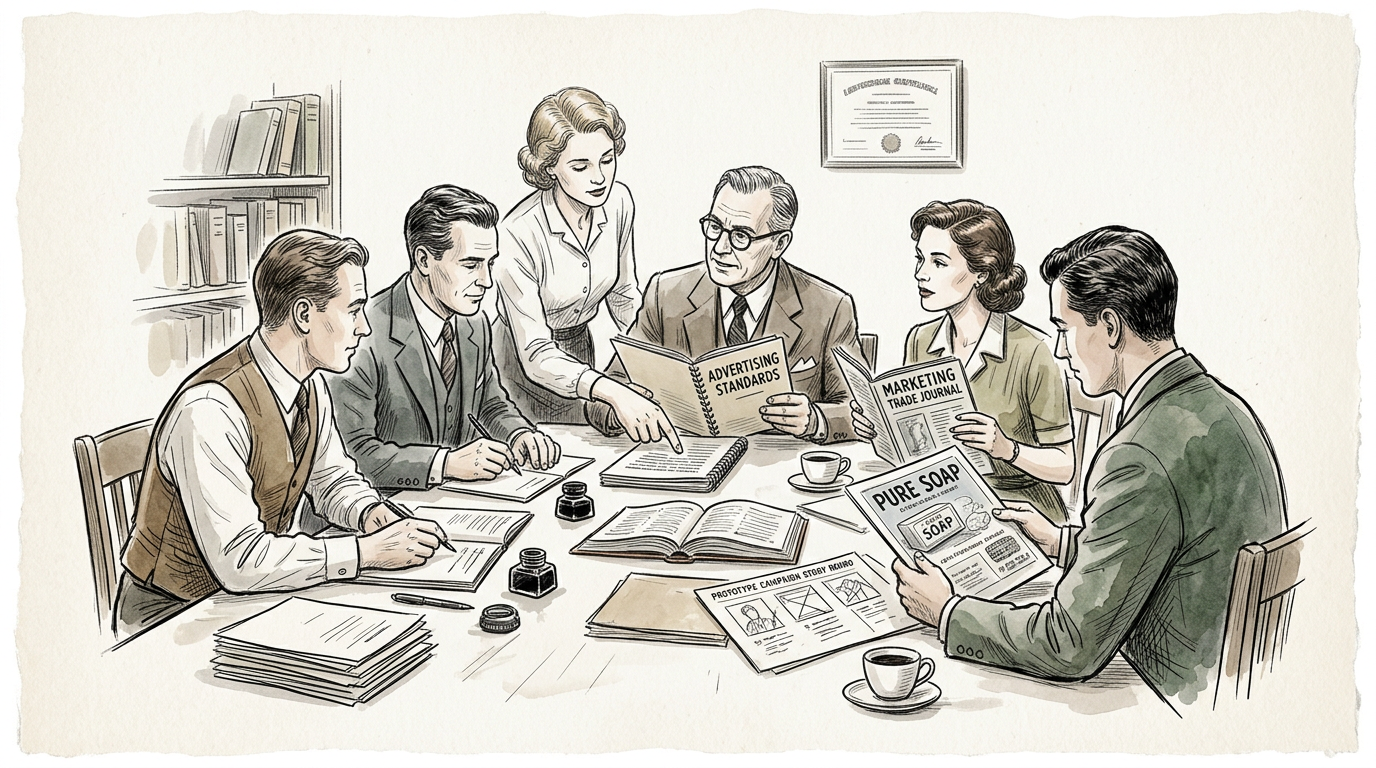
Advertising did not become a modern profession simply because agencies grew larger or media became more sophisticated. It also had to persuade the public, lawmakers, and its own practitioners that advertising could operate by recognizable standards. In the late nineteenth and early twentieth centuries, that was far from assured. Patent medicine fraud, misleading circulation claims, disguised promotions, and loosely organized sales practices made advertising vulnerable to criticism from reformers, publishers, business leaders, and consumers alike. Out of that environment came one of the most important but sometimes underappreciated developments in advertising history: the rise of advertising clubs, trade groups, and professional associations that tried to define what legitimate advertising was supposed to be.
These organizations did not eliminate deception, nor did they always act consistently or altruistically. But they helped build the language, institutions, and routines through which advertising came to present itself as a profession rather than a speculative trade. They created meeting places for practitioners, advanced educational programs, promoted ethical codes, organized campaigns for “truth” in advertising, supported self-regulation, and gave advertisers, agencies, media owners, and researchers a framework for collective action. Many of the industry’s most durable ideas about standards, accountability, and professional identity took shape through these associations.
From a loosely organized trade to a self-conscious profession
In the nineteenth century, American advertising expanded with industrial production, national brands, rail distribution, improved printing, and the rapid growth of newspapers and magazines. Yet the business remained fragmented. Space brokers, publishers, copywriters, manufacturers, and retailers often worked by different rules. Before the rise of more formal agency structures, many intermediaries operated chiefly as media sellers. Reliable audience measurement was limited. Verification of claims was inconsistent. The distinction between forceful persuasion and outright deception was often poorly policed.
This instability mattered because advertising depended on trust at several levels. Consumers needed some reason to believe product claims. Advertisers needed confidence that publishers delivered the circulation they promised. Publishers needed protection from fraudulent or disreputable advertisers that could damage reader confidence. Agencies, especially as they sought a more consultative role, needed a way to claim expertise and legitimacy beyond simply reselling media space.
Trade organization became one answer to that problem. By the 1890s and early 1900s, local advertising clubs began forming in major cities. Among the earliest and most influential was the Sphinx Club of Philadelphia, founded in 1906, often identified as one of the predecessors of the movement that became the Associated Advertising Clubs of America. These clubs brought together people from newspapers, magazines, agencies, department stores, manufacturing firms, and related businesses. They were social organizations, but they were also venues for exchanging methods, debating standards, and articulating a common occupational identity.
The movement quickly became national. In 1905, advertising club representatives met to coordinate their efforts, and the Associated Advertising Clubs of America was formally organized soon afterward. Over time, that body evolved into what is now the American Advertising Federation, which preserves part of this history at aaf.org. Early conventions and proceedings show that these groups were not merely arranging dinners and speeches. They were trying to define the obligations of advertisers to the public and to one another.
The “truth in advertising” movement and the fight for legitimacy
The issue that gave many clubs their clearest public purpose was deception. By the early twentieth century, false and misleading advertising had become a major political and cultural issue, especially in sectors such as patent medicines. Progressive Era reformers attacked fraudulent commercial practices more broadly, and federal policy began to respond. The Pure Food and Drugs Act of 1906 addressed labeling and adulteration, though its initial treatment of advertising claims was limited and uneven. Publishers also faced growing pressure over the advertisements they accepted.
Advertising clubs entered that environment with a dual motive. They genuinely sought to reduce abuses that discredited the field, but they also understood that self-policing could help protect advertising from more aggressive outside control. This was the context for the “truth in advertising” campaigns that became central to organized advertising’s public identity.
One of the key figures was Samuel C. Dobbs of Coca-Cola, an influential leader in the Associated Advertising Clubs of America. Under his leadership and that of other reform-minded industry figures, the clubs promoted standards against misleading claims and backed legislation designed to curb fraud. These efforts contributed to what became known as “Printers’ Ink statutes,” model laws against false advertising inspired by proposals circulated through the trade press, especially Printers’ Ink, one of the leading advertising publications of the era. Beginning in the 1910s, states adopted versions of these laws, though wording and enforcement varied.
The historical importance of the Printers’ Ink statutes lies not in a single uniform legal victory but in the broader coalition they represented. Publishers, club members, agencies, and brand advertisers used a mix of moral argument and commercial self-interest to argue that false advertising injured both consumers and honest business. That framing helped distinguish “legitimate” advertising from quackery, fakery, and manipulation. It also advanced a lasting claim: that advertising could be defended as a socially useful institution if it was truthful and professionally managed.
That claim should not be accepted uncritically. The industry’s definition of truthfulness was often narrower than modern regulators or consumer advocates would prefer. Enforcement depended heavily on local conditions, willingness to prosecute, and the business incentives of those involved. Even so, the organized campaign mattered because it established the principle that advertising ethics were not solely private matters between seller and buyer. They were subjects for collective professional standards, legal scrutiny, and public accountability.
Trade associations and the construction of shared standards
Advertising clubs were only one part of a broader associational landscape. As the advertising business grew more specialized, trade groups emerged to represent agencies, publishers, media owners, and advertisers with more specific institutional interests.
The American Association of Advertising Agencies, now the 4A’s, was founded in 1917 as the American Association of Advertising Agencies. Its history is documented at aaaa.org. The organization helped agencies present themselves not as opportunistic middlemen but as professional service firms with defined methods, financial practices, and responsibilities to clients and media. In the commission system era, when agencies were commonly compensated through publisher-paid commissions, disputes over rates, recognition, and business conduct had major implications for who counted as a legitimate agency. Association membership and standards helped regulate that status.
Publishers had parallel concerns. The Association of National Advertisers, founded in 1910 as the Association of National Advertisers of the United States, gave large advertisers a forum to address media accountability, agency relations, research, and national marketing issues. The organization’s institutional history appears at ana.net. Magazine and newspaper publishers, for their part, developed their own associations to address circulation, rate integrity, and advertising acceptability.
These organizations often cooperated, but they did not always agree. Agency groups wanted recognition and stable compensation arrangements. Advertisers wanted transparency and leverage. Media owners wanted revenue while preserving enough credibility to keep readers and advertisers. Trade associations became the structured environment in which those interests were negotiated. Professional standards, in other words, did not emerge from ethics alone. They also grew out of repeated bargaining over business models and market power.
One major example was circulation auditing. In the late nineteenth and early twentieth centuries, inflated or unverifiable circulation claims were a serious problem for advertisers. The development of the Audit Bureau of Circulations in 1914, now the Alliance for Audited Media, represented a significant step toward standardized media accountability. Its history is available at auditedmedia.com. Although not an advertising club in the social sense, the bureau reflected the same institutional impulse: an industry body using shared rules, third-party verification, and agreed procedures to make advertising transactions more credible.
That model proved influential. Standardization of media measurement, rate structures, contract terms, and agency recognition all relied on associational frameworks. They did not remove conflict, but they made the advertising marketplace more governable.
Professional identity through meetings, publications, and education
If trade associations helped rationalize business conduct, they also helped create advertising’s culture as a profession. Conventions, club luncheons, award competitions, manuals, newsletters, and journals gave practitioners a shared vocabulary and a sense of belonging to something larger than their individual firms.
That mattered in a field whose boundaries were still unsettled. Was advertising primarily salesmanship in print, as John E. Kennedy argued in his famous formulation? Was it a branch of marketing, a literary craft, a managerial science, or a commercial art? The answer changed across time and institutions, but professional associations provided the places where such questions were argued and codified.
Advertising education offers a clear example. Universities began introducing advertising courses in the early twentieth century as business education expanded. Trade associations and clubs helped legitimate these efforts by treating advertising as a body of knowledge that could be taught. The textbook tradition associated with writers such as Walter Dill Scott and later Paul T. Cherington and others did not emerge in isolation. It developed alongside an institutional movement that insisted advertising involved research, planning, psychology, copy strategy, media selection, and business ethics rather than mere hucksterism.
Local clubs frequently sponsored lectures, student competitions, and educational outreach. National associations worked with colleges, promoted training materials, and encouraged standard terminology. Over time, this educational role became one of the profession’s quieter but more enduring achievements. It helped create the pipeline through which advertising people came to see themselves as trained practitioners with specialized knowledge.
Associations also played a role in the recognition of specialized functions inside agencies and client organizations. Copywriters, art directors, account executives, researchers, and media specialists increasingly operated within an environment where best practices could be circulated through conferences, trade publications, and committee work. Professional identity became tied not only to belonging to “advertising” in general but also to belonging to recognized subfields within it.
Women, exclusion, and the limits of professional community
The history of advertising associations is also a history of inclusion and exclusion. Many early clubs reflected the business and social hierarchies of their time. Leadership ranks were overwhelmingly male, and access to influence often followed patterns of class, race, and corporate standing. Women worked in advertising in significant numbers, especially in copy, merchandising, retail promotion, and magazine-related roles, but they were not always granted equal status within the organizations that claimed to represent the profession.
The formation of women’s advertising clubs in the early twentieth century speaks directly to this imbalance. The Women’s Advertising Club of Chicago, founded in 1913, and similar groups elsewhere created professional spaces for networking, recognition, and advancement when mainstream industry bodies often offered limited access. Some women also participated in mixed associations, but separate organizations were frequently necessary to overcome structural barriers.
This does not make the broader club movement insignificant. It does mean that “professionalization” should not be treated as a neutral or universally shared process. The standards and identities created by associations were shaped by who had a voice within them. As with many professions in this period, organized advertising’s rhetoric of service and ethics coexisted with unequal access to authority.
Self-regulation and the interwar consolidation of standards
By the 1920s and 1930s, advertising had become more institutionally mature. National brands expanded, agencies grew more complex, market research developed further, and magazines and radio created new media opportunities. The professional challenges changed accordingly. Advertising no longer needed only to distinguish itself from obvious fraud. It also needed systems for handling substantiation, comparative claims, media standards, and public criticism on a larger scale.
Trade associations increasingly participated in self-regulatory efforts designed to preempt stricter government intervention. This was never a simple substitute for law. The Federal Trade Commission, established in 1914, had authority over unfair methods of competition and later deceptive acts and practices, and its role in advertising oversight expanded over time. But industry groups continued to argue that responsible self-policing was both more efficient and more consistent with commercial freedom.
The Better Business Bureau movement belongs in this story as well. Local vigilance committees, encouraged in part by advertising club activism, evolved into more formal Better Business Bureaus, which sought to investigate misleading claims and promote honest commerce. The Council of Better Business Bureaus was organized in 1912, though the structure and naming of the BBB system evolved over time. The BBBs were not solely advertising institutions, but they became closely entwined with the industry’s efforts to demonstrate that business could discipline itself.
One should be cautious here. Self-regulation often worked best where leading firms already saw advantage in policing fringe actors. It was less effective when deceptive practices were profitable for major players or when standards threatened important revenue streams. Nonetheless, the architecture of modern advertising self-regulation has roots in this era’s club and trade association initiatives: complaints processes, review boards, consensus principles, and the idea that industry credibility depends on visible mechanisms of accountability.
Broadcasting, measurement, and the expansion of collective governance
Radio and later television enlarged the scope of what trade associations had to manage. Broadcast advertising introduced new issues involving sponsorship, programming influence, audience measurement, and network power. The older print-era concerns with false claims and circulation remained, but they were joined by questions about time buying, ratings, talent practices, production standards, and the relationship between advertising and entertainment.
Associations proved essential in this transition because no single advertiser or agency could easily stabilize the system on its own. Broadcasters, sponsors, agencies, and researchers needed common metrics and accepted procedures. Organizations such as the National Association of Broadcasters, founded in 1923, and industry research bodies helped establish norms governing commercial loads, sponsorship identification, and sales practices. Audience measurement firms such as C. E. Hooper and Nielsen developed outside the club structure, but the acceptance and use of ratings data depended on organized industry agreement about what constituted a usable standard.
In this sense, trade associations helped advertising adapt each time media complexity increased. They were not only ethical guardians. They were mechanisms for coordination in markets where campaigns depended on shared technical conventions.
Creativity, awards, and the symbolic life of the profession
Another important contribution of advertising organizations was symbolic rather than regulatory. Clubs and associations helped define what counted as excellent advertising. Competitions, medal programs, and convention showcases rewarded not just salesmanship but increasingly copy craft, design, strategy, and public service messaging. These rituals elevated creative work into a recognized professional achievement.
The point was not merely prestige. Awards, lectures, and published case discussions circulated models of practice. They helped teach agencies and advertisers what good advertising should look like at a given historical moment. They also reinforced the profession’s internal hierarchy, often favoring work from major agencies and national advertisers. Even so, they played a real role in creating advertising’s creative canon and in separating professional work from the indiscriminate promotional clutter with which advertising had once been associated.
This symbolic role became especially important in the mid-twentieth century, as advertising increasingly defined itself through expertise and creativity as well as business efficiency. Associations supplied the stages on which that identity was performed.
What these organizations changed, and what they did not
It would be easy to overstate the achievements of advertising clubs and trade associations. They did not cleanse the industry of deception. They did not speak for every practitioner. Their standards were sometimes vague, selectively enforced, or aligned with the interests of dominant firms. At times, they protected industry autonomy more vigorously than consumer welfare. Historians have good reason to treat their rhetoric critically.
But it would be a mistake to dismiss them as mere public relations devices. They helped create durable features of modern advertising practice:
- Codes of ethics and truthfulness standards that linked professional legitimacy to public trust.
- Shared business procedures for agency recognition, media buying, auditing, and contract expectations.
- Educational infrastructure through lectures, training materials, university ties, and student outreach.
- Professional networks that allowed practitioners to exchange methods and define common interests.
- Self-regulatory frameworks that complemented, resisted, and sometimes anticipated government oversight.
- A stronger occupational identity for advertising as a field with specialized knowledge and norms.
Just as importantly, these organizations helped change the terms on which advertising was discussed in public life. Instead of being seen only as noisy promotion or dubious persuasion, advertising increasingly presented itself as a managed system of communication embedded in modern business. That reframing did not happen automatically. It was built institutionally, through meetings, bylaws, model statutes, audits, educational campaigns, and repeated assertions that responsible advertising served both commerce and the public.
The legacy remains visible across the industry. Today’s debates over platform accountability, influencer disclosure, brand safety, audience verification, political advertising standards, and AI-generated claims still depend on the same basic question that animated the club movement a century ago: who gets to define legitimate advertising practice, by what standards, and with what enforcement?
Advertising clubs and trade associations did not settle that question once and for all. What they did was create the organizational machinery through which the profession could keep asking it. That achievement was foundational. It helped turn advertising from a collection of transactions into an industry with institutions, standards, and an enduring, if always contested, sense of professional responsibility.
Leave a Reply