
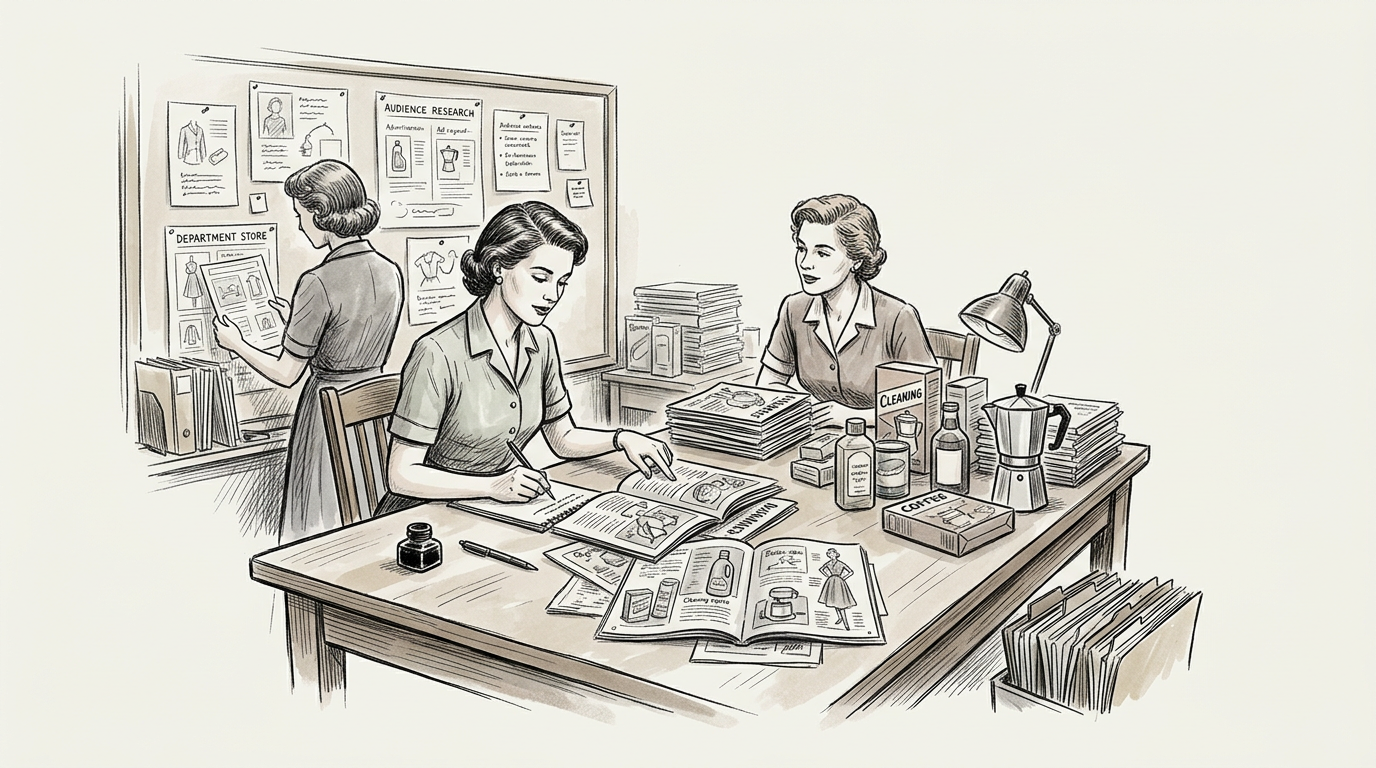
By the early twentieth century, American advertisers were no longer speaking to a generalized “public” in quite the same way they had in the nineteenth. Increasingly, they were addressing a more specific figure: the woman shopper, homemaker, household manager, and, in some categories, an independent consumer in her own right. That shift did not happen all at once, and it did not reflect a simple awakening to women’s importance. It emerged from changes in retailing, print culture, manufacturing, transportation, market research, and agency organization. It was shaped by the growth of national brands and women’s magazines, by department stores that treated women as central customers, and by copywriters and researchers who tried to translate domestic life into persuasive sales language. It also carried deep contradictions. The industry recognized women’s purchasing power while reducing women to narrow social roles, using assumptions about femininity, domesticity, class, race, and respectability to organize both media strategy and creative work.
Understanding how advertising learned to speak to women matters because it reveals how segmentation became professional practice. Long before “target audience” became standard industry vocabulary, advertisers were building campaigns around demographic distinction, household decision-making, and media environments associated with women’s lives. In the process, they helped define the modern consumer market itself.
From the household economy to the branded marketplace
In the nineteenth century, much advertising was local, informational, and merchant-driven. Newspapers carried notices for dry goods, patent medicines, groceries, and services, but much of the persuasive work of selling still happened in stores, through peddlers, catalogs, and personal recommendation. Women were always part of this economy, both as producers and purchasers within households, but they were not yet consistently addressed by a mature national advertising system.
Several structural changes altered that situation after the Civil War. Industrial production expanded the supply of packaged consumer goods. Railroads and improved distribution allowed manufacturers to move those goods nationally. Advances in printing, including better halftone reproduction by the late nineteenth century, improved the visual quality of newspapers and magazines. Department stores turned shopping into a more elaborate urban experience, while mail-order firms reached rural households. At the same time, literacy rates remained high and magazine circulation climbed.
These changes made the household a strategic site of commercial persuasion. Advertisers increasingly understood that many routine purchases, especially food, soap, cleaning supplies, textiles, and ready-made clothing, were selected or strongly influenced by women. Historian Roland Marchand, among others, later described how national advertisers presented themselves as guides to modern living as much as sellers of goods. That posture was especially visible in campaigns directed at women, where the ad often promised not simply a product but competent housekeeping, family well-being, social respectability, or relief from domestic labor.
This was not a discovery of women’s economic importance so much as a new business effort to formalize and exploit it. Census changes, urbanization, and a growing cash economy all made household purchasing more visible to manufacturers and retailers. The expansion of branded goods made it necessary to persuade end users, not just wholesalers and shopkeepers. Once manufacturers sought demand at the consumer level, women became indispensable to advertising strategy.
Department stores helped define the female consumer
Long before national agencies developed sophisticated women’s campaigns, department stores had already built commercial environments around women’s presence. Stores such as Wanamaker’s in Philadelphia and New York, Marshall Field in Chicago, and Macy’s in New York did more than sell merchandise. They created destinations organized around browsing, display, seasonal novelty, and a promise of urban respectability. Newspaper advertising was central to this system.
Department store ads in the late nineteenth century increasingly addressed women directly as readers and shoppers. They promoted apparel, household furnishings, cosmetics, and price-based bargains, but they also sold the store as a trustworthy intermediary in a crowded marketplace. Stores offered tearooms, rest spaces, delivery services, and elaborate displays that made public shopping more socially acceptable for middle-class women. Historians of retailing have shown that these institutions helped normalize women’s movement through commercial public space, even as they maintained strict assumptions about class and decorum.
Advertising for department stores also sharpened an important professional lesson: women were not just passive recipients of messages. They were comparative shoppers, readers of detail, judges of value, and repeat customers whose confidence had to be earned. This encouraged a practical style of copy built around merchandise description, quality claims, household usefulness, and seasonal need. The department store advertisement was often less ornamental than later memory suggests. It could be densely textual, highly specific, and grounded in price, fabric, quantity, and service conditions. That attention to concrete buying criteria fed directly into broader advertising practice.
In that sense, retail advertising taught agencies that women’s consumer behavior could be analyzed, anticipated, and addressed systematically. It also demonstrated that female readership was a media asset.
Women’s magazines became a national advertising platform
If department stores showed where women shopped, women’s magazines showed advertisers where women could be reached at scale. The transformation of the magazine business in the late nineteenth and early twentieth centuries was one of the most important developments in the history of audience construction.
Titles such as Ladies’ Home Journal, published by the Curtis Publishing Company, became especially influential. Under editor Edward Bok, Ladies’ Home Journal grew into one of the largest-circulation magazines in the United States. By the 1890s and early 1900s, it offered a powerful combination of editorial content and advertising aimed at the home. Other major titles included Good Housekeeping, Woman’s Home Companion, McCall’s, and Pictorial Review. These magazines provided advertisers not only with access to large female readerships but also with environments organized around housekeeping, childrearing, fashion, etiquette, food preparation, and domestic aspiration.
The business model mattered. Mass-circulation magazines depended heavily on advertising revenue, which allowed lower cover prices and larger audiences. In turn, the scale and demographic concentration of those audiences attracted national advertisers. By the early twentieth century, media buying increasingly relied on audited circulation claims and rate structures that treated audience composition as commercially meaningful. The professional logic of women’s advertising was inseparable from this publishing economy.
Magazines also gave advertisers formats suited to longer copy and detailed argument. A soap ad could explain purity, a stove ad could promise labor-saving efficiency, and a breakfast food ad could claim nutritional value. Since many women’s magazines were read in the home and often kept for repeated use, advertisers could present products as part of the rhythms of domestic management rather than as passing spectacles.
Some publications made their standards part of the sales proposition. Good Housekeeping introduced what became known as the “Good Housekeeping Institute” in the early twentieth century and later tied its “Seal of Approval” to product testing and refund guarantees. That did not eliminate the era’s exaggerated or misleading claims, but it signaled a market in which credibility, product demonstration, and expert endorsement had commercial value, especially with readers presumed to be cautious household buyers.
Agencies professionalized the “woman market”
As national advertising grew, agencies had to do more than place media. They needed to understand how different audiences bought, what arguments moved them, and how to build brand preference over time. Women became central to that effort.
N. W. Ayer & Son, J. Walter Thompson, Lord & Thomas, and other major agencies all participated in the development of consumer-focused advertising in the late nineteenth and early twentieth centuries. Their records and trade literature show a gradual movement away from purely space-broker functions toward research, copy strategy, account planning in an early form, and specialized service for clients selling household goods.
J. Walter Thompson is particularly important in this history because it institutionalized the idea that women could be both the intended audience and the creators of advertising aimed at that audience. The agency hired women in significant numbers earlier than many competitors. Helen Lansdowne Resor, who joined the agency in 1908 and became one of the most influential copy leaders in American advertising, is often cited for bringing a more intimate, less bombastic style to ads addressed to women. Some of the mythology surrounding any single figure’s influence should be treated cautiously, since changes in tone reflected broader market forces as well as individual talent. Still, Resor’s documented role at JWT was substantial, and her rise within a major agency signaled that women’s knowledge of female readership had become professionally valuable.
Women in agencies were not simply symbolic hires. They wrote copy, advised on product presentation, and sometimes argued that women readers responded better to realism, emotional nuance, and practical detail than to the louder claims common in nineteenth-century advertising. Agencies also recruited women for research and “service” work because clients selling food, toiletries, clothing, and household products wanted staff who seemed to understand domestic routines from the inside.
This should not be overstated as an egalitarian breakthrough. Women faced discrimination, salary limits, and occupational segregation. Many were steered into copy for “women’s accounts” rather than general management. Even so, their presence affected agency practice. It helped formalize the notion that audience insight could be a specialized competence and that the female consumer required dedicated interpretive labor.
Copywriting changed with the rise of household brands
The language advertisers used with women evolved alongside branded household goods. Nineteenth-century advertising often relied on direct claims, patent-medicine exaggeration, or blunt product description. By the early twentieth century, advertisers selling soap, packaged foods, canned goods, detergents, and personal care items increasingly used a more elaborated rhetoric. They promised cleanliness, convenience, scientific modernity, better motherhood, and social assurance.
Soap advertising offers a particularly clear example. Brands such as Ivory Soap, introduced by Procter & Gamble in the nineteenth century, were advertised heavily by the 1880s and 1890s. Claims of purity, mildness, and cleanliness were not just product attributes. They connected the soap to moral and domestic order. Later campaigns for products such as Lux, Rinso, and other household staples would refine this pattern by linking brand choice to competence and status within the home.
Food advertising followed similar lines. Branded baking powder, cereals, canned soups, and cooking fats were presented as instruments of efficient housekeeping and family care. Ads often combined recipes, household advice, and product claims, blurring the line between editorial usefulness and commercial persuasion. This was especially true in magazines where readers expected practical guidance. The advertiser was not merely a seller but an instructor in modern consumption.
The “reason-why” school associated with copywriter John E. Kennedy at Lord & Thomas in the early 1900s influenced this environment, though it was not aimed only at women. Kennedy argued that advertising should function as “salesmanship in print,” presenting concrete reasons to buy. That approach fit many products marketed to women because it encouraged specificity: why this soap was purer, why this flour was more reliable, why this stove saved labor, why this cream improved complexion. In practice, however, the line between rational explanation and emotional pressure was often thin. Many ads mixed practical claims with status anxiety and gendered moral expectations.
Advertisers also learned to use seriality. Repeated campaigns taught women to recognize brand symbols, remember slogans, and treat household purchasing as a field of continuing branded choice rather than occasional generic substitution. This was one of the foundations of modern consumer packaged goods advertising.
Research, circulation data, and the attempt to know female consumers
Advertising did not learn to speak to women only through intuition. It also did so through increasingly formal systems of information. The late nineteenth and early twentieth centuries saw important advances in circulation auditing, readership claims, coupon returns, mail response measurement, and retail observation. None of these methods provided perfect knowledge, but together they encouraged advertisers to treat women as a measurable market segment.
Trade publications such as Printer’s Ink and Advertising & Selling circulated discussions of copy tests, consumer motives, circulation quality, and buying psychology. Agencies and advertisers gathered letters from customers, tracked redemption devices, compared regional sales, and studied store turnover. Women’s magazines promoted themselves to advertisers with detailed descriptions of subscriber households, emphasizing family purchasing power, domestic authority, and loyalty to reputable brands.
By the 1910s and 1920s, what would later be called market research had become a more visible part of advertising work. J. Walter Thompson developed research capabilities, and other firms did the same. Daniel Starch’s work on advertising readership studies in the 1920s gave advertisers new ways to evaluate whether print ads were being noticed and remembered. These methods did not fully capture how women interpreted advertising, but they strengthened the industry’s confidence that audience behavior could be investigated systematically.
The category “woman consumer,” however, was itself a commercial construction. Research often treated women as household purchasing agents regardless of age, marital status, region, race, or employment. The result was a mix of insight and simplification. Advertisers learned enough to design more effective media and copy, but they often did so by flattening differences among women into a standardized ideal reader and buyer.
The housewife as both market reality and advertising stereotype
The most persistent figure in early twentieth-century advertising to women was the housewife. She was often represented as responsible for cleanliness, thrift, child welfare, nutrition, hospitality, and the family’s social standing. This was not purely fantasy. In many households, women did manage daily consumption under real material constraints. Advertisers were responding to a genuine concentration of domestic purchasing authority.
Yet the way advertising represented that authority was highly selective. The housewife in mainstream national advertising was disproportionately imagined as white, married, heterosexual, able-bodied, and aspiring to middle-class standards. Black women, immigrant women, working-class women, farm women, and wage-earning unmarried women were often ignored, caricatured, or addressed only in limited ways. Domestic service, labor inequality, and the demands of paid employment were routinely erased in favor of an idealized home manager who solved family problems by choosing the correct brand.
Advertisements also made women responsible for outcomes that products could only partially control. If a cake failed, if laundry looked gray, if a bathroom was not sanitary enough, if a husband’s approval seemed uncertain, the implied explanation was often the woman’s product choice. This transferred commercial risk into personal and moral pressure. Scholars of advertising and consumer culture have long noted that many household campaigns sold reassurance by first amplifying insecurity.
Beauty advertising intensified this dynamic. So did products tied to health, hygiene, and social acceptance. While some ads framed purchase as self-care or modern convenience, others preyed on fears of embarrassment, rejection, or social inadequacy. Deodorant advertising in the 1910s and 1920s is a well-documented case in point. Campaigns helped expand markets by identifying previously unspoken bodily conditions as commercial problems. Such work is often discussed as evidence of advertising’s power to manufacture need, though historians generally caution that success depended on receptive cultural conditions, not advertising alone.
Women as consumers, women as citizens, women as workers
One reason the history of advertising to women is more complex than a simple “homemaker market” story is that women’s public roles were changing. By the early twentieth century, increasing numbers of women worked for wages, attended college, participated in reform movements, and claimed new public identities. The woman suffrage movement culminated in the Nineteenth Amendment in 1920, and while voting rights did not transform the advertising business overnight, the political visibility of women strengthened the sense that they were a distinct national constituency.
Advertisers responded selectively. Some campaigns acknowledged women’s independence through themes of self-presentation, leisure, travel, and modern mobility. Fashion, toiletries, and personal care brands could speak to women as individuals rather than solely as wives and mothers. Department stores and magazines also cultivated the figure of the “modern woman” who consumed for herself.
At the same time, most mainstream advertising continued to route female autonomy through consumption rather than through full social agency. Even when ads addressed women as modern, they often did so within commercially useful boundaries: attractiveness, efficiency, popularity, domestic mastery, or better purchasing judgment. Consumer citizenship was easier for advertisers to embrace than political equality.
Women’s labor inside the advertising industry reflected similar tensions. Female copywriters, researchers, illustrators, and editors helped shape campaigns, but professional recognition remained uneven. Their work was often most accepted when it could be linked to “understanding women,” which both opened opportunity and reinforced segregation. The same industry that increasingly valued women as consumers and as interpreters of consumers was slow to treat them as equals in leadership.
Regulation, credibility, and the limits of persuasion
Advertising’s conversation with women unfolded in a period when standards of truth and fair dealing were still evolving. The patent-medicine era had shown how easily fear, testimony, and pseudo-science could be used to exploit consumers. Women, especially mothers, were frequent targets of dubious claims involving health, child welfare, beauty, and hygiene.
Public pressure for reform affected advertising practice. The Pure Food and Drug Act of 1906 and later regulatory developments did not create modern advertising law by themselves, but they signaled a changing environment in which claims required greater care. So did private industry reform efforts. The Associated Advertising Clubs of America, formed in the early twentieth century, promoted “Truth in Advertising” campaigns, and by 1911 vigilance committees were challenging deceptive advertising in local markets. These developments were imperfect and often selective, but they mattered because so much women’s advertising rested on trust, expertise, and repeated household use.
Credibility became a competitive asset. Brand names, package consistency, product demonstrations, testimonial structures, and publication reputations all worked to reassure buyers. The more advertising addressed women as careful managers of family welfare, the more it had to perform reliability. That need helped move the profession toward more disciplined claims-making, though exaggeration and manipulation remained common.
What advertising actually learned
By the 1920s, advertisers had learned several enduring professional lessons from decades of trying to sell to women.
First, they learned that consumer audiences could be segmented not just by geography but by social role, purchasing authority, and media habit. The female consumer was one of the earliest large-scale target categories in American advertising.
Second, they learned that media context mattered. Women’s magazines, department store newspaper sections, direct mail, recipe booklets, premiums, demonstrations, and in-store displays formed an integrated communications environment tied to domestic life. Advertising effectiveness depended not only on message content but on where and how the message was encountered.
Third, they learned that copy had to do more than announce availability. It had to explain use, reduce uncertainty, create habit, and connect products to daily routines and identities. This moved advertising toward more strategic forms of persuasion.
Fourth, they learned that “knowing the consumer” could itself be organized as professional labor through research, audience measurement, and specialized account knowledge. That principle became central to twentieth-century advertising practice.
But the industry also learned a more troubling lesson: stereotypes could be profitable. Simplified images of womanhood made it easier to standardize media plans and creative appeals. The cost of that efficiency was distortion. Advertising gave women commercial visibility while confining that visibility within narrow categories of domestic competence, beauty, and social approval.
Why this history still matters
Advertising did not invent women as consumers, and it did not uncover a previously hidden market by sheer insight. Rather, it developed techniques for identifying, measuring, addressing, and shaping women’s role in a rapidly expanding consumer economy. Those techniques emerged from the business needs of manufacturers, retailers, magazines, and agencies in the late nineteenth and early twentieth centuries. They helped build modern brand advertising, audience segmentation, research practice, and media planning.
This history matters because many features of contemporary advertising still bear its imprint. The practice of designing messages around household decision-makers, the use of editorial-style utility to support brands, the commercial value attached to audience data, and the tension between recognition and stereotyping all have roots in this earlier period. So does the enduring industry challenge of distinguishing real consumer insight from reductive assumptions.
When advertising learned to speak to women, it became more precise, more professional, and more ambitious. It also revealed a pattern that has followed the industry ever since: the better advertising gets at identifying an audience, the more responsibility it bears for how that audience is imagined.
Leave a Reply