
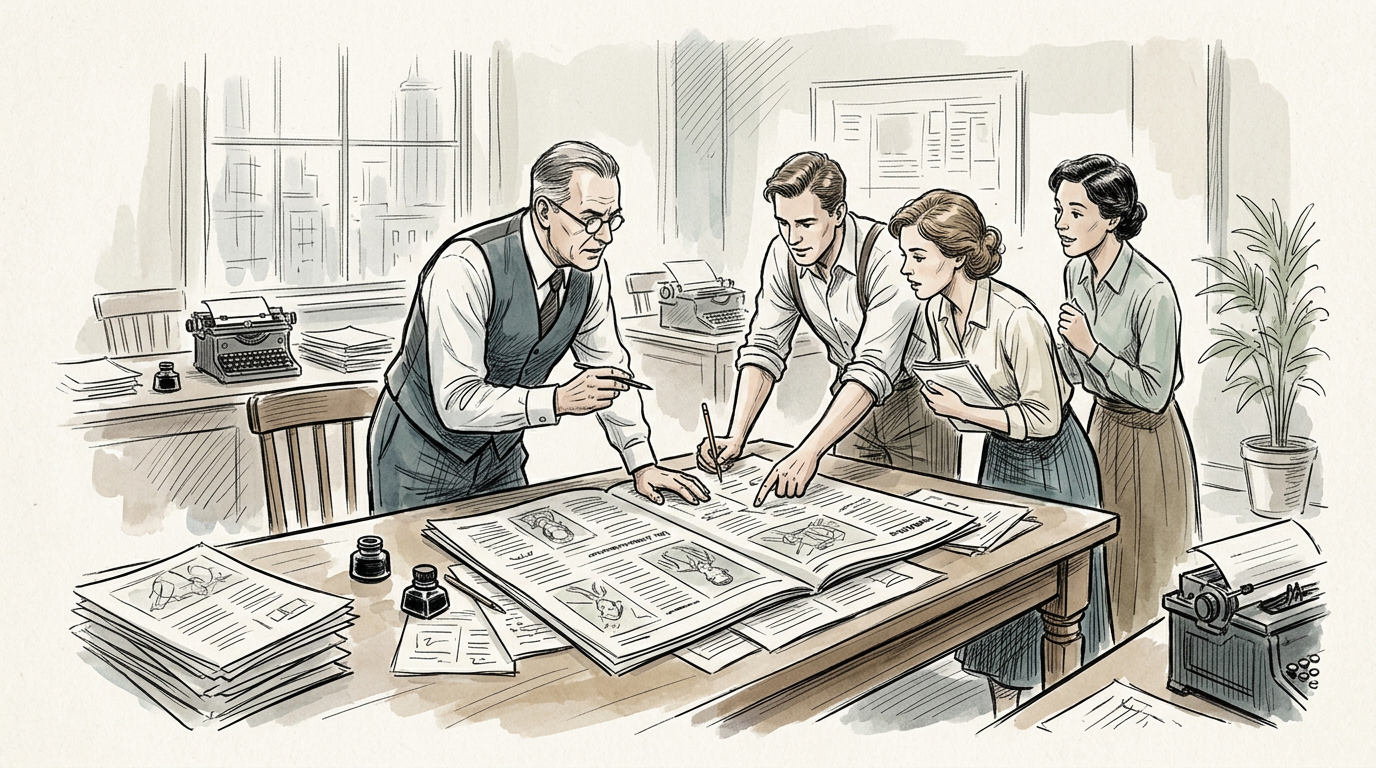
In the early twentieth century, American advertising was becoming too large, too expensive, and too consequential to remain a loose trade of space brokers, solicitors, and colorful copy men. National brands were expanding through rail distribution, mass-circulation magazines, and metropolitan newspapers. Manufacturers needed more than access to media space. They needed argument, strategy, coordination, and some credible explanation of why advertising worked at all. Albert D. Lasker, best known for his long tenure at the Chicago agency Lord & Thomas, became one of the central figures in that transition.
Lasker did not invent modern advertising by himself, and some stories attached to his name have been simplified by repetition. But his career matters because it helps explain how the agency business moved from media placement toward a broader professional role that joined copy, strategy, account stewardship, and business development. Under Lasker, Lord & Thomas became one of the country’s most influential agencies, and the phrase most often associated with him, “salesmanship in print,” gave the business a durable, if incomplete, theory of what advertising was supposed to do.
To understand Lasker’s significance, it is necessary to place him in the agency world he entered, examine what actually changed at Lord & Thomas, and separate documented contributions from later mythology.
From space brokerage to coordinated agency service
When Lasker entered advertising in the 1890s, agencies were still shaped by nineteenth-century business practices. Many agencies had originated as space brokers that bought newspaper space at a discount and resold it to advertisers. By the late nineteenth century, a number of firms were already offering copy and planning services, and historians have long noted that the “full-service” agency did not suddenly appear with Lasker. N.W. Ayer & Son, J. Walter Thompson, and others had been building more complex service models before the turn of the century.
Still, the industry remained unevenly organized. Compensation often depended on publisher commissions. Research was rudimentary. Copy standards varied widely. Client relationships could be highly personal and opportunistic. In that environment, a forceful agency executive who could present advertising as a disciplined business instrument, rather than just promotional noise, had an unusual opportunity.
Albert Davis Lasker was born in 1880 in Freiburg, Germany, while his American parents were abroad, and he grew up in Galveston, Texas. As a teenager he worked as a reporter, a background that mattered. Journalism gave him habits of deadline work, practical writing, and attention-getting headlines that would remain visible in his advertising career. In 1898, after unsuccessful efforts to secure a newspaper job in Chicago, he joined Lord & Thomas as an office boy. The firm had been founded in 1873 by Daniel M. Lord and Ambrose L. Thomas. By the time Lasker arrived, it was an established Chicago agency, but not yet the dominant force it would become.
Lasker advanced quickly. He became increasingly involved in solicitation and client work, and by the early 1900s he was central to the agency’s management. In 1904, while still in his twenties, he effectively gained control of Lord & Thomas, though ownership arrangements evolved over time. Under his leadership, the agency expanded aggressively and eventually became one of the largest in the United States.
That rise reflected more than salesmanship in the ordinary sense. Lord & Thomas under Lasker helped normalize the idea that an agency should not merely secure space and draft acceptable copy, but should define the selling proposition, organize creative work around that proposition, and align campaigns with the client’s broader commercial objectives.
The Kennedy story and the origins of “salesmanship in print”
No story about Lasker is repeated more often than the tale of John E. Kennedy walking into his office and offering to explain advertising in three words: “salesmanship in print.” The anecdote appears in Lasker’s own later recollections, most notably in his 1950s recorded conversations with advertising executive and historian Edward N. Ayer, later published as The Lasker Story by the American Advertising Federation. The broad outline is plausible and widely accepted: Kennedy, a Canadian-born former policeman and sometime copywriter, did work for Lord & Thomas beginning in the first decade of the twentieth century, and Lasker credited him with sharpening his thinking about advertising’s purpose.
But the anecdote should be treated carefully. Like many origin stories told decades later, it is tidy in a way real business development rarely is. Historians generally accept that Kennedy had an important influence on Lasker and that “salesmanship in print” became a working doctrine at Lord & Thomas. What is less certain is whether one meeting transformed the business overnight or whether the phrase simply condensed ideas already circulating among practitioners who were trying to distinguish effective persuasive copy from mere announcement advertising.
Even with that caution, the importance of the concept is clear. “Salesmanship in print” framed advertising as a surrogate salesperson, especially for products sold at scale through retailers or mail order, where the advertiser could not personally make the case to each customer. The phrase pushed copywriters to ask basic commercial questions: What exactly is being sold? Why should the reader believe the claim? What objection must be answered? What action should follow?
In practice, that doctrine favored explicit benefit-driven copy, demonstrations, reason-why arguments, and structured appeals rather than purely decorative writing. It also gave agency leaders a language for justifying larger fees and greater authority. If advertising was salesmanship, then copy was not a literary ornament added after space was purchased. It was the core of the transaction.
What Lasker changed at Lord & Thomas
Lasker’s significance lies less in a single slogan than in how he organized an agency around that understanding of the business.
First, Lord & Thomas placed unusual emphasis on copy as a strategic sales instrument. Lasker recruited and elevated copywriters who could turn product attributes into persuasive claims. Kennedy was one important figure, but he was not the only one. Claude C. Hopkins, who joined Lord & Thomas in 1907 after work in house and at other agencies, became another foundational practitioner. Hopkins later described in My Life in Advertising and Scientific Advertising how coupon returns, sampling, testing, and disciplined claim-making informed his work. Those books are self-interested memoirs rather than neutral records, but they align with the broader documentary record showing Lord & Thomas as a place where copy, offer structure, and measurable response mattered intensely.
Second, Lasker helped elevate the agency’s role in shaping client strategy. Rather than waiting for an advertiser to supply finished claims, the agency increasingly investigated how products were made, how they were distributed, and what could be said persuasively and distinctively about them. This was especially important in a market filled with near-parity goods. Advertising could not create product quality, but it could identify a feature, process, guarantee, usage habit, or brand personality around which sales arguments could be built.
Third, Lord & Thomas developed a more systematic internal division of labor. Early agencies often revolved around individual rainmakers or copy stars. Under Lasker, the firm became more managerial and departmental, though not in the later midcentury form associated with large New York agencies. Copy, account contact, management, and media functions became more integrated into an organization designed to produce consistent national work at scale. That mattered historically because the growing complexity of national campaigns demanded repeatable internal processes, not just occasional brilliance.
Fourth, Lasker was exceptionally aggressive in new business and client stewardship. He saw the agency not simply as a trade intermediary but as a business adviser whose value had to be continuously demonstrated. This approach contributed to a stronger conception of the client-agency relationship, one in which the agency sought both influence and accountability.
The campaigns that built the reputation
Lasker’s reputation rests in part on high-profile campaigns, though these too are often compressed into legend. Several examples are important because they show what Lord & Thomas actually did and what forms of advertising it helped popularize.
The Sunkist account is one of the most consequential. The California Fruit Growers Exchange, a cooperative marketing organization, used national advertising to increase demand for oranges at a time when agricultural overproduction threatened grower returns. Lord & Thomas helped promote oranges not just as fruit but as everyday necessities and ingredients, encouraging habits such as drinking orange juice. Histories of Sunkist and citrus marketing show that advertising worked alongside distribution, standardization, and cooperative branding to create a national market. The significance here is not merely a clever campaign. It is the use of advertising to reshape consumption frequency for a commodity-like product through branded national persuasion.
The agency also became associated with campaigns for products such as Van Camp’s Pork and Beans, Quaker Oats, and later Pepsodent. The Pepsodent work, often linked to Hopkins during his Lord & Thomas years, is especially revealing of the agency’s methods. Advertisements stressed a “film” on teeth that ordinary brushing supposedly left behind, positioning Pepsodent as the solution. The campaign became famous for both its effectiveness and its example of reason-why copy. Yet it also illustrates a central ambiguity in the history of persuasive advertising: some claims that were compelling at the time would later face stricter scientific and regulatory scrutiny. The point is not to single out one campaign as uniquely problematic, but to note that early twentieth-century advertising often operated in a looser evidentiary environment than later professionals would accept.
Palmolive is another frequently cited case. Lord & Thomas helped turn a soap into a nationally recognized beauty brand by emphasizing glamour, ingredient associations, and aspirational appeal. This reminds us that “salesmanship in print” was never limited to dry informational argument. Lasker-era advertising could be direct and reasoned, but it could also be emotive, image-conscious, and status-oriented. The doctrine described a function, selling, rather than a single tone or format.
In each case, the agency’s contribution was bound up with a larger commercial system: manufacturers or cooperatives that could supply national distribution, mass media capable of delivering repeat exposure, and growing consumer markets responsive to branded claims. Lord & Thomas succeeded because it operated at that intersection.
Copy doctrine, “reason why,” and the limits of the formula
Lasker’s association with “salesmanship in print” has sometimes led to a flattening of advertising history, as if effective advertising before him was mostly guesswork and effective advertising after him was simply reason-why copy. That is too simple.
The “reason why” tradition certainly gained force in the early twentieth century. It appealed to advertisers because it promised discipline. It suggested that copy could be built from product facts, demonstrations, testimonials, guarantees, and explicit consumer benefits. It fit well with mail-order logic, where response could be measured directly, and with categories in which habits still had to be formed. It also appealed to a business culture increasingly influenced by managerial rationality.
But even in Lasker’s own era, the field was more varied than later retrospectives imply. Retail advertising, patent medicine promotion, institutional advertising, luxury appeals, and emotional branding all coexisted. Visual design was growing in importance as magazine reproduction improved. Illustrators, layout artists, and typographic choices mattered. By the 1910s and 1920s, agencies were already negotiating between argument and atmosphere, fact and image.
Lasker should therefore be understood not as the sole inventor of persuasive copy, but as a leading executive who helped consolidate one influential school of thought and turn it into agency practice. His achievement was organizational as much as rhetorical.
Professionalization and the making of the modern agency leader
One reason Lasker looms so large in advertising history is that he embodied a new type of agency executive. Earlier agency founders often emerged from publishing, space selling, or entrepreneurial promotion. Lasker became something more expansive: part salesman, part strategist, part manager, part public spokesman for the field.
That mattered at a moment when advertising was seeking legitimacy. The industry faced criticism for waste, exaggeration, and manipulation. Trade groups and reformers were beginning to push for standards. Printers’ Ink’s model statute against false advertising, first developed in the 1910s, influenced state laws aimed at suppressing deceptive practices. The growing authority of the Federal Trade Commission, created in 1914, would eventually reshape the boundaries of acceptable advertising claims, particularly after the Wheeler-Lea amendments of 1938 expanded federal oversight of unfair or deceptive acts affecting consumers.
Lasker’s world predated the mature regulatory environment familiar to later advertisers, but it was not a lawless frontier. Agencies were operating amid rising public scrutiny, and leaders who could present advertising as a professional service rather than a speculative hustle were valuable to the industry. Lasker’s language about selling, discipline, and business purpose helped do that, even if actual practice often remained uneven.
His management of Lord & Thomas also reflected broader shifts toward scale and specialization in American business. National advertisers wanted agencies that could coordinate copy, media, budgeting, and market expansion across regions. The agency leader increasingly needed to understand circulation, retail channels, manufacturing claims, and executive-level client concerns. Lasker helped establish that enlarged role.
Radio and the expansion of agency influence
Although Lasker’s reputation was built primarily in print advertising, his career extended into the radio era, when agencies had to rethink both media strategy and creative form. By the 1920s, national broadcasting offered advertisers new ways to build familiarity and emotional connection. Agencies became important intermediaries not only in buying time but also in developing sponsored programs and integrating brand messages into entertainment formats.
Lord & Thomas participated in that transition, though other firms would become even more strongly identified with radio program production. The larger historical point is that Lasker’s conception of the agency as an active marketing partner adapted to new media conditions. The agency’s value was not confined to newspaper and magazine pages. It lay in translating commercial strategy across changing media systems.
That evolution also showed the limits of the phrase “salesmanship in print.” As radio matured, advertising could no longer be understood only through print analogy. Voice, performance, repetition, sponsorship, and serialized listening changed the persuasive environment. Yet Lasker’s broader principle, that advertising should perform a selling function rather than merely announce presence, remained influential.
The famous stories that deserve caution
Lasker’s prominence ensured that later histories, memoirs, and agency lore would surround him with origin stories. Some contain truth; others compress gradual developments into memorable scenes.
The Kennedy anecdote is the best-known case, but not the only one. Claims that Lasker single-handedly invented modern copywriting, created the full-service agency, or transformed advertising from art into science overstate the record. Many contemporaries contributed to those developments, among them Francis Ayer, Stanley Resor, Helen Lansdowne Resor, Claude Hopkins, Earnest Elmo Calkins, Theodore MacManus, and numerous less celebrated managers, researchers, artists, and media specialists.
Likewise, some campaign success stories have been polished by decades of retelling. Increased sales may indeed have followed major campaigns, but historians must be careful not to attribute every commercial gain to advertising alone when distribution, pricing, product reformulation, or broader demand conditions also changed. The best way to assess Lasker’s influence is not to search for miracles, but to look at durable shifts in professional practice.
Those shifts are substantial enough without embellishment. Lord & Thomas demonstrated that an agency could claim authority over selling strategy, not just media execution. It elevated copy as a core business function. It linked agency growth to disciplined management. And it helped make the agency executive a consequential figure in American business culture.
After Lord & Thomas
Lasker retired from Lord & Thomas in 1942 after more than four decades at the firm. By then the agency business had changed dramatically. Radio was entrenched, consumer research had advanced, national brands were dominant in many categories, and large agencies had become institutionalized parts of corporate marketing systems.
Lasker’s post-agency life included substantial philanthropic and public service activity. He and his third wife, Mary Woodard Lasker, became especially important supporters of public health and medical research, a legacy distinct from but larger than his advertising career. For advertising history, however, the key point is that he left the agency world after helping define what large-scale agency leadership could look like in the twentieth century.
The firm he shaped also had a long afterlife. Lord & Thomas was renamed Foote, Cone & Belding in 1942 after changes in ownership and leadership, linking Lasker’s agency to one of the major international agency names of the modern era. That continuity underscores how his career belonged not to a vanished prehistory, but to the institutional lineage of the contemporary agency business.
Why Lasker still matters
Albert Lasker remains important not because every story told about him is literally true, but because his career captures a real structural shift in advertising history. He came of age when agencies were moving beyond brokerage and into strategic service. He helped popularize a functional theory of advertising that made copy answerable to sales objectives. He built an organization in which persuasive writing, client counsel, and business management reinforced each other. And he did so at the very moment national media and national distribution made those capabilities commercially indispensable.
Modern professionals may not define advertising as “salesmanship in print,” and many would find the phrase too narrow for a world of branding, experience design, data systems, performance media, and platform economies. Even in Lasker’s own lifetime, the formula did not capture every form of persuasive communication. Yet its historical importance endures. It insisted that advertising should be judged by what it is trying to accomplish in the marketplace and by how clearly it turns commercial objectives into communication.
That was a crucial step in redefining the agency. Under Lasker, the agency became less a seller of space and more a seller of organized persuasive expertise. The modern agency business, for all its later changes in media, technology, and structure, still bears that imprint.
Leave a Reply