
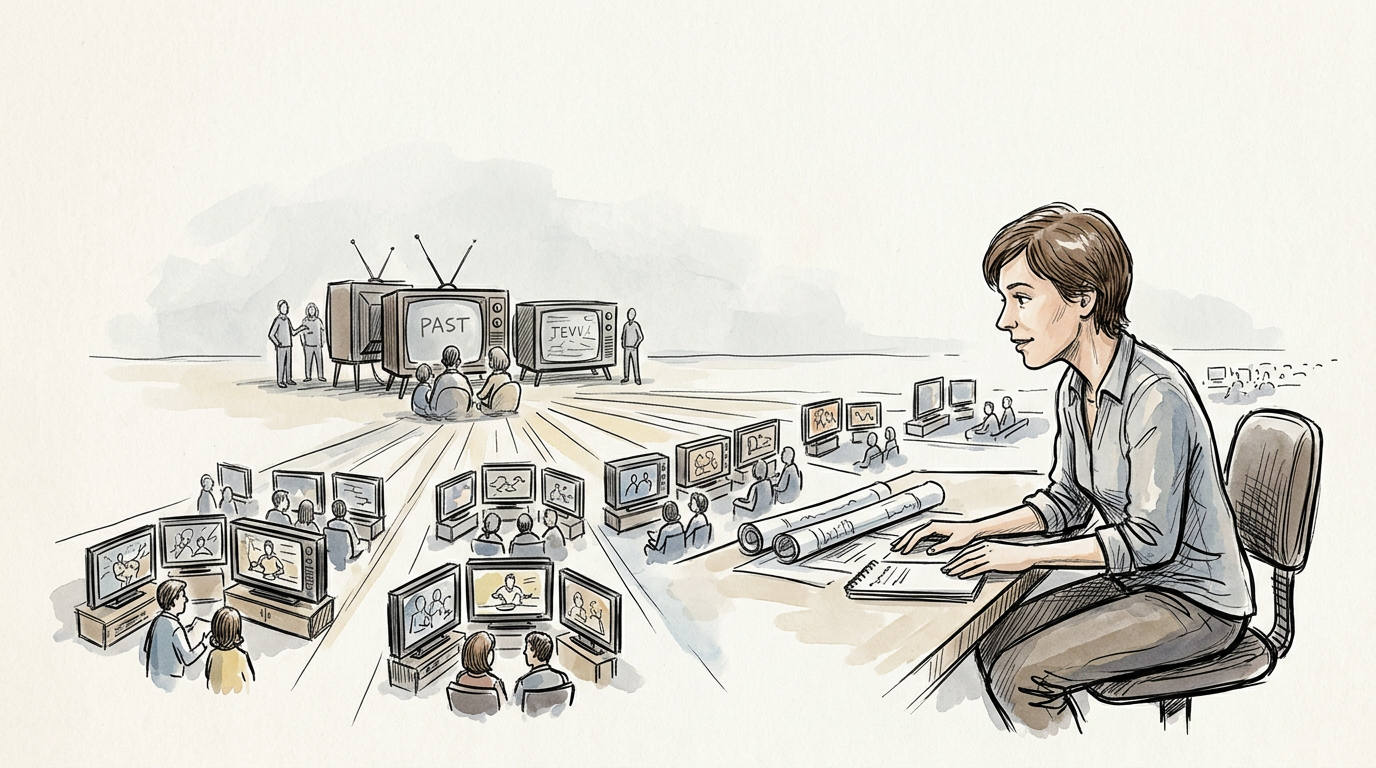
For much of television’s early commercial history, media planning revolved around scarcity. In the United States, a small number of broadcast networks delivered mass audiences at scale, and advertisers bought that scale through schedules designed to maximize national reach. Cable television did not end that system overnight, but over several decades it changed one of advertising’s central assumptions: that television worked best as a broad, relatively undifferentiated mass medium.
As cable expanded from a technical solution for weak broadcast reception into a national multichannel business, it produced a larger and more specialized channel universe. That fragmentation altered how agencies evaluated audiences, how sellers priced inventory, how brands thought about efficient reach, and how creative teams tailored messages to distinct viewing environments. By the 1980s and 1990s, cable had become more than an alternative distribution platform. It had become a different advertising proposition, one built on segmentation.
Understanding that shift helps explain several later developments that now seem routine: lifestyle targeting, narrowcast media plans, audience guarantees, daypart specialization, and the expectation that creative might vary by context rather than simply by format. Cable did not invent segmentation in advertising. Magazines, direct mail, and radio had long offered more selective audience delivery than broadcast television. But cable brought segmentation into the center of the television business, forcing advertisers and agencies to rethink what television could be.
From broadcast scarcity to cable abundance
Commercial television in the postwar decades was dominated by national broadcast networks, above all NBC, CBS, and ABC. Although independent stations and local spot markets mattered, the economic and creative prestige of television advertising centered on network television because it could assemble the largest audiences. A single prime-time program could deliver tens of millions of viewers. Media planning under those conditions emphasized broad demographic buying, especially households and adults by age and sex. The practical question was often not whether a brand should seek mass exposure, but which combination of programs would deliver the best version of it.
Cable’s origins were far more modest. Community antenna television systems appeared in the late 1940s, especially in mountainous or remote areas where over-the-air reception was poor. The industry organization now known as NCTA dates its origins to 1952. Early cable systems mainly improved access to existing broadcast signals. They did not yet represent a new advertising medium in the modern sense.
What changed was distribution technology and regulation. Microwave relay, satellite delivery, and federal policy gradually transformed cable from local signal enhancement into a national programming business. A frequently cited turning point came in 1975, when Home Box Office used satellite distribution to transmit the “Thrilla in Manila” heavyweight fight from Manila to cable systems across the country. Satellite delivery was not the sole cause of cable’s growth, but it demonstrated that programmers could distribute channels nationally at a scale previously difficult to achieve.
Regulation also mattered. The Federal Communications Commission’s cable rules shifted over time, and the policy environment became more favorable to expansion in the 1970s and 1980s. The deregulatory climate culminated in the Cable Communications Policy Act of 1984, which encouraged growth, though later concerns about pricing and market power prompted the Cable Television Consumer Protection and Competition Act of 1992. For advertisers and agencies, the key consequence of this policy and infrastructure development was straightforward: more households gained access to more channels.
The new channels were not simply more of the same. Their business logic depended on specialization. Instead of trying to be all things to all viewers, many cable networks sought identifiable niches that could be assembled into sellable audiences.
The rise of specialized cable networks
The best-known cable brands of the late 1970s and 1980s illustrate how this worked. ESPN launched in 1979 as a network dedicated to sports. CNN followed in 1980 with a 24-hour news format. MTV debuted in 1981, aimed at youth culture through music videos and youth-oriented presentation. The Weather Channel launched in 1982. Lifetime began in 1984 with programming designed to attract women viewers, though its identity evolved over time. Discovery Channel launched in 1985. A&E began in 1984. Nickelodeon, which first appeared in 1979, increasingly established itself as a destination for children and families.
These channels did not all become advertising successes immediately, and not all niche claims were equally precise in practice. But together they represented a structural break from broadcast television. The traditional networks still pursued the broadest possible audiences because their economics depended on mass ratings. Cable networks, by contrast, could build viable advertising and affiliate-fee businesses around narrower, more clearly profiled constituencies.
That had important implications for media planning. A planner buying ESPN was not simply buying “television.” The buy implied interest in sports fans, disproportionately male audiences in key age bands, and a viewing context associated with live competition, highlights, and sports news. A buy on MTV implied not just younger viewers, but a specific relationship to music, style, and youth identity. CNN offered an audience assembled by news habit, and often by higher attentiveness to current events. Specialized cable channels therefore made contextual targeting inside television far more practical than it had been in the three-network era.
The industry often described this as “narrowcasting,” in contrast to broadcasting. The term could be overstated, since even cable’s niches were often large by the standards of other media. Still, the distinction captured a genuine shift. Television was no longer only a platform for national mass communication. It had become a collection of differentiated environments.
Why advertisers found cable attractive
Advertisers did not turn to cable simply because it was novel. Cable met several practical needs that became more visible as consumer markets fragmented in the late twentieth century.
First, it offered more efficient audience composition. A brand that wanted younger adults, affluent homeowners, sports enthusiasts, children, or women interested in daytime lifestyle programming could often waste less circulation on cable than on a broad network schedule. In a broadcast environment, a large rating could still mask substantial inefficiency if many viewers fell outside the target. Cable allowed agencies to trade some raw scale for better concentration.
Second, cable created more inventory and more scheduling flexibility. As the number of channels grew, advertisers gained more places to place messages and more opportunities to build frequency among selected segments. This was useful not only for national brands but also for categories that needed sustained presence rather than occasional high-profile appearances.
Third, cable was often comparatively cost-efficient on a cost-per-thousand basis within specific demographics, even when total audiences were smaller. Sellers and buyers increasingly focused on CPMs against target audiences rather than on gross audience size alone. This orientation helped normalize a more segmented, data-driven view of television value.
Fourth, cable supported categories that matched channel identity. Sportswear, beer, automotive, consumer electronics, toys, beauty products, packaged food, financial services, pharmaceuticals, and movie studios all found reasons to align messages with particular cable contexts. Some of these categories had long histories in television, but cable let them refine placement more precisely.
This refinement became especially important as advertisers faced a more crowded consumer marketplace. Postwar mass marketing had not disappeared, but it was under pressure from demographic change, retail segmentation, and proliferating product variants. Cable fit a broader trend in American marketing away from the assumption of a single national consumer mainstream.
How agencies changed their planning methods
The rise of cable did not simply give buyers more channels to choose from. It changed the professional practice of television media planning.
In the network era, planners often concentrated on assembling broad schedules from a limited menu of high-rated programs and dayparts. Ratings and reach calculations still required considerable skill, but the universe was relatively legible. With cable growth, the planning problem became more complex. Instead of a few dominant national networks, agencies confronted dozens, and later hundreds, of channel options with varying audience sizes, compositions, daypart strengths, and local carriage levels.
This shift elevated the importance of research, software tools, and audience data integration. Nielsen had measured television audiences since the mid-twentieth century, but multichannel television increased demand for more granular reporting. Ratings had to be interpreted not only by program and network but by narrower demographic definitions and by distribution realities, since cable penetration varied by market and over time. Agencies needed to understand not just how many people watched, but which households had access to which services.
The language of media planning reflected the change. “Coverage” and “frequency” remained central concepts, but planners increasingly distinguished between total reach and target reach. “Audience composition” became more operationally important. So did “duplication,” because fragmented viewing meant that adding channels did not always expand unduplicated reach as efficiently as a broadcast-heavy schedule once had. Brands could no longer assume that a television buy naturally assembled a common mass audience. They had to model audience accumulation more carefully.
Cable also contributed to the professional growth of specialized media departments and independent media agencies. Those organizational changes had multiple causes, including broader dissatisfaction with commission-based compensation and increasing media complexity across channels, but cable clearly intensified the demand for dedicated media expertise. A planner who could navigate an expanding cable universe added measurable value.
Pricing in a fragmented market
Fragmentation did not make television cheaper in any simple sense. It changed the logic of pricing.
Broadcast network television retained premium value because it still delivered the largest simultaneous audiences, especially for hit entertainment series, sports, and major events. That premium often increased as large audiences became scarcer. In other words, one of cable’s paradoxical effects was to make mass reach both harder to achieve and, in certain contexts, more valuable.
At the same time, cable gave advertisers new ways to buy television more selectively. Networks sold the case that a smaller but better-matched audience could justify the schedule. For many advertisers, especially those with defined target demographics, that argument was persuasive. A lower-rated cable program might be a better buy than a higher-rated broadcast program if the target concentration was superior and the CPM against the desired audience was more favorable.
This logic encouraged a market in which impressions were increasingly valued by audience quality, not merely by audience volume. The shift was not absolute. High-profile broadcast environments still attracted brand-image advertisers and product launches. But cable made targeted efficiency more respectable in television planning, reducing the old assumption that “bigger” automatically meant “better.”
Scatter markets, upfront negotiations, and audience guarantees also took on new significance in this environment. As cable matured, networks sought to prove that fragmented audiences could still be bought with accountability. Buyers, in turn, expected more precise delivery commitments. The result was a more segmented television marketplace in which rates depended heavily on specific target definitions and contextual fit.
Creative strategy changed with the channel environment
One of the most important consequences of cable fragmentation was creative, not just media-related. When television was primarily a mass medium, creative strategy often aimed for broad cultural legibility. Spots had to work across large and heterogeneous audiences. That did not prevent sophistication or subcultural cues, but the default logic favored messages that could travel widely.
Cable made it easier for advertisers to think in terms of audience-specific tone, subject matter, and execution. The same brand might use different television creative in different environments, or at least adapt its messaging to fit the likely audience and viewing mood. Youth-oriented creative felt more at home on MTV than in a general prime-time network buy. Performance-driven sports messages fit naturally around ESPN programming. Toy advertising and packaged foods could be tailored to children’s or family channels. Financial and business-oriented brands found more contextual relevance in news environments.
This did not always produce wholly separate campaigns. Often it meant variation in edit length, copy emphasis, product featured, or media weight rather than an entirely different creative platform. But the underlying discipline changed. Creative teams and account planners could no longer assume that “television” meant a single audience psychology.
MTV’s influence is especially useful here, though it is sometimes overstated in popular memory. Advertising historians and media scholars have long noted the reciprocal relationship between music video aesthetics and television advertising in the 1980s. Quick cuts, stylized performance, youth-coded fashion, and a heightened sense of visual rhythm became more prominent in some categories. It would be too simple to say that MTV single-handedly transformed all TV advertising. Yet its emergence as a youth-centered cable environment undeniably encouraged advertisers targeting younger consumers to consider whether broadcast-style creative felt too slow, too generic, or too old.
Cable also enabled direct response television to flourish in new ways. Long-form paid programming and infomercials took advantage of lower-cost inventory and off-peak scheduling opportunities. That development belonged partly to a different branch of the television business than brand advertising, but it reinforced a broader lesson: multichannel television could support multiple economic models and multiple creative styles, not just the classic 30-second national network spot.
Audience fragmentation and the problem of reach
From an advertiser’s perspective, cable’s most consequential effect may have been the separation of targeting efficiency from mass reach.
In the broadcast era, a relatively small number of buys could produce extensive reach. As cable expanded, viewing dispersed across more outlets. A planner could target more precisely, but assembling large-scale national reach often required a more complicated mix of networks and programs. This increased transaction complexity and made media optimization more important.
Industry data across the 1980s and 1990s consistently showed declining shares for the broadcast networks as cable viewing increased, although the pace varied by demographic group and time period. Younger audiences in particular became harder to aggregate through the traditional networks alone. For advertisers whose products still required broad household penetration, this posed a real problem. Cable made television more efficient for niche or defined targets, but less naturally efficient for blanket coverage.
That tension reshaped media strategy. Many campaigns became hybrids, using broadcast for rapid scale and cable for target reinforcement, frequency, and contextual precision. This layered approach became standard practice. A planner might use a major network event or prime-time schedule to generate awareness, then extend or refine the campaign through cable channels that indexed strongly against the brand’s intended buyer.
This was not merely a tactical adjustment. It represented a conceptual shift in how television functioned within the media mix. Television was no longer a single broad instrument. It became a portfolio medium, internally segmented by audience and role.
Local cable and addressability, early and limited
Cable also mattered below the national level. Local cable systems offered zoned advertising opportunities that could be more geographically precise than traditional local broadcast in some circumstances. This was especially useful for retail, political, and service advertisers trying to reach selected communities within larger designated market areas.
The advertising industry has often discussed cable as a precursor to addressable television, and there is truth in that, but the history requires precision. Truly household-level addressability developed slowly and unevenly, constrained by technology, system fragmentation, and business adoption. The more immediate historical significance of cable was not full one-to-one targeting. It was the normalization of segmented television selling, both by audience profile and by distribution geography.
Still, the aspiration toward greater selectivity was visible early. If broadcast television represented a one-message, one-schedule model, cable suggested that television might someday function more like direct marketing in its precision. That promise would become more technologically plausible in later digital and set-top-box environments, but its conceptual roots were visible in cable-era thinking.
The limits of cable targeting
It is easy in retrospect to describe cable as the moment television became targeted. In practice, cable targeting had clear limits.
Audience definitions were still relatively blunt by later digital standards. Most cable buying relied on age, sex, and broad psychographic assumptions inferred from channel choice, not individually verified user profiles. A sports network audience was not identical to a brand’s customer base. Nor did viewers watch only one kind of programming. Duplication across channels remained significant, and audience behavior often defied simplistic niche categories.
Cable carriage also varied. A network’s value to advertisers depended not only on brand identity and ratings but on distribution. In its growth years, a promising cable channel could still have limited household penetration compared with broadcast. That affected both reach calculations and advertiser confidence.
Moreover, many cable channels struggled to balance niche identity with the need for larger audiences and broader advertiser support. As channels matured, some expanded programming strategies beyond their original narrow propositions. This is one reason cable history resists simplistic stories of perfect audience matching. The system created more specialized environments than broadcast had offered, but those environments remained commercial compromises.
Why cable mattered to the larger history of advertising
Cable television changed audience targeting because it altered television’s industrial structure. Instead of a medium dominated by a few national gatekeepers and broad schedules, advertisers faced a multichannel system organized around differentiated audiences. That shift changed the economics of media buying, the meaning of efficiency, the role of audience research, and the creative expectations attached to television campaigns.
Its importance lies not only in what happened on cable itself, but in how it prepared the industry for later fragmentation across digital media. Long before programmatic advertising and platform-based audience buying, cable trained advertisers to think of television audiences as segmentable, context-dependent, and unevenly valuable. It taught planners to weigh composition against scale, sellers to package identity as inventory, and creative teams to consider that context could shape message design.
At the same time, cable preserved an enduring truth about advertising media. Precision has value, but so does shared attention at scale. The fragmentation cable introduced did not eliminate demand for mass audiences. It made those audiences scarcer, more expensive, and more strategically consequential. Modern media planning still lives inside that tension.
Seen historically, cable’s legacy is not simply that television gained more channels. It is that television stopped being only a mass medium and became a segmented marketplace. Once that happened, audience targeting moved from the margins of TV planning to its center, and the profession has been adapting to that reality ever since.
Leave a Reply