
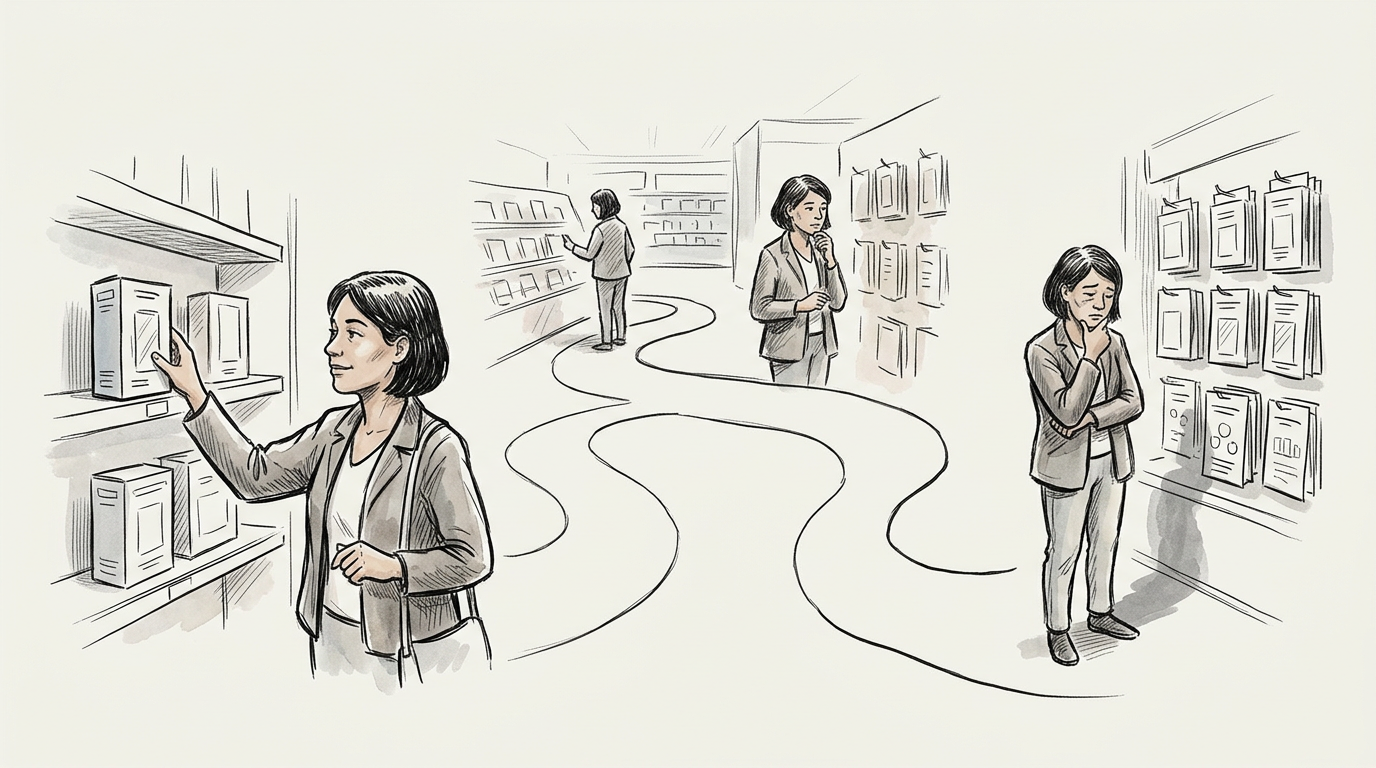
Marketers have long worked from an intuitive premise: people do not make the same quality of decisions at the end of a demanding day that they make at the beginning. The phrase “decision fatigue” captures that intuition, and it has become common shorthand for a wide range of behaviors, from impulse buying to subscription inertia to abandoned carts. Academic research offers partial support for that instinct, but not always in the simple way the popular term suggests.
The evidence is strongest when it focuses on a broader set of mechanisms: mental fatigue, cognitive load, repeated acts of choice, and the demands of self-control. Across these areas, researchers have found that people under strain often shift toward easier options, rely more on defaults and heuristics, and show less willingness to process complex information. At the same time, some of the most influential psychological explanations, particularly the once-prominent “ego depletion” theory, have been heavily debated, with mixed replication results and ongoing disagreement about what exactly is being depleted, when, and for whom.
For advertising and marketing professionals, that means two things can be true at once. Consumer decision quality and decision style clearly vary with fatigue and cognitive effort. But practitioners should be cautious about treating decision fatigue as a universal law that automatically makes people more persuadable.
## What researchers mean by decision fatigue
In professional conversation, decision fatigue often refers to the idea that making many decisions in sequence can reduce the quality of later decisions. In academic research, that broad idea overlaps with several more specific concepts.
One is **self-control depletion**, commonly known as ego depletion. The theory, associated especially with Roy Baumeister and colleagues, proposed that acts of self-control draw from a limited internal resource, making subsequent self-regulation more difficult. A widely cited early review by Baumeister, Vohs, and Tice argued that self-control operates in ways analogous to a muscle that can become temporarily fatigued after exertion ([Current Directions in Psychological Science](https://journals.sagepub.com/doi/10.1111/1467-8721.01204)).
A second concept is **mental or cognitive fatigue**, which refers more generally to reduced cognitive efficiency after sustained effort, prolonged task engagement, or demanding information processing. This literature is not limited to self-control. It includes research on attention, effort, vigilance, executive functioning, and cognitive overload.
A third concept is **choice overload and choice difficulty**, which addresses what happens when consumers face too many options or too much information. The issue here is not necessarily depletion from prior self-control, but rather the friction created by complex decision environments.
These distinctions matter. A shopper who selects a default option because a website presents too many similar plans may not be “depleted” in the classic ego-depletion sense. A tired commuter grabbing a familiar brand after a long day may be influenced by general fatigue, stress, time pressure, habit, and low motivation, not simply by the number of decisions made earlier. For marketers, the practical pattern may look similar, but the psychology behind it is more varied.
## The early ego depletion literature and why it became influential
Ego depletion became especially influential because it appeared to unify many observations about self-control. In a famous early experiment, Baumeister and colleagues assigned participants to resist eating cookies and instead eat radishes, then measured persistence on an unsolvable puzzle task. Those who had exerted restraint gave up more quickly, suggesting that one act of self-control reduced persistence on a subsequent task ([Journal of Personality and Social Psychology](https://psycnet.apa.org/record/1998-00217-006)).
Over time, similar paradigms were used to suggest that exerting self-control in one domain could impair later performance in another. Participants who regulated emotions, suppressed thoughts, resisted temptation, or made repeated choices were sometimes found to show reduced persistence, more impulsivity, or weaker performance on later tasks. For marketers and consumer researchers, this line of work was appealing because it seemed to explain why people might become less deliberate after effortful consumption choices, more susceptible to hedonic temptations, or more likely to rely on shortcuts.
Research in consumer behavior extended these ideas. A notable paper by Kathleen D. Vohs and colleagues reported that making repeated choices can be depleting, reducing self-control and persistence relative to nonchoice conditions ([Journal of Consumer Research](https://academic.oup.com/jcr/article-abstract/35/4/625/1812340)). The implication for market settings was straightforward: choice itself can be mentally costly, and long sequences of consumer decisions may change subsequent behavior.
That finding aligned with broader consumer research showing that difficult decisions can produce conflict, post-choice dissatisfaction, and avoidance. It also fit with Herbert Simon’s earlier concept of bounded rationality and with later behavioral research demonstrating that people often satisfice, defer choice, or lean on defaults when decision demands become too high.
## The replication debate changed how researchers interpret depletion
The difficulty is that ego depletion, as a single-resource theory, has not held up as cleanly as many researchers once believed.
A 2010 meta-analysis by Hagger, Wood, Stiff, and Chatzisarantis concluded that the ego depletion effect was robust across studies ([Psychological Bulletin](https://psycnet.apa.org/record/2010-06073-001)). For several years, that paper helped solidify depletion as a major theory in psychology and beyond.
Later scrutiny raised serious concerns. Researchers pointed to possible publication bias, small-study effects, and methodological variability. A 2015 registered multi-lab replication effort led by Hagger and colleagues did not find evidence for the specific ego depletion effect in the protocol it tested ([Perspectives on Psychological Science](https://journals.sagepub.com/doi/10.1177/1745691616652873)). The null result did not prove that all depletion effects are false, but it substantially weakened confidence in strong, general claims.
Subsequent reappraisals reinforced the need for caution. Michael Inzlicht and Brandon Schmeichel argued that what had been framed as depletion might be better understood through shifts in motivation, attention, and effort allocation rather than exhaustion of a single limited resource ([Trends in Cognitive Sciences](https://www.cell.com/trends/cognitive-sciences/fulltext/S1364-6613(12)00275-4)). Other scholars proposed process models in which initial exertion changes what people want to do next, what cues they attend to, and whether further effort feels worthwhile.
For marketers, this is more than an academic dispute. If ego depletion were a universal physiological-like resource loss, one might expect broad and predictable declines in self-control after any demanding sequence of choices. If, instead, later behavior depends on motivation, task framing, incentives, beliefs about willpower, and context, then fatigue effects will be more contingent and less mechanically predictable.
That is the safer reading of the current literature.
## What the evidence does support: effort changes how people choose
Even with the ego depletion debate unresolved, several conclusions are reasonably well supported.
First, **effortful decision-making has psychological costs**. Repeated choices, difficult tradeoffs, and information-heavy environments can create strain. Consumer research has repeatedly shown that people respond to this strain by simplifying.
Second, **under cognitive strain, people rely more on heuristics and defaults**. This broader claim is supported across behavioral decision research, even if any one explanation remains contested. Classic work on dual-process thinking, including Daniel Kahneman’s synthesis in *Thinking, Fast and Slow*, and decades of judgment research suggest that when people are tired, distracted, rushed, or overloaded, they are less likely to engage in slow, effortful evaluation and more likely to use familiar cues, salient signals, and simple rules.
Third, **self-control and attention are variable states**. They are influenced by sleep, stress, emotions, cognitive load, time pressure, and environmental demands. Marketing-relevant decisions therefore vary not only by preferences but also by how capable and willing consumers are to process available information in the moment.
A useful bridge between the self-control and consumer-choice literatures is work on **choice architecture**. Defaults, assortment structure, framing, recommendation systems, and interface design matter in part because consumers do not always approach decisions with full cognitive bandwidth. This is one reason default effects have proven so durable in domains ranging from retirement savings to digital subscriptions. People often accept the path of least resistance, especially when stakes are unclear or alternatives are difficult to compare.
## Choice overload is real, but it is conditional
One of the most cited adjacent ideas in marketing is choice overload, the possibility that more options can reduce satisfaction or participation. Sheena Iyengar and Mark Lepper’s well-known jam study found that larger assortments attracted more initial attention but smaller assortments generated more purchasing ([Journal of Personality and Social Psychology](https://psycnet.apa.org/record/2000-16701-010)).
That study became emblematic of the “too much choice” argument, but later evidence suggests a more nuanced picture. A meta-analysis by Benjamin Scheibehenne, Rainer Greifeneder, and Peter Todd found that choice overload effects are not uniformly strong and depend heavily on conditions such as preference uncertainty, assortment complexity, decision task, and measurement approach ([Journal of Consumer Research](https://academic.oup.com/jcr/article/37/3/409/1797761)).
This is a useful comparison for the decision-fatigue discussion. Just as more options do not always reduce purchase likelihood, more decisions do not automatically produce poorer later decisions in every setting. Effects depend on context, task design, motivation, product category, and the consumer’s existing knowledge or goals.
For instance, experienced buyers in a high-involvement category may not be especially impaired by repeated decisions if they
Leave a Reply