
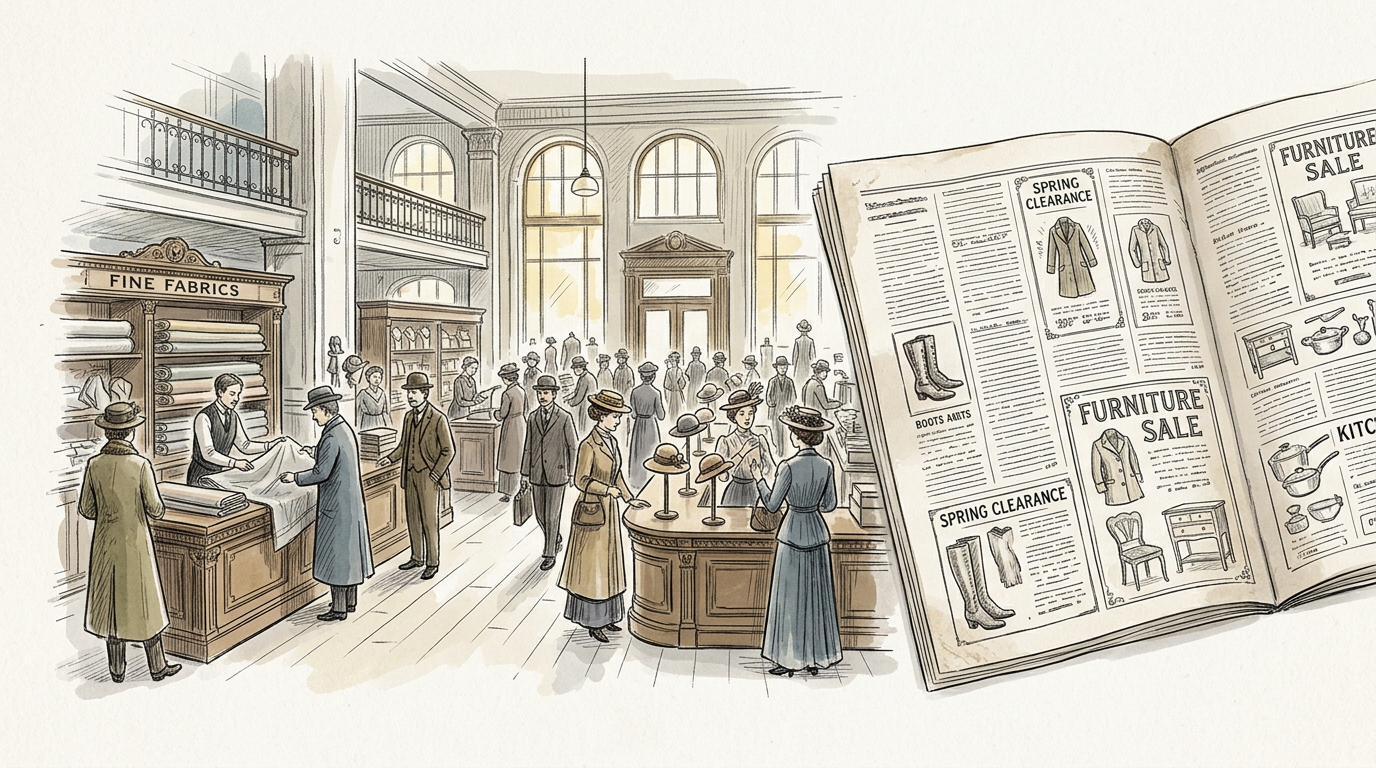
Long before department stores became fixtures in urban retailing, newspaper advertising for merchants was usually modest in scale and ambition. In the early nineteenth century, most retail notices looked more like classifieds than campaigns. They announced arrivals of goods, listed product categories, gave an address, and relied on repetition rather than design. By the late nineteenth century, that had changed dramatically. Department stores, especially in large American cities, helped transform the newspaper from a place for brief trade announcements into a primary stage for persuasive retail advertising. In the process, they changed not only how retailers sold merchandise, but also how newspapers sold space, how copywriters wrote, how pages were designed, and how consumers learned to read advertising as part of everyday urban life.
The department store’s importance to advertising history lies in this structural role. These businesses needed advertising at unusual scale. They carried vast inventories, turned stock rapidly, depended on high customer traffic, and competed intensely on novelty, price, service, and spectacle. Newspapers offered the reach and frequency required to support that model. As department stores grew in the second half of the nineteenth century, they became some of the biggest and most demanding newspaper advertisers in the United States. Their spending encouraged larger layouts, more distinctive typography, more systematic merchandising copy, and, eventually, more professionalized relationships among retailers, publishers, illustrators, and advertising specialists.
From merchant notices to mass retail promotion
The rise of the department store was itself part of a broader transformation in American commerce. Dry goods emporiums and other large urban retail houses emerged in the mid-nineteenth century as cities expanded, transportation improved, and industrial production widened the range of goods available for sale. Historians generally identify establishments such as Alexander Turney Stewart’s New York stores as early and influential examples of large-scale retailing organized by department. Stewart opened his famous Marble Palace on Broadway in 1846 and later the much larger cast-iron store on Broadway and Ninth Street in 1862. These were not department stores in the fully standardized twentieth-century sense, but they represented an important move toward centralized, high-volume, multi-category urban retailing.
That retail model placed unusual pressure on advertising. Smaller merchants could rely more heavily on location, personal reputation, or limited notices in the press. A large store with many departments and rapid merchandise turnover needed to create continual reasons to visit. The daily newspaper, especially as circulation rose in major cities, became indispensable. Cheapening newsprint, steam-powered presses, improved typesetting, railroad distribution, and urban literacy all helped make newspapers a mass medium by the second half of the nineteenth century. Retail advertising and newspaper growth reinforced one another. Newspapers needed dependable local revenue; department stores needed recurring access to large audiences.
By the 1870s and 1880s, major stores were no longer merely placing short announcements. They were buying substantial amounts of space to promote seasonal assortments, special purchases, clearance events, holiday goods, household items, women’s fashions, fabrics, furniture, and services such as delivery or charge accounts. In New York, Philadelphia, Boston, Chicago, and other growing cities, stores including Macy’s, Wanamaker’s, Marshall Field, Siegel-Cooper, and later others built advertising into the core of their retail operations.
Why department stores advertised differently
Department stores had business reasons for becoming aggressive newspaper advertisers, and those reasons shaped the form of the ads themselves.
First, their scale required constant demand generation. Unlike a specialty merchant with narrow lines, a department store had to move enormous quantities of goods across many categories. Newspaper advertising made it possible to feature different departments on different days and to bring underperforming merchandise to the front of public attention quickly.
Second, their economics rewarded traffic. Even when an ad promoted one category, the store hoped readers would enter the building and purchase other items. This encouraged advertising that sold not just a product, but the shopping trip itself. Newspaper ads began to describe the store as a destination: convenient, fashionable, trustworthy, modern, well stocked, and capable of offering superior value.
Third, department stores competed in crowded urban markets where rivals watched one another closely. If one store took a larger ad, emphasized prices more boldly, or launched a major seasonal event, others often responded in kind. This competitive escalation was one of the main forces behind the expansion of retail display advertising.
Fourth, department stores operated within changing consumer expectations. Fixed prices, money-back guarantees, bargain sales, white sales, and elaborate holiday merchandising all had to be communicated and normalized. Advertising served as retail instruction as well as persuasion. It taught readers how to shop in the new mass retail environment.
John Wanamaker and the newspaper as retail instrument
No discussion of department store advertising can avoid John Wanamaker, whose Philadelphia and New York stores became models of large-scale retail promotion in the late nineteenth century. Wanamaker has often been surrounded by advertising legend, including the widely repeated but poorly documented line about knowing that half his advertising worked but not knowing which half. That remark should be treated cautiously. It is difficult to verify in contemporaneous sources, and it has circulated for decades as industry folklore. What is much better documented is Wanamaker’s sustained investment in newspaper advertising and his belief that advertising should be treated as a serious business function.
Wanamaker opened his Philadelphia store, Oak Hall, with his brother in 1861 and later established the Grand Depot at the former Pennsylvania Railroad freight depot at Thirteenth and Market Streets in 1876. He used newspaper advertising extensively, buying space in Philadelphia papers and later in New York after acquiring A.T. Stewart’s retail palace in 1896. Wanamaker’s ads were notable not because he invented retail advertising, but because he helped systematize it at scale. He used advertising to project reliability, low prices, broad assortment, and consumer protection. His public emphasis on fixed prices and satisfaction guarantees mattered in an era when haggling and uneven quality remained familiar features of commerce.
Wanamaker also contributed to the professionalization of the in-house retail advertising function. Department stores often employed their own advertising managers and copy staff well before many advertisers built comparable internal departments. In large stores, advertising was not simply purchased space. It involved merchandise planning, copy preparation, coordination with department buyers, proofreading, scheduling, and increasingly sophisticated page organization. The department store ad became an operational document as much as a persuasive text.
The rise of the large-format newspaper advertisement
As department stores expanded their spending, they pushed newspapers toward bigger and more visually assertive retail layouts. In the mid-nineteenth century, retail notices were often text-heavy and arranged in uniform columns with limited display type. Over time, department store advertisers used larger headlines, multiple subheads, denser but more structured blocks of copy, ornamental borders, varied typefaces, and greater control over page presence.
This did not happen all at once, and it did not immediately produce modern ad design. Many nineteenth-century department store advertisements remained crowded by current standards. They often contained long lists, compressed typography, and multiple departments promoted in a single unit. Yet those pages represented an important stage in advertising development. They showed retailers learning how to use space hierarchically. Headlines began to do more than label goods. They announced urgency, occasion, or advantage: a seasonal opening, a special import purchase, a linen sale, a cloak reduction, a holiday display, a household bargain event.
As stores purchased ever-larger blocks of space, sometimes full columns, half pages, or more, they changed the visual rhythm of the newspaper itself. Advertising became more conspicuous and more editorially competitive. Newspapers had a direct incentive to accommodate this shift because retail display advertising was lucrative. In some cities, department stores became so important to newspaper finances that publishers adjusted production practices around their deadlines and page demands.
This pressure also helped shape newspaper advertising departments. Selling and processing large display schedules for major retailers required more than casual space brokering. Rate structures, contracts, preferred positions, makeup, and copy handling became more organized. The business of newspaper advertising grew more complex partly because retailers like department stores made complexity profitable.
Copy changed as retailing changed
Department stores did not simply buy larger space. They helped redefine what retail copy was expected to do.
Earlier merchant notices often focused on inventory declaration: what had arrived, where it could be found, and sometimes at what price. Department store copy added stronger claims about value, selection, quality, timeliness, and shopping convenience. It also became more segmented. A single advertisement might contain mini-messages for separate departments, each with its own price points and appeals. This was not brand advertising in the later national sense. It was merchandise-driven, immediate, and often ephemeral. But it required disciplined organization and a growing sensitivity to reader attention.
By the late nineteenth century, department store copy regularly used techniques that became standard retail practice:
- Prominent headlines tied to season, event, or urgency.
- Price emphasis, often with direct comparison or implied savings.
- Department-by-department structure that mirrored store organization.
- Descriptive language that made goods legible to readers who could not inspect them physically.
- Appeals to trust, economy, taste, novelty, and convenience.
- References to service features such as delivery, returns, tailoring, fitting rooms, or mail order fulfillment.
The emphasis on price was especially important. Department stores helped normalize the newspaper ad as a place where consumers expected concrete, itemized price information. This represented a different rhetorical mode from much later image-oriented advertising. The department store ad often worked by accumulation. It assembled evidence of abundance and value. In that sense, it was close to merchandising and far from pure slogans.
At the same time, copy became more polished. Retailers learned that layout alone was not enough. Readers needed to understand why one sale mattered more than another and why one store deserved confidence. The growth of women’s consumer culture in urban shopping districts also shaped tone and content. Since women were a major target audience for many departments, stores wrote at length about dress goods, household textiles, trimmings, millinery, ready-to-wear clothing, and domestic furnishings, while also addressing practical concerns such as budget and household management. The resulting copy was both commercial and cultural, reflecting changing assumptions about gender, household consumption, and public shopping.
Illustration, typography, and the visual selling of goods
Improved printing technologies expanded what department stores could do on the newspaper page. Nineteenth-century newspapers were not ideal environments for fine image reproduction, especially compared with magazines, catalogs, or later rotogravure sections. Even so, advertisers increasingly used line drawings, decorative devices, and typographic contrast to make merchandise more visible and ads more navigable.
Illustration was especially useful when retail competition centered on style, novelty, and seasonal fashion. A drawing of a dress silhouette, hat, cloak, sideboard, or toy could communicate more quickly than a block of type alone. While early newspaper reproduction imposed limitations, the direction of change was clear. Department store advertisers pushed visual merchandising into newspapers and helped establish the expectation that advertising could show goods, not merely name them.
Typography mattered just as much. Display type became a competitive instrument. Large headlines, varied font sizes, and strategic white space, though still limited in many nineteenth-century layouts, made ads easier to scan. These choices were not only aesthetic. They reflected a growing understanding that a newspaper reader’s attention had to be managed. Department stores were effectively teaching newspapers and advertisers how readers moved through a crowded page.
Some stores developed recognizable visual habits, though historians should be cautious about overstating early “brand identity” in the modern sense. Consistency of tone, preferred typographic styles, recurring sale names, and signature formats did contribute to store recognition. But these practices emerged gradually and were often driven by the practical routines of in-house advertising departments as much as by explicit long-range branding theory.
Seasonality and the invention of recurring retail occasions
Department store newspaper advertising also changed the calendar of selling. Retailers had always marked seasons, but large stores turned seasonal transition into a recurring advertising engine. Spring openings, fall millinery introductions, back-to-school needs, holiday gift promotions, January clearances, and white sales became annual newspaper events. Repetition across years trained consumers to expect retail rhythms and to time purchases accordingly.
The “white sale” is a useful example. Historians commonly credit John Wanamaker with early large-scale use of the January white sale for linens and household goods in the 1870s, though details of priority claims can be difficult to verify conclusively. What is not in doubt is that by the late nineteenth and early twentieth centuries, white sales had become a major department store advertising event. Newspapers were central to that development. Stores needed enough space to explain the event, list numerous items, and create a sense of temporary opportunity after the holiday season. The result was a form of promotion that combined inventory management with consumer ritual.
Holiday advertising grew similarly important. Department stores used newspapers to present Christmas shopping as both practical and theatrical. Ads promoted toys, gifts, decorations, apparel, and housewares, but they also sold the store as a festive destination. This mattered because department stores were not only places of transaction. They were increasingly public institutions of display, complete with decorated windows, elaborately arranged interiors, restaurants, and special services. Newspaper advertising extended that in-store experience into the home.
The shopping experience itself became part of the message
One of the most significant changes department stores brought to newspaper advertising was the move from merchandise announcement toward experiential selling. Ads still featured products and prices, but they increasingly promised a particular kind of shopping environment.
That promise varied by store and city. It could mean elegance, refinement, and imported taste. It could mean democratic access to abundance. It could mean orderly fixed prices in contrast to haggling. It could mean comfort, broad assortment, child-friendly services, lunchrooms, rest rooms, personal shoppers, or dependable delivery. By the late nineteenth century, some stores were advertising not only what they sold but how it felt to shop there.
This was historically important because it helped expand the function of advertising. The newspaper ad was no longer simply a sales notice. It became part of a larger retail system in which architecture, service, display, and publicity worked together. Department stores were among the earliest advertisers to integrate those elements at large scale. Their newspaper campaigns often coordinated with window displays, seasonal openings, direct mail pieces, and special events. In that sense, they anticipated later ideas about integrated retail communications, even though the tools and terminology were quite different.
Competition, circulation, and the business of newspapers
The transformation of department store advertising cannot be separated from changes in the newspaper business. The penny press and later mass-circulation dailies widened readership in the nineteenth century. By the 1890s and early twentieth century, urban newspapers were reaching large audiences that retailers considered commercially valuable. Stores followed circulation, and newspapers in turn courted retail accounts aggressively.
This relationship had several consequences for advertising practice. Newspapers created more formal advertising sales operations. They developed rate cards, positioning options, and production systems that could handle large, recurring retail schedules. They also learned to present circulation as a measurable commodity. While audience measurement in this period was far less standardized than later media research, the growing attention to verified reach foreshadowed modern media planning logic.
Retail competition among stores also interacted with competition among newspapers. A leading department store might place advertising in multiple papers, adjust spending according to readership, or negotiate for premium treatment. Newspaper management understood that department store accounts signaled commercial prestige as well as revenue. Large retailers therefore had leverage in shaping newspaper advertising conventions.
Trade publications documented this evolving relationship. Titles such as Printers’ Ink, founded in 1888, discussed advertising methods, retail copy, and the importance of newspaper display. These publications helped circulate ideas about best practice across cities and firms. Department store advertising, once a local operational matter, became an object of professional discussion.
From in-house retail copy to professional advertising expertise
Department stores were especially important in the development of advertising as a practical profession because they required dedicated specialists. Long before the rise of the modern full-service agency model in its mid-twentieth-century form, stores employed advertising managers, copywriters, artists, and promotional planners who worked close to merchandising operations.
The internal retail advertising office was often a hybrid environment. Buyers supplied information on stock and prices. Copy staff translated that information into persuasive prose. Layout and art personnel organized the page. Management reviewed tone, expense, and strategic emphasis. Tight deadlines were common because advertising often tracked merchandise arrivals and sales conditions very closely. This was fast, iterative work. It rewarded clarity, production discipline, and knowledge of how readers responded to specific offers.
Some department stores also worked with external agencies or space brokers, particularly as the agency business matured. But for many large stores, control over advertising remained closely tied to internal merchandising systems. That distinction matters historically. Department store advertising helped define one major branch of professional advertising practice: retail advertising grounded in stock movement, promotional calendars, and store traffic rather than in national brand image alone.
This branch of advertising sometimes received less historical glamour than the later creative revolutions associated with magazine and television campaigns. Yet its influence was profound. Retail price presentation, promotional planning, event merchandising, local market adaptation, and headline-driven newspaper copy all developed in part through department store routines.
Early twentieth-century refinement
By the early twentieth century, department store newspaper advertising had become more sophisticated in both visual organization and copy strategy. Improvements in printing, photoengraving, and newspaper production widened creative options. Ads became easier to scan, illustrations more common, and page architecture more deliberate. Stores used stronger sectional structure, more consistent typography, and increasingly promotional headlines.
At the same time, consumer expectations had changed. Readers were accustomed to looking to newspapers for sale information. Department store ads had become part of household planning. They influenced shopping routes, budget decisions, and seasonal consumption. In many cities, reading store ads was itself a regular domestic practice.
Large retailers also expanded beyond the central-city flagship model. Chain department stores and regional store groups adapted newspaper methods to different markets. As suburbanization later altered retail geography, many of the promotional conventions first refined by urban department stores migrated into a wider retail system. The twentieth-century newspaper insert, the weekend sale ad, and the highly structured promotional circular all owed something to the earlier department store page, even if formats and production methods evolved substantially.
Limits and complications
It is important not to turn this history into a simple story of creative progress. Department store advertising could be manipulative, exclusionary, and excessive. Price claims were not always transparent by modern standards. Idealized representations of class, gender, and respectability shaped who was imagined as the proper customer. Black consumers and workers, immigrants, and working-class shoppers were often addressed unevenly or stereotyped within the wider culture of retail promotion. The grandeur of some department store advertising also rested on labor systems and supply chains that were rarely visible in the ad itself.
Moreover, not every development credited to department stores began with them. Illustrated advertising, attention-getting typography, and persuasive retail copy all had precedents in other forms of commercial printing and newspaper display. What department stores did was institutionalize these methods at large scale and with unusual regularity. Their importance lies less in single inventions than in sustained commercial application.
It is also worth distinguishing newspaper advertising from the broader publicity and promotional cultures that surrounded famous stores. Not every spectacular store event translated directly into newspaper innovation, and not every dramatic claim later associated with a retailer can be documented in the contemporary record. The strongest historical case is that department stores were major spenders whose needs materially shaped newspaper advertising practice over decades.
Why this history still matters
Department stores changed newspaper advertising by making it larger, more frequent, more competitive, and more professionally organized. They helped shift the newspaper ad from a simple merchant notice to a complex retail instrument capable of moving inventory, staging seasonal events, signaling prices, shaping store image, and inviting consumers into a managed shopping experience. Their demands encouraged newspapers to refine display advertising, production workflows, and commercial sales practices. Their internal operations helped define retail advertising as a specialized discipline with its own logic, deadlines, and creative conventions.
Much of modern retail advertising still carries this inheritance. The promotional headline, the event sale, the category breakout, the traffic-driving offer, the blend of price and experience, and the close coordination between merchandising and media all have deep roots in department store newspaper practice. Even in digital environments, retailers continue to solve problems that nineteenth-century department store advertisers recognized clearly: how to present abundance without confusion, how to create urgency without sacrificing trust, how to balance immediate sales with long-term store reputation, and how to make the shopping experience itself part of the selling proposition.
For advertising history, the department store’s role is therefore larger than nostalgia for grand emporiums and holiday windows. These retailers helped turn newspaper advertising into a central business system of modern commerce. They did not merely use the medium heavily. They changed what the medium was expected to do.
Leave a Reply