
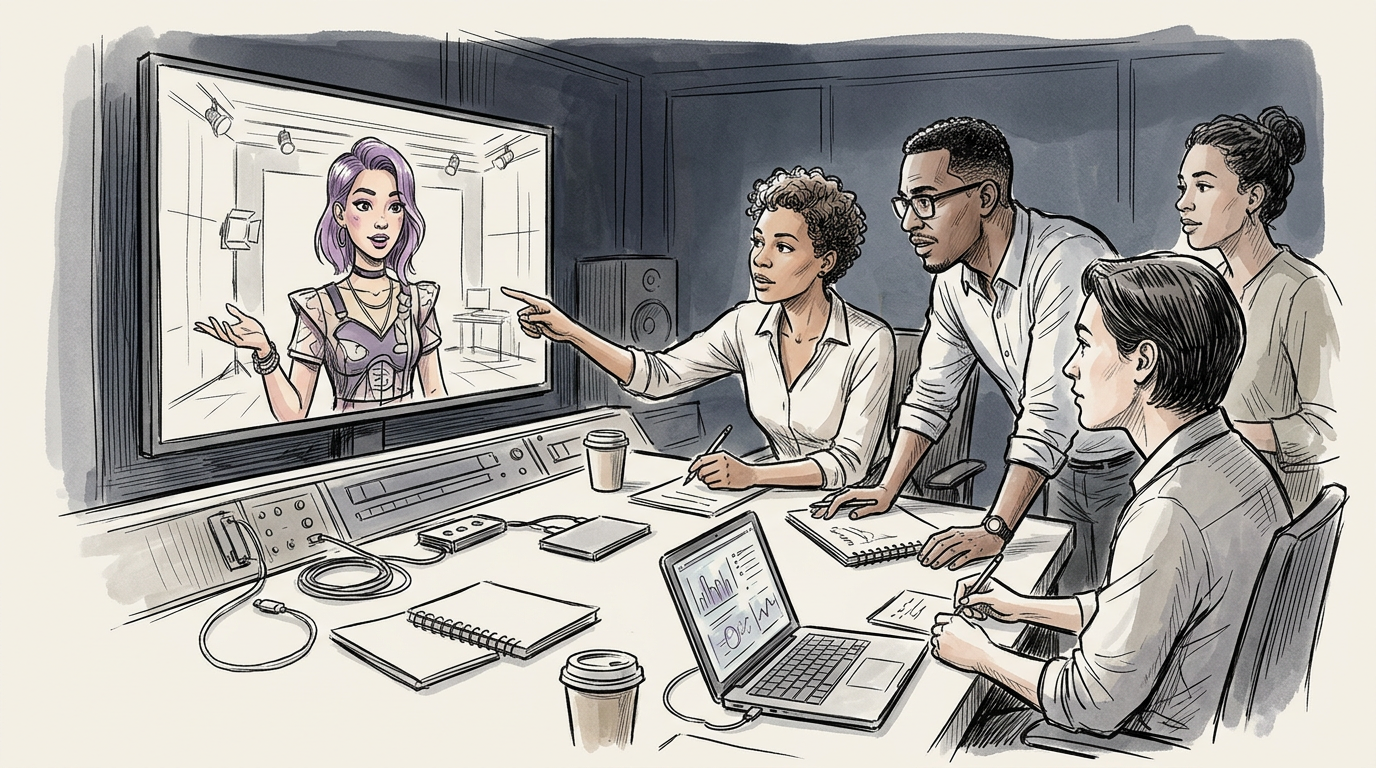
Digital humans and virtual influencers have moved from novelty campaigns into a more practical place in marketing operations. Brands, agencies, entertainment companies, retailers, and platform owners are now using computer-generated spokespersons, branded avatars, and synthetic on-screen presenters in social content, customer engagement, ecommerce experiences, and campaign production. What makes the category important is not simply that these figures look increasingly polished. It is that they offer a different production and brand-control model from working with human talent.
That difference matters to advertising and marketing professionals because synthetic personalities solve some familiar business problems while creating others. They can provide visual consistency across channels, reduce some scheduling and talent constraints, localize appearances for multiple markets, and keep a brand character available long after a specific campaign ends. At the same time, they raise questions about disclosure, audience trust, labor, intellectual property, and whether a designed persona can actually build the kind of credibility that marketers often hope to borrow from a human creator, celebrity, or spokesperson.
Understanding where digital humans fit requires separating several technologies and use cases that are often grouped together under one vague label.
What marketers mean by digital humans, virtual influencers, and branded avatars
The category includes several distinct formats.
A virtual influencer is a fictional persona presented on social platforms in a way that resembles a human creator or celebrity account. The character may have a defined voice, backstory, style, and ongoing content presence. Some are fully computer-generated. Others combine edited photography, 3D graphics, animation, motion capture, and human creative direction. Well-known examples such as Lil Miquela helped establish the format years ago, but the larger lesson for marketers is less about any single character than about the business model: the persona can be scripted, scheduled, styled, and licensed with much tighter control than a human influencer relationship usually allows.
A digital human usually refers to a more realistic computer-generated person used in video, interactive experiences, retail, gaming, events, training, or customer service. These may be rendered in real time with game engines such as Unreal Engine or produced in pre-rendered form for advertising and content.
A branded avatar or character is broader still. It may be photorealistic, stylized, animated, mascot-like, or obviously fictional. In practice, many brands are not trying to create a simulated human at all. They are building a recognizable brand entity that can appear across social media, digital out-of-home, websites, apps, livestreams, and immersive experiences.
These distinctions matter because the production requirements, audience expectations, and risk profile differ significantly. A photorealistic digital presenter meant to appear trustworthy in a finance or healthcare context is not judged the same way as a stylized fashion avatar on TikTok or a game-like branded character in a retail app.
What the technology actually does
Behind the polished surface, most digital humans are assembled from several established technologies rather than one unified system.
Common components include:
- 3D character design and rigging, which create the model, facial structure, clothing, and controls needed for animation.
- Animation and motion capture, which drive body movement and facial expressions from keyframing, performer capture, or automated animation systems.
- Voice synthesis or recorded human voice performance, depending on the desired quality, language support, and rights structure.
- Lip sync and facial animation tools, which align speech with mouth and face movements.
- Generative AI systems, which may help draft scripts, generate concept art, create alternate visuals, or automate some localization and production tasks.
- Real-time rendering engines, which allow interactive appearances in live events, virtual environments, or conversational interfaces.
- Conversational AI, when the avatar is designed to respond dynamically to user questions rather than present fixed content.
Vendors sometimes package these capabilities as if they produce a fully autonomous digital spokesperson. In practice, most successful marketing executions still rely on substantial human work. Creative teams define the persona, strategists determine the use case, writers script or supervise language, designers control visual identity, producers manage content pipelines, and legal or brand teams review disclosure and claims. Even when generative AI is involved, it is typically one layer in a broader production system rather than the whole solution.
That distinction is important because current systems are much better at producing repeatable visual assets and controlled performances than at sustaining a believable, safe, and contextually appropriate public personality over time.
Why marketers are interested
The appeal of digital humans is straightforward. They offer a level of consistency and operational flexibility that human talent often cannot.
A virtual spokesperson does not age out of a campaign, develop scheduling conflicts, negotiate every incremental appearance, or create the same level of brand-safety unpredictability associated with a celebrity or creator partnership. A single digital character can be adapted for ecommerce tutorials, multilingual explainers, social videos, event screens, and interactive product demonstrations. Assets can be updated without reshooting a full production. Wardrobe, settings, and expressions can be modified digitally. For global organizations, the same character can appear across markets with different voice tracks or localized creative.
This makes synthetic characters especially attractive in contexts where brands value continuity over spontaneity. A retailer may want the same avatar guiding shoppers through product categories across app, web, and in-store screens. A consumer electronics brand may want a consistent digital host for launch videos and post-purchase support content. A gaming, entertainment, or youth-focused brand may see strategic value in a fictional personality that can live across merchandising, short-form video, and interactive experiences.
The economics can also be attractive in narrow circumstances. A digital human can be expensive to create well, particularly if realism, animation quality, multilingual capability, and platform-specific assets are required. But once the system and asset library exist, incremental content production may become cheaper and faster than repeatedly organizing live shoots for similar executions. The savings are most credible when the use case involves repeated, structured output at scale, not when a brand simply wants an attention-grabbing experiment.
Consistency and control are real advantages
Among the clearest benefits is creative control.
Human influencers and celebrity endorsers bring their own audience relationships, cultural value, and personal credibility. They also bring unpredictability. A virtual character allows a brand or its agency to define the visual identity, tone, frequency, backstory, and behavioral boundaries from the start. In theory, that makes brand governance easier.
This can be especially useful for long-running characters. Traditional brand mascots have always served this purpose, from animated icons to spokes-animals and fictional personalities. Digital tools now expand the range of what those characters can do. A modern branded avatar can appear in video, respond in a chat interface, host a livestream, demonstrate product features in 3D, or be inserted into personalized content variations.
For multinational organizations, digital asset control also supports adaptation. A brand can maintain a recognizable core identity while modifying styling, language, and setting for different markets. In performance marketing environments where asset variation matters, synthetic presenters can also support more rapid versioning and testing than traditional shoots.
Still, control is not the same as effectiveness. The fact that a persona is consistent does not mean people will care about it, trust it, or remember it for the reasons a brand intends.
Scalability is useful, but only for the right kind of work
The scalability argument for digital humans is strongest where content is repetitive, modular, and operationally constrained.
Examples include product walkthroughs, FAQ-style videos, routine promotional updates, training content, localized commerce assets, and interactive kiosks. In these settings, the digital character functions less like a celebrity substitute and more like a reusable interface layer. If the performance quality is acceptable and the task is well defined, the system can reduce turnaround time and simplify updates.
Scalability claims become weaker when marketers expect the same character to generate durable audience attachment across culture-driven channels. Social audiences are often responding not just to appearance but to perceived lived experience, spontaneity, humor, risk, social awareness, and accountability. Those are harder to simulate convincingly, and they are rarely produced by automation alone.
Some marketers are also using synthetic avatars in internal workflows, such as automated multilingual presenters for sales enablement or regional marketing materials. That use may be less visible, but it is often more practical than the public-facing virtual influencer model because the audience expectation is functional clarity, not emotional authenticity.
Novelty still matters, but novelty fades quickly
Part of the appeal of virtual influencers is simple attention value. They can generate curiosity, press coverage, and social conversation, especially when a campaign makes the artifice visible rather than trying to hide it. For fashion, beauty, gaming, entertainment, and experimental retail experiences, that novelty can be useful. It signals digital fluency and can create assets that stand out in crowded feeds.
The problem is that novelty is an unreliable long-term strategy. Once audiences understand the trick, the brand still needs a reason for the character to exist. A digital persona that offers only visual novelty often struggles to maintain engagement after initial launch. The same is true of many branded mascots, but the issue is sharper here because the marketing promise often implies relationship, personality, or influence.
In other words, a virtual influencer may be easy to notice but hard to sustain. If the persona is not attached to a meaningful creative strategy, product relevance, entertainment value, or utility, scale only makes the weakness more visible.
Audience relationships are the central question
Marketers often describe virtual influencers in terms borrowed from creator marketing, but the comparison has limits.
A human influencer’s value usually comes from a mix of audience trust, parasocial familiarity, niche expertise, cultural participation, and the perception that there is a real person making choices, taking reputational risks, and standing behind recommendations. Even when those relationships are commercially structured, audiences understand them through a human lens.
A synthetic character can mimic the format of that relationship, but it does not reproduce all of its foundations. The account may be operated by a creative team. The persona may be written with consistency. The images may be highly polished. But the figure itself does not use the product, have lived experience, or possess independent judgment. If a brand tries to position that persona as a direct substitute for human credibility, the strategy can become unstable.
This does not mean synthetic personalities cannot build followings. Some clearly can. But the audience relationship is different. Fans may engage with the character as fiction, entertainment, fashion imagery, storytelling, or brand theater. That can still be commercially useful. It is simply not the same thing as trust in a human recommender.
For marketers, the practical question is not whether audiences can form attachments to fictional entities. They clearly can. The question is what kind of attachment is being built, and whether that attachment matches the campaign objective.
Disclosure is not a side issue
If a digital human is presented in ways that could reasonably cause confusion about whether a real person exists, disclosure becomes important both ethically and commercially.
The U.S. Federal Trade Commission’s endorsement framework focuses on deceptive practices and clear disclosure of material connections in advertising. While the rules were not written specifically for virtual influencers, the broader principle is highly relevant: consumers should not be misled about the nature of an endorsement or the commercial relationship behind it. The FTC’s Endorsement Guides and related guidance emphasize that advertising disclosures must be clear and conspicuous, particularly in social environments where format can obscure sponsorship or intent. Marketers should review current FTC materials directly at ftc.gov.
Disclosure questions also extend beyond sponsorship. Audiences may reasonably expect clarity about whether an apparent person is fictional or synthetic, especially in contexts involving news-style presentation, customer service, sensitive subjects, or product claims that rely on trust. Some brands treat the artificial nature of the character as obvious. In other cases, realism increases the chance of confusion.
Platform rules can matter as well. Social and video platforms have been developing policies around manipulated and synthetic media, though those policies vary by use case and are not identical to advertising law. The point for marketers is operational: disclosure should be designed into the concept, not added as a last-minute compliance note.
Clear disclosure does not necessarily reduce effectiveness. In many cases, it may improve trust by making the creative premise explicit.
Creative control comes with reputational responsibility
One reason brands like synthetic personalities is that they do not wake up to a scandal involving the avatar’s off-camera life. But control introduces its own responsibility because the brand, agency, or production entity is effectively accountable for everything the character says or implies.
That includes tone, representation, product claims, social commentary, and behavioral choices. If a virtual influencer appears insensitive, appropriative, implausible, or manipulative, there is no independent human creator to absorb the blame. The design choices point back to the organization behind the character.
This is particularly relevant when brands use fictional identities to enter communities or cultural conversations that normally depend on lived experience. A synthetic persona can be art-directed to signify youth culture, activism, luxury, diversity, or expertise, but signifying is not the same as embodying. Poorly considered use can come across as strategic ventriloquism rather than engagement.
The issue is not that fictional characters are inherently suspect. Advertising has always used characters. The issue is that realism and social-platform framing can blur the line between character and person, increasing the reputational consequences when audiences feel that line has been exploited.
The limits of synthetic personality
The strongest case against overreliance on digital humans is not technical. It is strategic.
Synthetic systems can now produce expressive faces, naturalistic speech, and a high volume of character-led content. Some conversational avatars can answer questions, guide users through workflows, and maintain a recognizable voice within narrow parameters. What they do not reliably provide is the full set of qualities marketers often hope to access when they hire a trusted person.
A synthetic personality does not bring firsthand product experience. It does not independently decide what is worth recommending. It does not possess professional expertise unless that expertise is genuinely encoded in the supporting system and carefully governed. It does not bear reputational risk in the same human sense. And if generative systems are involved in real-time responses, the output may still be inaccurate, generic, or inconsistent unless tightly constrained.
That means digital humans are usually strongest in roles where performance, presentation, continuity, or utility matter more than personal credibility. They are weaker when the marketing objective depends on testimony, judgment, advocacy, or authentic participation in culture.
This distinction should shape casting decisions. A brand that needs a consistent guide, host, explainer, or fictional ambassador may benefit from a synthetic character. A brand that needs real trust transfer from a respected person should be cautious about assuming an avatar can do the same job.
Operational and production implications for marketing teams
Using digital humans well requires more than software access. It changes workflow.
Creative development becomes partly a character governance exercise. Teams need rules for tone, style, visual continuity, approved claims, platform behavior, localization, and escalation when the persona is used interactively. Asset management also becomes more complex. The brand is no longer just storing logos, templates, and campaign files. It may be maintaining a reusable performance system including voice rights, model assets, animation libraries, prompt controls, and disclosure language.
Measurement can also be tricky. High view counts or engagement spikes may reflect curiosity rather than persuasion. Marketers should evaluate synthetic-character programs against the actual business objective: reduced production cost, faster localization, improved completion rates on product education, higher return-visit rates, lower support burden, or stronger branded recall. Vanity metrics are especially misleading in this category because novelty can temporarily inflate attention.
Teams should also clarify who owns what. If external vendors create the character, the voice, or the animation system, contract terms around intellectual property, licensing, retraining, reuse, exclusivity, and termination matter. A branded avatar intended to become a durable marketing asset should not be treated like a one-off campaign deliverable.
Risks beyond disclosure
Several other risks deserve practical attention.
Intellectual property: Character design, voice cloning, likeness rights, and training data issues can all create disputes. If a digital human resembles a real person, uses a recognizable voice style, or is built with unclear source material, the legal and reputational exposure can widen quickly.
Accuracy and claims control: If the avatar is connected to a generative language system or used in customer-facing guidance, hallucinated or misleading statements are a real operational risk. Constraining output to approved knowledge sources can reduce this problem, but it requires design discipline.
Bias and representation: Synthetic characters are designed artifacts. Choices about body type, accent, skin tone, age presentation, and behavioral style are not neutral. Brands should expect these choices to be interpreted socially and culturally.
Audience backlash: Some consumers are comfortable with fictional digital characters. Others see them as inauthentic, unsettling, or labor-replacing. Reaction can differ sharply by category, demographic, and context.
Maintenance burden: A virtual personality is not a set-and-forget asset. Social presence, visual updates, technical upkeep, moderation, and creative refresh all require ongoing resources.
These risks do not make the format unusable. They simply mean that digital humans should be governed like durable branded media properties, not treated as lightweight content experiments.
Where digital humans fit best right now
The most credible current uses are generally those where synthetic presentation creates operational value without pretending to replace human authority.
That can include branded characters in entertainment-driven campaigns, digital presenters for product education, avatars in retail and service interfaces, multilingual ecommerce explainers, or recurring fictional hosts in categories where audiences accept stylized brand storytelling. It can also include internal and business-facing use cases where consistency and rapid adaptation matter more than public personality.
The least convincing uses are usually those that ask audiences to treat a synthetic persona as if it possesses human experience, moral agency, or earned expertise when it does not. Marketing can borrow the language of personality, but it cannot manufacture genuine credibility simply by increasing realism.
What marketers should understand now
Digital humans and virtual influencers are best understood as a new layer of brand media and interface design, not as a wholesale replacement for human creators or spokespeople. Their practical advantages are real: consistency, reuse, centralized control, and scalable asset production. Their strategic limitations are just as real: they can simulate presence more easily than trust, and they can project personality more easily than they can earn credibility.
For advertising and marketing professionals, the key question is not whether synthetic characters are possible. That has already been answered. The more important question is what role they are being asked to play. If the job is structured communication, recurring branded presence, or fiction-based audience engagement, the model may fit. If the job depends on lived experience, testimony, judgment, or authentic cultural standing, human credibility still matters in ways a synthetic persona cannot simply reproduce.
That is where the category deserves the most disciplined thinking. Not in asking whether digital humans are the future of marketing, but in determining where they function as useful brand assets, where they remain mostly theatrical, and where the attempt to simulate human influence becomes a strategic mistake.
Leave a Reply