
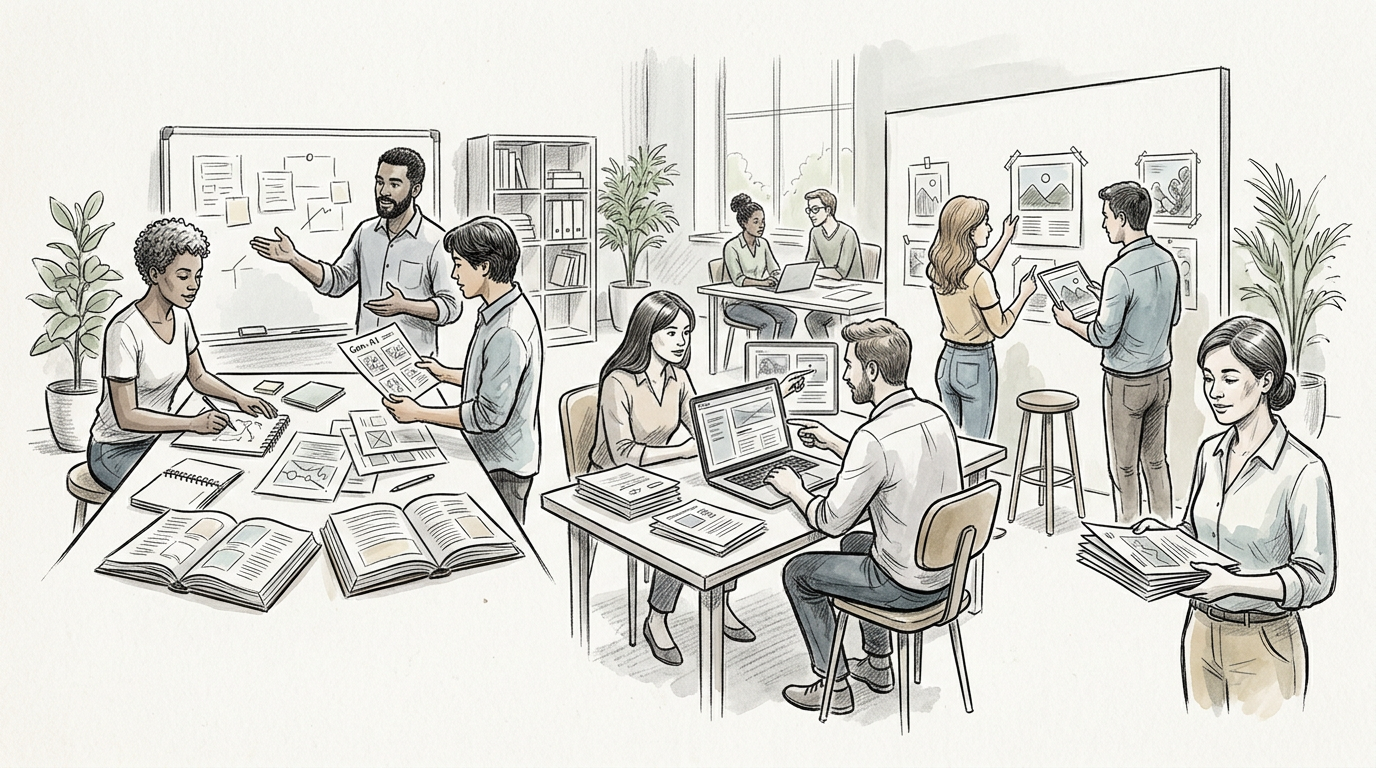
Generative AI is often discussed as if it were a single tool that either replaces creative work or leaves it untouched. In practice, it is better understood as a cluster of systems that can accelerate some parts of the creative workflow, complicate others, and place more value on judgment where brand, legal, and reputational stakes are high.
For advertising and marketing teams, the central question is not whether a machine can “be creative.” It is whether these systems can help produce useful starting points, variations, and production assets without lowering strategic quality or creating new operational risk. In many cases, they can. Large language models can draft copy options, summarize briefs, generate alternative headlines, and adapt messaging for different channels. Image-generation models can turn text prompts or reference inputs into visual concepts, backgrounds, style explorations, and rough layouts. Related tools can resize assets, remove objects, translate or localize text, clone voices under controlled conditions, and generate versioned content at greater scale than a traditional manual process.
That is already changing how agencies, in-house teams, production partners, and brand organizations approach concept development and content operations. But it is not eliminating the need for human strategy, art direction, editing, review, or accountability. If anything, generative AI makes those functions more visible because the technology can generate many outputs quickly, but it cannot reliably determine which of them should represent a brand in market.
What generative AI actually does in a creative context
Generative AI systems are designed to produce new outputs based on patterns learned from large training datasets. In marketing practice, the most relevant systems today fall into a few broad categories.
Large language models generate text, rewrite text, summarize material, classify content, and help structure messaging. They can produce copy in different lengths, tones, and formats, but they do not “know” facts in the way a human subject-matter expert does. Their output is probabilistic, which means it can be useful, polished, and wrong at the same time.
Image-generation models create or transform visuals based on text prompts, sketches, reference imagery, or uploaded assets. Some tools are designed for free-form image creation, while others are increasingly embedded inside mainstream creative software to support background generation, object insertion, expansion, retouching, or style exploration.
Video and audio generation tools are also advancing, though their reliability and suitability for production work vary significantly by task. In current advertising workflows, they are often more useful for storyboarding, animatics, rough concepting, voice experimentation, and adaptation than for final high-stakes brand output, unless tightly controlled.
These tools are not all-purpose creative substitutes. They are better understood as systems for generating options, manipulating assets, and compressing the time required for certain repetitive or exploratory steps.
Why the workflow changes even when the creative standard does not
The creative workflow has always included a mix of strategic definition, idea generation, drafting, internal review, revision, production, trafficking, and adaptation. Generative AI affects this workflow most where teams need to move from one version to many, from rough concept to multiple explorations, or from a core message to channel-specific expressions.
That matters because modern marketing already operates under conditions of content proliferation. Brands need assets across paid, owned, social, retail media, ecommerce, CRM, search, and often multiple languages or local markets. Even before generative AI, many teams were under pressure to increase content throughput without expanding timelines proportionally.
Generative AI addresses that pressure unevenly. It can reduce the time required to create first drafts, mockups, or variants. It can help teams test different directions earlier. It can speed up adaptation work that was once handled manually. But it also introduces new review burdens. More output does not automatically mean more usable output, and faster iteration can create a temptation to skip the strategic discipline that makes creative work effective.
The core standard of professional creative work does not change. The need to understand audience, clarify the message, protect the brand, support claims, and comply with platform and legal requirements remains. What changes is the distribution of effort across the workflow.
Ideation and concept exploration: faster breadth, not automatic insight
One of the clearest uses of generative AI in creative work is early-stage ideation. Teams can use language models to produce alternate campaign territories, headline directions, audience-specific angles, naming explorations, or thematic routes from a creative brief. Image-generation tools can help visualize broad stylistic possibilities before photography, illustration, or design resources are fully committed.
This can be useful for several reasons. It lowers the cost of exploring weak ideas quickly. It gives teams more rough directions to react to. It can help translate abstract strategic language into something that can be seen, critiqued, and improved. It can also support internal alignment when stakeholders need to compare multiple directions before selecting one for development.
But ideation support should not be confused with strategic originality. These systems recombine patterns from what they have been trained on and from the prompts they receive. That makes them effective at generating plausible options, not necessarily differentiated ones. Left unguided, they often default to generic category language, familiar visual tropes, and average-looking brand expression. A campaign team that treats AI outputs as strategic thinking will often end up with work that looks complete before it is actually distinctive.
This is where planners, creative directors, copy leads, and art directors remain essential. The professional task is not merely to produce options. It is to decide which strategic territory is worth pursuing, what emotional and commercial job the work must do, and whether a generated concept sharpens or weakens the brand position.
Copy development: useful drafting, unreliable authority
Language models are already being used across the copy workflow. They can help convert a brief into messaging frameworks, generate multiple headline and body-copy alternatives, adapt existing copy to different lengths, propose email subject lines, structure product descriptions, rewrite text for different reading levels, and create first-draft variants for testing.
For certain kinds of marketing language, especially high-volume and operationally repetitive formats, this can create real efficiency. Ecommerce descriptions, metadata, paid-search variants, CRM versions, retail media copy, and localization support are common examples. A well-governed system can also help maintain consistency by working from approved brand messaging, product information, and editorial rules.
Still, the gap between draft quality and publication readiness remains significant. Language models can produce fluent copy that overstates benefits, invents features, introduces compliance problems, borrows category clichés, or misses a brand’s actual voice. The smoother the writing sounds, the easier it is for weak reasoning or factual error to slip through review.
This means copywriters and editors do not become optional. Their role shifts in part from generating every line from scratch to directing prompts, evaluating alternatives, correcting inaccuracies, sharpening claims, and protecting tone. The strongest use case is often not “write the ad for me,” but “give me ten structured approaches based on this brief and these constraints so I can develop the strongest one.”
For regulated industries or products with substantiation requirements, human review is especially important. A model cannot be trusted to determine whether a claim is legally supportable, medically accurate, or aligned with disclosure rules. Approval responsibility still belongs to people and organizations, not to the system that drafted the line.
Image generation and art direction: acceleration with aesthetic and legal constraints
Image-generation tools have had an obvious effect on creative experimentation because they can create visual concepts far more quickly than traditional production methods. Teams can use them to explore mood, color, composition, character types, environments, packaging contexts, and campaign visual directions at the rough-concept stage. Designers can create comps before commissioning shoots or illustrations. Production teams can generate placeholders and references to communicate intent more efficiently.
Integrated features in creative platforms have also made narrower tasks easier. Background replacement, image expansion, object cleanup, compositing assistance, and variant generation can reduce time spent on technical adjustments. In some cases, that shifts effort away from repetitive production work and toward higher-value visual decisions.
Yet image generation remains highly dependent on human art direction. A model can produce many images, but it does not reliably understand a brand system, visual hierarchy, product truth, cultural sensitivity, or the fine differences between “attention-grabbing” and “off-brand.” It can also produce inconsistencies in anatomy, typography, logos, packaging details, perspective, and object relationships that make an image unsuitable for final use without substantial correction.
There are also important rights and provenance questions. The legal status of training data and generated outputs remains contested in some contexts, and copyright law is still developing around AI-generated works. The U.S. Copyright Office has stated that purely AI-generated material without sufficient human authorship is generally not eligible for copyright protection, while works containing human-authored selection, arrangement, or modification may qualify depending on the facts. That matters for campaigns where ownership, exclusivity, and reuse rights are important. Brands and agencies should also review the terms, indemnities, and content policies of the specific tools they use rather than assuming all platforms offer the same protections. The U.S. Copyright Office’s guidance is available at https://www.copyright.gov/ai/.
For final creative output, especially in large brand campaigns, image generation is often most useful as part of the development and production-support process rather than as an unrestricted replacement for established visual craft.
Adaptation and versioning: one of the most practical applications
If there is a part of the workflow where generative AI offers immediate operational value, it is adaptation. Marketing organizations rarely produce only one asset. They produce families of assets: six-second, 15-second, and 30-second cuts; platform-specific crops; alternate headlines; different product configurations; localized versions; retailer-specific formats; and audience-targeted message variants.
Generative systems can help create these permutations faster. A language model can rewrite approved copy for different channels while preserving the core message. Image tools can extend, resize, or recompose assets for multiple formats. Video tools can support subtitling, transcript generation, translation, and rough recutting assistance. Combined with templates and digital asset management systems, AI features can compress the time between master concept and deployable asset set.
This is not a trivial change. Adaptation work consumes significant creative operations capacity, and it often happens under tight deadlines late in the campaign cycle. When done well, automation in this area can help teams preserve quality while handling scale.
But the quality question remains. Automated versioning only works if the source material, brand rules, and approval logic are clear. Otherwise, teams may generate many variants that technically fit size requirements but drift from the intended message or visual standard. Personalization and localization can also increase the risk of inconsistency if outputs are not governed by approved language, cultural review, and clear escalation rules.
Production support, not just content generation
Some of the most consequential uses of generative AI in creative work are not headline-grabbing content outputs at all. They are support functions inside production workflows.
These include:
- Summarizing creative briefs and research materials.
- Extracting key messages from existing documentation.
- Tagging and organizing assets in content libraries.
- Generating shot lists, call sheets, rough scripts, or edit outlines.
- Creating transcripts, captions, and accessibility-support materials.
- Helping convert approved campaign language into modular content components.
This kind of workflow assistance can reduce friction around handoffs and make creative operations more efficient without raising the same level of consumer-facing risk as fully generated campaign assets. For many organizations, those quieter applications may produce more dependable value than attempts to automate top-level concept creation.
What human oversight still does that the technology does not
The most useful way to think about generative AI in the creative workflow is not to ask where humans remain “in the loop” as a ceremonial safeguard. It is to identify the functions that require judgment the system cannot reliably supply.
Strategy remains a human responsibility because it depends on business context, category understanding, audience insight, competitive interpretation, and decision-making under ambiguity. A model can summarize positioning statements; it cannot decide which strategic tradeoff a brand should make.
Art direction remains a human responsibility because a brand’s visual identity is not simply a style prompt. It involves coherence across assets, sensitivity to context, and an understanding of what details communicate quality, trust, or distinctiveness.
Editing remains a human responsibility because generated content often needs compression, clarification, taste, and discipline. More options can create the illusion of progress while making it harder to recognize the strongest idea.
Approval remains a human responsibility because accountability for claims, representation, disclosures, rights, and brand risk cannot be delegated to a tool. No output should be treated as self-validating because it was produced quickly or appears polished.
In that sense, generative AI often shifts creative work upward. Less time may be spent on blank-page drafting or mechanical resizing. More time may be spent on defining constraints, choosing among alternatives, integrating outputs into a coherent campaign system, and maintaining quality under higher-volume production conditions.
Why governance matters inside the creative process
As generative AI moves into mainstream creative software and enterprise marketing platforms, the governance issue is no longer limited to specialized innovation teams. It becomes a routine operational concern.
Organizations need to decide what data can be used in prompts, which tools are approved, whether outputs can be used for internal ideation versus public release, how rights and disclosure are handled, and what review steps are mandatory by asset type. Some models retain or process user inputs under terms that may not be appropriate for confidential campaign materials, unreleased product information, or client data. Others offer enterprise controls designed to limit that exposure. Those distinctions matter.
Brands and agencies should also be careful about provenance and verification. If a tool generates a visual resembling a real location, person, product configuration, or protected work, someone must verify whether the use is accurate, licensed, or potentially misleading. Synthetic spokesperson content, cloned voices, and photorealistic generated scenes raise additional disclosure and trust questions depending on context.
Standards work is also beginning to shape these practices. The Content Provenance and Authenticity effort led by the Coalition for Content Provenance and Authenticity, or C2PA, aims to provide a technical method for attaching provenance information to digital media. Adoption is still developing, and it does not solve every authenticity problem, but it is relevant for marketers thinking about transparency and asset traceability. More information is available at https://c2pa.org/.
The economic tradeoff is not simply “faster equals cheaper”
Generative AI is often sold on speed and scale, and there is truth to that. It can lower the labor required for some categories of drafting, adaptation, and mockup creation. But creative organizations should be cautious about assuming that speed automatically lowers total cost or improves effectiveness.
A faster tool can create more review work. It can generate more stakeholder opinions because more options are available. It can increase the number of assets expected per campaign. It can shift labor from production vendors to internal reviewers, editors, and legal teams. It can also lower the cost of mediocre content in ways that flood channels without improving performance.
The operational gain is real when teams have a clear use case, a defined approval process, and an understanding of where automation adds value. It is weaker when the tool is used simply because it exists, without a workflow redesign that matches actual business needs.
For agencies, this may also affect pricing models and client expectations. If adaptation becomes more automated, clients may expect greater output volume or faster turnarounds. Agencies will need to articulate the continued value of strategic development, concept refinement, governance, and quality control rather than treating all creative labor as interchangeable production time.
What advertising and marketing professionals should watch closely
Several practical questions will determine whether generative AI improves the creative workflow or merely adds another layer of complexity.
The first is whether organizations can separate exploratory use from final-use production standards. Rough concepts have different risk tolerances than published campaign assets.
The second is whether teams have structured brand guidance in forms that AI-enabled systems can actually use. A brand book written for human interpretation may not be enough to support automated adaptation at scale. Modular messaging frameworks, approved claims libraries, and structured visual rules become more important.
The third is whether performance claims are being measured realistically. Many vendors promise faster production, better personalization, and stronger performance, but evidence tends to be strongest for efficiency gains in bounded tasks and weaker for broad claims about campaign effectiveness. Teams should evaluate results by workflow segment rather than assuming a general uplift.
The fourth is whether human review capacity keeps pace with machine-generated volume. If not, the organization may simply move the bottleneck downstream.
Generative AI changes the workflow by changing where effort matters most
Generative AI is already altering creative operations in advertising and marketing, especially in ideation support, copy drafting, visual exploration, adaptation, and versioning. Its strongest demonstrated value is not that it independently produces great advertising. It is that it can help creative teams move through certain stages of exploration and production more quickly, with more options and greater scale.
That does not reduce the importance of human creative work. It clarifies it. The parts of the workflow most affected by automation are often the parts where speed and variation matter. The parts that remain firmly human are the parts where brands decide what they mean, what they can credibly say, how they should look, what risks they will accept, and what quality standard they are willing to publish.
For advertising and marketing professionals, that is the practical takeaway. Generative AI changes the workflow not by eliminating judgment, but by increasing the amount of output that depends on judgment to become useful.
Leave a Reply