
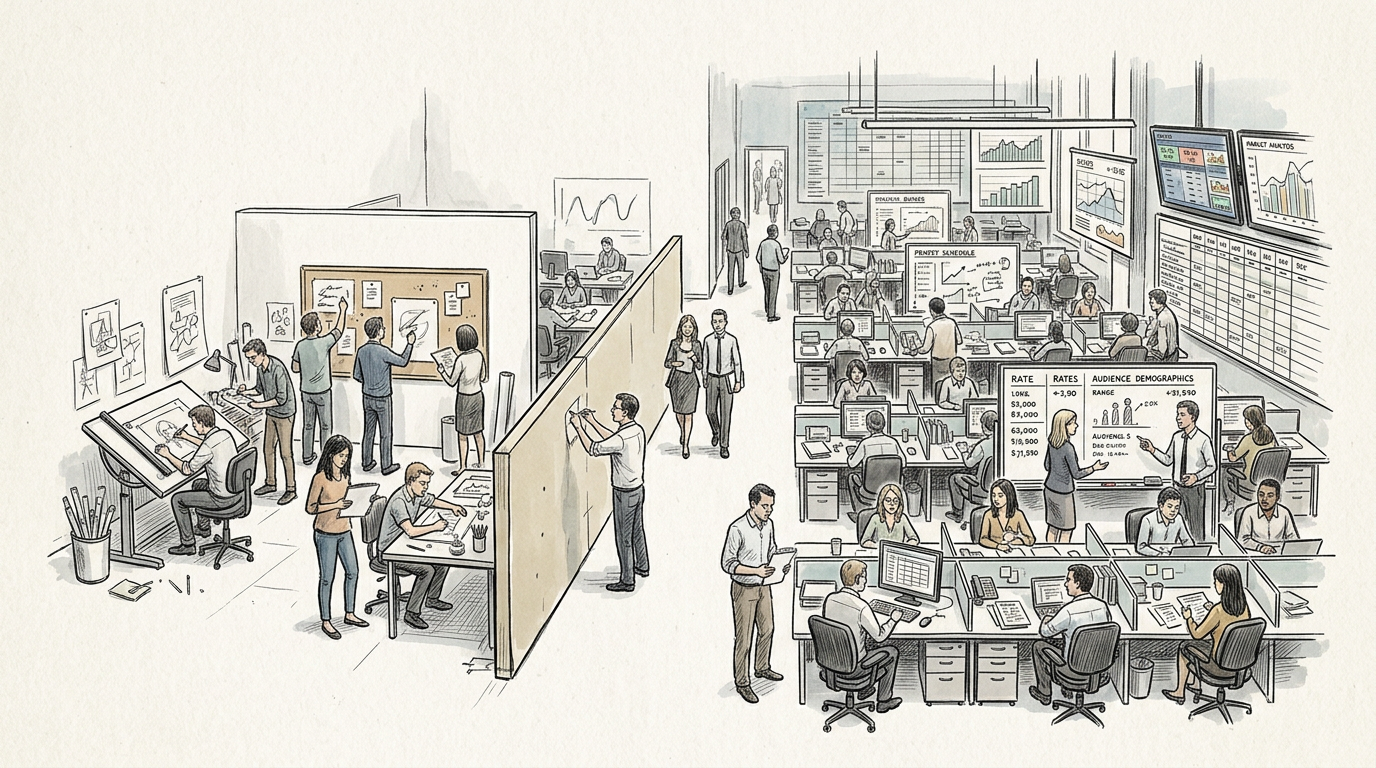
For much of the twentieth century, media buying was not a separate business. It was one of the core functions of the full-service advertising agency, sitting alongside copy, art, account management, and client counsel. Agencies planned campaigns, negotiated space in newspapers and magazines, placed radio and television schedules, and were typically paid through media commissions. In that system, creative development and media placement were commercially and operationally intertwined.
By the end of the twentieth century, that arrangement had been fundamentally reorganized. Media planning and buying had become specialized businesses, often housed in stand-alone media agencies or global media networks structurally distinct from creative shops. That shift changed how agencies made money, how clients evaluated performance, how media owners sold inventory, and how advertising itself was planned. It also laid important groundwork for the contemporary ad industry, in which audience data, buying technology, procurement pressure, and platform complexity make media specialization seem almost inevitable.
The separation did not happen because one generation of executives suddenly decided that media deserved its own organizational chart. It emerged from a longer chain of changes in agency compensation, advertiser demands, media scale, audience measurement, computerization, and negotiation economics. Understanding that history helps explain why media agencies became so powerful in the late twentieth and early twenty-first centuries, and why the relationship between creative agencies and media specialists has remained one of the defining structural questions in advertising.
When media was the agency’s commercial center
In the classic full-service model that took shape in the late nineteenth and early twentieth centuries, agencies grew out of media brokerage. Early American agencies such as N.W. Ayer & Son and J. Walter Thompson developed from systems in which buying newspaper and magazine space was a central service, not a support function. By the early twentieth century, agencies had broadened into campaign development, research, copywriting, and account service, but media remained financially central because agency compensation was typically tied to media placement.
The standard agency commission system, commonly described as the 15 percent commission on media billings, was never as timeless or universal as later memory sometimes suggests. It evolved across different media and markets, and it was shaped by publisher and broadcaster practices rather than by a single founding rule. Still, by the middle decades of the twentieth century, the commission system was entrenched enough that large advertisers and agencies organized their relationships around it. As long as media volume drove agency income, media buying was not merely a technical function. It was one of the agency’s economic foundations.
This mattered professionally. Agencies had strong incentives to cultivate relationships with publishers and broadcasters, understand circulation and audience data, and build internal expertise in scheduling and negotiation. Media departments became important centers of craft knowledge. In print they dealt with rate cards, position, color, regional editions, and closing dates. In radio and television they managed sponsorships, spot buying, network options, and the fast-changing economics of broadcasting. Research departments supported these decisions with readership studies, circulation audits, ratings data, and eventually television audience measurement.
By the 1950s and 1960s, major agencies were already highly sophisticated in media work. The rise of television intensified that sophistication. Buying national television required scale, timing, and experience. Nielsen ratings, network sales structures, and the growing importance of reach and frequency made media more analytically demanding than the older image of space-buying clerks would imply. Yet this growing complexity did not immediately produce organizational separation. Instead, it reinforced the full-service model by making agencies more indispensable to clients.
The commission system created both stability and strain
For decades, the full-service agency’s promise was straightforward: one firm could develop strategy, produce creative work, and place the advertising. But the same compensation model that gave agencies stability also created tensions that became harder to ignore after the 1960s.
As marketing grew more complex, advertisers began asking for services that were not neatly compensated by media commissions. Research, promotion, package design, direct marketing, and other specialized functions did not always fit comfortably into a model built around media billings. At the same time, some marketers began to question whether commissions distorted incentives. If agency income rose with spending volume, was the agency being rewarded for business results or simply for placing more media?
These concerns were amplified by broader changes in advertiser management. Large corporations were becoming more metrics-oriented, more procurement-conscious, and more willing to scrutinize outside suppliers. The commission system remained powerful, but it no longer seemed inevitable. Fee arrangements, project billing, and hybrid compensation structures gained ground in later decades, weakening the old economic bond that had held creative and media functions together.
There was also a structural imbalance inside agencies. Creative departments increasingly became the symbolic center of agency identity, especially after the celebrated creative culture associated with firms such as Doyle Dane Bernbach. But media departments remained the place where huge sums of money actually moved. That combination could generate internal tension. Media was commercially vital, increasingly technical, and often under-recognized in public narratives of agency value.
Television scale and negotiation began to reward specialization
The postwar expansion of television did not immediately split media from creative, but it created some of the conditions that later made separation plausible. National television buying concentrated very large budgets in a comparatively small number of sellers and dayparts. That concentration rewarded buying leverage.
Agencies with enough aggregated billings could negotiate more effectively with networks and station groups. They could secure better pricing, better unit access, and stronger marketplace intelligence. These advantages did not depend only on creativity or client strategy. They depended on scale, market knowledge, and constant contact with sellers.
As television matured, media buying became more institutionalized as a market function in its own right. The annual network upfront system, in which major advertisers and agencies committed large sums in advance to secure inventory, put a premium on forecasting, negotiation discipline, and pooled volume. Spot television, local radio, print, and outdoor each had their own buying conventions, but television became the clearest example of how aggregated demand could create buying power.
This did not mean agencies were simply bargaining for lower prices in a straightforward commodity market. Media value also depended on context, programming, audience composition, seasonal demand, market-by-market variation, and increasingly granular research. But as billings grew, it became harder to argue that media decisions were just an extension of creative service. They were becoming a specialist commercial practice.
Research and computing changed what “media planning” meant
The distinction between media planning and media buying also became more pronounced over time. Earlier agencies had certainly planned media, but the planning function grew more formal as audience research expanded and computer-assisted analysis became practical.
From the 1960s onward, agencies and advertisers had access to increasingly sophisticated audience data. In television, Nielsen’s ratings services and related research tools became central to campaign construction. In print, audited circulation and readership studies provided comparative measures for magazine and newspaper planning. In later decades, syndicated consumer research, product usage databases, geodemographic systems, and single-source or fusion-based planning tools encouraged a more analytical view of audience allocation.
Computerization mattered here. Media planning had once involved labor-intensive manual tabulation. As mainframes, minicomputers, and later desktop systems became part of agency operations, planners could model schedules, compare efficiencies, and test distribution strategies with greater speed. Concepts such as cost per thousand, reach, frequency, duplication, and target composition had long been part of professional media language, but new systems made them easier to operationalize across larger datasets.
This development helped change professional identity. Media specialists could now claim expertise not simply in placement mechanics but in analytical planning. They were not just buyers negotiating with sellers. They were strategists interpreting data, optimizing schedules, and advising clients on how advertising exposure should be distributed across markets and audiences.
That analytical claim would become even more important in the 1980s and 1990s, when fragmentation and accountability pressures made media decisions seem too consequential and too technical to remain just one department within a generalist agency structure.
The media environment fragmented
In the middle decades of the twentieth century, many large advertisers operated in a comparatively concentrated mass-media system. National magazines, network radio, network television, metropolitan newspapers, and outdoor provided a limited set of major channels. Even within that environment, media planning was complex, but the broad architecture was relatively stable.
That stability eroded in the late twentieth century. Cable television expanded. Syndication proliferated. More specialized magazine categories emerged. Radio formats multiplied. Local and national opportunities became more segmented. By the 1980s and 1990s, advertisers were navigating a much more fractured audience environment than the three-network era had presented.
Fragmentation changed the economics of expertise. In a simpler media market, a full-service agency could plausibly keep creative and media integrated because the number of significant buying channels was manageable. In a fragmented market, the sheer amount of information, inventory, and performance comparison made specialization more attractive. More channels meant more research inputs, more pricing variables, more audience intersections, and more negotiating relationships.
This was not only a television story. Print buyers faced increasingly segmented publication ecosystems. Direct marketing and database-driven targeting were expanding. Outdoor companies were consolidating while also diversifying formats. Early digital services began to appear by the 1990s, adding another emerging channel with its own metrics, vendors, and technical demands.
As complexity rose, large advertisers increasingly wanted media operations that could aggregate knowledge across categories and clients. A dedicated media unit could promise concentrated expertise, larger buying scale, and more consistent investment in systems than a traditional agency media department serving primarily as one part of a broader creative organization.
The British opening and the global spread of media independents
One of the most important turning points in the separation of media from full-service agencies occurred in the United Kingdom during the 1980s, where the economics of media negotiation and agency compensation encouraged new organizational forms. The details varied by market, but the broader lesson traveled quickly: media could be extracted from the full-service bundle and run as a specialist business.
Among the best-documented landmarks was the launch of The Media Business in London in 1987 by Christopher Ingram, following his departure from Saatchi & Saatchi. It presented itself as an independent media specialist at a moment when large advertisers were increasingly receptive to the idea that media buying and planning could be handled outside the traditional full-service agency model. Around the same period, other specialist media operations and buying groups were proving that scale itself could be a saleable service.
The British market mattered beyond Britain because many multinational advertisers and holding companies watched it closely. If media scale and specialist focus could deliver economic advantage there, the logic could be applied elsewhere. By the late 1980s and 1990s, major agency groups were building or acquiring media operations that were organizationally more distinct from their creative agencies.
The idea of the “media independent” was not just that media was separable, but that it could be more powerful when separated. A specialist shop could pool clients who did not share a creative agency. That pooling increased billings and therefore negotiation leverage. It also justified investment in proprietary tools, planning systems, research capability, and dedicated buying talent.
Why holding companies embraced stand-alone media agencies
Once large agency holding companies saw that pooled media scale could become a competitive asset, structural separation accelerated. In the 1990s and early 2000s, global groups reorganized aggressively around media networks.
WPP created GroupM in 2003 as the management company for its media investments, bringing together operations associated with Mindshare, Mediaedge:cia, and later Maxus and others. Omnicom developed OMD as a global media brand in the 1990s and expanded a broader media services structure that would later include PHD. Publicis and Interpublic made similar moves through media networks and centralized buying structures. Havas Media, then developing under earlier corporate configurations, reflected the same strategic direction.
These reorganizations were responses to several reinforcing pressures.
First, scale produced bargaining power. A holding company that pooled billions in client media spending could negotiate more effectively across television, print, radio, and emerging digital channels than a single creative agency could on its own.
Second, technology investment was becoming more expensive and more strategically important. Audience databases, planning software, optimization tools, and later digital ad-serving and buying systems required dedicated capital and specialist staff.
Third, clients increasingly separated media reviews from creative reviews. A marketer might retain one agency for brand strategy and creative development while appointing another for media planning and buying. Once clients became willing to unbundle services, agency groups had strong incentives to offer stand-alone media products.
Fourth, transparency and accountability pressures encouraged formalization. Media clients wanted more explicit reporting on rates, efficiencies, delivery, and stewardship. A specialized media agency could position itself as more disciplined and data-driven than the older image of the creative-led full-service shop.
Fifth, global clients wanted consistency across markets. Media agencies could centralize tools, trading principles, vendor relationships, and reporting structures across regions in ways that matched the globalization of large advertisers.
The result was not the disappearance of full-service agencies, but a redistribution of power inside the agency business. In many holding companies, media operations became some of the largest revenue generators and most strategically important units.
Unbundling changed the client-agency relationship
The rise of dedicated media agencies was also part of a larger history of unbundling in marketing services. Advertisers increasingly broke apart tasks that had once been entrusted to one lead agency: media, direct response, promotion, public relations, digital, CRM, shopper marketing, and analytics could all be assigned separately.
This shift reflected management fashion, but it also reflected real operational change. Different disciplines now required different infrastructures. A creative agency’s value proposition rested on brand development, messaging, and executional originality. A media agency’s proposition rested on audience strategy, market intelligence, negotiation, performance analysis, and buying systems.
As unbundling spread, media reviews became major procurement events. Marketers compared agencies on rates, planning tools, category expertise, global capabilities, and financial controls. The review process itself reinforced specialization by asking media agencies to compete on criteria that differed from those used in creative reviews.
At times, this created friction. Critics argued that separating media from creative risked weakening campaign coherence. If the agency shaping the message was not the same agency shaping audience delivery, strategic integration could suffer. Supporters countered that modern media complexity made specialization unavoidable and that disciplined collaboration could preserve integration where it mattered.
Both arguments had merit, and both reflected real industry experience. The historical point is not that one model definitively defeated the other. It is that the conditions of late twentieth-century advertising made the single-agency bundle less stable than it had once been.
Compensation, rebates, and transparency debates
The separation of media from creative also intensified longstanding debates about how agencies are paid and how value is extracted from media markets. Under the classic commission system, agency compensation was linked visibly to billings. As that system weakened, a wider range of fee structures, performance models, and trading arrangements emerged.
This transition brought new scrutiny. Large-scale media buying generated questions about volume incentives, free space, rebates, and principal trading practices in different markets and periods. Some of these practices had deep historical roots in the commercial realities of media markets; others became controversial precisely because specialized media agencies operated at such scale that small margin differences could become significant.
Industry bodies and trade press examined these issues repeatedly. In the United States, the American Association of Advertising Agencies and the Association of National Advertisers were among the organizations involved in debates over compensation, stewardship, and transparency. Later, high-profile concerns about media transparency in the 2010s drew attention from auditors, consultants, and trade associations, reminding the industry that the structural separation of media had not ended old agency incentive problems. It had changed their form.
Historically, this matters because specialization did not produce a purely technical market governed only by neutral optimization. Media agencies were, and are, commercial intermediaries. Their rise reflected genuine professional expertise, but also the economic logic of aggregation, arbitrage, and negotiation in complex media markets.
Digital accelerated a separation that had begun earlier
It is tempting to treat digital advertising as the cause of media specialization, but that overstates the case. Dedicated media agencies were already well established before the internet became central to advertising. The more accurate view is that digital accelerated and deepened an existing structural change.
Online advertising introduced new forms of buying, trafficking, targeting, measurement, and optimization. Ad servers, web analytics, search marketing, demand-side platforms, ad exchanges, verification tools, and programmatic systems expanded the skill set required to manage media effectively. The operational distance between creative development and media execution widened further.
Digital also reinforced the logic of centralized data and technology investment. Few creative agencies could justify building all the infrastructure needed for cross-channel digital planning and buying at scale. Specialized media networks, by contrast, could spread those costs across many clients and markets.
At the same time, digital revived an older truth: media and message were still deeply interconnected. Search copy, display formats, social placements, video units, retail media listings, and dynamic creative optimization all showed that channel mechanics could shape the communication itself. So while digital strengthened media specialization institutionally, it also exposed the costs of treating creative and media as entirely separate worlds.
What actually changed in professional practice
The historical significance of specialized media agencies lies not only in corporate restructuring but in day-to-day professional practice.
Before the rise of stand-alone media businesses, many advertisers treated media as one department within a larger agency relationship. After specialization, media became its own strategic conversation, its own review process, and often its own center of power in budget allocation.
Several practical changes followed:
- Media planning became more explicitly data-driven and tool-dependent.
- Buying leverage increasingly depended on pooled volume across many clients.
- Media owners negotiated with organizations whose primary value proposition was trading and planning expertise rather than creative development.
- Marketers developed more formal media governance, including auditing, benchmarking, and performance reporting.
- Agency holding companies built networks in which media leadership could rival or exceed the strategic influence of creative leadership.
These changes also altered career paths. Media professionals gained routes to senior leadership through specialized agencies rather than through full-service agency hierarchies. Dedicated media shops created more distinct disciplines within planning, buying, analytics, investment, ad operations, and later digital activation.
Why this history still matters
The rise of dedicated media agencies was not a minor administrative reshuffle. It marked a redefinition of what counted as agency expertise and how advertising value was organized. In the commission era, media placement was the economic engine of the full-service model. In the specialist era, media became a business important enough to stand on its own, supported by its own data systems, trading structures, and global networks.
That transformation was driven by several forces working together: the weakening of traditional commission economics, the scale advantages of pooled buying, the growth of television and then fragmented multichannel media, advances in audience measurement and computing, more demanding advertiser procurement, and the capital requirements of digital systems. No single turning point explains the shift on its own.
What endured from the earlier era was the central importance of media as a marketplace. What changed was the industry’s recognition that navigating that marketplace could itself be the basis of a specialized agency business.
For modern advertising professionals, this history is useful because it clarifies a recurring industry tension. Advertising has always needed both persuasive communication and effective distribution. The full-service agency once held those functions together under one commercial structure. Specialized media agencies emerged when market complexity, data intensity, and buying scale made that structure less stable. The resulting division of labor solved some problems and created others, but it permanently changed how the industry defines agency value.
That is why media buying did not simply become more complicated. It became a separate business.
Leave a Reply