
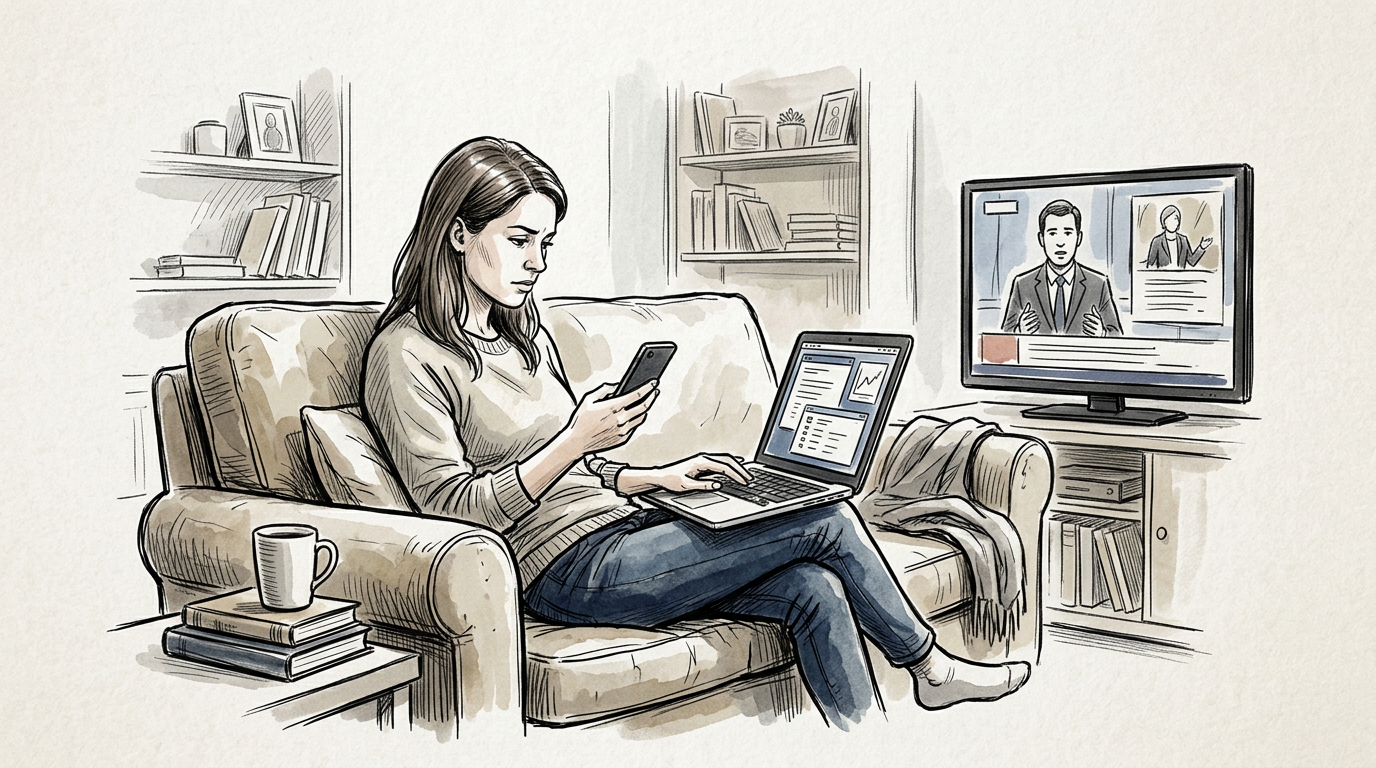
Advertising has always competed for attention. What has changed is the environment in which that competition happens. A viewer can stream a show while checking social feeds, scanning retail apps, responding to messages, and glancing at a laptop open nearby. In that setting, an ad may be on screen, audible, and technically viewable, yet still fail to leave much of a memory trace.
Academic research on media multitasking helps explain why. Across psychology, communication, and marketing, the evidence points to a straightforward but often misunderstood principle: exposure is not the same as encoding. People can look at multiple screens or switch rapidly among tasks, but cognitive processing remains limited. When attention is divided, advertising may still be noticed in a basic sense, yet it is less likely to be processed deeply enough to support later recall, recognition, or persuasion.
For marketers, that distinction matters. If a campaign is evaluated mainly on delivery and visibility metrics, it may overstate what audiences actually took away from the experience.
### The cognitive bottleneck behind multitasking
A useful starting point is not advertising research at all, but cognitive psychology. Daniel Kahneman’s capacity model of attention, first developed in the 1970s, argued that attention is a limited resource that people allocate across tasks rather than an unlimited system that can fully process everything at once. Later work on working memory by Alan Baddeley and others reinforced the same general point: people can maintain and manipulate only a constrained amount of information at a time.
That basic framework has held up well, even as media environments have changed. When two tasks draw on overlapping cognitive resources, performance usually suffers on one or both. In practice, so-called multitasking often consists of rapid task switching, not simultaneous full processing. Switching itself carries costs, including slower responses, more superficial processing, and weaker memory for what was encountered.
This is consistent with a large experimental literature on divided attention and memory. In one influential review, Robert Craik, Fergus I. M. Govoni, Moshe Naveh-Benjamin, and Nicole D. Anderson examined how dividing attention during encoding affects later remembering. Their findings showed that memory formation is especially vulnerable when attention is split at the moment information is being encoded. Retrieval can also suffer, but encoding costs are particularly robust. For advertising, the implication is clear: if consumers are texting, scrolling, or monitoring another screen when an ad appears, the brand message may never be encoded strongly enough to support later recall.
### Visibility is not memory
That point aligns with longstanding advertising and memory research. Scholars have repeatedly distinguished between mere opportunity to see and meaningful processing of a message. Attention affects whether information moves beyond fleeting sensory exposure into working memory and then, potentially, into longer-term storage.
Research on attention in advertising often draws on levels-of-processing theory, associated with Fergus Craik and Robert Lockhart. The central idea is that deeper, more elaborative processing tends to support better memory than shallow perceptual exposure. An ad glimpsed while someone is half-watching television and half-composing a text may register visually, but if the viewer does not semantically engage with the brand, claim, or execution, later recall may be weak or absent.
This does not mean every ad requires prolonged, effortful concentration. Distinctive assets, familiar brand cues, repetition, and emotionally salient creative can still leave traces under lower-attention conditions. But the research suggests that low attention changes what is likely to be remembered. Broad sensory impressions may survive. Specific claims, new product information, URLs, pricing, and calls to action are more vulnerable.
### What media multitasking research actually shows
The term media multitasking generally refers to consuming one medium while using another, such as watching television while using a smartphone. Communication researchers have studied this behavior extensively because it has become routine rather than exceptional.
A widely cited review by Shalom M. Fisch, Pantea Ferdig, and colleagues on media multitasking and cognitive processing synthesized findings showing that simultaneous media use often reduces comprehension and memory compared with focused exposure, though the size of the effect depends on the tasks, the medium, and the user’s goals. The researchers also noted an important nuance: people multitask partly to manage boredom, social connection, and perceived efficiency, so the behavior persists even when it impairs processing.
More directly relevant to advertising, studies of “second-screen” television behavior have found that attention to advertising declines when another device is used during breaks or while programming continues. In one stream of research, marketing and media scholars measured television ad memory under conditions where participants also engaged with a tablet or smartphone task. The general pattern is consistent: concurrent device use tends to reduce ad recall and recognition relative to single-task viewing, particularly for ads requiring verbal or conceptual processing.
These studies vary in design. Some use lab experiments with assigned multitasking tasks. Others use naturalistic observation or passive measurement panels that track device use while participants watch television at home. Lab studies provide stronger control over causality but may oversimplify real-world behavior. Field studies are more realistic but often make it harder to determine whether multitasking itself caused lower memory or whether lower-interest viewers were simply more likely to multitask. The convergence across methods is what gives the broader conclusion weight.
### Why divided attention disrupts ad encoding
There are several mechanisms behind the effect, and they matter because each points to different creative and media implications.
First, multitasking reduces available processing capacity. If a person is reading messages or navigating an app, fewer resources remain for processing ad content. This is especially problematic for messages that depend on language, argument structure, comparison, or sequential storytelling.
Second, multitasking interrupts continuity. Advertising often relies on cumulative processing across a few seconds: the brand appears, a narrative develops, a benefit is demonstrated, and a closing frame ties it together. Task switching can break that sequence. Even if the viewer catches parts of the ad, they may miss the integration required to form a coherent memory.
Third, divided attention weakens transfer into memory. Cognitive research distinguishes between initial perception and durable encoding. Under distraction, consumers may notice colors, motion, a celebrity face, or a sonic cue without forming a strong memory for brand-message links. In advertising terms, the execution may be seen without the intended brand association being firmly stored.
Fourth, multitasking can encourage habitual rather than reflective processing. That does not make advertising ineffective, but it changes what works. Quick heuristics, familiar visual assets, and emotionally immediate signals may fare better than dense informational copy.
### Second-screen behavior is not all the same
It is tempting to treat all multitasking as equally harmful, but the evidence is more nuanced. What the second screen is used for matters.
When the concurrent activity is unrelated to the ad or program, such as messaging, browsing, gaming, or shopping elsewhere, memory for ad content generally declines. Those tasks compete directly for visual attention, language processing, or executive control.
When the second-screen activity is related to the content being watched, the outcome can differ. Research on cross-platform engagement suggests that synchronized, relevant interaction may reinforce rather than undermine memory in some cases. For example, looking up sports statistics during a game or participating in a program-related social conversation can deepen involvement with the event. For advertisers, this raises the possibility that coordinated second-screen experiences, if tightly related and well timed, may support engagement. But that should not be confused with a general benefit of multitasking. The supportive effect appears more likely when the second activity complements the primary content rather than competes with it.
Even then, the brand’s own message must still survive the competition. A related social feed can intensify attention to the event while reducing attention to the ad break. Engagement with the medium does not automatically translate into encoding of the advertising.
### Heavy media multitaskers and attentional control
A separate line of research asks whether people who frequently media multitask develop different attentional habits over time. This literature received major attention after work by Eyal Ophir, Clifford Nass, and Anthony D. Wagner at Stanford reported that heavy media multitaskers performed worse on some tests of attentional control and susceptibility to irrelevant information than light multitaskers. The study, published in the Proceedings of the National Academy of Sciences, helped shape popular discussions about a “distracted” generation.
The interpretation, however, requires caution. The study was influential, but later work has produced mixed results. Some replications found associations between heavy media multitasking and poorer sustained attention or working memory performance, while others found weaker effects or results that depended heavily on measurement choices. A meta-analysis by Rui Zhang and Zheng Wang, for example, concluded that the relationship between media multitasking and cognitive control exists but is small and heterogeneous across studies.
For marketing professionals, the practical takeaway is not that heavy multitaskers are cognitively impaired in a broad sense. The evidence does not support such a sweeping claim. What it does suggest is that frequent multitasking is associated, at least in some contexts, with more fragmented attention and greater distractibility. In ad environments built around constant switching, that pattern may make focused encoding even harder to achieve.
### What eye tracking and attention metrics add
Advertising researchers have increasingly used eye tracking, biometric measures, and passive attention data to understand this gap between exposure and processing. These tools can reveal whether people looked at a stimulus, for how long, and sometimes in what sequence. That information is valuable, but it also illustrates the limits of simple viewability concepts.
A glance is not the same as comprehension. Eye movements indicate visual orientation, not necessarily conceptual processing or later memory. Someone may fixate briefly on a brand logo and still fail to recall the ad afterward if attention immediately shifts elsewhere. Likewise, audio may be audible in the room without receiving enough active listening to encode the message.
This distinction appears in advertising memory research that compares attentive versus inattentive exposure. Recognition tends to be less
Leave a Reply