
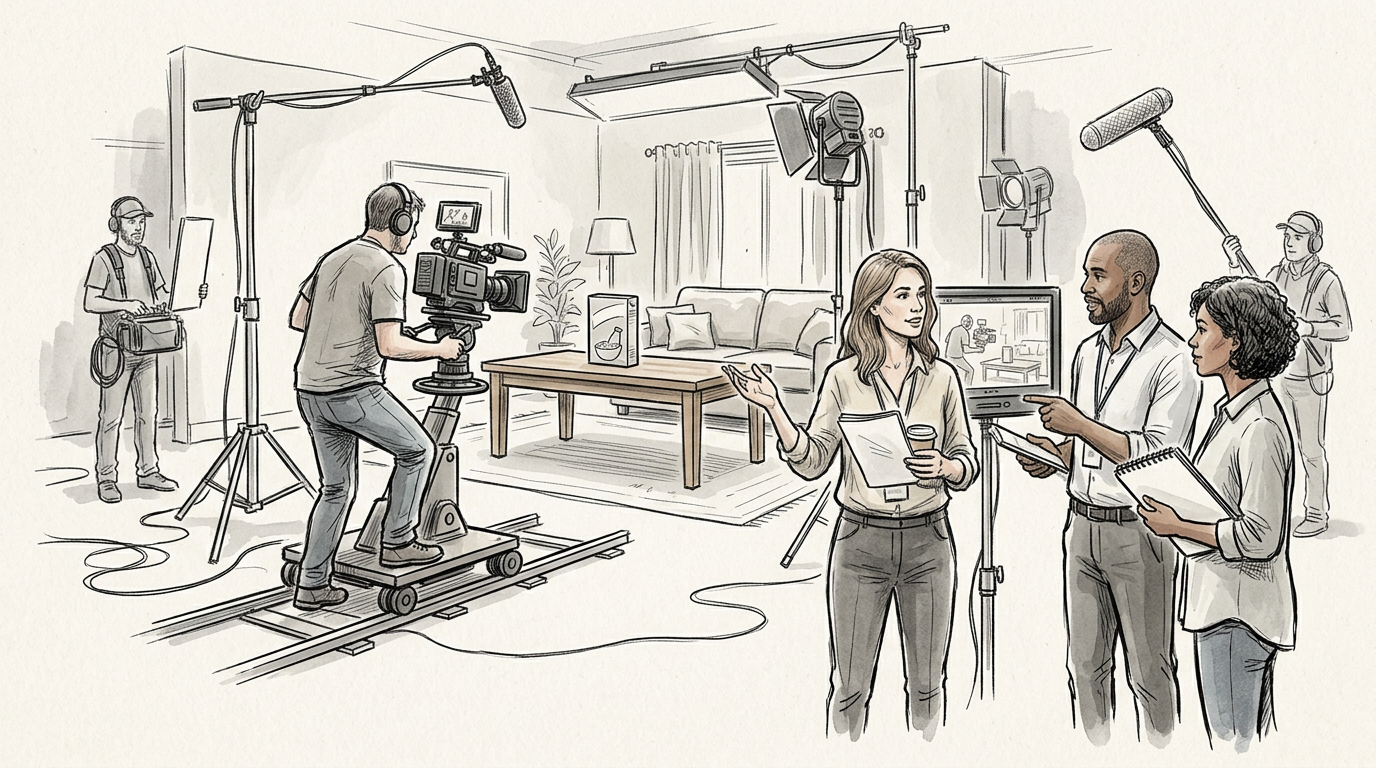
Long before “brand integration” became a line item in media plans, advertisers and entertainment producers were testing ways to put products inside the content itself. Sometimes that meant a studio borrowing a car or a radio program naming a sponsor. Sometimes it meant a negotiated fee for a branded appearance designed to shape audience perception without looking like a conventional advertisement. Over time, those practices developed into product placement, a hybrid form that sat uneasily between advertising, publicity, sponsorship, and storytelling.
That hybrid status is exactly why product placement matters to advertising history. It shows how advertisers responded whenever audiences became harder to reach or more resistant to interruption. It also reveals how media industries monetized content by inviting brands more deeply into the creative product. The history of placement is not a simple story of a clever tactic becoming standard practice. It is a history of changing business arrangements, evolving disclosure rules, technological shifts, and recurring arguments about influence, transparency, and editorial independence.
Before “product placement” had a name
Commercial goods appeared in entertainment long before the modern advertising industry developed a formal vocabulary for the practice. In the nineteenth century, theatrical productions often depended on local merchants, costume suppliers, and other commercial relationships, though these arrangements were not standardized as advertising buys. By the early motion picture era, branded goods sometimes appeared on screen because they were simply part of modern life, because producers needed props, or because companies saw value in association with stars and settings.
That distinction matters historically. Not every visible product in early entertainment was a paid placement, and later commentary often collapses naturalistic use, barter arrangements, and formal advertising deals into the same category. Film historians and advertising scholars have pointed out that early studios frequently sourced real products for realism or production convenience without the kind of contractual fee structure that later defined the business. In some cases, companies provided goods at no cost in exchange for exposure. In others, filmmakers avoided fictional labels because real packaging looked more credible on screen.
By the 1910s and 1920s, however, advertisers and studios were already aware that screen exposure could have promotional value. Trade publications occasionally discussed tie-ins between films and consumer goods, and the broader culture of publicity was expanding. Hollywood had become a national marketing engine, and brands increasingly sought association with film stars, premieres, and fan culture. The line between publicity support and paid advertising was still fluid, but the commercial logic was becoming clearer: entertainment could sell indirectly by embedding goods in desirable lifestyles and narratives.
Radio provided an even more obvious bridge between advertising and entertainment because much of American broadcasting was built around sponsorship. In the 1920s and 1930s, advertisers did not merely buy spots around programs. They often underwrote the programs themselves. That system differed from later product placement because the sponsor’s identity was usually explicit. Yet it established an essential precedent. Brands could shape entertainment environments, influence tone, and gain audience goodwill through program association rather than through stand-alone ads alone. Soap operas, variety hours, and branded programming normalized the idea that promotional messaging could be woven into entertainment formats.
Hollywood, props, and the rise of organized placement
The postwar period brought a more recognizable product placement economy in film and television. Consumer culture was expanding, national brands were more visible, and entertainment production became more dependent on a credible material world filled with cars, appliances, alcohol, packaged goods, and fashion. Producers wanted realism. Marketers wanted exposure. Intermediaries began turning that overlap into a business.
One pivotal figure in the U.S. history of formalized placement was Jules Power, whose company, later known as the Hollywood Product Placement Service, became active in arranging brand appearances for films and television productions in the 1970s. Power is frequently cited in trade histories as among the first specialists to systematize the practice at scale by serving as a broker between entertainment producers and marketers. These arrangements often involved free goods, props, or logistical support rather than large cash payments. That reflected both economics and culture. Studios welcomed production assistance, while many marketers still regarded on-screen exposure as a supplement to conventional advertising, not yet a major media category of its own.
Television also gave placement new relevance. Unlike theatrical films, television delivered recurring exposure into the home, where many advertised goods were actually purchased and used. Yet American television had its own regulatory complications. The 1950s quiz show scandals prompted renewed attention to undisclosed influence in broadcasting, and Congress amended the Communications Act to strengthen sponsorship identification rules. Broadcasters were expected to disclose when money, services, or other valuable consideration had been provided in exchange for on-air material. The Federal Communications Commission’s sponsorship identification requirements, rooted in Section 317 of the Communications Act and Section 507 of the Communications Act for employee disclosure obligations, became a central part of the legal landscape. The rules did not ban product appearances, but they underscored that hidden commercial influence in programming raised public-interest concerns.
Those concerns did not eliminate the practice. They did, however, help shape its development. In broadcasting, overt commercial integration had to navigate disclosure obligations and standards practices. In film, where the regulatory framework was different, placements could develop with less direct federal intervention. As a result, cinema often became the more flexible space for branded appearances designed to feel organic to the story.
Why advertisers wanted integration
By the 1970s and 1980s, the appeal of product placement to advertisers had become easier to articulate in professional terms. It offered advantages that traditional media could not always deliver.
First, placement attached brands to character, narrative, and emotion. A thirty-second commercial could state claims or display product benefits, but a branded object in a story could signify taste, status, aspiration, or authenticity with less overt persuasion. If a hero drove a certain car, used a certain camera, or drank a certain beverage, the brand gained meaning from the context.
Second, placement promised audience attention in environments where ad avoidance was becoming more salient. In film theaters, viewers could not skip embedded products. On television, placements inside the program survived channel switching better than spot breaks. Later, in the digital era, placements would also survive recording, fast-forwarding, and some ad-free viewing environments.
Third, placements could produce a halo of realism. As advertising practitioners and producers alike recognized, branded goods often made fictional worlds look more contemporary and credible. That made the arrangement especially attractive to categories such as automobiles, consumer electronics, fashion, and packaged foods.
Fourth, integration could be amplified through promotions outside the entertainment text itself. A placement in a film could be paired with in-store merchandising, sweepstakes, co-branded advertising, public relations, and retailer support. In those cases, the value was not only the seconds of screen time but the entire marketing program built around the entertainment partnership.
This is why product placement should not be understood as merely sneaking logos into the frame. At its most developed, it became a cross-functional practice involving account teams, entertainment marketing specialists, licensing professionals, studio marketers, PR departments, and retail channels.
The modern turning point: E.T. and Reese’s Pieces
No discussion of product placement history can ignore the best-known case in the field: Reese’s Pieces in Steven Spielberg’s E.T. the Extra-Terrestrial in 1982. The episode is often told in simplified form, but the documented record makes it important for specific reasons.
According to contemporaneous reporting and later accounts from executives involved, the film’s producers sought a candy tie-in for the alien’s trail of treats. M&M/Mars declined participation. The Hershey Company, through Reese’s Pieces, agreed to a promotional partnership. Hershey reportedly committed significant advertising support to promote the film in exchange for the candy’s appearance and related tie-in rights. The arrangement was not just a prop placement. It was a coordinated marketing campaign.
Trade and business press coverage after the film’s release widely credited the tie-in with raising awareness and boosting sales of Reese’s Pieces, though exact figures have varied across retellings and should be treated cautiously unless tied to contemporaneous financial reporting. The broader significance is better documented than any single percentage increase. E.T. demonstrated to advertisers, studios, and agencies that an integrated placement, backed by national promotional support, could become a highly visible part of a film’s commercial strategy.
After E.T., product placement gained legitimacy as a strategic marketing tool rather than a peripheral barter arrangement. Agencies and specialist firms could now point to a concrete case when selling integration to clients. Studios could point to tie-in revenue and promotional amplification. The industry did not begin in 1982, but the business clearly accelerated after it.
From props to media category in the 1980s and 1990s
The decades after E.T. saw rapid professionalization. Specialized placement firms expanded. Entertainment marketing became a clearer agency function. Marketers began evaluating placements not only for exposure but for brand fit, character alignment, demographic reach, and promotional extensibility.
Film and television offered different opportunities. In film, placements could benefit from repeat viewings, global distribution, home video, and later cable syndication. In television, recurring series could build habitual associations over multiple episodes and seasons. Soap operas, sitcoms, dramas, and game shows all offered different integration possibilities. A kitchen set in a family sitcom might support appliance and packaged food placement. A police procedural might showcase cars, phones, and office technology. A youth-oriented program might anchor music, fashion, and beverage brands.
The 1980s and 1990s also brought increasing concern from advocacy groups, journalists, and regulators about whether viewers understood when branded appearances were paid for. Those concerns intensified as the practice became more deliberate and as appearances grew less incidental. The historical issue was not simply whether products were visible. It was whether commercial consideration influenced creative content in ways audiences could not recognize.
Trade press documented the growing scale of the business. Researchers and entertainment marketing firms began trying to estimate placement value through screen time, prominence, verbal mention, and audience size. Those metrics were imperfect, but they signaled an important shift. Placement was increasingly treated as something that could be measured, priced, and compared to other media options.
At the same time, professionals understood its limitations. A placement could be memorable for the wrong reasons. It could feel clumsy or intrusive. It could associate a brand with a box office failure or an unlikeable character. Unlike a traditional ad, the brand did not fully control context, timing, or dialogue. Placement therefore required a different kind of risk assessment.
Music videos, lyrics, and new forms of branded entertainment
As cable television expanded and MTV reshaped youth culture in the 1980s and 1990s, music became another important setting for integrated branding. Products appeared in videos as markers of style, nightlife, luxury, and authenticity. These appearances often functioned differently from film placements. Videos were shorter, more image-driven, and closely tied to artist identity. Brands were not merely decorating a scene. They could become part of a performer’s public persona.
By the 2000s, branded integration extended into song lyrics as well as visuals. That raised new historical questions about compensation and disclosure. Some artists and labels entered formal brand partnerships that included tour sponsorships, video appearances, promotional rights, and media support. In other cases, brands appeared without direct payment, either because they were culturally salient or because their mention suited the artist’s creative goals. As with early film history, not every branded mention was necessarily a bought placement.
For advertisers, music offered something especially valuable: cultural transfer. A brand could borrow some of the credibility, coolness, or relevance associated with artists and scenes. But the risks were also high. Music audiences were often sensitive to perceived commercial compromise, and brands had less control over the meanings audiences attached to artists than they did in a standard endorsement campaign.
Reality television and the normalization of integration
The rise of reality television in the late 1990s and 2000s changed the practice again. Reality formats were especially hospitable to placement because they often included real-world settings, consumer tasks, travel, retail experiences, and competition mechanics that could easily incorporate products.
Programs such as American Idol, Survivor, The Apprentice, and many others made brand integration highly visible. Coca-Cola’s cups on the judges’ table at American Idol became one of the period’s most recognizable examples. On The Apprentice, brand-sponsored tasks effectively turned portions of the program into entertainment-driven marketing exercises. Contestants pitched products, created ads, staged events, and interacted directly with client brands on screen.
This period mattered because it made integration more explicit while also making it more routine. Audiences could plainly see that brands were participating in the program, yet the appearances were still embedded in content rather than isolated in commercial pods. Industry groups such as the Branded Content Marketing Association and trade publications covering media and entertainment increasingly treated these practices as part of a broader branded content economy.
The economics of television also encouraged the shift. Audience fragmentation was weakening the reach once offered by mass-network schedules. Digital video recording technologies threatened the effectiveness of conventional spot advertising by enabling fast-forwarding through commercials. Product integration looked like one answer to both problems. If viewers skipped the break, the brand could still be present in the show.
Digital distribution made placement more attractive and more complicated
The digital era did not invent product placement, but it changed the cost-benefit calculation. Streaming, DVR use, ad-free subscription tiers, online piracy, and mobile viewing all increased pressure on interruption-based advertising models. Branded entertainment and in-program integration became more attractive because they traveled with the content itself.
At the same time, digital production and post-production opened new possibilities, including virtual product placement. Technology companies developed systems for digitally inserting or replacing signs, billboards, and products in filmed scenes after the original production was complete. That created new inventory and, in some cases, allowed different brands to appear in different markets. It also raised fresh questions about authorship, creative integrity, and disclosure. If a brand was added after filming, was the appearance part of the original work or a later advertising layer imposed on it?
Streaming platforms and global distribution added another complication. A placement negotiated for one territory could be seen worldwide. Measurement became more complex as viewership moved across theatrical release, broadcast windows, video-on-demand, subscription streaming, clips, memes, and social media discussion. The old metric of screen time no longer captured the full value of a brand’s participation in a scene that might circulate endlessly online.
Meanwhile, digital creators and social platforms extended the history of placement beyond traditional entertainment industries. YouTube videos, podcasts, livestreams, and influencer content often combined personality, storytelling, and product integration in ways that resembled earlier entertainment placements but operated under different norms and monetization systems. Historically, this represented not a break from the past but an expansion of the same core logic: brands seeking persuasive value from embedded presence inside content audiences choose to watch.
Regulation, disclosure, and the problem of hidden persuasion
From a historical perspective, product placement has always forced regulators to confront a basic question: when does commercial influence require disclosure, and what kind of disclosure is meaningful to audiences?
In U.S. broadcasting, the FCC’s sponsorship identification rules remained a key reference point. The Commission has long required disclosure when programming matter is aired in exchange for money, service, or other valuable consideration, though the application of those principles has varied by medium and circumstance. Public concern intensified in the 2000s with the growth of paid integration and “embedded advertising.” In 2005, the FCC issued a public notice seeking comment on sponsorship identification and embedded advertising, reflecting concerns that newer forms of integration might outpace older disclosure practices. The notice is still useful historically because it shows regulators grappling with whether existing rules adequately addressed contemporary advertising formats.
The Federal Trade Commission, while operating under a different authority focused on deceptive practices, has also shaped the broader disclosure environment through endorsement and advertising guidance. Its role became particularly visible in digital and influencer contexts, where the distinction between editorial, entertainment, and advertising content could be especially difficult for consumers to parse.
Children’s programming created additional concern. Advocacy groups argued that younger audiences were less able to recognize persuasive intent when brands appeared inside entertainment rather than in clearly separated commercial messages. Those debates connected product placement history to a much older tradition in advertising regulation: the effort to distinguish content from advertising so audiences, especially vulnerable ones, can identify persuasion as persuasion.
Disclosure, however, has never fully resolved the issue. A credit at the end of a program stating that promotional consideration was furnished does not necessarily tell viewers which appearances were paid, who shaped them, or how the arrangement influenced creative decisions. Historically, that gap between formal compliance and audience understanding has been one of the defining tensions of product placement.
Audience perception and the credibility paradox
Advertisers valued product placement partly because it could feel less intrusive and more credible than traditional advertising. Yet that advantage depended on a paradox. The more integrated and unobtrusive the placement, the less likely audiences were to process it as an ad. That could increase persuasive effect, but it also heightened ethical and regulatory concern.
Researchers in advertising and communication have spent decades examining how audiences respond to placements. Findings vary by age, medium, prominence, brand familiarity, and disclosure conditions, but several themes recur. Subtle placements may pass with little resistance but also with limited conscious recall. Prominent placements may improve recall while increasing irritation or skepticism. Congruence matters. A brand that fits the story world can seem natural, while a forced appearance can damage both the entertainment experience and the brand.
Audience literacy has also changed over time. By the twenty-first century, many viewers understood that branded appearances were often commercial arrangements. But awareness did not eliminate the persuasive value of the practice. In some cases, audiences even welcomed real brands as part of realism, especially in genres built around contemporary lifestyle, fashion, food, cars, or technology. The historical lesson is not that audiences were naïve and later became sophisticated. It is that perceptions of authenticity, persuasion, and acceptable commercialization have always been negotiated within specific media cultures.
What product placement changed in advertising practice
Product placement altered advertising work in several lasting ways.
It expanded the definition of media. A film scene, television storyline, music video, game environment, or creator-produced segment could now function as ad inventory even when it was not sold like a standard unit.
It encouraged closer collaboration between advertisers and entertainment industries. Agencies, specialist integration firms, studio business affairs teams, producers, and brand managers increasingly worked together on negotiations, scripts, rights, approvals, and promotional tie-ins.
It made context a more central planning variable. The value of an appearance depended not just on audience size but on narrative role, character association, cultural relevance, and downstream publicity.
It complicated measurement. Exposure value, earned media, sales lift, social discussion, and franchise longevity all became part of the evaluation challenge.
It weakened the old conceptual boundary between “the ad” and “the content.” That change now seems ordinary in an era of branded content, creator partnerships, native advertising, and retail media integrations. Historically, however, product placement helped normalize the idea that advertising need not sit outside entertainment to be commercially effective.
From embedded props to embedded media logic
The long history of product placement is ultimately a history of media adaptation. As entertainment industries industrialized, brands sought access not just to audiences but to stories, stars, and cultural meaning. As advertising faced clutter, fragmentation, and avoidance, integration offered a way around the limits of interruption. As regulators tried to preserve transparency, marketers and media companies kept testing how far commercial influence could be woven into content before audiences objected.
What began as informal prop use, barter support, and occasional tie-ins developed into a professional practice spanning film, television, music, digital video, games, and influencer media. Along the way, the business forced advertising professionals to confront questions that remain unsettled: When does realism become promotion? When does sponsorship become authorship? And how much disclosure is enough when persuasion is built into the entertainment itself?
Those questions explain why product placement belongs at the center of advertising history rather than at its margins. It did more than place products on screen. It helped reshape the industry’s understanding of where advertising can live, how brands acquire meaning, and why the boundary between commerce and culture has always been contested.
Leave a Reply