
Commercial radio did not simply give advertisers another place to put messages. It changed what advertising could be. By bringing branded persuasion into the home as scheduled sound, radio altered creative practice, media buying, agency organization, client expectations, and the economics of modern media. It encouraged advertisers to think in terms of time rather than space, performance rather than display, continuity rather than isolated insertions, and audience habit rather than one-time exposure.
That shift took place quickly, but not instantly. In the 1920s and 1930s, radio moved from an experimental communications technology to a mass medium organized around networks, program schedules, ratings, and sponsorship. As that happened, advertisers and agencies had to develop methods that had no exact precedent in print. They needed new writing styles, new production workflows, new research tools, and new ways to integrate brand identity with entertainment, information, and household routine. Many of the core structures of modern advertising media, including audience measurement, branded content, reach planning, and cross-functional campaign production, took shape in radio’s early decades.
Before radio, advertising was largely visual, local, and intermittent
Before broadcasting, the dominant advertising media in the United States were newspapers, magazines, outdoor posters, streetcar cards, circulars, direct mail, and trade publications. National advertisers could reach broad markets through magazines and syndicated newspaper placements, but the experience remained primarily visual and often asynchronous. Consumers encountered ads while reading, walking, commuting, or shopping. Even when motion pictures began carrying advertising experiments, the core habit of consumer persuasion still depended on print, packaging, retail display, and salesmanship.
That environment favored copywriters, illustrators, and space buyers. Agencies made their money largely through commissions on media placements, especially in print. Creative work centered on headlines, body copy, layouts, trademarks, testimonials, coupons, and retail tie-ins. Sound could be used in live events and storefront demonstrations, but there was no national, continuously scheduled medium that could speak into the household at appointed times.
Radio changed that.
The medium emerged before the business model was settled
Commercial radio in the United States developed through a mix of technological innovation, corporate strategy, regulation, and experimentation. The widely cited 1920 debut of KDKA in Pittsburgh, operated by Westinghouse, is a conventional starting point because it signaled the public potential of regular broadcasting, including election returns. Yet early broadcasting was not immediately built around modern advertising logic. Manufacturers such as Westinghouse, General Electric, and RCA initially had reasons to encourage radio ownership itself, including receiver sales and control over patents and infrastructure.
In the early 1920s, stations experimented with different funding methods, and the idea of overt advertising on radio was controversial. Some broadcasters and commentators feared that direct commercial appeals would damage the medium’s credibility or drive listeners away. Others viewed broadcasting as a public service or a technical demonstration rather than a sales platform.
Still, commercial sponsorship emerged early. On August 28, 1922, WEAF in New York aired what is often described as the first paid radio advertisement, a ten-minute talk for the Queensboro Corporation promoting apartment living in Jackson Heights. Contemporary accounts and later documentation from broadcasting historians treat the WEAF sale as a turning point because it established the principle that airtime itself could be sold to advertisers. The significance was less the copy style of that specific message than the business precedent it represented.
AT&T, which operated WEAF, promoted what it called “toll broadcasting,” essentially charging sponsors for access to listeners. That model helped clarify radio’s commercial future. Instead of simply using stations to support receiver sales or corporate prestige, broadcasters could monetize audiences directly.
Networks made radio a national advertising medium
The next major change was the rise of network broadcasting. Local stations mattered, but national advertising on radio became transformative only when programs could be distributed across multiple markets at once through reliable telephone lines and coordinated scheduling.
The National Broadcasting Company began operations in 1926, organized by the Radio Corporation of America with two networks, Red and Blue. In 1927, William S. Paley acquired the struggling United Independent Broadcasters system, reorganized it as the Columbia Broadcasting System, and built CBS into NBC’s major rival. These networks gave advertisers something no print medium provided in quite the same way: the ability to address geographically dispersed audiences simultaneously through a single live or centrally produced performance.
Network radio made scale easier to buy and easier to imagine. An advertiser could now sponsor a comedy hour, music program, drama, or variety show heard in cities and small towns at the same time. The campaign unit was no longer only an insertion in a publication. It could be a recurring program, with a fixed time slot, a regular audience expectation, and cumulative brand associations.
That changed media planning profoundly. The question was no longer just where to place copy, but when to appear, what audience habits to attach to, and whether to buy local spot announcements, regional hookups, or national network sponsorships. Radio planning began to combine geography, daypart, program environment, and frequency in ways that anticipated later television and digital scheduling logic.
Advertising entered the home as a voice
Print ads asked for visual attention. Radio demanded auditory presence. That mattered because the home was the center of listening. Families gathered around sets for news, music, sports, and entertainment, often during predictable evening hours. Radio therefore put advertising inside domestic routines in a way that newspapers and posters could not.
The intimacy of the medium became one of its defining commercial features. Announcers sounded as if they were speaking directly to listeners, not posting messages in public space. A persuasive voice could convey friendliness, authority, urgency, reassurance, or excitement without requiring literacy at the moment of exposure. Music and dramatic performance could create emotional tones that print had to suggest indirectly through text and image.
Advertisers quickly recognized the value of that access. Household goods companies, food brands, soap manufacturers, tobacco firms, and packaged goods marketers found in radio a medium that could reach consumers, especially women managing household purchases during daytime listening, through repetition embedded in everyday life. The domestic setting also shaped content. Programs often reflected family life, household aspiration, and consumer routine, which helped align sponsored messages with product categories tied to cleaning, cooking, health, convenience, and leisure.
Sponsored programming became the dominant commercial form
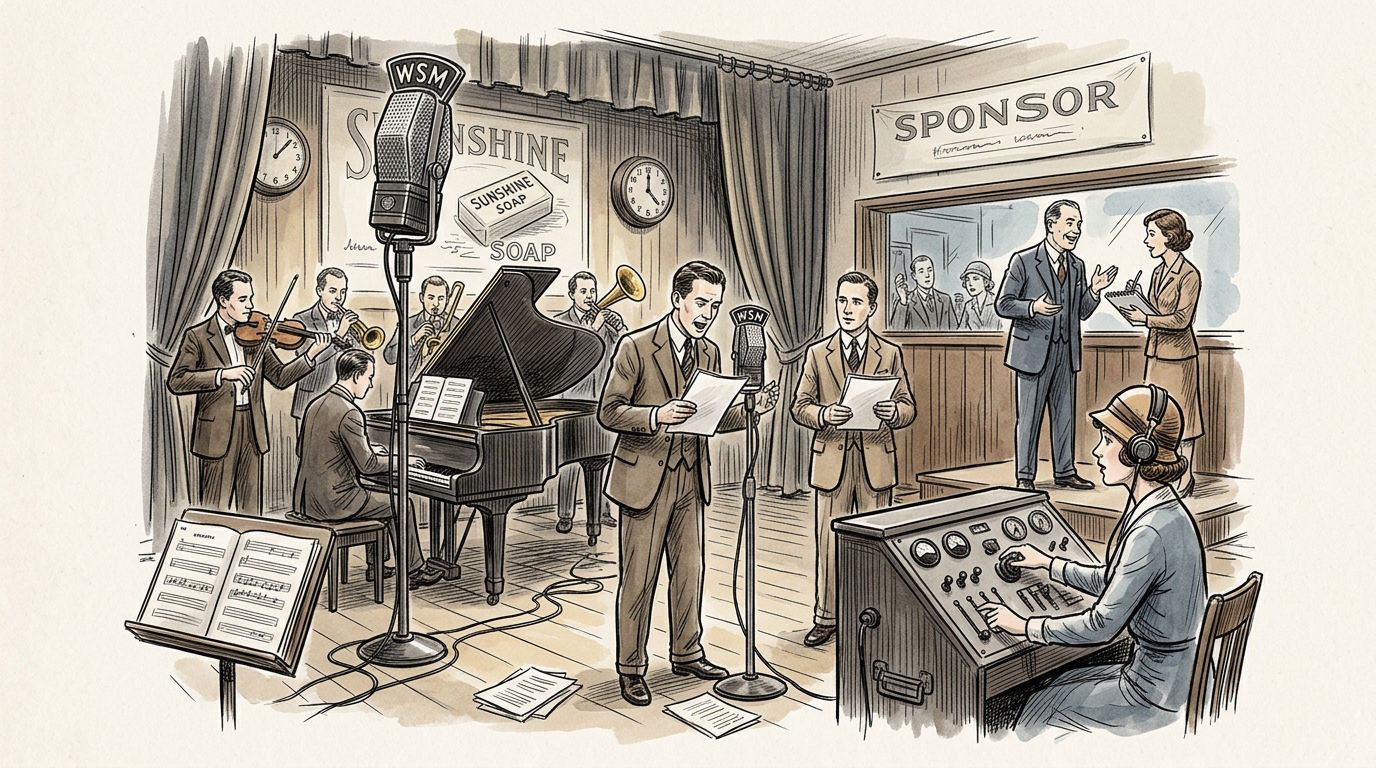
In radio’s classic network era, the most important advertising unit was often not the standalone commercial but the sponsored program. A single advertiser might underwrite an entire show, attach its name to the title, control or heavily influence format choices, and receive integrated mentions by announcers or performers. This was a different relationship between advertising and media content than a magazine page opposite editorial matter.
Examples are numerous. “The Eveready Hour,” which began on NBC in 1923, is one of the early nationally significant sponsored programs. By the later 1920s and 1930s, sponsorship had become a central feature of network economics. Programs such as “The Fleischmann Hour,” “The A&P Gypsies,” “The Lucky Strike Dance Orchestra,” and “The Chase and Sanborn Hour” illustrate how brands used entertainment as the principal vehicle for audience attention and brand recall.
Procter & Gamble became especially important in daytime serials, helping cement the connection between soap manufacturers and what became known as “soap operas.” The term emerged from the structure of sponsorship, not from a grand theory of genre. Brands such as Oxydol sponsored serial dramas aimed at daytime listeners, and by the 1930s the continuing, sponsor-supported serial had become a durable advertising form.
This system gave advertisers unusually deep integration with content, but it also created tensions. Sponsors wanted audience size, favorable association, and sales impact. Networks sought schedule stability and broad appeal. Talent wanted creative freedom. Agencies often mediated these relationships, shaping programs not only as media placements but as branded productions.
Agencies had to invent radio advertising practice
Radio demanded capabilities that traditional print agencies did not automatically possess. Writing a magazine ad and producing a weekly live program were different kinds of work. As advertisers committed larger budgets to broadcasting, agencies built departments and professional roles tailored to the new medium.
Copywriters had to learn spoken language. Radio copy needed to be heard once and understood immediately. Long, visually dense claims common in print usually performed poorly on air unless adapted into conversational structure. Writers developed short sentences, repeated brand names, mnemonic phrases, testimonial formats, dramatized product problems, and announcer-friendly transitions. Timing became a discipline. A 60-second script was not a metaphorical space but measured speech.
Agencies also needed radio producers, music directors, casting contacts, engineers, and continuity specialists. Live broadcasting required rehearsal, cueing, microphone technique, sound effects, and strict coordination with network operations. In the 1920s and early 1930s, many shows aired live, which meant creative and operational risk was high. Errors, dead air, missed cues, and uneven performances could damage both program quality and sponsor credibility.
By the 1930s, major agencies such as J. Walter Thompson, Young & Rubicam, Benton & Bowles, Batten, Barton, Durstine & Osborn, and others had become deeply involved in radio production and strategy. JWT, for example, developed extensive expertise in sponsored programming and daytime serials for clients including Kraft, Lever Brothers, and General Foods. Agencies were no longer only brokers of media space. They became coordinators of complex branded entertainment systems.
Radio changed the economics of agency work
The medium also complicated the traditional commission model. Print advertising had long fit relatively standardized buying procedures, but radio involved not only time purchases but talent fees, script development, orchestras, actors, rehearsal, technical production, and program packaging. Agencies increasingly had to supervise or directly manage these non-media costs.
That encouraged a broader service model. Agencies could not remain purely space brokers if clients expected them to create and produce full programs. Radio therefore helped accelerate the agency’s evolution into a multidimensional organization combining account management, creative development, media planning, research, and production.
It also raised questions about control and compensation. Who owned the program concept: client, agency, network, or packager? How should an agency be paid for entertainment production in addition to airtime placement? Those questions did not always have clean answers, but the commercial pressures of radio forced the industry to confront them.
Creative strategy shifted from claims to performance
Radio did not eliminate reason-why copy or hard-sell technique. Many commercials remained direct, repetitive, and product-centered. But the medium rewarded performance in new ways. Tone of voice, comic timing, catchphrases, jingles, celebrity endorsement, and serial narrative all became practical tools of persuasion.
The jingle deserves particular attention because it exploited radio’s most distinctive strength: memory through sound. Sung brand names and musical phrases could be recalled more easily than spoken claims alone. General Mills’ Wheaties became famous for “Have you tried Wheaties?” singing commercials in the 1920s, a much-cited early example of how musical branding could build national recognition. Such techniques later became standard across radio and television.
Radio also encouraged dramatization. Instead of merely describing a product benefit, advertisers could stage a problem and resolution through dialogue. Household dissatisfaction, social embarrassment, romantic uncertainty, expert advice, and testimonial authority could all be performed. This made advertising feel less like a printed argument and more like an event unfolding in time.
That development mattered to the profession because it changed what counted as creative skill. Successful radio work required ear, rhythm, pacing, and collaboration with performers. It brought advertising closer to theater, vaudeville, music, and show business without making it identical to any of them.
Audience measurement became more urgent and more sophisticated
Radio’s growth intensified the need to know who was listening, when, and in what numbers. Print circulation figures had long offered imperfect proxies for audience reach, but broadcasting presented a more immediate problem. Advertisers buying expensive sponsorships wanted evidence of audience size and program popularity.
This demand helped institutionalize audience research. Archibald Crossley’s Cooperative Analysis of Broadcasting, introduced in 1930, used telephone recall methods to estimate listening behavior. In the 1930s and 1940s, C. E. Hooper developed coincidental telephone surveys that asked respondents what they were listening to at that moment, an attempt to improve upon recall-based methods. A. C. Nielsen, already known for market research, later entered radio measurement and expanded the industry’s data infrastructure.
These methods were far from perfect, and they were debated at the time. But they changed advertising practice by making audience delivery a measurable commercial claim. Ratings affected pricing, scheduling, renewals, program survival, and agency recommendations. The profession moved further toward research-based media decision-making, even as creative instinct and sponsorship prestige remained important.
Regulation shaped the commercial medium
Radio’s development as an advertising medium cannot be separated from regulation. The early 1920s saw severe interference and spectrum disorder as stations proliferated faster than governance systems could stabilize them. The Radio Act of 1927 created the Federal Radio Commission and introduced the standard of serving the “public interest, convenience, or necessity.” The Communications Act of 1934 then established the Federal Communications Commission, which assumed federal oversight of broadcasting.
These measures did not prohibit commercial broadcasting. Instead, they created a framework in which advertising-supported radio could operate as a licensed medium with public obligations. Broadcasters had to balance commercial demands with regulatory expectations around service, technical order, and, over time, political and social responsibilities.
Advertising claims themselves were also subject to broader regulatory currents. The Federal Trade Commission, established earlier in 1914, increasingly shaped standards around deceptive advertising across media, including broadcast. Radio’s persuasive intimacy gave added urgency to debates over health claims, endorsements, and vulnerable audiences. The medium’s reach into the home heightened concerns that misleading messages could acquire unusual trust and influence.
The relationship between advertiser and program was powerful, but unstable
The sponsor era gave advertisers extraordinary visibility, but it also exposed them to the unpredictability of entertainment. A program could succeed beyond expectations, tying a brand to beloved talent and shared national experience. It could also become expensive, controversial, or creatively unruly.
A useful example is the long-running relationship between Lucky Strike and network entertainment. American Tobacco’s sponsorships helped make the brand a major radio presence, and the “Lucky Strike Hit Parade,” which began on radio in 1935, became one of the period’s best-known sponsored music formats. But these arrangements required continual management of talent, format, standards, network relationships, and public perception. Sponsorship was not a passive media purchase. It was active brand stewardship through programming.
By the 1940s, some tensions in the single-sponsor model were becoming visible. Networks wanted more control over schedules and program assets. Production costs rose. Agencies had built large radio departments, but independent packagers and talent-driven arrangements also competed for influence. These pressures would become even more pronounced with the rise of television, where control gradually shifted from full sponsorship toward spot advertising and magazine-style programming. Radio thus foreshadowed a larger reorganization of advertiser-media relations.
Radio professionalized the use of dayparts and audience routines
Another enduring contribution of radio was the practical importance of time segmentation. Because listening varied by hour, advertisers learned to match messages and program types to daily routines. Morning farm reports, afternoon serials, evening variety programs, and late-night music each offered different audiences and commercial opportunities.
This seems obvious now, but it represented a real advance in media thinking. Print buyers had long considered circulation, geography, and editorial environment. Radio added habitual listening patterns tied to household labor, commuting, mealtimes, and leisure. The medium trained advertisers to think in dayparts, appointment audiences, and program adjacency. Later television planning borrowed heavily from this logic, and digital media’s obsession with behavioral timing has deeper roots than is often acknowledged.
Political, economic, and cultural conditions accelerated radio’s importance
Radio’s advertising power grew in a society being reshaped by urbanization, mass production, chain retailing, consumer packaging, and national distribution. Brands needed scalable awareness. Households increasingly purchased standardized goods marketed across regions. Radio helped create common reference points for those goods.
The Great Depression did not halt this development. It made advertising effectiveness and efficiency even more important. Sponsors sought media that could maintain consumer demand, protect market share, and justify spending. Radio’s relatively low cost per listener, combined with its emotional presence, made it attractive despite economic strain.
News and crisis also reinforced listening habits. During the 1930s and World War II, radio became an essential source of public information as well as entertainment. That increased its authority and regularity in daily life. Advertisers benefited from the fact that audiences were not merely consuming diversion. They were building a lasting habit of turning on the radio as a central household medium.
Radio’s legacy was not purely positive
An accurate history should resist treating radio as a simple golden age. Commercial broadcasting amplified many of advertising’s strengths, but also some of its liabilities. Sponsorship could blur the line between entertainment and salesmanship. Some programs trafficked in stereotypes that reflected and reinforced racial, ethnic, and gender prejudice. Certain product categories, including tobacco, benefited from a level of cultural normalization through radio that would later come under much harsher scrutiny. Claims in health, beauty, and domestic products could be manipulative or misleading, especially when delivered by trusted voices.
Radio also concentrated power. Networks, major sponsors, and leading agencies gained enormous influence over national culture and access to audiences. Smaller advertisers often lacked comparable reach. The new medium opened opportunity, but not equally.
Recognizing those facts does not diminish radio’s importance. It clarifies what sort of institution advertising became when it fused with mass electronic media: more intimate, more continuous, more professionally organized, and more socially consequential.
How radio changed advertising practice
By the time television emerged as a commercial force after World War II, many of the essential practices advertisers needed for electronic media had already been built in radio. Among the most important were:
- Writing for the ear rather than the eye.
- Using performance, music, and dramatization as persuasive tools.
- Planning media by daypart, program type, and audience habit.
- Buying national reach through network distribution.
- Integrating brands with entertainment through sponsorship.
- Building research systems to estimate audience delivery.
- Creating agency departments devoted to production, talent, and broadcast operations.
- Managing ongoing campaigns as scheduled series rather than isolated placements.
Each of these practices had analogues before radio, but radio made them central, systematic, and scalable.
Why this history still matters
Radio changed advertising because it turned persuasion into an experience unfolding in time, in sound, and in routine contact with audiences at home. It forced agencies to become more than creators of print messages and buyers of space. They had to become producers, schedulers, researchers, and managers of branded media systems. It taught advertisers to value continuity, audience habit, and the emotional power of performance. It helped establish the modern expectation that media could be measured, segmented, sponsored, and creatively integrated with content.
Much of contemporary advertising, from host-read podcasts to streaming audio, branded entertainment, audience analytics, and omnichannel planning, still operates within structures radio helped create. The devices are different, the metrics are more granular, and the distribution systems are digital. But the underlying professional challenge is familiar: how to use a medium’s distinctive form, economics, and audience behavior to create advertising that people will accept, remember, and act upon.
That is why radio belongs at the center of advertising history. It did not merely add sound to existing practice. It reorganized the profession around the possibilities and demands of electronic media.
Leave a Reply