
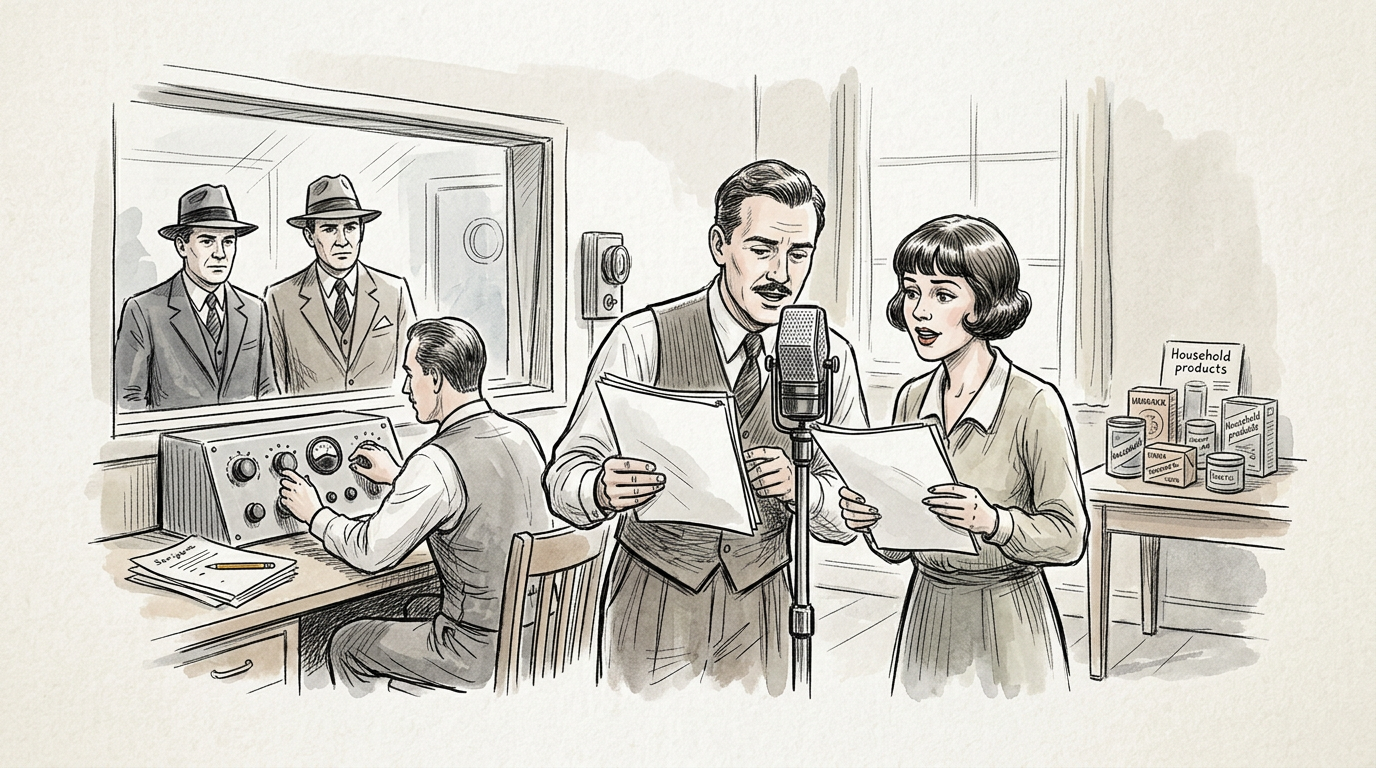
Daytime serial drama did not simply become associated with soap brands by coincidence. The format developed within a specific advertising system that linked packaged-goods manufacturers, advertising agencies, radio networks, stations, and audience research. What later became shorthand as the “soap opera” was, in practical industry terms, a form of advertiser-built programming. It emerged when household-product marketers needed reliable access to women managing home consumption, and when radio’s business model still allowed a single sponsor to underwrite, shape, and often effectively own a program.
That history matters because it shows advertising doing more than buying media space. In the early broadcast era, major advertisers and their agencies helped create the content form itself. The daytime serial became one of the clearest examples of branded entertainment before the term existed, and it demonstrated several lasting principles of advertising practice: the value of habitual listening, the importance of audience segmentation, the commercial power of emotional continuity, and the strategic advantage of controlling the environment around the message rather than inserting a message into somebody else’s environment.
Before television, before “content marketing,” there was sponsor-built radio
American broadcasting in the 1920s and 1930s developed under a sponsorship model very different from later spot television and digital ad markets. National advertisers often bought not only commercial time but the program itself. Networks such as NBC and CBS distributed shows to affiliated stations, but sponsors and agencies played unusually direct roles in production, talent selection, creative format, and scheduling.
This system was shaped by both economics and technology. Radio sets had entered American homes quickly during the 1920s, and by the early 1930s broadcasting had become a mass medium. At the same time, national brands in packaged goods were expanding through chain stores, improved distribution, and heavy investment in print advertising. Companies selling soap, detergents, shortening, and other household staples were already accustomed to repetitive national promotion. Radio offered something print could not: recurring, intimate contact in the home, often during the hours when women were doing domestic work.
Advertisers did not initially know what kinds of programming would best hold those listeners. Variety, comedy, music, and dramatic anthologies all circulated through early radio. But for daytime, agencies and sponsors gradually recognized the commercial potential of serialized storytelling. A continuing narrative could encourage listeners to return at the same hour every weekday, creating a disciplined advertising habit aligned with repeated-purchase consumer goods.
The term “soap opera” came later as an industry and popular nickname, not as an official genre label at the moment of invention. It reflected a recognizable pattern: many daytime serials were sponsored by soap and detergent makers, and the melodramatic structure invited comparison to grand opera. The label was often used wryly, but the commercial system behind it was serious business.
The audience strategy was specific: homemakers, routine, and repeat purchase
Daytime broadcasting developed around assumptions about household labor and consumption. Networks, stations, agencies, and advertisers understood daytime radio as reaching women at home, especially homemakers responsible for shopping and brand choice. Those assumptions were shaped by the gender division of labor in the period and by the way audience measurement and media selling classified listeners. They were also reinforced by the categories of products buying the time.
Household products were especially suited to frequent reminder advertising. A company selling soap flakes or laundry soap did not need to persuade a consumer once for life. It needed to remain familiar, trusted, and available every week at the point of purchase. Serial radio fit that need. A fifteen-minute weekday program could create five branded contacts a week, each embedded within a familiar emotional experience.
This strategy depended on routine. Listeners folded radio into housework, meal preparation, sewing, and childcare. Trade publications and agency discussions from the period repeatedly addressed the daytime listener as someone listening while working, which had consequences for program design. Scripts relied on clear recaps, strong vocal differentiation, steady pacing, and cliffhangers. Missing a day should not make the story incomprehensible, but following every day should deepen attachment. In media terms, these were campaigns built on continuity and frequency through content itself.
Agencies were central, not peripheral
One of the most important historical facts about soap operas is that agencies were often the operational center of the enterprise. In the classic network era, agencies frequently handled far more than ad copy and media placement. They packaged shows, hired writers and actors, supervised production, negotiated with networks, and represented sponsor interests in nearly every decision.
No agency is more closely associated with the rise of daytime serials than Blackett-Sample-Hummert, later known as B-S-H after changes in partnership structure. The husband-and-wife team Frank and Anne Hummert became enormously influential in serialized daytime radio. Working within the agency world rather than as independent entertainment producers in the modern sense, they developed and oversaw large numbers of serial programs, including Ma Perkins, Backstage Wife, Just Plain Bill, Our Gal Sunday, and others. Their production system emphasized efficiency, emotional clarity, and replicable format.
The Hummerts did not invent serial storytelling, nor were they the only important figures in daytime radio. But their work illustrated how thoroughly agencies could function as content factories when advertiser demand, network distribution, and audience habit aligned. Scripts were often written under intense volume conditions. Production methods prized reliability and scalability over auteur prestige. What mattered was not artistic uniqueness in the modern premium-television sense, but the ability to deliver a compelling, sponsor-friendly, weekday audience machine.
This is one reason the history should not be reduced to a quaint story about detergent brands funding melodrama. Soap operas were also industrial products of the agency era, demonstrating how agencies once exercised integrated control over creative, media, research, and production in ways that later became more fragmented.
Procter & Gamble and the logic of household-product sponsorship
No company is more central to the subject than Procter & Gamble. By the 1930s, P&G was already a major national advertiser with deep experience in brand management and mass promotion. Radio gave the company an opportunity to sustain regular contact with consumers of Oxydol, Duz, Ivory Snow, Camay, and other household products.
P&G did not singlehandedly create all soap operas, and the nickname should not obscure the participation of other sponsors such as Colgate-Palmolive-Peet and Lever Brothers. Still, P&G became the most historically consequential sponsor in the field, both in radio and later in television. The company’s involvement was extensive enough that by mid-century it had become one of the best-known examples of advertiser influence over broadcast programming.
A key milestone came with Oxydol’s Own Ma Perkins, which debuted on radio in 1933. The program was created by Irna Phillips, one of the most important writers in serial drama history, and sponsored by Oxydol, a P&G laundry product. Phillips had already been active in radio serial writing, and she is often credited with shaping the emotional and structural grammar of the form. Ma Perkins centered on a widowed small-town lumberyard owner, combining domestic sentiment, moral conflict, and continuing plot development. It proved that a sponsor-backed daytime serial could build powerful listener loyalty over time.
The significance of P&G’s radio sponsorship was not just that its brands advertised in daytime. It was that the company participated in an advertising system where the brand and program identity were tightly interwoven. Program titles could include the sponsor’s product name. Announcers and embedded commercial copy connected story emotion to household trust, thrift, care, and family responsibility. The serial was not merely adjacent to the ad. It was part of the same persuasive environment.
That arrangement offered several advantages to the sponsor:
- Control over scheduling and continuity.
- A stable association between brand identity and a familiar daily ritual.
- Reduced dependence on unrelated editorial surroundings.
- Repeated exposure that reinforced memory for low-priced, frequently purchased goods.
- A way to align products associated with caregiving and cleanliness with emotionally resonant narratives.
In modern vocabulary, this was a sophisticated form of audience strategy and contextual integration, even if the terminology of the period was different.
Why serial drama worked better than many alternatives
The daytime serial solved several advertising problems at once. First, it encouraged habitual tune-in. A self-contained drama or variety show could entertain, but a serialized cliffhanger created return behavior. Second, it generated emotional investment over long periods, which sponsors hoped would strengthen receptivity to commercial messages. Third, it fit the economics of daytime broadcasting, where production budgets were lower than prime time and audiences, though less prestigious in some public discourse, were highly valuable to certain consumer categories.
The fifteen-minute format was especially important. It was affordable, easy to schedule, and adaptable to weekday strip programming. It also made room for commercials without requiring a full half-hour commitment. This structure became standard enough that serial writing evolved around it. Openings quickly reestablished context, scenes moved efficiently, and endings pushed listeners to return tomorrow.
There was also a cultural logic to the stories themselves. Daytime serials often explored marriage, kinship, money pressures, illness, social mobility, and moral uncertainty. These themes were broad enough to sustain endless variation yet intimate enough to create identification. For advertisers of household goods, the emotional world of care, anxiety, and domestic responsibility was commercially useful, though that does not mean every listener interpreted the programs in the same way or listened only because of sponsor influence.
Historians of radio have long cautioned against simplistic claims that these programs merely manipulated passive housewives into buying soap. Listeners used radio in complex ways, and fan responses could be active, critical, and emotionally sophisticated. But from the advertiser’s perspective, serial drama offered what media planning always seeks: a repeatable format that could gather a clearly defined audience at predictable intervals and place the brand at the center of that habit.
Networks, stations, and the business model of daytime radio
The growth of soap operas also depended on network and station economics. NBC and CBS needed daytime programming that could attract sponsors and justify affiliate carriage during non-prime hours. Serials helped fill the schedule with inexpensive, steady, sponsor-friendly content.
Because sponsors underwrote production, networks assumed less financial risk than they would have under a fully network-produced system. The arrangement also gave agencies leverage. If an agency controlled a proven serial property and represented a major packaged-goods client, it occupied a powerful position between sponsor and network.
Trade coverage from publications such as Broadcasting and advertising journals in the 1930s and 1940s shows how seriously daytime sponsorship was treated as a commercial category. These were not marginal buys. They were systematized national advertising vehicles. Audience ratings, affiliate clearances, and talent costs all mattered, but the core calculation was straightforward: if the program reliably delivered women making household purchase decisions, the time could be sold and resold to soap, food, and household-product accounts.
The sponsorship structure also helps explain why the genre remained so closely tied to advertisers even after the phrase “soap opera” became common. The form was born not from abstract dramatic experimentation but from a concrete alignment of commercial sponsorship, network distribution, and audience targeting.
Research, ratings, and the measurement of the daytime audience
Soap operas were early beneficiaries of the expanding audience research business. As ratings services such as C. E. Hooper and later A. C. Nielsen became more influential, they provided advertisers and agencies with more systematic data on listening habits. Daytime audiences were not always measured with the same precision or prestige accorded to prime-time programs, but they were increasingly legible to buyers and sellers.
Measurement mattered because it turned assumptions about homemaker listening into saleable evidence. Advertisers could compare programs, time periods, and network performance. Agencies could justify sponsor investments with data rather than anecdote alone. The growth of audience research also encouraged programming regularity. If listening could be tracked by time slot and sponsor, then schedule discipline became even more valuable.
Research extended beyond ratings. Mail response, couponing, dealer reports, and broader consumer research all informed sponsor thinking. Packaged-goods marketers were among the companies most committed to systematic advertising evaluation in the twentieth century. They understood serial sponsorship not as cultural patronage but as a measurable sales instrument.
Still, historical caution is important. Direct causal proof between a single serial and a specific increase in soap sales was not always easy to establish, and trade rhetoric could overstate effectiveness. Claims made in promotional materials or agency self-descriptions should be read as part of competitive selling. Yet the longevity of the format, and the continued investment of major advertisers, indicates that sponsors believed the results justified the cost.
Creative integration before the age of “integrated marketing”
What distinguished many soap-opera sponsorships was the degree of integration between program, commercial copy, and brand identity. Announcers often delivered live commercial messages in tones calibrated to the surrounding drama. Testimonials, domestic advice, and problem-solution language were common. Commercials could speak directly to laundry, cleanliness, economy, child care, or household dignity, themes that resonated with both product category and program audience.
This was not the same as modern product placement, where branded goods appear inside fictional scenes. Nor was it the same as today’s sponsorship idents or podcast host reads, though there are family resemblances. In the radio soap era, the sponsor identity could frame the entire listening experience. The advertiser’s name might appear in the title, open and close the program, and dominate continuity announcements. The show existed because the sponsor paid for it, and everyone involved knew it.
For advertising history, that is significant. It reveals an era in which the boundary between “content” and “advertising” was organized differently than it is in many current media systems. Later generations sometimes imagine a clean separation between artistic programming and commercial interruption, but early broadcasting often operated through sponsorship structures that made the relationship explicit and foundational.
Regulation, criticism, and cultural status
Soap operas did not grow without criticism. Cultural commentators often dismissed them as low-status, overly emotional, or commercially manipulative. Such criticism sometimes carried gendered assumptions about women’s tastes and domestic life. The format’s daytime placement and female-targeted sponsorship made it easy for critics to trivialize, even as the programs represented serious business for sponsors and networks.
Regulatory history also forms part of the picture. The Federal Radio Commission, and after 1934 the Federal Communications Commission, regulated broadcasting within the broader “public interest” framework of American radio, but U.S. broadcasting remained commercially sponsored rather than publicly funded on the British model. That policy environment made sponsor-created programming normal rather than exceptional.
There were also ongoing debates about advertising standards in broadcasting. Commercial excess, disguised advertising, and program influence all attracted scrutiny at different moments. Industry codes and network standards evolved over time, and by the television era sponsor control would become a more contested issue. But during the formative radio decades, the basic legitimacy of advertiser-sponsored daytime serials was firmly embedded in the commercial broadcasting system.
From radio to television: the sponsor’s influence continued
The transition from radio to television after World War II did not erase the advertiser logic that had created soap operas. It carried it into a new medium. Procter & Gamble, in particular, became a major force in television serial production, eventually giving its name to the long-running production unit Procter & Gamble Productions.
Television soaps such as The Guiding Light, which began on radio in 1937 under the guidance of Irna Phillips and moved to television in 1952, and later P&G-associated serials such as As the World Turns and The Edge of Night, preserved core features developed in radio: serialized domestic storytelling, daytime scheduling, and sponsor alignment with household purchasing audiences.
At the same time, the business model began to shift. In television’s early years, single-sponsor control remained common, but over time networks moved toward magazine-style selling of multiple commercial units within programs. This reduced the total authority of any one advertiser and helped redefine the relationship between agency, sponsor, network, and producer. Soap operas survived that change, but their origins in full sponsorship remained visible in both name and structure.
That transition is historically revealing. Soap operas were born in a media economy where advertisers made formats. They matured in one where advertisers increasingly bought into formats managed by larger network and production systems. The genre’s history therefore traces a broader evolution in the advertising business itself, from sponsor dominance toward a more segmented media marketplace.
What the rise of soap operas reveals about advertising as an institution
The history of soap operas shows that advertising has often shaped media not only through spending levels but through organizational design. Household-product manufacturers did not just support a genre that already existed. Working through agencies and networks, they helped define the genre’s scheduling logic, production routines, narrative form, and audience assumptions.
Several enduring industry lessons emerge from that history.
First, audience targeting is never only about demographics. The daytime serial succeeded because it mapped itself onto daily behavior. It addressed not just women as an abstract market segment, but women understood by advertisers as living within routines of work, caregiving, shopping, and domestic management. Whether those assumptions were accurate, limited, or exclusionary in particular cases, they were central to how media products were built.
Second, repetition works best when attached to habit. Soap advertising had long relied on repeated exposure in print, but radio serials turned repetition into an appointment. They made frequency feel less like message duplication and more like relationship maintenance.
Third, branded entertainment is not a digital-age invention. The soap opera demonstrates a much older tradition in which advertising value increased when the brand helped structure the audience experience itself. The current vocabulary of content strategy, creator partnership, native integration, and owned audience has deep historical precedents.
Fourth, agencies once exercised a far wider sphere of influence than contemporary readers may assume. In the radio soap era, agencies were often strategic planners, media buyers, program producers, creative supervisors, and client representatives all at once. That integrated role helps explain both the power agencies achieved and the later pressures that would push the business toward specialization.
Finally, the history of soap operas complicates any simple division between commerce and culture. These programs were advertising vehicles, but they were also long-form narrative worlds that mattered to listeners. Their commercial origins do not make them culturally insignificant. If anything, the scale of their influence shows how deeply advertising institutions could participate in shaping everyday media life.
The phrase “soap opera” survives today mostly as a genre label and metaphor, often detached from the business system that produced it. But the original connection matters. Daytime serial drama grew out of advertising because advertisers needed a medium that could hold attention, build routine, and speak to a strategically defined audience in emotionally durable ways. In meeting that need, sponsors, agencies, and networks created one of the most influential forms in broadcast history. The result was not just a successful ad vehicle for soap makers. It was a durable example of how advertising can help invent the media forms it later uses.
Leave a Reply