
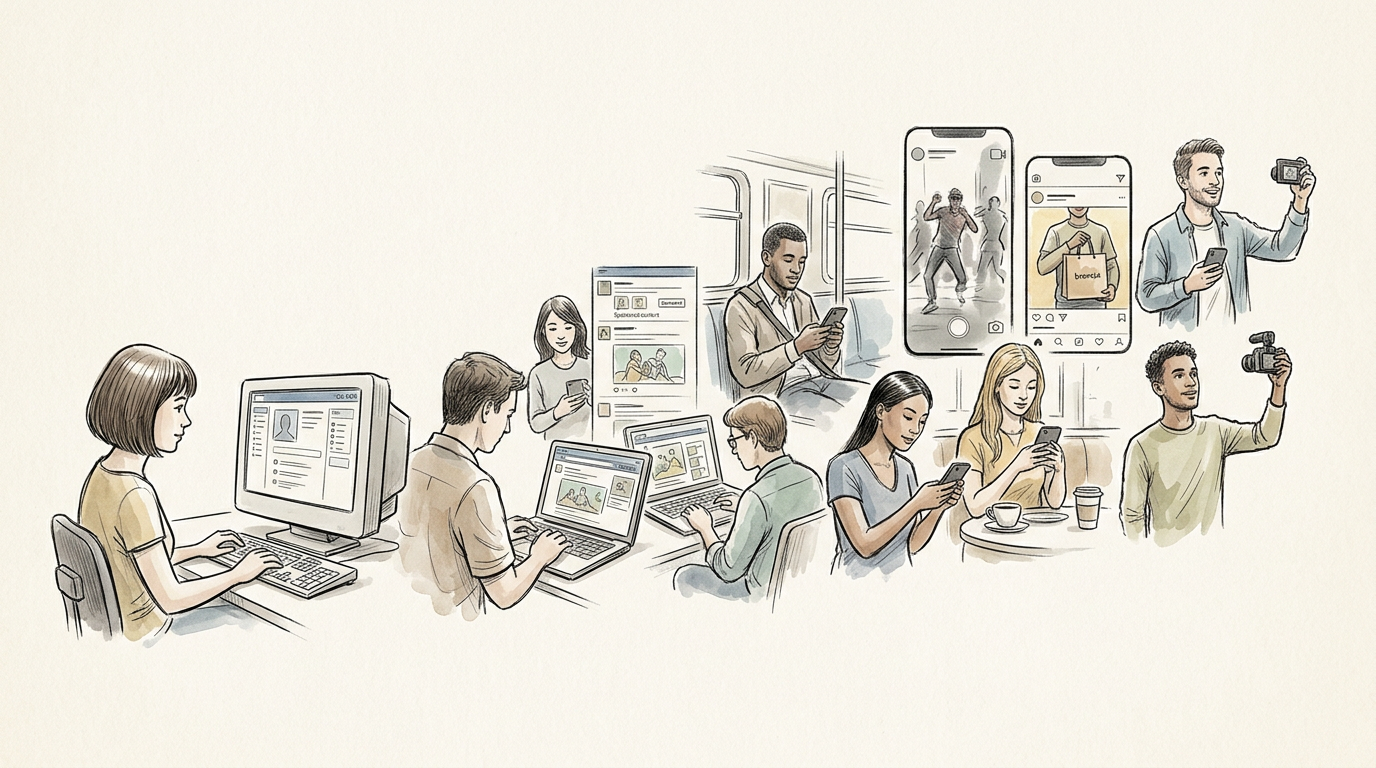
Social media did not begin as an advertising medium. It became one by degrees, and those degrees mattered. Early social networks were built around profiles, friend lists, messaging, and user-generated content rather than around the editorial packages, audience guarantees, and ad positions familiar to print, broadcast, and portal-era web publishing. When advertising arrived, it had to adapt to spaces organized around identity, conversation, and constant interaction. In the process, social platforms changed not only how ads were sold and targeted, but also how advertising related to content, audiences, and measurement.
That shift reshaped the advertising business. It helped move digital media away from premium display sold by direct sales teams and toward self-service buying, auction pricing, behavioral and interest targeting, mobile-first formats, creator collaboration, and algorithmic distribution. It also blurred distinctions that earlier media systems kept more separate: advertising and personal expression, paid placement and organic reach, media planning and software optimization, brand publishing and audience acquisition. The social advertising model that emerged in the 2000s and 2010s is now so embedded in the industry that it can seem inevitable. Historically, it was not.
Before the feed: social networks as communities first, ad businesses later
In the late 1990s and early 2000s, social networking services such as SixDegrees, Friendster, MySpace, and LinkedIn were usually discussed as internet communities or utility platforms rather than as mature advertising vehicles. Their early business models were unsettled. Subscription fees, venture financing, recruitment tools, premium features, and conventional web display all appeared in different combinations.
That uncertainty reflected the state of online advertising more broadly. By the early 2000s, banner advertising was already established, search advertising was growing rapidly after Google launched AdWords in 2000, and portals such as Yahoo sold audience scale through display inventory. But social networks presented a different commercial problem. Users were not coming primarily to consume professionally produced editorial content. They were building profiles, maintaining relationships, posting updates, joining groups, and reacting to one another. The value of the platform lay in participation.
Early social networks did carry standard web ads. MySpace, founded in 2003, became especially important because it demonstrated that social traffic could attract large advertisers even before the medium had developed distinctive native formats. News Corporation’s 2005 acquisition of Intermix, MySpace’s parent company, was widely read as a wager that social audiences could be monetized through advertising at scale. MySpace sold homepage takeovers, entertainment tie-ins, and display inventory that fit the broader digital ad market of the time. It also became a major venue for music, film, and youth-oriented promotion. Yet much of this advertising still treated the platform as a high-traffic website rather than as a fundamentally new advertising environment.
LinkedIn, launched in 2003, took a somewhat different path. It built a business around recruitment, premium subscriptions, and business-oriented marketing products rather than mass consumer social display. That distinction matters historically. Social media did not produce one advertising model. From the beginning, platform design influenced commercial design. A professionally oriented network generated different advertiser demand, targeting logic, and ad formats than a youth entertainment network or a campus social graph.
Facebook and the transformation of identity into ad infrastructure
The decisive change came when social platforms turned the structure of user identity and interaction into advertising infrastructure. Facebook, founded in 2004, became the central example.
Early Facebook advertising was relatively conventional. As the company expanded beyond colleges in 2006, it sold display units and sponsored placements alongside profile pages and other interface elements. But Facebook’s actual advantage was not simply inventory. It was the detailed, continuously updated data users supplied about themselves and their relationships: age, school, location, interests, affiliations, friendships, and later behavior across the platform. That made possible a far more granular form of targeting than most publishers could offer.
In 2007, Facebook launched Facebook Ads and Pages, presenting brands not only with ad units but with a way to establish an ongoing presence inside the network. Marketers could target users by profile characteristics and interests, while branded Pages encouraged companies to seek followers and interaction rather than merely buy impressions. In the same period, Facebook introduced Beacon, a system that shared certain user activities from external partner sites back into Facebook’s social environment. Beacon quickly became controversial and was widely criticized as intrusive. After protests and a proposed class action settlement, Facebook shut it down. Historically, Beacon is important because it revealed both the commercial ambition of social advertising and the limits of user tolerance. Platforms wanted to convert social data and user activity into more actionable advertising signals, but the effort immediately raised questions about privacy, consent, and surveillance that would shadow the business thereafter.
Facebook’s self-serve interface also marked a major professional shift. Digital advertising had already been moving toward auction systems through search, but social platforms extended self-service tools into brand, local, and direct-response advertising aimed at identified audiences rather than search queries. Small businesses that could never have bought national media through traditional channels could now run targeted campaigns with modest budgets. This widened the advertiser base dramatically and helped normalize the idea that media buying could be performed inside software dashboards rather than through negotiated insertion orders alone.
The company’s later advertising history is often summarized through the News Feed, and for good reason. Introduced in 2006, the News Feed reorganized Facebook around a stream of updates selected and ranked for each user. That interface change did not merely improve usability. It created the basic architecture for modern social advertising. Once user attention concentrated in a personalized feed, advertising no longer had to sit at the margins of the page. It could be inserted into the same scrolling environment as social content itself.
In 2011 and 2012, Facebook rolled out Sponsored Stories more broadly and then mobile News Feed ads. These were crucial steps. Sponsored Stories attempted to turn social actions, such as liking a brand, into paid promotional units shown to friends. News Feed ads moved promotion into the central interaction space of the platform and, just as importantly, into the mobile app experience that would define the next era of digital media. By the time Facebook went public in 2012, investors were sharply focused on whether it could monetize mobile usage. The company’s rapid development of mobile feed advertising became one of the most consequential revenue transitions in platform history.
The feed as ad medium
The feed changed the relationship among advertising, content, and attention more profoundly than the banner ever did. Traditional display on the web borrowed from print layout and magazine display logic: ads occupied designated spaces around content. Feed advertising operated differently. It appeared inside the content flow, matched the visual conventions of surrounding posts, and competed not for isolated page real estate but for moments of interruption in an endlessly refreshed sequence.
This was not purely a creative change. It altered media planning, production, and measurement. Advertisers now had to make creative that could function in-stream, often on mobile screens, and often without the user actively seeking commercial information. Visual hierarchy, opening frames, headline compression, square and vertical formats, captioning, and thumb-stopping tactics all became practical concerns. Platform recommendations and creative best practices increasingly shaped execution.
The feed also made engagement a commercial signal. Likes, comments, shares, video views, reactions, watch time, saves, click-throughs, and later conversion events became inputs in optimization systems as well as measures reported to advertisers. This did not mean all campaigns were bought for engagement, nor that engagement was always a reliable proxy for effectiveness. It did mean that platform advertising was increasingly entangled with social behaviors visible on the interface itself. In earlier media, audience response might be delayed, sampled, or inferred. On social platforms, response was immediate, countable, and often public.
Twitter followed a related path. Founded in 2006, it long resisted heavy ad clutter while it defined its product. In 2010, it introduced Promoted Tweets, followed by Promoted Accounts and Promoted Trends. The logic was consistent with the platform’s structure. Twitter’s primary unit was the tweet, distributed through a timeline. Its advertising products therefore promoted tweets, accounts, and topic visibility rather than relying chiefly on standard banners. This design linked advertising directly to the platform’s core communication form. Brands had to behave, at least superficially, like participants in the stream.
Pinterest, launched in 2010, introduced Promoted Pins in 2013. Here again, platform design drove format design. Pinterest users collected and organized visual inspiration for shopping, home projects, fashion, and planning. Advertising on Pinterest therefore sat close to search, discovery, and commercial intent, even though the interface was social. Snapchat, founded in 2011, later built ad products around Stories, vertical video, augmented reality lenses, and full-screen mobile immersion. Instagram, launched in 2010 and acquired by Facebook in 2012, opened advertising more broadly in 2015, bringing highly visual in-feed and later Stories formats into a platform where branding, lifestyle imagery, and creator culture were already deeply integrated.
Each case reinforces the same historical point. Social advertising did not develop as one universal template imposed from outside. It emerged from platform-specific interaction designs. Profiles, feeds, timelines, Stories, followers, likes, subscriptions, and recommendation systems all shaped what counted as an ad, where it appeared, and how it would be measured.
Self-service buying and the expansion of the advertiser base
The professional history of social advertising cannot be told only through formats. Equally important was the spread of self-service buying tools and automated delivery systems.
In earlier advertising systems, access to media often depended on scale, agency relationships, and negotiated buying. Social platforms retained direct sales teams for large accounts, especially for major brand campaigns, but their growth depended heavily on tools that allowed millions of businesses to buy media directly. Facebook’s Ads Manager, lookalike audience tools, retargeting products, and conversion tracking helped turn the platform into a performance engine for small and midsize advertisers as well as global brands. Similar systems spread elsewhere.
This mattered economically because it changed who could participate in advertising markets. Local retailers, app developers, direct-to-consumer startups, political campaigns, nonprofits, creators, and independent service businesses could all use the same infrastructure. Historically, this resembled the democratizing rhetoric that often accompanies new media, but with a critical difference: access was mediated by platform software, data collection, and auction economics rather than by lower printing costs or expanded broadcast capacity alone.
Agency work changed with it. Social media buying initially sat awkwardly between media departments, interactive specialists, PR teams, and community managers. Over time, it produced new specializations in paid social, social analytics, community management, creator strategy, social video production, and platform-native creative. Media agencies had to incorporate auction-based optimization and always-on campaign management. Creative agencies had to develop assets for multiple placements, versions, audiences, and testing cycles. The boundary between media and creative weakened because performance increasingly depended on the interaction between audience targeting, bid strategy, placement, and platform-adapted content.
The growth of Facebook Exchange in 2012 and Custom Audiences in the same period linked social media more tightly to the broader ad-tech ecosystem. Social platforms were not identical to the open web programmatic market, but they adopted some of its principles: data-driven segmentation, pixel-based tracking, automated bidding, and continuous optimization. They also differed in one crucial respect. Unlike the open web, social platforms controlled the environment, the identity layer, the distribution logic, and much of the measurement stack. This vertical integration gave them unusual power over both advertising practice and advertiser dependence.
Mobile made social advertising central
The rise of smartphones transformed social media from an internet subcategory into a dominant daily media habit. Apple’s introduction of the iPhone in 2007 and the App Store in 2008, followed by the growth of Android, changed how often and where people used social platforms. Social networking became ambient, portable, and frequent. Users no longer logged on occasionally from desktop browsers to check profiles. They carried feeds in their pockets.
That shift was decisive for advertising. Mobile screens reduced available display real estate and made side-rail banner formats less useful. The feed, by contrast, translated elegantly to mobile. A sponsored post could appear between organic updates in a scrollable stream without requiring separate page architecture. Mobile also increased the importance of speed, simplicity, and immediate relevance. Advertisers had less space and less time to communicate, but they also gained access to users throughout the day.
The mobile era accelerated video adoption. Facebook made video a strategic priority in the mid-2010s, including autoplay video in the feed and later emphasizing live video and short-form mobile viewing. Instagram expanded video options and Stories placements. Snapchat helped establish vertical video as a mainstream advertising format rather than an amateur deviation from horizontal television norms. By the late 2010s, short-form video and sound-off design conventions had become standard considerations in social advertising production.
This did not simply import television into social media. Social video was typically shorter, more targetable, more measurable, and more interruptive. It was designed for feed competition, not scheduled programming. Completion rates, view-throughs, swipe-ups, and conversions mattered alongside reach and frequency. Production workflows adjusted accordingly, with modular edits, variant testing, and creator-led formats becoming more common than the long campaign shelf life associated with traditional broadcast spots.
From audience buying to algorithmic delivery
One of the most important historical developments in social advertising was the shift from advertiser-selected audiences toward platform-optimized delivery. At first, the selling proposition emphasized targeting categories chosen by marketers: demographics, interests, location, connections, behaviors. Over time, machine learning systems increasingly determined which users within or beyond those parameters would actually see the ad.
This altered the professional role of media planning. In earlier systems, planners selected publications, programs, dayparts, or placements based on audience estimates. In social advertising, planners and buyers increasingly set objectives, creative assets, budgets, and broad audience rules, then allowed platform algorithms to optimize toward outcomes such as clicks, app installs, leads, purchases, or video views. Advertisers still made strategic decisions, but they ceded more delivery control to opaque systems trained on massive behavioral datasets.
The move was not confined to Meta properties. TikTok’s rise after the international launch of its merged platform in 2018 made recommendation-driven distribution central to the user experience and, by extension, to advertising. TikTok’s “For You” feed is often discussed as an entertainment product, but from an advertising history perspective it also represents an evolved ad environment: algorithmically ranked, highly personalized, video-native, and less dependent on the user’s explicit social graph than Facebook’s earlier model. Advertising on TikTok therefore developed around in-feed video, creator participation, music and meme conventions, and recommendation responsiveness. The platform’s structure encouraged advertisers to think less in terms of stable audience communities and more in terms of content velocity, trend fluency, and algorithmic pickup.
That shift marks a broader historical turn. Early social media advertising relied heavily on declared identity and friend connections. Later platform advertising relied increasingly on inferred interest, observed behavior, and model-based prediction. In practical terms, the system moved from “who users say they are and whom they know” toward “what the platform predicts they will watch, click, share, or buy.”
Creator partnerships and the commercialization of personal influence
Advertising on social media did not develop only through paid platform inventory. It also grew through creator partnerships, influencer marketing, affiliate systems, and branded content arrangements that used social personalities as advertising intermediaries.
There were precursors in blogging and early YouTube sponsorships. YouTube, founded in 2005 and acquired by Google in 2006, developed as both a video platform and an advertising business, but it occupies a somewhat different historical position because it combined social features with a video publishing economy and Google’s broader ad infrastructure. Still, creator sponsorships on YouTube, Instagram, Vine, Snapchat, TikTok, and other platforms became a major part of the social advertising system.
This development mattered because it relocated part of advertising’s persuasive function from formal ad units to trusted or at least familiar personalities embedded in users’ feeds. The creator was not only a media placement. The creator was also a producer, performer, targeter, and brand interpreter. For advertisers, this offered access to niche communities and cultural credibility that standard platform units could not always deliver. For creators, it offered revenue outside or alongside platform ad-sharing arrangements. For agencies, it produced a new layer of talent management, rights negotiation, disclosure compliance, content review, and measurement challenges.
Regulators took notice. In the United States, the Federal Trade Commission had long required that material connections between advertisers and endorsers be disclosed. Its 2009 revised Guides Concerning the Use of Endorsements and Testimonials in Advertising became especially important for social media because they addressed blogger and online influencer relationships more explicitly than prior guidance. Later FTC staff guidance, including materials on social media disclosures, reflected the reality that advertising could now look like ordinary user content unless clearly identified. This was not a minor compliance issue. It went to the heart of how social media altered the boundary between advertising and expression.
Creator partnerships also deepened the historical link between identity and commerce. In mass media, celebrity endorsement was familiar. Social platforms extended endorsement into a far larger and more stratified market, where micro-influencers, niche experts, entertainers, gamers, beauty creators, and lifestyle personalities all became potential advertising channels. The result was a more distributed form of promotional labor, embedded in everyday posting and often dependent on the same metrics that governed paid social media buying.
Measurement, attribution, and the platform as referee
Social platforms expanded the amount of behavioral data available to advertisers, but they also concentrated measurement power inside proprietary systems. Impressions, reach, frequency, clicks, engagement, conversions, view durations, lift studies, pixel events, and audience segments were often defined, counted, and reported by the platforms themselves.
For advertisers, this created both precision and dependency. Campaigns could be optimized quickly, audiences could be segmented finely, and conversion paths could be tracked more directly than in most legacy media. At the same time, the underlying mechanics were not fully transparent, and independent verification was not always available at the same level of granularity.
The industry’s debates over video metrics in the 2010s revealed the stakes. In 2016, Facebook disclosed errors in some reported video viewing metrics. The issue became a flashpoint because so much planning and publisher strategy had come to rely on platform-provided numbers. More broadly, social media advertising encouraged a world in which platforms served simultaneously as seller, distributor, targeter, and measurer. That concentration of roles had few exact precedents in earlier ad media.
Attribution also became more ambitious and more contested. Social platforms encouraged advertisers to connect exposure to site visits, app installs, purchases, and other downstream actions. Multi-touch attribution, retargeting, and conversion optimization promised a closer relationship between media spend and business outcome. Yet these systems depended on cross-site tracking, device identification, and data retention practices that would later face regulatory and technical restrictions.
Privacy, regulation, and the limits of surveillance advertising
The history of social advertising is inseparable from privacy conflict. From Beacon onward, platforms sought to increase the commercial value of user data and observed behavior. Governments, regulators, journalists, civil society groups, and users repeatedly challenged how those systems worked.
The European Union’s General Data Protection Regulation, which took effect in 2018, imposed stricter conditions on data collection, consent, transparency, and user rights. In the United States, the policy environment remained more fragmented, but federal and state scrutiny increased, particularly around political advertising, children’s privacy, platform accountability, and data practices. The Cambridge Analytica scandal, which broke into public view in 2018, intensified scrutiny of Facebook’s data governance and the broader political uses of social platform targeting, though many of the advertising tools under discussion had developed earlier for commercial purposes.
Technical changes also narrowed some forms of tracking. Apple’s App Tracking Transparency framework, introduced with iOS 14.5 in 2021, required users to opt in to cross-app tracking. Meta publicly reported that the change would significantly affect ad targeting and measurement. The episode underscored a fundamental historical fact: social advertising’s growth depended not only on creative innovation and audience scale, but also on the availability of data flows that could be restricted by platform owners, regulators, or operating system providers.
These constraints did not end social advertising, but they did force adaptation. More emphasis shifted toward first-party data, modeled conversions, aggregated measurement, platform-native commerce, and creative strategies designed to perform with less individualized tracking. Historically, this resembles earlier cycles in advertising, where regulation and technological change periodically redefined what counted as an acceptable business practice. The difference is the speed and scale at which those changes now affect global media systems.
How platform design changed advertising itself
The largest historical significance of social media advertising lies in how platform design changed the logic of advertising.
First, it fused media exposure with identity systems. Users were not anonymous audience members assembled mainly by publication choice or program rating. They were logged-in participants with persistent profiles, behavioral histories, and social relationships. That made targeting more personal and more commercially valuable, but it also made advertising more dependent on data extraction and classification.
Second, it relocated advertising from peripheral positions to the core content experience. Feed advertising, Stories ads, promoted posts, and creator integrations work because they occupy the same navigational and visual spaces as noncommercial content. This increased relevance and performance for many advertisers, but it also made ad recognition and disclosure more complicated.
Third, it transformed engagement into both a user behavior and an advertising metric. A comment, follow, share, swipe, or save could signal cultural resonance, help algorithmic distribution, and contribute to campaign reporting all at once. In this environment, advertising no longer sat outside social interaction. It became one of its inputs.
Fourth, it gave platforms greater control over the practical craft of advertising. Because the platform owned the interface, the targeting tools, the ad server, the auction, and much of the measurement, it could influence not just where ads ran, but how creative was made, how campaigns were optimized, and how success was defined. This was a major shift in power from agencies and publishers toward platform firms.
Finally, it blurred the traditional distinctions among paid, owned, and earned media. A brand post could be supported by paid distribution. A creator partnership could generate organic discussion amplified by paid retargeting. A customer comment could become a visible part of brand communications. This integration created opportunities for more continuous and responsive advertising, but it also complicated planning, governance, and accountability.
What endured, and what changed
Social media did not replace earlier advertising principles so much as reorganize them inside new technical systems. Advertisers still seek attention, persuasion, reach, frequency, salience, and sales. Creative still matters. Positioning still matters. Audience understanding still matters. What changed was the environment in which these functions operated.
Platforms turned advertising into a more dynamic, iterative, and data-dependent practice. They made it easier for small advertisers to buy media and harder for any advertiser to remain independent of proprietary systems. They rewarded speed, testing, and adaptability. They elevated video, mobile design, and creator collaboration. They made identity and behavior central to targeting, then exposed the legal and ethical vulnerabilities of that model. They placed ads inside social experience rather than beside it and made algorithmic delivery a routine part of media execution.
For advertising history, the rise of social media matters because it marks more than the arrival of another channel. It represents a reconfiguration of the relationship between media business and social life. Platforms became advertising businesses by converting participation into inventory, data into targeting, engagement into optimization, and interface design into commercial architecture. Modern advertising practice still bears the imprint of that transformation, from the dashboards used by local merchants to the creator strategies of global brands and the regulatory debates
Leave a Reply