
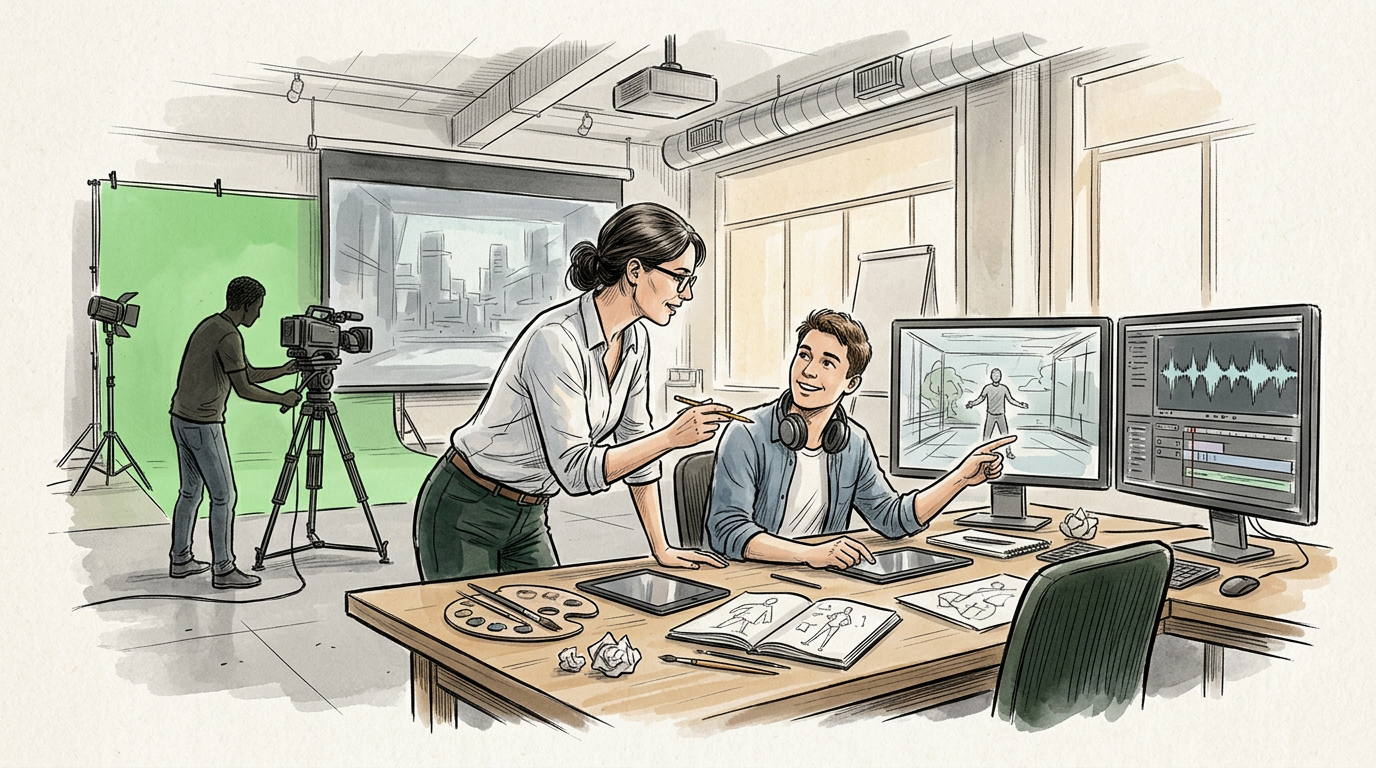
Synthetic media has moved from research labs and visual effects pipelines into mainstream advertising production. For marketers and agencies, the significance is not that every campaign will soon be fully AI-generated. It is that image generation, text-to-video systems, voice cloning, digital avatars, and synthetic environments are becoming practical production inputs for certain kinds of work. They can reduce the time and cost required to create drafts, variants, mockups, background assets, and in some cases finished content. They also introduce new questions about consent, disclosure, brand trust, quality control, and rights management that traditional production processes handled differently.
For advertising professionals, the important issue is not whether synthetic media is “real” or “fake” in some abstract sense. The practical question is what these tools can reliably do in production today, what they cannot yet do consistently, and how their use changes creative workflows, budgeting, approvals, and risk.
Synthetic media is best understood as a category, not a single tool. It includes AI-generated still images, video clips, voices, human likenesses, environments, and edited or composited content that did not exist in that exact form before the system produced it. Some systems generate assets from text prompts. Others transform existing materials, such as extending a background, changing a speaker’s lip movements to match another language, or creating a digital version of a performer from licensed source footage. Some rely on large foundation models trained on extensive datasets. Others are narrower production tools designed for dubbing, cleanup, rotoscoping, motion transfer, or image editing.
That distinction matters because synthetic media does not enter advertising production in one uniform way. A retail marketer producing high volumes of product-background variations faces a different set of opportunities and risks than a brand considering a synthetic spokesperson, a multilingual video campaign, or a stylized image-led social concept.
What the technology actually does
At a practical level, synthetic media systems generate or alter media files by identifying statistical patterns in training data and producing new outputs that match requested characteristics. For images, that often means text-to-image or image-to-image generation systems that can create scenes, objects, textures, and compositions in response to prompts or reference materials. For video, current tools can generate short clips, animate still images, extend footage, create synthetic camera motion, or alter parts of a scene. For audio, synthetic voice systems can produce narration from text, imitate vocal characteristics with permission-based voice models, or localize speech into multiple languages while attempting to preserve tone. Avatar systems can create digital on-screen presenters from recorded performers or prebuilt character libraries. Environment-generation tools can build virtual locations, product backdrops, or immersive scenes for interactive experiences.
The key phrase is “can produce,” not “can produce reliably in every case.” The strongest current production use cases are usually narrow and controlled. Image generation is often effective for concepting, storyboards, mood exploration, and some finished visual assets where perfect realism is not essential or where the image can be closely art-directed and retouched. Synthetic voice is already in use for some narration, localization, and testing applications, especially when budgets or timelines do not support repeated studio recording. AI-assisted video is improving quickly, but consistency across shots, accurate physics, brand-safe visual details, and dependable editability remain challenges. High-quality digital humans and likeness-based avatars are possible, but they typically require stronger controls, better source material, tighter legal review, and more postproduction oversight than vendor demos may suggest.
In other words, synthetic media is currently most dependable when it is used to accelerate parts of production, not when it is expected to replace every craft discipline within production.
Why production teams are paying attention
Advertising production has long been constrained by a familiar set of tradeoffs: time, budget, access, and variation. A brand may want ten product settings, six audience-specific versions, multiple aspect ratios, seasonal refreshes, local market localization, and fast turnaround for testing. Traditional production can deliver those outcomes, but often with escalating costs in photography, crews, locations, talent, reshoots, and postproduction.
Synthetic media changes that equation most clearly in four areas.
First, it can compress early-stage ideation. Creative teams can produce visual territories, character styles, sample frames, rough motion concepts, and alternate compositions far faster than through conventional mockups alone. That does not eliminate the need for creative judgment. It simply means teams can look at more options sooner.
Second, it can lower the cost of variation. Once a campaign concept exists, brands often need multiple versions for placements, markets, audience segments, and retail partners. Synthetic backgrounds, resized layouts, language variants, and alternate visual treatments can sometimes be produced without rebuilding the entire asset from scratch.
Third, it can expand production access. Smaller brands, in-house teams, and regional organizations can now create polished visuals or explainer-style video that previously required capabilities outside their budgets. That does not guarantee strong work, but it does change the production threshold for participation.
Fourth, it can support localization at scale. Voice synthesis and lip-sync tools are increasingly used to adapt campaigns for different languages. Some vendors now offer systems that preserve speaker timing and vocal character while replacing speech. These systems can be useful, but the quality varies considerably depending on accents, emotional nuance, background audio, and language pairings. Teams still need native-language review, cultural review, and performance review.
For marketers, these gains matter because much of modern advertising is no longer built around a small number of fixed hero assets. It is built around ongoing content systems. Any technology that affects the economics of asset creation changes campaign planning, testing, and optimization.
Images are the most mature synthetic production format
Among synthetic media categories, AI-generated images are the most established in everyday marketing use. Tools from Adobe, Midjourney, OpenAI, Stability AI, and others have made generation, expansion, editing, and compositing easier for non-specialists, though the products differ significantly in controls, commercial terms, and workflow fit.
In production, image systems are commonly used for:
- Concept boards and visual exploration.
- Storyboard frames and pitch visuals.
- Background creation and set extension.
- Social content variations.
- Packaging or merchandising mockups.
- Product-in-context imagery, especially when the context is more important than documentary accuracy.
- Retouching, cleanup, and generative fill.
Adobe has integrated generative tools across its Creative Cloud applications, including features for image generation, fill, expansion, and object manipulation, framed as commercially oriented creative assistance within design workflows. Those tools are not identical to open-ended image generators because they are often embedded in established editing environments and approval processes. That matters for advertising teams. A synthetic image is less risky when it can be art-directed, version-controlled, reviewed, and edited within a familiar production system than when it appears as a loosely sourced output from an external consumer tool.
Still, image generation has persistent weaknesses. Text rendering remains inconsistent in many systems. Hands, reflections, product geometry, logos, packaging details, regulated product claims, and brand-specific visual standards can all fail in subtle ways. A luxury brand that depends on material fidelity, or a CPG marketer that needs exact pack representation, may find that synthetic imagery creates more corrective labor than expected. These systems are often strongest in impressionistic ideation and weakest where exactness matters.
That tradeoff is easy to miss in pitch stages, when outputs are judged for mood rather than accuracy.
Video generation is improving, but control is still the issue
AI video has drawn enormous attention because it promises one of the most expensive goals in advertising production: moving-image creation without the full cost of live-action shoots or complex animation. Major technology firms and startups have released text-to-video and image-to-video tools, and some can produce visually striking short clips. However, striking examples should not be confused with robust production reliability.
Current AI video systems can often generate short sequences with attractive lighting, camera movement, or stylized motion. They can help with animatics, concept films, social content experiments, product demos, background motion elements, and previsualization. Some teams use them to test visual ideas before committing to a more expensive shoot or animation pipeline. They can also support postproduction tasks such as background extension, object removal, frame interpolation, or style transfer.
What remains difficult is shot-to-shot consistency, precise brand control, and editable continuity. A campaign video is not just a collection of interesting clips. It requires repeatable characters, correct products, consistent wardrobe, regulated claims, exact supers, legal copy, continuity, and predictable revision rounds. Video generation systems still struggle with many of those requirements, especially in fully generative modes.
This means that for many advertising applications, the near-term value of synthetic video is less about producing final hero spots from a prompt and more about accelerating particular tasks around the production process. Previsualization, rough cuts, multilingual adaptation, scene extension, synthetic B-roll, and lower-stakes social content are more realistic current use cases than complete replacement of established commercial production.
Synthetic voice may have the clearest business case
Synthetic voice has developed into one of the most commercially practical forms of synthetic media because many marketing use cases already prioritize speed, scale, and localization. Text-to-speech systems have improved significantly in naturalness, and voice cloning systems can now create custom models from recorded speech, subject to platform policies and contract terms.
For marketers, the attraction is straightforward. A single campaign may require dozens of script updates, regional versions, accessibility outputs, explainer videos, ecommerce descriptions, IVR systems, and social edits. Traditional studio recording remains valuable, especially for emotionally nuanced or brand-defining work, but it is not always economical for high-volume production.
Synthetic voice can help in several ways:
- Rapid draft narration during concept and edit stages.
- Lower-cost updates when legal or product copy changes.
- Localization into multiple markets.
- Always-on content systems where frequent voice updates are required.
- Audio testing before final talent recording.
The risks are equally clear. Consent and contract terms are central when a recognizable voice is modeled. The entertainment industry has already pushed this issue into public view. In 2023, SAG-AFTRA negotiated protections around digital replicas in its agreements, reflecting broader concerns that performers’ likenesses and voices can be reused or simulated beyond the original scope of work. Even outside union contexts, advertisers should not assume that old recording agreements cover synthetic reuse. A voice performance that was licensed for one campaign may not include rights to create a reusable voice model for future work.
Quality is another issue. A synthetic voice can sound fluent while still mishandling emphasis, pacing, emotional tone, pronunciation, or culturally sensitive phrasing. For high-trust categories such as healthcare, finance, public service, and political communication, those details matter.
Avatars and digital humans create efficiency, but also reputational exposure
Avatar platforms offer synthetic on-screen presenters that can deliver scripts in multiple languages, often with synchronized lip movements and a consistent visual identity. Some systems use stock avatar libraries. Others build custom avatars from a real person who records source footage. These tools are now common in corporate communications, training, internal marketing, and some performance-marketing contexts.
The appeal is obvious. A brand can produce many presenter-led videos without repeatedly scheduling shoots, crews, styling, studio time, and retakes. That is especially useful for product explainers, onboarding content, dealer communications, and sales enablement material.
But avatar use in advertising raises a more delicate set of questions than generic efficiency discussions usually acknowledge. If the avatar is based on a real person, the brand needs clear rights for likeness use, duration, territories, revisions, and any future retraining or adaptation. If the avatar is synthetic but human-like, the brand still has to decide whether audiences may infer that an actual person delivered the message. In some contexts that may not matter much. In others, especially where trust and authenticity are central to the brand relationship, it could matter a great deal.
There is also a quality threshold problem. Audiences generally tolerate less naturalism in training videos and simple explainers than in brand advertising. A digital presenter that is acceptable in an internal HR module may feel flat, uncanny, or impersonal in a consumer-facing campaign. The production decision is therefore not just technical. It is strategic. Teams need to ask where synthetic presentation supports the communication goal and where it undermines it.
Synthetic environments can reduce production friction
Not all synthetic media centers on faces and voices. One of the more practical applications in advertising is the creation of synthetic environments: virtual showrooms, product staging scenes, dynamic retail contexts, CGI sets, AR try-on spaces, and immersive branded worlds. Some of these environments are built with conventional 3D tools. Others now incorporate generative systems that can create textures, props, lighting concepts, or whole scene variations more quickly.
For product marketers, synthetic environments can be useful when the objective is to place a product in many contexts without repeatedly photographing it on location. Furniture, beauty, automotive accessories, fashion, and home goods marketers have all been experimenting with virtual staging and 3D-backed merchandising systems for years. Generative tools make that process faster in some cases by reducing manual asset creation or speeding up ideation.
This does not eliminate the need for accurate product representation. If a generated room setting makes a sofa look larger than it is, or if a virtual cosmetics simulation misrepresents shade performance, the problem is not merely aesthetic. It becomes a claims and trust issue. Synthetic environments can improve production efficiency, but the same standard still applies: the ad has to present the product truthfully enough for its category and context.
What synthetic media changes in creative workflow
The biggest operational impact of synthetic media may be less about finished outputs than about where production begins and how many times it loops.
Traditional production often separates concept development, preproduction, production, and postproduction into clearer phases. Synthetic media compresses those boundaries. Concept boards become mock finished frames. Storyboards become moving animatics. Localization becomes an ongoing post-launch production function rather than a one-time adaptation stage. A creative review may now involve generated options that look polished enough to influence decision-making long before they have been legally vetted or technically finalized.
That affects several roles at once. Art directors and designers increasingly need prompting skills, model-specific visual judgment, and the ability to identify subtle output defects. Producers need new processes for rights review, disclosure decisions, source tracking, and vendor evaluation. Legal teams need visibility into how synthetic assets were created, what source materials were used, what licenses apply, and whether a real person’s likeness, voice, or performance is implicated. Brand teams need stronger governance on when synthetic assets are appropriate and what approval thresholds apply.
In many organizations, the practical result is not less production management but more front-loaded production management. Synthetic tools can reduce asset creation time while increasing the need for controls around provenance, review, and consistency.
Cost savings are real, but they are not uniform
One reason synthetic media discussions become distorted is that cost savings are often described too broadly. It is true that some production tasks are now cheaper than they were a few years ago. It is also true that synthetic workflows can create new costs that are easy to overlook.
The most plausible savings tend to appear in areas such as concept generation, adaptation, background creation, rough production, voice iteration, and repetitive low-risk asset work. If a team can avoid multiple reshoots, reduce studio time, or create localized variants without rebuilding entire productions, the economics can be compelling.
But synthetic media does not simply remove cost. It often redistributes it. Teams may spend less on some traditional production inputs while spending more on software, asset review, rights clearance, compliance checks, retouching, media provenance, custom model creation, or specialist talent who can guide outputs into usable form. There is also organizational cost in retraining teams and establishing acceptable-use policies.
For higher-end advertising, another factor matters: synthetic tools can lower the cost of making more content, which can increase stakeholder demand for more versions, more markets, more testing, and faster refresh cycles. In that situation, the unit cost per asset may fall while total production volume and complexity rise.
That is why synthetic media should be evaluated against actual workflow economics, not just against a headline claim that “AI makes production cheaper.”
Quality control becomes a strategic function
Traditional production has always required review, but synthetic media changes what review looks for. The concern is no longer limited to continuity errors or retouching mistakes. Teams now need to check whether a generated hand has the right number of fingers, whether a bottle label includes nonexistent text, whether an avatar blink pattern looks distracting, whether a synthetic voice mispronounces a drug name, or whether a scene unintentionally resembles a copyrighted style or competitor’s trade dress.
These are not merely cosmetic issues. In advertising, a small defect can become a trust issue, a regulatory issue, or a social-media issue very quickly.
Quality control in synthetic production usually needs to cover at least four areas:
- Brand accuracy, including logos, packaging, colors, claims, and tone.
- Technical plausibility, including anatomy, motion, reflections, physics, and synchronization.
- Rights and provenance, including source inputs, licenses, consent, and model terms.
- Contextual appropriateness, including cultural nuance, inclusivity, disclosure expectations, and category-specific standards.
This is one reason the “press button, get ad” framing is misleading. Synthetic production still depends heavily on human supervision, just at different points in the workflow.
Disclosure is not a universal rule, but it is becoming a practical brand question
Whether brands should disclose synthetic media use depends on what was generated, how it was used, the legal context, the audience expectation, and the risk of deception. There is no single universal disclosure rule for all synthetic media in advertising. However, several legal and platform developments make the issue more important.
At the policy level, the Federal Communications Commission has moved on AI-generated voice abuse in robocalls, and the Federal Trade Commission has warned that deceptive AI claims and AI-enabled deception can violate existing law. Political advertising has faced especially visible scrutiny, with some states enacting or proposing rules around deceptive AI use in election contexts. Platform policies are also evolving. For example, some major digital platforms have introduced labeling requirements or election-related restrictions for certain manipulated or synthetic political content.
For commercial advertising outside politics, the professional question is often broader than formal legal obligation. If a campaign materially depicts a person, event, testimonial, demonstration, or product experience in a way that could mislead audiences about what they are seeing or hearing, disclosure may be prudent even when not explicitly required by a synthetic-media-specific rule. The closer the content comes to documentary representation, the stronger the authenticity expectation.
A synthetic fantasy environment in a fashion ad raises a different expectation than a synthetic customer testimonial, a simulated executive message, or a cloned celebrity voice. Marketers should evaluate not only whether disclosure is legally mandated, but whether omission could damage trust if the production method later becomes public.
The emerging technical ecosystem is also relevant. The Coalition for Content Provenance and Authenticity, or C2PA, has developed standards for attaching provenance information to digital content. Adoption is still uneven, and metadata can be lost across platforms and workflows, but provenance standards may become increasingly useful for enterprise content governance even before they become visible to most consumers.
Consent and likeness rights are central, not secondary
Among all the risks associated with synthetic media, consent may be the most immediate for advertisers because it intersects with contract law, publicity rights, privacy, labor concerns, and reputation. If a campaign uses a real person’s face, voice, performance traits, or digital replica, the scope of permission matters. A broad content-use clause may not be enough. Teams need to know whether they have the right to create a synthetic version, retrain it, modify it, localize it, reuse it, or deploy it in future contexts.
This applies to celebrities, influencers, employees, executives, voice actors, presenters, and customers. It also applies to source materials used in model creation. If a brand works with a synthetic production vendor, the contract should address not only what is delivered but how the system was trained, what inputs are stored, who owns the resulting assets, whether the vendor can reuse the brand’s materials, and how future use is restricted.
Likeness rights are also becoming more contested at the state level. In the United States, rights of publicity vary by jurisdiction, and several states have passed or considered laws related to digital replicas and unauthorized synthetic use. The details differ, which is why brands should avoid simplistic assumptions that standard production releases automatically cover synthetic generation.
For advertising practice, the takeaway is straightforward: if a synthetic asset is connected to a recognizable human identity, legal review should begin before production, not after creative approval.
Authenticity still matters, but not in one simple way
Synthetic media often gets discussed as a threat to authenticity, but advertising has never been a purely documentary medium. Brands have always used staging, retouching, animation, compositing, and performance. The more useful question is not whether synthetic media is authentic in the absolute. It is whether its use aligns with audience expectations and brand positioning.
A toy brand can use obviously synthetic environments with little friction. A luxury fragrance campaign may use stylized artificiality as part of its aesthetic language. An enterprise software marketer may use a synthetic avatar for multilingual tutorials without much resistance if the content is clear and useful.
The tension increases when authenticity itself is the promise. Categories that depend on trust, human expertise, lived experience, testimony, craftsmanship, or realism may need stricter standards. If a healthcare brand uses a synthetic patient story, or a nonprofit uses generated imagery that appears documentary, the issue is not simply production technique. It is whether the communication misrepresents reality in a way that audiences would consider material.
Authenticity, then, is not the opposite of synthetic production. It is a matter of fit between method, message, and expectation.
What synthetic media does not change
Despite the speed of tool development, synthetic media does not repeal the basic requirements of effective advertising production. Brands still need clear strategy, strong concepts, audience understanding, distinctive creative direction, legal compliance, and disciplined execution. Generating more options does not ensure better judgment. Faster production does not guarantee stronger ideas. Lower asset costs do not remove the need for approvals, brand standards, and editorial rigor.
It also does not eliminate the value of traditional production. There are still many situations where live-action filming, original photography, human voice talent, illustrators, designers, animators, and craft specialists are the best choice. In some cases, synthetic tools support their work. In others, they are poor substitutes. The practical question is not whether one mode will replace the other, but which combination produces work that is effective, accurate, and appropriate for the brand.
What advertising professionals should watch next
The synthetic media landscape is changing quickly, but a few developments deserve sustained attention.
One is controllability. The commercial usefulness of synthetic video and avatars will depend less on spectacular demos than on whether teams can maintain continuity, editability, compliance, and brand precision through revision cycles.
Another is provenance infrastructure. If C2PA-style content credentials become more common in enterprise workflows, advertisers may gain better ways to document how assets were produced and modified.
A third is contract and rights standardization. Many of today’s operational risks exist because synthetic production practices have outpaced standardized business terms around digital replicas, reusable voice models, and training-data restrictions.
Finally, audience norms are still forming. Consumers may accept synthetic media readily in some contexts and reject it in others. Brands that treat this as a messaging and trust issue, not just a production issue, will be in a stronger position than those that view synthetic assets as interchangeable with any other low-cost content source.
Synthetic media changes advertising production most meaningfully where production is repetitive, iterative, versioned, localized, or constrained by budget and time
Leave a Reply