
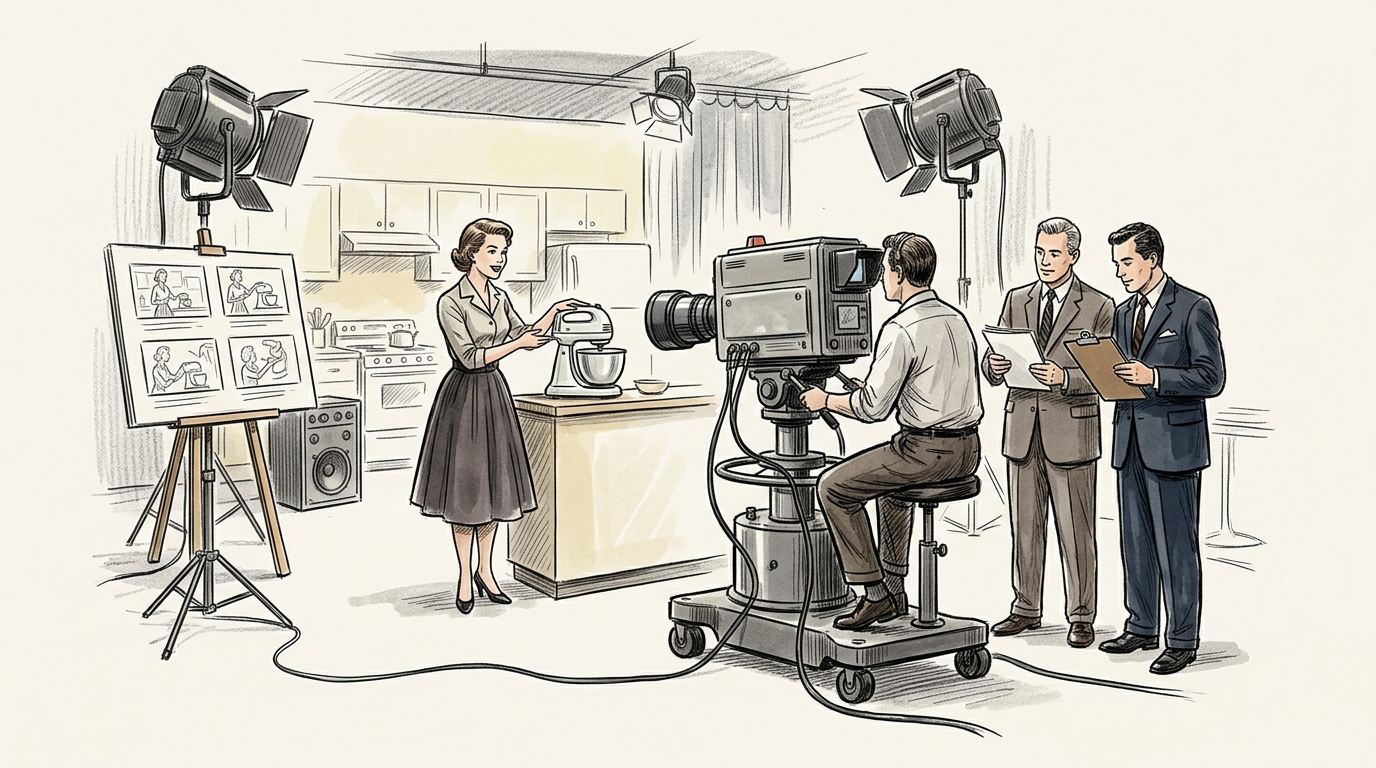
Television did not simply give advertisers a new place to run messages. After World War II, it reorganized the economics, craft, and social reach of American advertising. In one medium, television combined moving images, spoken language, music, performance, product demonstration, and the possibility of simultaneous national exposure on a scale that print, radio, film shorts, and outdoor advertising had never matched in the same way. By the late 1940s and especially through the 1950s, that combination altered how agencies staffed accounts, how brands budgeted campaigns, how creative ideas were developed, how media was bought, and how advertisers imagined their relationship to the public.
The transformation was not instantaneous, and it was not driven by creative possibility alone. It depended on postwar manufacturing growth, expanding consumer demand, the rapid spread of television sets into American homes, the structure of network broadcasting, and the business practices inherited from radio. It also depended on a new production system inside agencies and studios, one that had to coordinate writers, art directors, directors, performers, musicians, engineers, researchers, media buyers, and client approvals around a medium that was both expensive and fleeting. Television became central to American advertising because it offered something advertisers had long wanted: persuasive messages delivered repeatedly into the home, with emotional force and demonstrative power, at mass scale.
Before television, advertisers were already thinking in multimedia terms
Television’s arrival makes more sense when placed against the media environment that preceded it. By the 1920s and 1930s, American advertising was already a mature national business built on magazines, newspapers, outdoor posters, direct mail, and, increasingly, radio. National brands such as Procter & Gamble, General Foods, Colgate-Palmolive, Ford, and Lucky Strike had learned how to coordinate distribution, packaging, promotion, and media across broad geographic markets. Agencies had developed specialized departments for copy, art, media, account management, and research. Consumer products companies were already using serial campaigns, slogans, celebrity endorsements, testimonials, and product demonstrations in print and radio-adjacent promotional forms.
Radio was the most important immediate predecessor. It taught advertisers how sponsored entertainment could build familiarity and trust over time. It also familiarized agencies and clients with concepts that television would inherit and modify: network buying, ratings, daytime versus prime-time scheduling, and the close connection between programming and sponsorship. Soap operas themselves took their name from household-products sponsors that used daytime radio to reach women managing household purchasing. The advertising industry did not enter television as a blank slate. It brought with it habits formed in print and radio, then adapted them to a medium that was more demanding and more visually expressive.
Commercial television existed before the postwar boom, but wartime interruption delayed its large-scale development. NBC’s New York station WNBT aired what is widely cited as one of the first legal television commercials on July 1, 1941, a ten-second Bulova watch spot before a Brooklyn Dodgers-Philadelphia Phillies game. The ad’s historic status is well documented, but it should not be mistaken for the beginning of television as a mass advertising medium. World War II limited consumer set production and slowed station expansion. Television became a major advertising force only after 1945, when consumer manufacturing resumed and station building accelerated under the emerging network system.
The postwar household became television’s commercial setting
Television advertising expanded because television itself spread with remarkable speed. According to historical figures compiled by the Federal Communications Commission and industry researchers, only a small minority of American households owned television sets in the late 1940s, but adoption surged in the early 1950s. By the end of that decade, television had become a routine household appliance in most American homes. This diffusion mattered not only because it increased audience size, but because it changed where advertising was encountered. Newspaper and outdoor advertising met people in public. Magazines entered the home but were individually handled and read at different times. Radio was often ambient and portable within the household. Television, by contrast, organized shared viewing around a screen, usually in a family room or living room, at scheduled hours.
That domestic setting helped redefine advertising’s tone. Television messages had to work amid family routines, meal times, children’s attention, and shared viewing across age groups. A message could be intimate without being private and mass without feeling distant. That tension became one of television advertising’s most distinctive characteristics. National brands could speak to millions at once, yet appear to do so in a familiar domestic environment through a host, a spokesperson, a demonstration, or a dramatic scene.
The social meaning of television also mattered. In the years of postwar prosperity, suburbanization, and rising consumer spending, television set ownership itself signaled modern participation in middle-class life. As historians of consumer culture have noted, television was both a product sold through advertising and the platform through which many other products were made desirable. The medium was therefore woven into the expansion of postwar consumer capitalism at two levels: as a household technology and as an advertising system.
Television united demonstration and drama
What made television especially powerful for advertisers was not simply that it showed products, but that it could combine showing with telling and feeling. Print had long excelled at detailed claims and static imagery. Radio had excelled at voice, repetition, jingles, and personality. Film could demonstrate products in motion, but theatrical advertising shorts and cinema commercials lacked television’s household regularity and scheduling power. Television brought these capacities together.
For many categories, demonstration became central. Cleaning products could be shown removing stains. Automobiles could be shown moving through landscapes or city streets. Food products could be shown being prepared and served. Appliances could be shown simplifying domestic tasks. Cosmetics could be associated with before-and-after transformations. Cigarettes, beer, and soft drinks could be placed within dramatized social scenes or linked to celebrities. The medium did not eliminate verbal claims, but it gave those claims sensory support. Advertisers could dramatize cause and effect, build atmosphere with music, and reinforce memory through taglines, logos, and recurring characters.
This combination affected creative structure. Commercials increasingly had to do several things at once within tight time limits: establish a situation, introduce the brand, demonstrate a benefit, create memorability, and close with a clear sales point. Television rewarded concise visual storytelling, but not every early commercial achieved it elegantly. Many early spots looked like radio transferred awkwardly to screen, relying on static camera setups, announcer-heavy scripts, or stagey presentations. Over time, agencies, production companies, and directors developed a more fluent grammar of television advertising, one that used editing, camera movement, music, casting, and visual metaphor more deliberately.
A well-known early example of television’s demonstrative and dramatic potential is the series of commercials for Anacin developed by Ted Bates & Company in the 1950s. The ads visualized headache pain with animated hammering effects and linked symptom relief to direct product claims. Their style was blunt and repetitive, and later critics often cited them as emblematic of hard-sell television. Whether admired or mocked, they showed how television could turn an invisible bodily complaint into a dramatic, memorable visual event.
The sponsorship model shaped early television advertising
Television did not begin with the now-familiar pattern of many short commercial spots scattered through programs. In the late 1940s and early 1950s, much network television followed a sponsorship model inherited from radio. Single advertisers, or sometimes a small number of sponsors, underwrote entire programs. Their names often appeared in the program title or opening, as in The Colgate Comedy Hour, Kraft Television Theatre, or The U.S. Steel Hour. Sponsors could exert significant influence over content, scheduling, and talent decisions because they were effectively buying not just advertising time but the program vehicle itself.
For agencies, this created a broader role than making commercials alone. Some agencies were deeply involved in program production and talent coordination as well as media placement. The relationship among advertiser, agency, network, and producer could be complex, with agencies sometimes functioning as intermediaries not only in messaging but in entertainment packaging. Television advertising in this period cannot be separated neatly from program history because sponsors often saw programs themselves as brand environments.
This arrangement had advantages. Sponsorship allowed brands to associate themselves continuously with specific entertainment properties and personalities. It also made room for host-read commercials, integrated demonstrations, and sponsorship identification that felt more woven into the viewing experience than later spot interruptions. Yet it had drawbacks. Full sponsorship was expensive, inflexible, and risky. If a program underperformed, the advertiser carried substantial cost. As audiences grew and network schedules became more complex, the model began to give way.
A major turning point came in the mid-1950s as NBC and CBS increasingly shifted toward the participation, or magazine, concept in which multiple advertisers bought shorter commercial units within programs. Industry histories often point to NBC president Sylvester “Pat” Weaver as a leading advocate of this change. The participation model reduced risk for advertisers, increased inventory for networks, and helped standardize the 60-second and later 30-second commercial as a discrete product. It also separated program production more clearly from advertising production, even though the ties between them remained strong.
Agencies had to build new production capabilities
Television advertising changed agency organization because it demanded skills and workflows that neither print nor radio had fully required. Agencies needed producers who could manage film or live television shoots, coordinate studios, secure talent, supervise sets and wardrobe, work with unions, and oversee postproduction. Copywriters and art directors had to think in time, sequence, and performance rather than only in layouts and headlines. Account executives had to navigate larger budgets and more intricate client approvals. Media departments had to understand network schedules, station clearances, sponsorship packages, and ratings data. Research teams had to connect audience measurement with campaign planning.
The early years of television included both live commercials and filmed commercials. Live spots were common when stations and networks lacked the infrastructure or budgets to rely entirely on filmed inventory. Live production could be economical and fast, but it was technically demanding and prone to mishaps. Filmed commercials offered greater control, repeatability, and consistency across markets, especially as network distribution expanded. By the late 1950s and early 1960s, filmed commercials had become increasingly central to national advertising practice.
That shift drew agencies closer to Hollywood and to independent production specialists. Directors, cinematographers, editors, composers, and actors became more integral to advertising. The commercial was no longer merely a printed message adapted to the screen. It became a short-form production requiring craft disciplines associated with film and television entertainment. This was one reason television raised the cost structure of advertising. Media time was expensive, but so was making professional commercial content that could stand beside network programming.
The financial stakes altered client-agency relations. A print campaign could be revised comparatively late in the process. Television required earlier decisions and tighter coordination because production schedules, talent bookings, and network slots imposed hard deadlines. Mistakes could be costly. Agencies that had once relied heavily on copy departments now had to support broadcast production units and cultivate executives fluent in both creative development and production management.
Budgets grew, and so did the importance of media planning
Television became the largest advertising medium in the United States during the postwar era not because it replaced every other medium, but because it absorbed growing shares of national brand budgets. As television ownership and network reach expanded, advertisers shifted spending from radio and, in some cases, from print into broadcast schedules that could deliver massive audiences quickly. Trade publications such as Broadcasting and Sponsor chronicled this shift in detail, and annual media expenditure analyses documented television’s ascent across the 1950s and 1960s.
This did not make media buying simpler. In fact, television increased the strategic importance of media planning. Advertisers had to decide among network programs, local spot television, time periods, seasonal placements, and audience profiles. They had to coordinate national network buys with local dealer or retail support. Frequency and reach became more central planning concepts, especially as ratings systems developed to quantify audience delivery.
Audience measurement was crucial to television’s commercial legitimacy. Radio had ratings, but television intensified their importance because the sums involved were larger and the visual nature of the medium made program context especially consequential. A.C. Nielsen’s work in television measurement became increasingly influential in the 1950s as the industry sought standardized metrics to price time and compare programs. Ratings were never perfect representations of audience attention or persuasion, and contemporaries understood that. But they provided a common trading language for networks, agencies, and advertisers.
As a result, television accelerated the professionalization of media research and planning inside agencies. Buying time was no longer a straightforward matter of placing insertions in publications. It involved forecasting audience composition, negotiating availabilities, balancing national and spot schedules, and connecting ratings data to sales goals. The television era helped establish media planning as a more analytically central agency function.
Storytelling changed because time itself became the canvas
Television also transformed the creative discipline of advertising by making sequence, pacing, and audio-visual integration central to brand storytelling. In print, persuasion could rely on headline structure, typography, illustration, and body copy that readers engaged at their own pace. On television, advertisers controlled the order and speed of information. This was a profound shift. Brands could build suspense, stage a reveal, coordinate dialogue with gesture, and make music or sound effects part of the sales argument.
Jingles became especially important in early television because they linked radio-era mnemonic techniques with visual branding. Catchy musical phrases helped viewers remember products after a brief commercial exposure. Mascots and spokespersons likewise gained new force when they could be seen and heard repeatedly. Some campaigns used animation effectively because it stood out on-screen and translated well across repeated airings.
Celebrity use also expanded, though not always in the simple form later memory suggests. Television gave advertisers access to personalities whose familiarity derived from broadcasting itself. Hosts could endorse products directly, actors could appear in commercials, and brands could benefit from the borrowed authority or likability of public figures. At times this was highly integrated into sponsored programming. At other times it took the form of stand-alone spots. The practice raised questions about authenticity, influence, and disclosure that would become more formally regulated later.
By the late 1950s and 1960s, television was also one of the arenas in which broader creative changes in the agency business became visible. The so-called creative revolution associated with agencies such as Doyle Dane Bernbach affected television as well as print, even if its print work has often received more retrospective attention. DDB’s campaign for Volkswagen, developed in the United States after the 1959 “Think Small” print debut, extended a quieter, irony-inflected sensibility into television. One notable example is the 1960 commercial often referred to as “Snow Plow,” a spare and understated spot that trusted viewers to infer product reliability rather than bombarding them with claims. That approach stood in contrast to many more declarative mid-century commercials and demonstrated that television could support tonal subtlety as well as direct demonstration.
Still, the hard sell did not disappear, nor did demonstration-led formats. Television’s history is not a straight line from blunt pitchmanship to sophisticated cinematic persuasion. Different product categories, price points, dayparts, and target audiences sustained multiple styles at once.
Television redefined national brands and local adaptation
One of television’s most important contributions to advertising history was its role in consolidating national brands. Network broadcasting offered advertisers a way to deliver a coordinated message across wide geographic areas with unprecedented simultaneity. This mattered in a country whose postwar economy was increasingly organized around national manufacturing, distribution, and retail systems. Brands could launch products nationally, support dealer networks, and sustain common positioning across regions.
Yet television did not eliminate local variation. Spot television remained important for regional campaigns, retail events, dealer associations, movie exhibitors, political advertisers, and categories with uneven distribution. Agencies and media buyers often had to combine national network schedules with local station placements to achieve both scale and market-level efficiency. This dual structure strengthened the complexity of campaign planning and helped make television a layered market rather than a single monolithic one.
The national power of television also affected branding itself. Repetition across a common screen environment pushed advertisers toward consistent visual identities, sonic cues, and slogans that could survive frequent exposure. Packaging design, logo clarity, and product recognizability became increasingly important because the commercial was now one touchpoint among many in a coordinated national brand system. The message on-screen had to connect with what consumers saw on store shelves.
Regulation, standards, and public criticism grew alongside the medium
Television’s persuasive power and reach made it a target of scrutiny almost from the beginning. Some concerns involved broadcasting structure rather than commercials directly, including network concentration and licensing obligations under federal regulation. The Federal Communications Commission, which had regulated broadcasting since the Communications Act of 1934, shaped the technical and licensing conditions under which commercial television expanded. Its 1952 Sixth Report and Order was particularly important in reopening the television station licensing process after a freeze and establishing a framework for VHF and UHF allocation that allowed broader system growth.
Advertising claims themselves also faced growing attention. The Federal Trade Commission continued to police deceptive practices, and television made dubious demonstrations or exaggerated promises more publicly visible. The medium’s ability to show “proof” heightened the stakes of substantiation. Endorsement practices, sponsorship identification, and category-specific standards evolved over time, though the regulatory framework developed unevenly.
Television’s close link to children’s viewing generated special concern. Critics worried about the influence of commercials on young audiences, especially as toy and cereal advertising expanded. These debates did not begin in the deregulation battles of the late twentieth century. They have roots in the earliest decades of children’s commercial television, when the blending of entertainment, host authority, and product promotion prompted questions about vulnerability and manipulation.
There was also criticism from within the industry. By the late 1950s and early 1960s, some advertisers and commentators argued that television’s cost and ratings pressures encouraged formulaic work and excessive conformity. The quest for mass audiences could flatten distinction. The famous 1961 FCC chairman Newton Minow speech describing television as a “vast wasteland” was aimed at programming quality, but it reflected a broader unease about what the commercial system was producing. Advertisers were not passive observers of these concerns. They were central participants in the system being judged.
Color, tape, and new production tools extended television’s influence
Television advertising continued to evolve technically after its initial postwar breakthrough. Color broadcasting, though introduced earlier in limited form, expanded materially after the mid-1950s and became much more widespread in the 1960s. For advertisers, color created new opportunities and new expenses. It mattered especially for food, fashion, automobiles, household goods, and any category in which visual richness supported desire or product differentiation. Agencies had to learn how colors reproduced on television screens, how sets and costumes should be designed for broadcast, and how packaging would appear under studio lighting.
The spread of videotape after Ampex introduced practical videotape recording in 1956 gradually altered production and scheduling practices as well. Tape did not immediately replace film for commercials, but it changed the broader television production environment and expanded options for recording, editing, and distribution. Over time, improvements in editing and postproduction gave agencies and production companies more flexibility in shaping commercial timing and presentation.
These changes reinforced television’s status as a technically mediated advertising craft. Success depended not only on an idea, but on how that idea survived the realities of cameras, lighting, editing, broadcast transmission, and the home receiver. Television made production literacy a core advertising competency.
The audience relationship became more immediate and more contested
Perhaps television’s deepest historical effect was the way it changed the perceived relationship between advertisers and audiences. The medium encouraged advertisers to think of persuasion as something enacted in time before viewers rather than merely delivered to them as text or image. Television commercials could create characters, recurring situations, and tonal worlds that audiences recognized week after week. This strengthened the idea of the brand as a familiar presence in everyday life.
At the same time, television made intrusion more obvious. A magazine advertisement could be turned past. A radio commercial might blur into audio flow. Television interruptions were harder to ignore because they claimed both eye and ear. This sharpened the tension between advertising’s economic necessity for commercial broadcasting and viewers’ resentment of interruption. Much of modern advertising strategy, from shorter units to integrated sponsorship to branded entertainment and later digital targeting, can be read in part as a response to a problem television made unmistakable: how to command attention without exhausting goodwill.
The medium also amplified a long-running contradiction in advertising. Television allowed brands to address “the nation,” but the nation it addressed was neither uniform nor equally represented. Mid-century television advertising often assumed white, middle-class, heterosexual domestic norms and marginalized or stereotyped many Americans. Those patterns were not created by television alone, but television gave them extraordinary visibility and repetition. Understanding television’s advertising history therefore means recognizing both the medium’s creative and commercial significance and its role in normalizing limited and exclusionary representations.
What television changed in advertising history
Television transformed American advertising because it fused the selling strengths of earlier media into a new industrial system. It brought demonstration, emotion, performance, music, branding, and mass scheduling together inside the home. In doing so, it shifted advertising from a business centered largely on printed persuasion and audio sponsorship to one organized around expensive audiovisual production, ratings-based media planning, and national broadcast scale.
The changes were practical as much as aesthetic. Agencies built broadcast departments and production capabilities. Clients committed larger budgets and accepted new creative and scheduling disciplines. Media buying became more data-driven and strategically central. Storytelling evolved from static claims to timed sequences of image, sound, and action. The national brand became more standardized, more familiar, and more dependent on repeated screen presence.
Not every later development in advertising came from television, and many older practices survived alongside it. Print remained important. Radio adapted. Direct response continued to thrive. But television redefined the center of gravity of American advertising in the postwar decades. It taught the industry how to think in integrated audiovisual campaigns, how to buy audiences at scale through measured delivery, and how to manage persuasion in a medium that was at once intimate and industrial.
Modern advertising still carries television’s imprint. Video storytelling across streaming platforms, social feeds, connected TV, and online pre-roll depends on production logics, attention problems, and brand habits shaped in the television era. The technologies have changed, and audience control is far greater today. Yet many of the profession’s enduring questions became unavoidable when television entered the American home after World War II: How should a brand use sight, sound, and motion together? How much scale is worth the cost? What belongs in the message, and what belongs in the surrounding content? And what kind of relationship, exactly, does an advertiser create when it appears not just in public, but in everyday domestic life?
Leave a Reply