
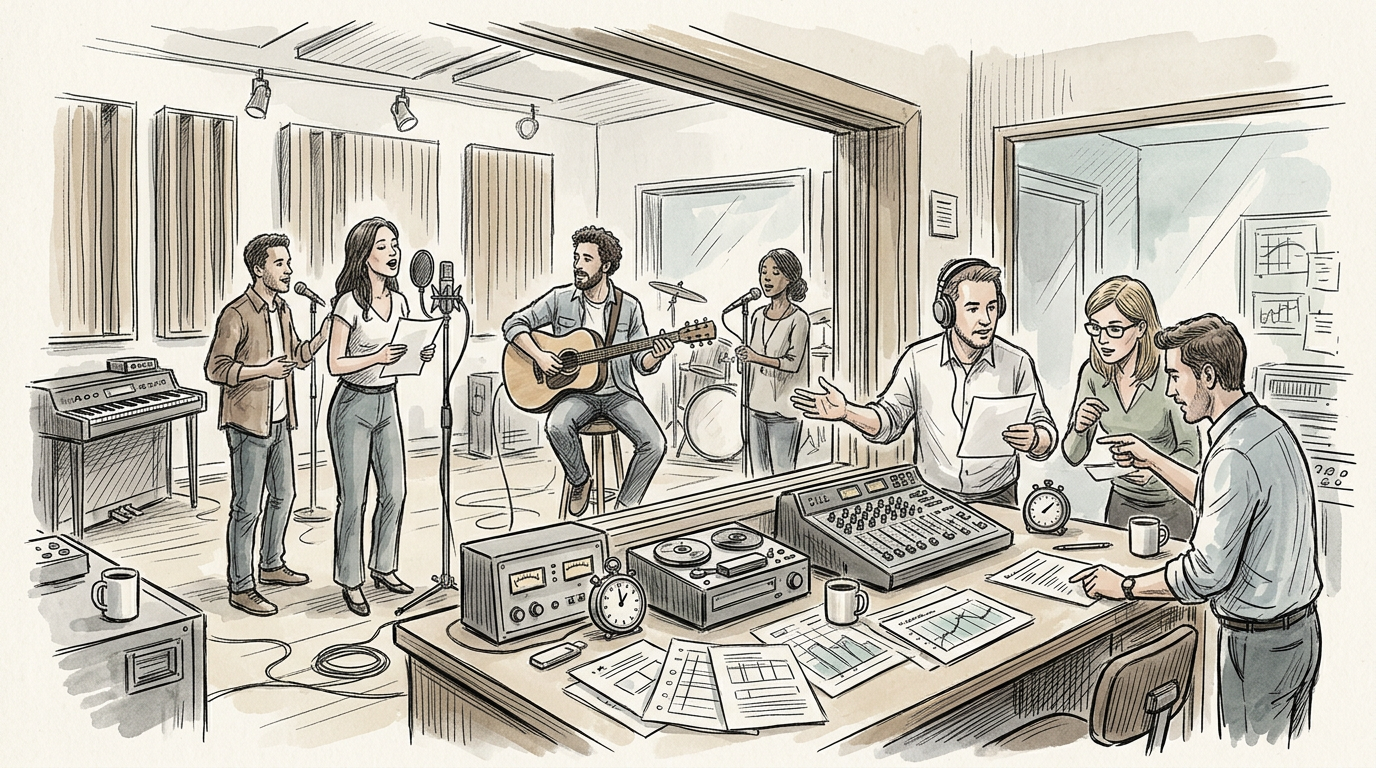
The advertising jingle did not emerge as a novelty on the margins of commercial culture. It developed as a practical response to a specific mass-media problem: how to make a brand memorable when audiences could hear it but not see it, and later, how to make a television commercial cut through clutter with a recognizable sonic signature. By the middle of the twentieth century, the jingle had become one of advertising’s most efficient tools for recall, combining melody, repetition, rhyme, and branding in ways that fit the economics and production systems of broadcasting.
Its history matters because the jingle helped define how advertisers adapted to electronic media. It linked agency strategy, popular music, sponsorship, audience psychology, and production craft. It also helped institutionalize a set of advertising practices that now seem familiar: integrated campaign thinking, mnemonic branding, audio logos, custom composition for commercial use, and the idea that a brand could own not just a line of copy or visual style, but a sound.
Before the Broadcast Jingle: Sung Selling in Print and Public Space
Long before radio, advertisers and sellers understood that rhyme and melody aided memory. Street cries, medicine-show songs, trade cards with verses, and promotional sheet music all used music to fix product names in the public mind. In the late nineteenth and early twentieth centuries, brands sometimes distributed songs or sponsored musical performances, especially when selling patent medicines, household goods, or regional retail services. Those efforts, however, belonged to a mixed promotional culture rather than to a stable advertising format.
The true jingle required a different media environment. It depended on the rise of national broadcasting, regularized commercial time, sponsored programming, and audio production systems capable of repeating a message consistently across markets. Once radio became a household medium in the 1920s, advertisers faced a new challenge. Print could rely on typography, imagery, package illustration, and page repetition. Radio had only voice, sound effects, silence, and music. That limitation became the jingle’s opening.
Radio Creates the Conditions for the Modern Jingle
Commercial broadcasting expanded rapidly after the first sponsored radio advertisements of the early 1920s. As stations multiplied and networks matured, advertisers moved from merely buying announcements to sponsoring entire programs. Soap manufacturers, cereal brands, tobacco companies, and appliance makers all sought durable ways to associate themselves with popular entertainment. In that setting, music was not incidental. It was central to how radio sounded and how listeners organized their attention.
Radio commercials in the 1920s and early 1930s often sounded more like sponsored announcements than later spot advertising. Many were read live by announcers or embedded in program continuity. But agencies and sponsors quickly recognized that sung commercial messages could do something spoken copy often could not. A melody could carry a brand name repeatedly without sounding like simple repetition. Rhyme could compress selling points. A tune could remain in memory after the set was turned off.
One of the best-documented milestones in this development is General Mills’ Wheaties. In 1926, station WCCO in Minneapolis aired the now-famous “Have you tried Wheaties?” song, generally treated by historians as an early radio jingle and often described as the first widely influential singing commercial for a packaged national brand. The campaign emerged when Wheaties sales were weak, particularly outside the Midwest. General Mills and its radio partners found that the sung message gave the cereal a distinct identity and helped support broader radio promotion. The exact “first jingle” claim is sometimes simplified in popular retellings, since sung commercial messages existed in other forms before it, but Wheaties is important because of its documented role in turning a musical commercial message into a repeatable brand device within network-era advertising.
Its best-known lyric, “Have you tried Wheaties? They’re whole wheat with all of the bran,” shows the essential grammar of the jingle in compressed form. It names the brand repeatedly, uses easy rhythm, and combines a product claim with a tune ordinary listeners could remember. Over time, Wheaties also linked its radio identity to sports broadcasting, helping shape the cereal’s long association with athletic achievement.
Why Music Worked So Well on Radio
The jingle’s effectiveness has often been explained in broad psychological terms, sometimes too broadly. It is safer historically to say that advertisers and broadcasters, through experience and audience research, came to believe that music improved attention and recall in the radio environment. Contemporary trade publications and agency discussions repeatedly treated melody as a practical memory aid.
Several features made jingles especially useful:
- Repetition without monotony: Repeating a spoken brand name could sound blunt or tiresome. Repeating it inside a melody felt more natural and often more pleasant.
- Rhyme and meter: Regular phrasing made copy easier to memorize, especially when listeners heard it casually rather than with full concentration.
- Distinctive sonic identity: In an all-audio medium, a recognizable tune could serve some of the same identifying function as a logo or package design in print.
- Emotional transfer: Cheerful orchestration, reassuring harmonies, or regional musical styles could carry associations that spoken copy alone could not establish as quickly.
- Adaptability: A jingle could be used in program openings, closings, station breaks, spot announcements, and local dealer adaptations.
These were not merely aesthetic benefits. They matched the business structure of broadcasting. Sponsors needed messages that could travel well across stations, fit strict time lengths, and work whether the listener was paying close attention or only partly listening while cooking, cleaning, or reading.
Agencies, Sponsors, and the Rise of the Singing Commercial
The spread of jingles also reflected institutional change inside the advertising business. As radio spending increased in the 1930s, agencies built radio departments to handle program production, scriptwriting, talent, and scheduling. Commercial music became professionalized along with those functions.
Agencies did not always compose jingles in-house. They frequently collaborated with outside musicians, radio producers, and later specialized jingle companies. But the strategic use of music was clearly an agency matter. Copywriters, account executives, producers, and sponsors had to decide what the brand should sound like, how often the song would run, whether it would tie to a program format, and whether it would reinforce a slogan already established in print.
This was one reason jingles became part of broader campaigns rather than isolated tunes. A strong radio jingle could echo product claims from magazine ads, dealer materials, and package copy. It could also reinforce program sponsorship. In the network era, when advertisers often “owned” the program surrounding the commercial message, the line between entertainment and advertising could be unusually fluid.
The relationship between popular songwriting and advertising was equally important. Tin Pan Alley had already shown that Americans could absorb songs quickly through repeated performance and sheet-music circulation. Radio compressed that process. A commercial melody no longer needed to become a hit to be effective. It only needed enough exposure, structural simplicity, and brand repetition to establish recognition.
Professional Jingle Production Takes Shape
By the 1930s and 1940s, a specialized commercial music business had begun to form around radio advertising. The best-known early firm in this field was Blackett-Sample-Hummert’s associated production operation and, especially, the company founded by composer Richard H. Ullman. In 1931, Ullman established what became R. H. Macy? No, that would be incorrect; the historically important company here is not Macy but specialized jingle production firms such as The Harry Zimmermann operation and, more significantly, the later firm Music Corporation of America? Those broad references can become muddy because several music services operated in the period. The clearer and better-documented landmark is the company founded by Philip H. Rapp and later the major role of PAMS in station identification. For national brand jingles, however, the most important historically documented name is Steve Karmen in a later era, while the radio-era production system was more dispersed than some later summaries imply.
What can be said with confidence is that by mid-century agencies were routinely commissioning original commercial songs rather than relying solely on public-domain tunes or program musicians. Custom composition offered several advantages. It reduced the risk that a melody would carry unwanted associations from an existing song. It gave the advertiser exclusive control over the musical phrase. And it allowed composers to build the brand name into the rhythm itself, which was often the key to recall.
This period also saw the growth of “singing commercials” as a standard broadcast category. Trade publications such as Broadcasting and Sponsor regularly discussed the cost, production quality, and effectiveness of musical spots. By the 1940s, the jingle was no longer an experiment. It was part of radio’s normal commercial toolkit.
Television Adopts and Transforms the Jingle
Television did not replace the jingle. It expanded its possibilities. Early TV inherited many practices from radio, including sponsor integration, live production habits, and agency control over program-linked advertising. Yet television added a visual dimension that changed how jingles functioned.
In TV, the commercial song no longer had to do all the identifying work by itself. It could interact with product shots, package graphics, demonstrations, on-screen performers, typography, and later animation. That made the jingle both more flexible and, in some cases, more powerful. A repeated melody attached to a recurring visual identity could produce a stronger overall mnemonic system than radio alone.
At the same time, television introduced new constraints. Commercial time became more standardized, especially with the rise of shorter spot formats. Producers had to fit melody, copy, image, and product demonstration into 60, 30, or even shorter units. The result was a more compressed art form. TV jingles tended to become tighter, hook-driven, and structurally efficient.
The postwar expansion of television ownership made these developments commercially significant. According to U.S. Census and industry data, television moved from a luxury item to a mass household medium with remarkable speed in the late 1940s and 1950s. National advertisers followed the audience. So did agencies, composers, production houses, and unionized performers who specialized in recorded commercial work.
The Jingle in Television’s High-Growth Decades
From the 1950s through the 1970s, the jingle became a defining feature of American broadcast advertising. Many of the era’s best-known campaigns used music not simply as accompaniment but as the organizing principle of the commercial.
Some campaigns relied on adaptation of existing melodies or familiar musical conventions, but many of the most influential used custom compositions. That distinction mattered professionally. Custom jingles allowed brand ownership of sound, better fit with product claims, and more precise timing for spot lengths. They also encouraged agencies to think about a campaign as a coordinated system in which slogan, tune, and visual style reinforced one another.
Among the most cited television-era examples are campaigns such as Winston cigarettes’ “Winston tastes good like a cigarette should,” introduced in the 1950s. That line became culturally famous, though not always for reasons advertisers welcomed. Grammarians criticized the use of “like” in place of “as,” and the slogan entered broader public conversation. The controversy itself is historically revealing. It shows that jingles were not just mnemonic devices inside media schedules. They circulated into everyday speech.
Another important case is Pepsi-Cola’s mid-century use of “Pepsi-Cola hits the spot,” a tune that grew out of radio and carried into television with revisions over time. It demonstrated how a musical identity could migrate across media while staying recognizable. This was an early form of integrated campaign continuity.
By the 1960s and 1970s, jingle craft had become highly sophisticated. Agencies increasingly worked with specialist composers and production houses capable of delivering multiple versions for national, regional, and local use. Orchestration could be tailored to current popular styles. Vocal arrangements could target youth audiences, suburban families, or upscale consumers. A brand could sound modern, traditional, playful, wholesome, or urbane depending on strategic need.
Specialist Jingle Houses and the Economics of Sonic Branding
The growth of dedicated jingle companies was one of the clearest signs that commercial music had become a recognized advertising specialty. Firms such as PAMS of Dallas, founded in 1951, are especially important in broadcast history, though PAMS is best known for radio station identification packages rather than national product jingles. Its success still matters here because it demonstrated the commercial value of standardized, repeatable sonic branding and helped professionalize the production side of short-form audio identity.
For national advertisers, later figures such as Steve Karmen became central to the business. Karmen wrote or oversaw memorable work for major brands and later published reflections on commercial music’s professional logic. His career illustrates a broader truth about the field: by the late twentieth century, jingles were no longer a side activity for anonymous staff musicians. They were commissioned pieces created by composers who understood brand strategy, media timing, audience segmentation, and campaign integration.
Jingle production also reflected changing business practices in advertising. Because broadcast spots required substantial media investment, the message inside the spot had to justify frequent repetition. A successful jingle could increase the efficiency of that repetition by making one exposure support the next. For local advertisers and dealer groups, customizable sung tags extended national campaigns into regional markets. For agencies, that meant a jingle could function as an asset with long-term value rather than a one-off execution.
Research, Recall, and the Search for Measurable Effect
The jingle’s reputation for memorability was not simply folklore. Advertisers and agencies in the mid-twentieth century increasingly relied on audience research, recall studies, and copy testing to evaluate commercial performance. Methods were imperfect and varied by firm, but the industry placed growing emphasis on whether audiences remembered the brand, the claim, and the association after exposure.
Music frequently tested well on these terms, especially when the brand name was integrated directly into the lyric. This did not mean every jingle was effective, nor that recall automatically translated into persuasion or sales. But it did support the business case for continued use. In an era when broadcasters, sponsors, and agencies all sought evidence of commercial impact, jingles benefited from a metric-friendly promise: if people could sing it back, they had at least retained the brand cue.
This fit neatly with broader mid-century developments in advertising research. As media buying became more national and more expensive, advertisers wanted techniques that increased message retention across mass audiences. The jingle offered a practical answer in a medium where fleeting exposure was the rule.
Creative Tensions: Hard Sell, Soft Sell, and Cultural Fit
Not everyone in the industry admired jingles equally. Their popularity produced creative tensions that became more visible in the 1960s. Some practitioners associated heavily sung commercials with an older, more repetitive mode of persuasion. As television style evolved, especially under the influence of more cinematic production and the so-called creative revolution, certain agencies leaned toward subtler uses of music, contemporary licensed tracks, spoken wit, or atmospheric scoring rather than overt singing copy.
This shift should not be overstated. Jingles did not disappear in the 1960s. Many remained highly effective and culturally prominent. But they did begin to occupy a more contested creative position. For some categories, especially packaged goods, fast food, household products, and local retail, the jingle remained central. For other categories seeking prestige, realism, or youth authenticity, an obvious commercial song could feel too insistent or artificial.
That distinction reflected changing consumer culture as much as internal agency taste. As rock, soul, folk, and later other genres became markers of identity, advertisers had to decide whether custom commercial music sounded contemporary enough. In some cases, it did. In others, brands moved toward popular-song licensing or subtler mnemonic devices.
Regulation, Sponsorship Changes, and Media Structure
The jingle’s development also needs to be placed in the context of changing broadcast regulation and commercial structure. In the early network era, single sponsorship gave advertisers deep control over programming context. Later, the move toward magazine-style programming with multiple spot advertisers changed how commercials worked. As brands lost exclusive association with entire shows and instead competed within pods or breaks, the need for instant recognition increased. That favored highly distinctive sonic devices.
The Federal Communications Commission did not regulate jingles as a separate form, but broader rules around sponsorship identification, advertising practices, and broadcast standards shaped the environment in which they circulated. So did self-regulatory pressures and category-specific scrutiny. Tobacco advertising, for example, relied heavily on jingles in radio and television before the 1971 ban on cigarette advertising on those media in the United States ended a major field of broadcast musical branding. Changes like that altered not just media spending but the repertoire of categories most associated with jingles.
From Jingle to Sonic Identity
By the late twentieth century, the classic fully sung jingle faced more competition from other audio strategies, but its underlying logic remained influential. Brands still needed short, memorable, repeatable sonic cues. In many cases those cues became shorter: mnemonic tags, audio signatures, musical logos, or slogan fragments rather than full-length songs.
This was less a disappearance than a transformation. The jingle had taught advertisers several enduring lessons:
- Sound could function as proprietary brand property.
- A brand name embedded in rhythm and melody could improve recall.
- Consistency across media mattered.
- Audio branding worked best when tied to a broader creative system rather than used in isolation.
In that sense, the modern sonic logo, app sound, mnemonic sting, and branded music system all descend from the same mass-media logic that shaped the radio jingle.
Why the Jingle Endured
The advertising jingle became a mass-media tool because it solved real communication problems at scale. Radio required memory without imagery. Television required fast recognition in increasingly crowded commercial environments. Agencies and sponsors needed messages that could be repeated often, adapted widely, and tied closely to the brand. Music met those needs better than spoken copy alone.
Just as important, the jingle fit the organizational development of the advertising business. It encouraged collaboration among account teams, copywriters, producers, musicians, and media planners. It linked campaign strategy to production craft. It turned sound into a managed commercial asset. And it demonstrated that advertising effectiveness often depends not on novelty alone, but on the disciplined shaping of memory.
For modern professionals, the jingle’s history is useful precisely because it is more than a story of catchy tunes. It shows how advertisers learned to work inside new media systems, how agencies translated sensory limitations into creative opportunity, and how branding expanded from words and images into sound. The form may have changed, but the core problem it addressed remains familiar: in a fleeting media environment, what can a brand make people remember?
Leave a Reply