
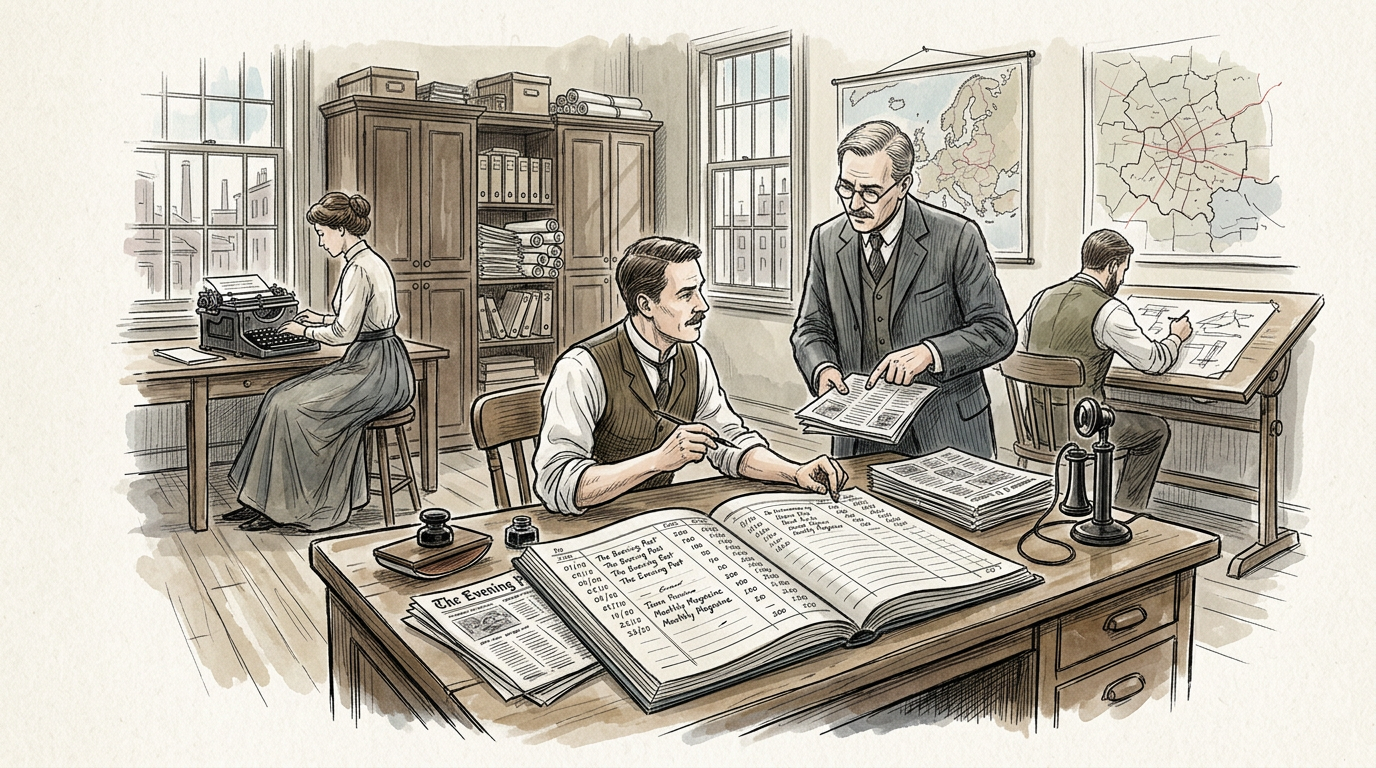
The agency commission system was not simply a billing convention. For more than a century, it helped determine what an advertising agency was, how agencies made money, how they organized their labor, how they related to publishers and broadcasters, and how clients understood the value of advertising services. The familiar percentage commission, most famously the 15 percent standard associated with American media advertising, became one of the central economic structures of the modern advertising business. It also became one of its most contested inheritances.
To understand why commission-based compensation mattered so much, it is important to begin before the full-service agency existed. The system emerged from the economics of 19th-century newspaper publishing and only later became the financial base for copywriting, media planning, account service, research, radio production, and television-era campaign development. In other words, the commission system did not begin as payment for strategy or creativity. It began as a way to sell media space.
That origin shaped the agency business for decades.
Before the full-service agency: space brokers and the newspaper economy
American advertising agencies developed in the mid-19th century out of a media marketplace that was still fragmented, local, and logistically cumbersome. Newspapers proliferated as printing technology improved, transportation networks expanded, and literacy and commercial distribution widened. National manufacturers and patent medicine advertisers increasingly wanted access to publications far from their home markets, but buying space across many titles was difficult. Rates varied, circulation claims were inconsistent, and arranging insertion in multiple newspapers required extensive correspondence.
The earliest agencies were, in practice, advertising space brokers. The best-known early figure is Volney B. Palmer, who opened what is often identified as the first American advertising agency in Philadelphia in 1841, with later offices in Boston and New York. Palmer represented newspapers and sold their advertising space to merchants and advertisers. He did not operate a modern creative agency in the later sense. His value lay in aggregation, access, and transaction management.
By the late 19th century, firms such as N.W. Ayer & Son, founded in 1869, helped move the business closer to a client-serving model. Ayer is often credited with pioneering the “open contract” in 1875, under which the agency acted for the advertiser rather than as a secretive dealer in media space. Even so, the economics of the business still rested largely on the difference between what publishers charged agencies and what agencies billed clients, or on commissions granted by media owners to agencies for placing business.
The arrangement made sense in the context of the time. Publishers wanted reliable intermediaries who could bring them business from advertisers they could not easily reach on their own. Agencies wanted recognized compensation that did not require them to negotiate a separate payment with every advertiser for every transaction. Advertisers wanted someone who could navigate a scattered print market more efficiently than they could themselves.
The commission system solved a distribution problem in the media marketplace before it became the revenue engine of the full-service agency.
How the commission model took shape
During the late 19th and early 20th centuries, the agency commission system became more formalized. In general terms, publishers quoted a gross rate for space and allowed recognized agencies a commission, often standardized at 15 percent. That standard did not arise from a single law or universal agreement imposed across all media at once. It developed through trade practice, publisher-agency relations, and industry standardization over time.
By the early 20th century, the 15 percent agency commission had become deeply embedded in American magazine and newspaper advertising. Agencies typically billed clients the gross cost of media and retained the commission allowed by the publication. In many cases, agencies were responsible for paying the medium whether or not the client had yet paid the agency, which gave agencies both leverage and financial risk. Creditworthiness mattered. So did recognition by media owners and trade bodies.
This was not a trivial administrative matter. Once commission income became regularized, agencies could build salaried organizations around it. They could hire copywriters, artists, account executives, and researchers because media billings generated a recurring revenue stream. The more media a client bought, the more money the agency earned. Compensation was therefore tied directly to volume.
That structure helped make the modern agency possible. It also introduced tensions that would never fully disappear.
Recognition, standards, and the professionalization of the agency business
As agencies grew in importance, publishers and agencies both sought mechanisms to distinguish reputable firms from speculators or insolvent intermediaries. One key development was the establishment of recognition systems under which media owners granted commissions only to agencies meeting certain standards. These standards often concerned financial stability, billing practices, and the extent to which the agency was genuinely engaged in preparing and placing advertising rather than merely brokering orders.
Trade organizations played an important role in this process. The American Newspaper Publishers Association, founded in 1887 and now part of today’s News/Media Alliance, and the Association of National Advertisers, founded in 1910, were among the major bodies involved in debates over agency recognition, media standards, and compensation practices. The American Association of Advertising Agencies, founded in 1917 as the American Association of Advertising Agencies, became especially important in codifying agency status and defending the commission system. Its historical materials document how central recognition and commission arrangements were to defining the agency business in the first half of the 20th century. See the organization’s history at https://www.aaaa.org.
In practice, recognition systems helped stabilize the market, but they also reinforced hierarchy. Not every advertising service firm qualified equally. A recognized agency enjoyed access to standard commissions and industry legitimacy. That in turn supported larger staffs, more national accounts, and more influence with publishers. The commission system therefore did more than compensate agencies. It helped determine which firms counted as agencies in the first place.
Why 15 percent mattered so much
The famous 15 percent figure acquired an almost mythic status in the American ad business, but its importance was practical rather than mystical. Because the commission was tied to gross media expenditure, it created a simple and scalable formula. It spared clients from negotiating line-item charges for copy, artwork, scheduling, and routine service. It gave agencies a predictable income stream as long as clients kept buying media. It allowed agencies to present many of their nonmedia services as effectively included within the placement process.
This had several consequences.
First, it encouraged agencies to define themselves as full-service organizations. If media commissions funded the whole operation, then copy, art, account service, and planning could be bundled together. A client buying advertising space might also receive campaign development, merchandising help, market analysis, and production oversight. The full-service agency was not merely a creative idea. It was an economic possibility created by media-based compensation.
Second, it linked agency prosperity to client scale. Large national advertisers generated large commissions. This favored the growth of agencies capable of handling major packaged goods, automotive, department store, and later broadcast accounts. It also helped explain why agencies fought so intensely for big accounts. The prize was not only prestige. It was the commission flow that supported payroll and overhead.
Third, it could create an incentive to recommend media volume. Critics later argued that commission compensation rewarded agencies for spending more rather than spending better. That critique should not be oversimplified. Many agencies believed their long-term interest lay in effective advertising, not simply larger bills, because ineffective spending endangered the client relationship. Still, the structural tension was real and widely recognized by the mid-20th century.
The commission system and the rise of agency departments
As the agency profession expanded in the early 20th century, commission income helped underwrite the internal specialization that came to define modern advertising work. Agencies developed distinct departments for copy, art, media, account service, production, and eventually research. The ability to maintain this salaried expertise depended on predictable revenue.
N.W. Ayer, J. Walter Thompson, Lord & Thomas, BBDO, Young & Rubicam, McCann-Erickson, and other major agencies built extensive organizations during the era when media commissions were the standard financial base. J. Walter Thompson in particular became famous for its development of professionalized departments, including research and women-focused market insight, as magazines became central national advertising vehicles. Duke University’s Hartman Center and other archives preserve important agency materials that document this period of organizational growth, including JWT collections at https://guides.library.duke.edu/rubenstein/hartmancenter.
This is one reason the history of commission compensation should not be reduced to a cynical story about media markups. The system funded real professional infrastructure. It helped transform advertising from opportunistic space selling into a complex service industry with specialized labor. It supported not only media placement but also the institutionalization of account management, consumer research, copywriting, art direction, and campaign coordination.
At the same time, the fact that so many services were financed indirectly through media commission often made their cost hard to see. Clients received strategic and creative labor, but the explicit invoice centered on media. That opacity later became a major source of dispute.
Magazines, national brands, and the economics of scale
The commission system became especially consequential during the rise of national brands and mass-circulation magazines in the late 19th and early 20th centuries. Publications such as The Saturday Evening Post, Ladies’ Home Journal, and other large-circulation titles offered advertisers access to national audiences at unprecedented scale. Manufacturers of soap, packaged food, cigarettes, household goods, and patent medicines increasingly relied on agencies to plan and place these campaigns.
In that environment, commissions could be substantial. A major advertiser’s media budget could support not only its own service team but also the growth ambitions of the agency itself. The economics encouraged account-centered agency structures in which major clients effectively subsidized broad institutional capabilities.
By the 1920s and 1930s, as national consumer advertising became a pillar of American business culture, the commission system had become so normalized that many advertisers treated agency service as “free” in the sense that they did not write a separate check for it. Of course, the service was not free. It was embedded in the cost of media and ultimately in the economics of the advertiser’s marketing budget. But the psychological effect mattered. It reinforced the perception that agencies were compensated by media rather than by clients, even when agencies legally and strategically claimed to work for the advertiser.
That dual identity sat at the heart of many later controversies.
Radio extends the model into broadcasting
The advent of commercial radio in the 1920s brought a new medium but not an entirely new compensation logic. As national radio networks developed and sponsorship became a dominant advertising form, agency commissions carried into broadcasting. Agencies did not merely buy time. They often created, packaged, and produced programs for sponsors, arranged talent, supervised scripts, and coordinated national scheduling.
The economic structure remained broadly familiar: the media expenditure generated the commission that financed agency service. But radio intensified the service burden. Producing sponsored programming required much more than trafficking print insertions. Agencies became deeply involved in entertainment production, audience appeal, and continuity between brand message and program form.
This broadened the agency’s role while preserving the basic commission model. A client’s media budget still paid for much of the agency’s labor, but now that labor included broadcast production expertise. That further entrenched the full-service ideal.
The growth of audience measurement also mattered. As radio ratings systems developed, especially through services associated with C.E. Hooper and later A.C. Nielsen, agencies and sponsors gained more data for evaluating media performance. Yet compensation remained tied primarily to media volume rather than directly to measured outcomes. The gap between what agencies were paid for and what advertisers increasingly wanted to measure would widen over time.
Television and the high-water mark of commission-based agency power
Television after World War II gave the commission system its most visible and perhaps most powerful era. Network television concentrated mass audiences and attracted enormous brand investment. Agencies played central roles in media planning, spot and program buying, commercial production, and overall campaign stewardship. The standard commission remained deeply embedded in national media buying.
Television’s scale amplified both the advantages and the distortions of the system. Large advertisers could support very large agencies. Creative departments gained prestige, and television commercial production became a major craft. Account management expanded. Media departments grew in importance as network schedules, ratings, and cost efficiencies became more complex. Much of that infrastructure was sustained by commissions on increasingly large media outlays.
At the same time, the television era made certain weaknesses more visible. A compensation model based on percentage of media spend sat awkwardly beside an agency workload that did not always vary proportionately with spending. Some accounts required intense strategy, production, and client management but comparatively modest media budgets. Others generated substantial commission income with relatively manageable service demands. Cross-subsidization was common.
Clients noticed. So did procurement-minded executives and corporate financial managers. By the 1950s and 1960s, debates over whether 15 percent fairly reflected agency value had become more pointed, even though the model still dominated major media advertising.
Conflict of interest, stewardship, and the “media first” critique
Critics of the commission system often focused on conflict of interest. If an agency earned more when a client spent more, could it objectively advise restraint? If commission rates were granted by media owners, did agencies have divided loyalties between clients and publishers or broadcasters? If some media or vehicles offered more favorable economics, did that subtly distort recommendations?
These concerns were not inventions of the late 20th century. They appeared much earlier in trade discussion, though the industry often defended the system by arguing that agency reputation and client retention depended on trustworthy stewardship. In this defense, any short-term incentive to overspend was checked by the long-term necessity of making advertising work.
There was truth in that argument, but it did not eliminate the structural issue. The agency’s income was tied to the client’s media bill, not directly to labor hours, strategic contribution, sales effect, or business outcome. Commission compensation aligned agency and media growth more neatly than it aligned agency pay and demonstrable performance.
That distinction became more difficult to ignore as advertisers developed more sophisticated internal management systems and more rigorous expectations for accountability.
The shift toward fees and cost accounting
From the mid-20th century onward, a growing number of advertisers questioned whether the traditional commission model matched the realities of agency work. Some wanted more transparency about what they were paying for. Others believed the commission overcompensated agencies on large media accounts and undercompensated them on labor-intensive assignments. Still others objected to paying the same percentage regardless of the medium’s complexity or the amount of senior attention required.
One influential development was the movement toward fee-based compensation. Instead of relying solely on media commissions, some agencies and clients negotiated retainers, labor-based fees, project charges, or combinations of fees and commissions. These arrangements attempted to connect payment more directly to actual work performed.
The debate intensified in the postwar decades and became increasingly prominent by the 1970s and 1980s. As marketing services diversified, the limitations of commission became more obvious. Direct marketing, promotion, package design, public relations support, and later digital work did not fit neatly into a traditional 15 percent media formula. Even within media advertising, some clients preferred unbundled compensation and explicit cost structures.
Trade press coverage from this period shows that the issue was not simply whether 15 percent was too high or too low. The deeper question was what exactly agencies were selling. Was the agency primarily a media intermediary, a professional adviser, a creative partner, a marketing contractor, or some combination of all four? The answer had always been mixed, but the commission system had papered over those distinctions. Fee debates forced them into the open.
Regulation, antitrust pressure, and the unmaking of old certainties
By the later 20th century, regulatory and antitrust developments further destabilized the old commission order. Industrywide standards that had once seemed normal came under greater scrutiny if they looked like collective price maintenance or restraints on competition. Although the history is complex and unfolded over many years, the broad effect was clear: the era in which a near-universal commission norm could quietly organize the market was ending.
The U.S. Department of Justice’s antitrust attention to advertising trade practices and the broader deregulatory climate of the late 20th century weakened some of the institutional supports that had long sustained standardized compensation conventions. Recognition systems and commission expectations did not disappear overnight, but they became less automatic and more negotiable.
At the same time, advertiser sophistication increased. Large clients built internal marketing departments, demanded detailed reporting, and compared agency proposals more aggressively. Agency compensation became a matter for procurement, finance, and legal review, not just a customary industry practice.
As cable television, fragmented media markets, specialized agencies, and later digital platforms expanded, the notion that one percentage could naturally compensate all agency functions looked increasingly untenable.
Media buying separations and the transparency problem
The separation of media buying from broader agency services in the late 20th century fundamentally altered the legacy of the commission system. Once media departments spun off into dedicated media agencies or were reorganized into global buying entities, the relationship between compensation and service changed again. Scale purchasing, negotiated rates, rebates, research tools, and later programmatic systems created new complexities in how agencies and holding companies were compensated.
This period revived concerns about transparency in a new form. Under the classic commission model, compensation may have been imperfectly aligned, but it was at least relatively legible: a stated percentage of media billing. In newer arrangements, revenue could come from fees, incentives, volume deals, data services, trading margins, or undisclosed financial flows. Debates over rebates and principal media trading in the 21st century show that transparency controversies did not end with the decline of the simple commission. In some respects, they became more intricate.
That is part of the historical significance of the commission era. Whatever its flaws, it established the enduring industry problem of how to align agency incentives, media economics, and client trust. Later models changed the mechanics, but not the underlying question.
What the commission system made possible, and what it distorted
The commission system deserves a balanced historical assessment.
It made possible:
- the growth of the full-service agency as a stable business institution;
- the hiring of salaried specialists in copy, art, research, media, and account management;
- efficient aggregation of media buying in a fragmented national market;
- standardized commercial relations among advertisers, agencies, and media owners;
- the scaling of national brand advertising across print, radio, and television.
It also created distortions:
- agency income rose with media expenditure rather than necessarily with strategic value or labor intensity;
- the system could obscure what clients were paying for creative and advisory work;
- it encouraged the impression, and sometimes the reality, of divided loyalties between clients and media sellers;
- it fit some accounts and media much better than others;
- it made later transparency disputes almost inevitable as advertising services diversified.
Both sides of that ledger matter. It is not historically accurate to describe the commission system only as a relic of self-serving agency practice, nor is it accurate to portray it as an elegant golden-age arrangement disrupted only by modern complexity. It was a practical solution to a specific media marketplace that became the financial architecture of an entire profession. Its strengths and weaknesses were inseparable from that success.
Why this history still matters
Modern agency compensation includes retainers, project fees, labor-based pricing, incentives, performance components, consulting arrangements, licensing, and platform-related revenue streams. Yet many contemporary arguments about transparency, value, stewardship, and incentive alignment are direct descendants of the commission era.
When clients ask whether an agency is recommending a channel because it is effective or because it is remunerative, they are revisiting an old problem. When agencies argue that strategic and creative work cannot be fairly valued by media-linked formulas alone, they are responding to a structure that once bundled everything under commission. When the industry debates rebates, markups, trading desks, or principal-based buying, it is still grappling with the same central issue that shadowed the 15 percent model: who pays the agency, for what, and with what incentives attached?
The agency commission system shaped advertising because it gave the business a durable economic foundation at the moment national media and national brands were expanding together. It financed institutional growth, defined professional roles, and standardized relations across agencies, clients, and media. It also embedded tensions that later generations could not ignore.
That is why the history of agency compensation is not a narrow accounting story. It is a history of how advertising became organized work, how agency power was built, and why questions of trust and transparency have remained at the center of the business ever since.
Leave a Reply