
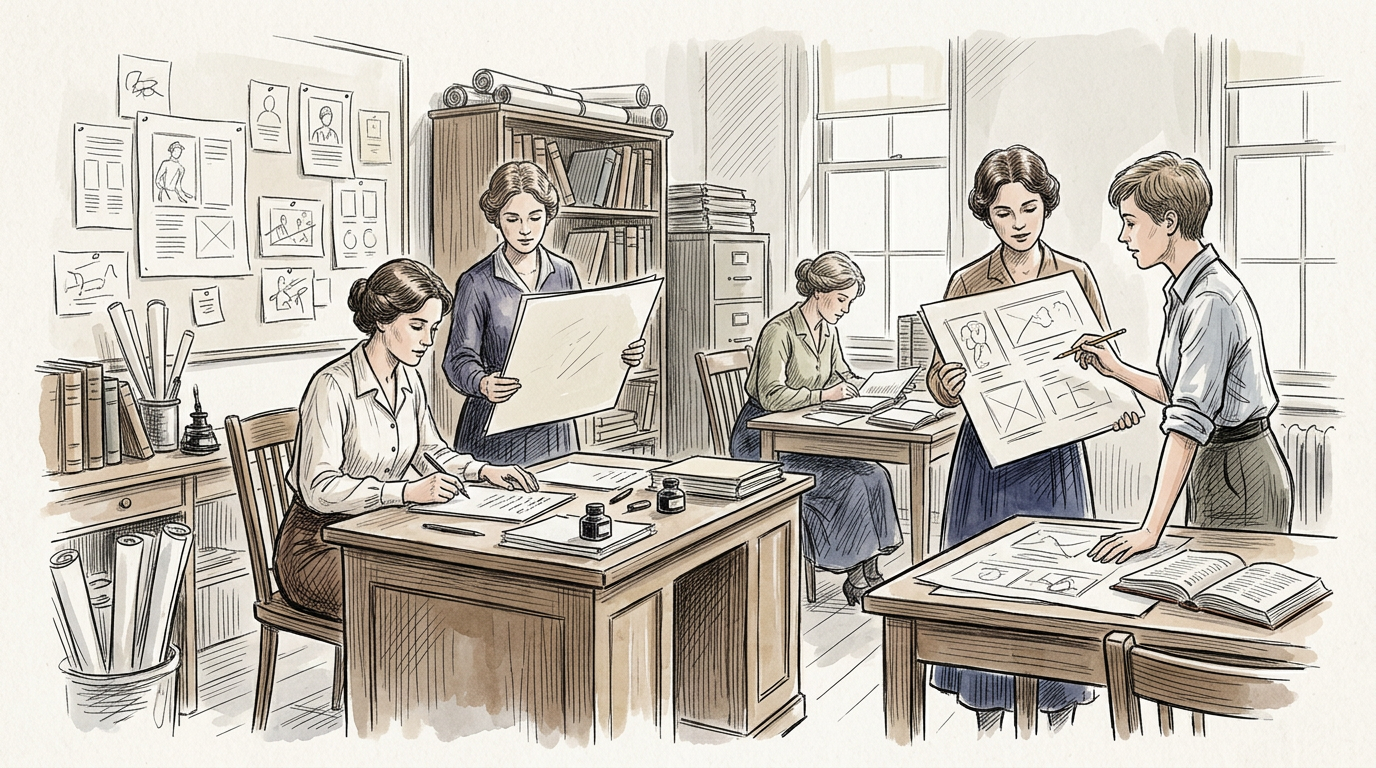
When advertising became a recognizable profession in the late nineteenth and early twentieth centuries, women were not simply part of its audience. They also helped build its methods, language, visual forms, and organizational structures. They worked as copywriters, illustrators, account specialists, researchers, media thinkers, retail advertising managers, and, in some cases, agency leaders. Their contributions mattered because early advertising was being assembled at the same time that mass consumer markets, national magazines, department stores, circulation auditing, and brand competition were transforming American business. As advertisers tried to understand how to reach households, women were frequently positioned as both presumed purchasing authorities and unusually useful advertising workers.
That dual position created opportunity, but it also imposed limits. Women were welcomed into some parts of the business because agencies and clients believed they had special insight into household consumption, domestic products, and women readers. The same logic could narrow their authority, confining them to “women’s accounts,” supporting roles, or work that men in the industry treated as intuitive rather than strategic. A history of women in early advertising is therefore not a story of simple progress or overlooked heroines finally restored to view. It is a history of professional formation in which women contributed substantially to modern advertising practice while operating inside an industry structured by gender hierarchy.
Advertising’s professional turn created openings for women
In the decades after the Civil War, U.S. advertising shifted from a largely space-broker business into a more elaborate service industry. Agencies increasingly offered copy, artwork, campaign planning, media advice, merchandising support, and market knowledge in addition to buying print space. At the same time, national magazines expanded, printing technology improved, branded packaged goods multiplied, and urban department stores turned advertising into a central retail function. These developments produced more kinds of advertising labor.
Women entered this changing environment through several routes. Some came from journalism, magazine work, teaching, stenography, or department store promotion. Some began in clerical positions and moved into copy or account responsibilities. Others developed careers in illustration and commercial art as advertising became more visual. The growth of women’s magazines also mattered. Titles such as Ladies’ Home Journal, Woman’s Home Companion, and later Good Housekeeping were major advertising vehicles, and agencies valued workers who could write for those editorial environments and for their readers.
By the 1890s and 1900s, trade publications were already discussing women as advertising workers. That discussion was often patronizing. Women were praised for “understanding women,” for domestic sensibility, or for emotional intuition. But even that restricted language points to an important fact: advertisers increasingly recognized that selling in mass consumer markets required knowledge of audiences, tone, and buying habits that many women practitioners could claim professionally, not just socially.
The copy department was one of the first visible paths
Copywriting offered some of the earliest and most visible opportunities for women in agency life. This was not because agencies had embraced gender equality. Rather, copy was still emerging as a specialized craft, and women were often hired to write for products sold to women or families. Yet from that starting point many women did work that shaped the broader development of advertising style.
Among the most important figures was Helen Lansdowne Resor, who joined J. Walter Thompson in 1908 and became one of the most influential copywriters in agency history. Before arriving at JWT, she had worked at the Cincinnati advertising agency Street Railways Advertising Co. and then at Procter & Gamble’s in-house advertising department. At JWT she rose quickly, eventually becoming vice president. She is often identified as the first woman to hold that title at the agency, and by the 1910s she was overseeing major accounts and managing substantial creative operations.
Resor’s importance lies not only in her advancement, but in the kind of advertising she helped normalize. She worked on campaigns for products such as Woodbury’s Facial Soap and Pond’s Cold Cream, among others, during a period when advertisers were moving away from dense product description toward more suggestive emotional appeals, lifestyle framing, and image-conscious copy. The famous Woodbury line, “A skin you love to touch,” first used in 1911, is closely associated with JWT and with the campaigns shaped under Resor’s influence. Precise line-by-line authorship in early agency work can be difficult to document, and later retellings sometimes flatten the collaborative nature of these campaigns. Still, the historical record leaves little doubt that Resor was central to the development of this work and to JWT’s understanding of how intimate, aspirational, and socially coded copy could expand a beauty brand’s appeal.
That mattered beyond cosmetics. Resor helped legitimize a less declarative and more atmospheric mode of copywriting, one that integrated headline, image, and emotional implication. In the process, she also demonstrated that women in agencies were not merely translating male strategy into feminine language. They were helping define strategy itself.
Other women copywriters also built careers during this period, though often with less later recognition. Some worked inside agencies, some at magazines, and some in retail advertising departments where the demands of frequent newspaper promotion sharpened practical headline-writing and merchandising skills. Their work contributed to the professionalization of copy as a function requiring not just grammar and taste but sales logic, audience awareness, and adaptation to specific media contexts.
Women also shaped the visual language of advertising
Early advertising history often gives more attention to male art directors of the later “creative revolution” than to the women who helped establish advertising’s visual conventions in the magazine era. Yet women were important contributors to commercial illustration, layout sensibility, fashion imagery, and the broader relationship between editorial and advertising aesthetics.
Magazine advertising in the early twentieth century depended heavily on illustration before photography became dominant. Women illustrators and designers worked in a field that overlapped with publishing, fashion, and decorative arts. They contributed to advertisements that needed to appear refined, modern, respectable, or intimate, especially in women’s magazines and department store promotions.
The best-known example is probably not an agency art director but a commercial artist whose work transformed visual advertising culture: Neysa McMein. McMein became one of the leading illustrators of her era, producing covers for major magazines and advertising art for national brands. Her career demonstrates how porous the boundaries could be between editorial fame and advertising utility. An illustrator’s prestige could become part of an ad’s selling power, especially when style signaled modernity and aspiration.
Women also worked in fashion illustration and retail art departments, where they influenced how products were staged visually for newspaper and magazine audiences. Much of this labor remains less documented than executive agency history, in part because crediting practices favored firms over individuals and because ephemeral retail advertising was not preserved as systematically as national campaigns. But the effect was real. Women helped make advertising more visually responsive to consumer self-image, domestic settings, and changing ideals of femininity.
Department stores and mail order created important advertising careers
To understand women’s early advertising work, it is important to look beyond agencies alone. Department stores, mail-order firms, and large retailers were major advertising institutions. They employed copywriters, artists, promotion managers, display specialists, and researchers, and they often offered women more direct operating responsibility than agencies did.
Stores marketed heavily to women customers and needed constant newspaper advertising, seasonal campaigns, event promotion, and merchandise copy. The pace was demanding and the work highly commercial. This setting became a practical training ground in audience targeting, pricing communication, layout, and response-driven retail messaging. Women who succeeded there were not just writing soft-focus domestic appeals. They were handling deadlines, coordinating with buyers and merchants, and linking advertising to actual sales movement.
The retail environment also made visible a key feature of women’s advertising labor: they were often valued when management believed female experience aligned with female consumption. That assumption could be reductive, but it opened jobs in a business that otherwise excluded women from many lines of authority. Retail promotion and mail order thus became significant parts of the profession’s gendered structure.
Women helped formalize audience knowledge and research
One of the most consequential, and often underappreciated, areas of women’s contribution to early advertising was audience analysis. As agencies and advertisers sought more systematic ways to understand markets, women played visible roles in the collection and interpretation of consumer information, especially concerning household purchasing and women readers.
J. Walter Thompson was especially important here. Under Stanley Resor’s leadership, the agency became known for its investment in research and planning. Helen Lansdowne Resor was part of that broader intellectual environment, but so were many women employees who gathered consumer information, analyzed product usage, studied readership, and translated social observation into advertising decisions. JWT’s archives, now housed in part at Duke University’s John W. Hartman Center for Sales, Advertising & Marketing History, show extensive use of women in research and account support roles during the early twentieth century.
These positions were not identical to modern account planning, and it would be misleading to project today’s job titles backward too neatly. But women did important proto-planning and research work. They conducted investigations into how consumers shopped, what products they used, what they feared, what status signals mattered, and how advertising should speak within the rhythms of household life. This was especially significant in categories such as soap, food, personal care, and household goods, where the industry assumed women were primary purchasers or influential gatekeepers.
The rise of market research in the interwar years widened this area further. Researchers such as Herta Herzog, an Austrian-born scholar who later worked in the United States and became associated with radio research and motivational analysis, represent a somewhat later phase of this story. Herzog’s best-known work developed in the 1940s, particularly through the Office of Radio Research and later commercial media and consumer research. She is important because she shows how women’s authority in understanding audiences could move from presumed “women’s intuition” toward more formal social-scientific legitimacy. Her work helped illuminate why audiences used media and how emotional motives shaped consumption, concerns that would become central to later advertising research and strategy.
Women’s magazines were both media platforms and professional ecosystems
The growth of women’s magazines was essential to women’s advertising history, not just because these publications carried large volumes of ads but because they connected editorial authority, consumer education, and advertising opportunity. They created a commercial environment in which women wrote for women, edited for women, and sold products to women, even as ownership and top management often remained male.
An important figure here is Christine Frederick, who is not best understood as an agency executive but as a widely read household efficiency writer, consumer commentator, and advocate of applying scientific management to domestic life. Through books, articles, and public commentary in the 1910s and 1920s, Frederick articulated a view of the housewife as a rational purchasing agent whose labor could be organized and improved through better products and informed choice. Advertisers and agencies paid close attention to this kind of thinking because it reframed domestic consumption as a matter of expertise, efficiency, and modern identity.
Frederick’s significance to advertising history lies in how she helped rationalize the consumer household for business audiences. She was part of a broader ecosystem of women writers, editors, and experts who translated everyday domestic experience into categories legible to advertisers. That translation supported the industry’s growing confidence that audiences could be segmented, studied, and addressed through specific appeals.
Magazine editors also influenced advertising indirectly through standards and compatibility. The longstanding divide between editorial and advertising departments never eliminated mutual awareness. Advertisers wanted environments that would confer trust, and women editors could shape those environments. The rise of endorsement systems, household advice columns, and service journalism gave advertisers more cues about what kinds of appeals would seem credible to readers.
The agency business offered advancement, but usually within boundaries
Some women rose to unusual prominence in early advertising, but those cases should not obscure the industry’s structural constraints. Women often entered agencies in lower-paid positions, encountered pay disparities, and faced assumptions that they were temporary workers before marriage. Marriage itself could complicate careers, not least because women were often judged according to norms different from those applied to men.
Helen Lansdowne’s marriage to J. Walter Thompson executive Stanley Resor in 1917 is a reminder that even the careers of highly successful women were interpreted through gendered frameworks. Her authority within JWT was real and substantial, but later histories sometimes folded her achievements too neatly into her husband’s better-known institutional role. The documentary record shows that she was not merely a symbolic female presence or adjunct to management. She led work, shaped campaigns, and supervised staff. At the same time, her exceptional status also underscores how unusual such power remained.
Trade discourse of the period frequently celebrated a handful of successful women while preserving the idea that top-level business judgment belonged mainly to men. Women were more often concentrated in copy, research, or product areas coded as feminine. Financial control, agency ownership, and broad corporate authority remained much harder to secure.
Even so, women’s presence altered agency culture. They affected hiring patterns, office organization, client assumptions, and the internal division of labor. In some agencies, women’s copy departments or women-focused account groups institutionalized the belief that female consumers required specialized understanding. That notion could perpetuate stereotypes, but it also made audience knowledge a more explicit professional asset.
The rhetoric of “woman’s viewpoint” was useful and limiting
The phrase “woman’s viewpoint,” common in early twentieth-century advertising discourse, deserves careful treatment. It helped many women gain entry and authority. Agencies told clients that women copywriters and researchers understood women buyers better than men did. Given that women were central purchasers in many household categories, the claim had practical force.
But the phrase also reduced expertise to gender identity. It suggested that women’s professional value arose naturally from being women, rather than from training, experience, observation, testing, and creative discipline. That mattered because it could make women’s work appear intuitive and narrow rather than strategic and generalizable.
This tension remains one of the most important historical lessons. Women helped advance some of advertising’s core professional principles, especially audience sensitivity, tonal calibration, emotional realism, and close attention to purchase context. Yet the industry often credited these contributions in language that diminished them, treating them as personal traits rather than as forms of skilled labor and managerial intelligence.
Representation, persuasion, and the ethics of early women’s advertising
A serious history of women in early advertising also has to address the content of the work itself. Women helped create advertising that expanded female professional presence in business, but some of that advertising also reinforced restrictive beauty standards, domestic ideology, class aspiration, and racial exclusion.
Beauty advertising offers a clear example. Copy and imagery developed in the 1910s and 1920s often linked self-care to romantic success, social advancement, and personal worth. Campaigns could be inventive and influential while also intensifying pressures on women’s appearance and conduct. Likewise, household product advertising frequently framed women as responsible for family health, cleanliness, and moral order, increasing the symbolic burden attached to domestic labor even as it promised convenience and modernity.
None of this means women practitioners were uniquely responsible for problematic representations. They worked within a commercial system shaped by clients, publishers, agencies, and social norms. But it does mean that their history cannot be told simply as a triumph of inclusion. Women helped build modern advertising, and modern advertising helped build powerful, sometimes damaging, ideas about femininity, consumption, and social status.
Why this history matters to the profession
The women who helped build early advertising mattered not because they were anomalies inserted into an otherwise male story, but because the profession developed through their labor. They were present where major changes were taking shape: the rise of branded consumer persuasion, the maturation of copywriting, the integration of visual and verbal appeal, the use of audience research, the expansion of magazine advertising, and the organizational growth of agencies and retail promotion departments.
Their history also clarifies something basic about advertising’s professional evolution. The industry did not become more sophisticated only by adding data, larger media systems, or more formal management. It also became more sophisticated by taking audiences seriously as social beings whose buying decisions were shaped by identity, aspiration, habit, and everyday life. Women were central to that shift, even when the industry explained their contribution in constrained or stereotyped terms.
For modern professionals, this history offers two enduring insights. First, many capabilities now treated as strategic fundamentals, including audience understanding, tonal nuance, category immersion, and context-sensitive creative development, were advanced in important part by women whose work was long undercredited. Second, the profession’s structures of opportunity have always shaped whose expertise gets recognized as expertise. Early advertising did not merely discover women as a market. It depended on women as workers, thinkers, and makers, even while limiting the terms on which many of them could participate.
That is why the subject belongs at the center of advertising history rather than at its margins. The women who helped build early advertising were not a sidebar to the profession’s development. They were among the people who made the profession possible.
Leave a Reply