
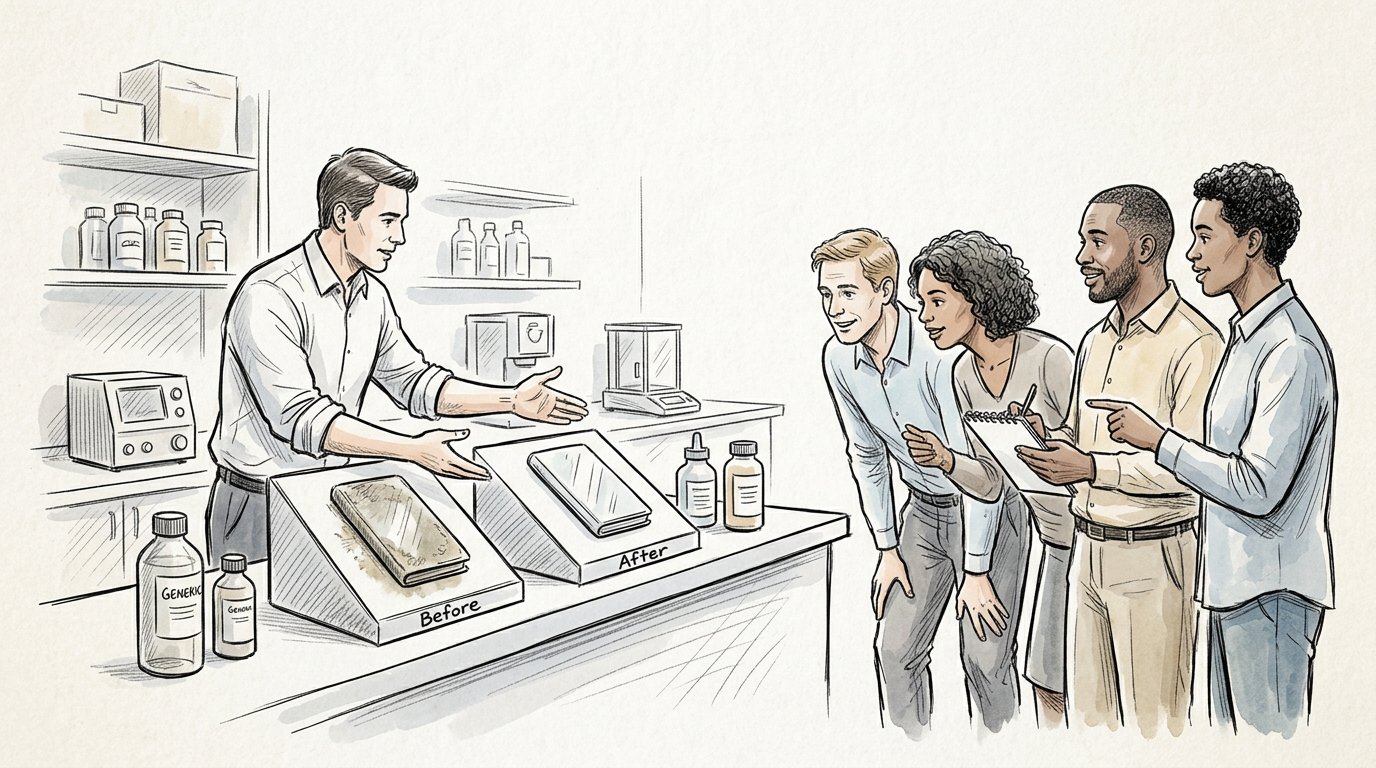
Not every advertising problem is best solved by symbolism, mood, or brand storytelling. In many categories, the most persuasive creative move is simpler: show the product doing the job it claims to do.
Demonstration advertising has long occupied a distinctive place in the profession because it addresses a specific persuasion problem. When a product benefit is concrete, visible, and relevant to choice, a demonstration can reduce uncertainty more efficiently than abstract image-building. It gives audiences evidence, or at least the impression of evidence, about performance. It also gives creatives and strategists a structure for making claims memorable without relying solely on borrowed emotion or entertainment value.
That does not mean demonstrations are universally superior, or that they are somehow a lower form of creativity. It means they are often the better choice when the category is complex, the purchase involves perceived risk, or the competitive field makes proof more useful than atmosphere. For advertisers, the strategic question is not whether demonstrations are old-fashioned or direct-response oriented. It is whether the audience needs to see the promise verified.
Why demonstration remains a durable advertising form
A product demonstration is not just a visual description of a product. It is an attempt to connect claim and evidence inside the ad itself. That evidence may be literal, as in showing a stain remover lifting a mark from fabric, or structured, as in a side-by-side comparison, timed test, or expert validation. In each case, the ad is designed to answer a skeptical audience question: “Can it actually do that?”
Advertising research has long suggested that concreteness matters in memory and judgment. Concrete information is generally easier to process and recall than vague abstraction, especially when the consumer is evaluating functional benefits. In practice, demonstration advertising exploits that advantage by making the promised benefit observable. Instead of merely asserting superiority, it stages superiority.
This is particularly relevant in categories where brand claims sound interchangeable. Laundry detergent, adhesives, cleaning products, batteries, razors, skincare, appliances, software, telecommunications services, and industrial products often compete on performance attributes that can be difficult to distinguish through language alone. If every brand says it is stronger, faster, safer, cleaner, or more reliable, the advertiser that can dramatize those claims credibly may gain an advantage in both attention and persuasion.
The form also travels well across media environments. On television and online video, demonstrations can unfold in real time. In social media, short proof-led clips can perform strongly because they present a self-contained payoff. In retail media and ecommerce, product videos and comparison modules can reduce hesitation near the point of purchase. In B2B advertising, demonstrations often provide a bridge between awareness communications and sales enablement by visualizing performance criteria that matter to procurement or technical stakeholders.
When showing is strategically better than saying
Demonstration advertising tends to outperform more abstract approaches under several recurring conditions.
First, it is often the stronger choice when the benefit is truly demonstrable. If a product can remove a stain faster, survive greater impact, brew coffee more consistently, cut prep time, or simplify a workflow in a visible way, failing to show that advantage may be a wasted strategic asset. Advertisers sometimes default to lifestyle imagery even when the product contains its own best proof.
Second, demonstration is useful when perceived risk is high. Perceived risk is not limited to expensive products. It can involve money, time, effort, safety, social embarrassment, or the fear of making a poor choice in a crowded category. A parent buying a car seat, an operations manager evaluating software, or a consumer switching from a trusted cleaner to an unfamiliar one all face some degree of uncertainty. Demonstration works by narrowing the gap between claim and confidence.
Third, it is especially valuable in complex categories. Products with technical features, novel mechanisms, or category-specific jargon often ask audiences to imagine functional outcomes they cannot easily visualize. A well-constructed demonstration translates technical complexity into practical understanding. This is one reason technology advertising often shifts, over time, from feature language to interface demonstration. Showing how a tool works can be more persuasive than reciting specifications.
Fourth, demonstration can be a useful answer to parity. In mature categories where competitors share similar emotional territories and media conventions, proof can create differentiation even when the functional edge is narrow. The point is not that every difference is meaningful. It is that meaningful differences are often best established by evidence rather than assertion.
The classic logic of reason-why advertising, updated
The intellectual roots of demonstration advertising sit partly in what used to be called “reason-why” advertising: work that gives consumers a concrete basis for believing a claim. That tradition never disappeared. It evolved.
Some of the most enduring demonstration-led campaigns in U.S. advertising came from packaged goods and household brands that understood a simple principle: if the benefit can be seen, then the ad should make seeing central to persuasion. Procter & Gamble built generations of detergent and paper product advertising around visual proof structures. Oral-B, OxiClean, Bounty, Mr. Clean, and many others have relied on variants of the same logic. The creative treatments differ, but the strategic premise is consistent. Audiences are invited not merely to hear the promise but to witness a test.
This approach has also been visible in automotive advertising, where safety and engineering claims often require substantiation, and in technology categories, where screen-based demonstrations help audiences understand product utility more quickly than feature lists. Apple’s product advertising, for example, frequently relies on demonstrations of interface behavior, camera capability, or hardware interaction rather than broad declarative claims alone. Even when the brand’s communications retain a strong aesthetic signature, the functional evidence is doing real work.
Direct-to-consumer digital brands have rediscovered the same principle through performance media. Many social video ads now use “problem-solution-proof” structures that are, in essence, condensed demonstration advertising. The novelty lies less in the technique than in the placement context and speed of execution.
Proof is persuasive, but only if audiences believe it
The central challenge with demonstration advertising is credibility. A demonstration is persuasive not because it is visual, but because it appears fair, relevant, and representative of actual performance.
This is where advertisers must be careful. Consumers have seen enough staged proof, selective framing, and overproduced “tests” to approach some demonstrations with skepticism. If the ad seems rigged, the form can backfire. The visual proof that should reduce resistance instead activates it.
That is one reason comparative advertising and product demonstrations sit close to regulatory scrutiny. In the United States, the Federal Trade Commission requires that objective product claims be truthful, not misleading, and supported by appropriate substantiation. Comparative claims are not prohibited, but advertisers must have evidence for express and implied assertions, including what a reasonable consumer is likely to take away from the ad. The FTC’s advertising substantiation doctrine and related guidance make the principle straightforward: if an ad conveys that a product performs in a certain way, the advertiser needs a reasonable basis for that claim before dissemination. For health-related claims, safety representations, and scientific assertions, the evidentiary bar may be higher depending on the claim context. The FTC’s business guidance on advertising substantiation remains the essential reference point for practitioners.
Credibility also matters outside formal regulation. The National Advertising Division of BBB National Programs reviews truth and accuracy challenges in national advertising, including superiority claims, demonstrations, and comparative presentations. NAD case decisions have repeatedly turned on whether an advertiser’s evidence matches the message reasonably conveyed. For advertisers, that is a practical reminder that the execution itself shapes the claim. A visual can imply more than the copy states.
Professional practice therefore requires close coordination among strategy, creative, legal, research, and client teams. Demonstration-heavy advertising is rarely something to “fix in post.” The proof architecture must be designed from the start.
Comparison works best when the difference matters
Demonstration and comparison advertising frequently overlap, but they are not identical. A demonstration can prove absolute performance without naming a competitor. A comparison raises the stakes by asking the audience to judge relative advantage.
Comparison becomes particularly powerful when buyers are already evaluating alternatives side by side. That is common in retail, ecommerce, telecom, insurance, consumer electronics, and many B2B categories. In those environments, shoppers are not simply asking whether the product works. They are asking whether it works better, faster, longer, more safely, or more efficiently than the available substitute.
Used well, comparison sharpens relevance. It translates a product attribute into a decision criterion. A battery lasting “up to X percent longer” may be a claim. Showing two devices run side by side until one fails is a choice aid.
Used poorly, comparison clutters the message or overstates trivial distinctions. Not every feature difference deserves comparative dramatization, and not every audience wants to watch a category tutorial. Comparison is most useful when the difference is both understandable and consequential. If the claimed advantage does not change the buying decision, proof alone will not create importance.
Categories where demonstration earns its keep
Some categories are structurally well suited to demonstration advertising.
Household products remain the clearest example because the benefits are highly visible and repeatable. Cleaning, absorbency, odor control, durability, and stain removal all lend themselves to simple visual tests. The ad can collapse product trial into a few seconds of observable proof.
Beauty and personal care categories increasingly use demonstrations as well, though the evidentiary standard is often more delicate. Before-and-after formats, texture shots, ingredient explanations, and application demos can help audiences evaluate products whose results may otherwise feel subjective. At the same time, these categories face heightened scrutiny around retouching, disclosure, and the line between cosmetic enhancement and misleading performance implication.
Technology and software are another major arena. Here, the “demonstration” may not involve dramatic physical proof but practical workflow visualization. Interface walkthroughs, speed comparisons, setup sequences, and feature-in-use scenarios can all reduce friction for prospects evaluating a product’s usefulness. This is especially important when adoption costs are cognitive rather than financial. If the product seems hard to understand, abstract brand advertising may generate awareness without reducing resistance.
Pharmaceutical and health advertising uses demonstration more cautiously, often through explanatory animation or depictions of product use rather than simplistic visual claims. Regulatory constraints are stricter, and advertisers must avoid implying outcomes that exceed approved evidence. Still, the underlying logic is similar: help the audience understand what the product does and why that matters.
In B2B categories, demonstrations are often undervalued in brand advertising discussions even though they can be highly effective. Industrial equipment, cybersecurity tools, logistics platforms, and enterprise software all benefit from making the functional promise visible. The demonstration may be less theatrical than in consumer packaged goods, but the need for proof is often greater because the stakes are higher and buying committees are more risk-sensitive.
Creative discipline matters more than creative spectacle
Demonstration advertising is sometimes dismissed as formulaic. That criticism usually confuses format with execution.
A weak demonstration ad simply illustrates the obvious. A strong one identifies the exact moment where uncertainty becomes belief. It selects a product truth worth proving, finds a fair and understandable way to prove it, and dramatizes that proof so the audience can grasp it quickly and remember it later.
This requires creative discipline. The product benefit must be expressed in terms that matter to people, not just engineers or product managers. The test must be easy to interpret. The visual focus must stay on the relevant variable. The pacing must allow the viewer to process what changed and why. If the ad relies on complicated setup, unexplained conditions, or technical caveats, the proof may be accurate but ineffective as communication.
Great demonstration work often succeeds because it simplifies without distorting. It turns product performance into a decisive visual idea.
That idea can still be entertaining. Many memorable demonstration campaigns have used humor, surprise, or exaggeration in service of proof. But entertainment is additive, not the core mechanism. The ad works because the audience understands the product advantage and believes it might be real.
Media context changes how proof should be built
Demonstration advertising should be adapted to the medium, not merely cut down from a master asset.
Television historically gave demonstration work the time and audiovisual clarity needed to establish setup, test, and result. In digital video, the same structure often has to happen faster. The first seconds must establish both the problem and the proof logic before users scroll away. In social environments, successful demonstration ads often surface the result early and then replay or explain the mechanism.
On ecommerce product pages, demonstrations often function less as awareness advertising than as conversion support. Here, viewers are already evaluating purchase, so the proof can be more detailed. Product videos, interactive comparisons, and user-generated demonstrations may all play a role. The standard for clarity is high because the audience has immediate access to alternatives.
Retail media adds another layer. Sponsored product placements, onsite video, and shoppable display can all benefit from demonstration-led creative when the product’s advantage is practical and choice-relevant. In these contexts, demonstration works not as broad brand theater but as decision assistance close to transaction.
For B2B media, the appropriate proof format may vary by stage. A short paid social video might show the “before and after” of a workflow bottleneck, while a longer landing-page video or webinar can unpack the mechanics. The advertising challenge is to preserve the clarity of the core proof while adjusting the depth to match audience intent.
Measuring demonstration advertising requires precision
Because demonstration advertising is often chosen for its persuasive clarity, advertisers should be careful not to evaluate it only on broad brand metrics.
The right measurement depends on the job the demonstration is meant to do. If the objective is to make a functional advantage understood, diagnostic measures might include message comprehension, claim takeaway, brand linkage, and belief in the demonstrated benefit. If the objective is competitive switching, then consideration, preference shift, or conversion behavior may be more relevant. If the demonstration is used near purchase, sales lift, add-to-cart rate, or assisted conversion may matter more than ad recall alone.
Attention is not the same as persuasion. A demonstration may generate strong view-through or engagement because it is visually satisfying, but that does not prove the audience attributed the benefit to the brand or found the proof credible. Conversely, some proof-led executions may appear less entertaining than lifestyle creative but produce stronger gains in brand belief or purchase confidence.
This distinction matters in creative testing. Research should isolate whether the audience understood the demonstrated claim, whether they believed it, whether they found it relevant, and whether the brand was clearly associated with it. Those are different outcomes. Too many post-campaign summaries collapse them into a generic claim of “effectiveness.”
Where demonstration advertising can go wrong
The most common failure is proving the wrong thing. Advertisers sometimes build elaborate demonstrations around features that are technically distinct but commercially unimportant. The ad may be accurate and memorable, yet still fail because the demonstrated benefit is not a real driver of choice.
A second failure is visual ambiguity. If viewers cannot tell what they are seeing, cannot identify the comparison basis, or cannot infer why the result matters, the proof loses force. Demonstration requires economy and precision.
A third risk is overspecification. Some advertisers, especially in technical categories, try to prove too much at once. They layer feature claims, test conditions, statistics, endorsements, and disclaimers into a single execution. The result may satisfy internal stakeholders while overwhelming the audience.
There is also a strategic risk in overreliance. Demonstration can establish product truth, but it does not automatically build broader brand meaning. In categories where functional differences are easy to copy, advertisers may need a stronger brand platform around the proof so that product superiority does not become interchangeable over time. The choice is not demonstration or brand building in some absolute sense. The stronger practice is often to use demonstration as one component of brand building when the brand promise rests on real, visible performance.
What the best demonstration advertising understands about persuasion
At its best, demonstration advertising respects the audience’s skepticism. It does not ask people to admire the brand before understanding it. It understands that in many purchase situations, belief is earned through evidence, not just tone.
That insight is especially important in an advertising environment saturated with claims, optimized creative, and stylized sameness. Professionals rightly value emotional resonance and long-term brand distinctiveness. But there are many circumstances in which the most strategically intelligent move is to make the product accountable in public, inside the ad, on terms the audience can quickly evaluate.
When the benefit is concrete and demonstrable, showing what the product does is not a retreat from creativity. It is often the most disciplined use of creativity available. It aligns message, evidence, and audience need. It reduces perceived risk, clarifies category complexity, and gives comparison real substance. Most importantly, it turns advertising from assertion into demonstration, which in the right category is exactly what persuasion requires.
Leave a Reply