
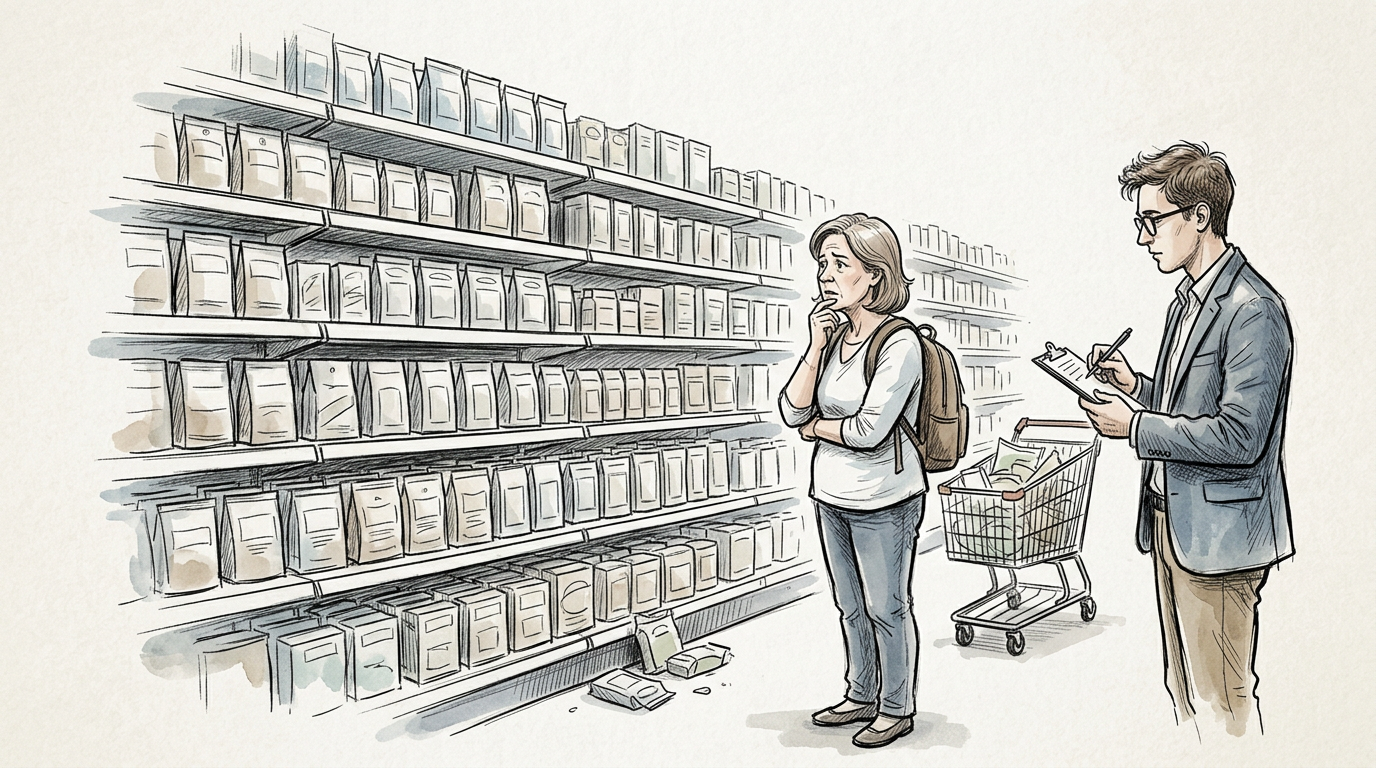
For marketers, “more choice” has long carried an intuitive appeal. A broader assortment can signal abundance, increase the odds that consumers find something that fits their needs, and strengthen a retailer’s or brand’s competitive position. Yet the idea that choice can become counterproductive has been equally influential, especially since the early 2000s, when behavioral research helped popularize the phrase “choice overload.”
The basic proposition is straightforward: after some point, adding options may make selection feel harder, reduce confidence, delay decisions, or discourage purchase altogether. But the research record is more nuanced than the popular version suggests. Some studies have found strong overload effects. Others have failed to replicate the most widely cited results. Meta-analyses now suggest that large assortments do not reliably undermine choice in every setting, but they can create problems under identifiable conditions.
For advertising and marketing professionals, that distinction matters. The question is not whether choice is inherently good or bad. It is when assortment breadth helps consumers and when it creates friction that communication, merchandising, and experience design need to resolve.
## The study that shaped the conversation
Much of the modern discussion traces back to a highly influential paper by Sheena S. Iyengar and Mark R. Lepper, published in the *Journal of Personality and Social Psychology* in 2000: “When Choice is Demotivating: Can One Desire Too Much of a Good Thing?” ([APA record](https://psycnet.apa.org/record/2000-16701-002)).
The paper reported several experiments, the best known of which involved jam tasting in an upscale grocery store. In one condition, shoppers encountered a display of 24 jams. In another, they saw six. The larger display attracted more initial interest, but those who encountered the smaller assortment were more likely to purchase. In another experiment, college students were more likely to submit extra-credit essays, and reportedly wrote better ones, when choosing from a smaller rather than larger set of topics.
These studies resonated because they captured a tension familiar to anyone who has browsed an overstuffed shelf, menu, or product page. More options can be enticing at first glance, but harder to act on. The findings became foundational in academic work on consumer choice and quickly spread into management writing, design thinking, retail strategy, and popular books.
Still, the original paper did not claim that large assortments always depress decisions. It showed that under specific experimental conditions, extensive choice could reduce motivation or commitment relative to a smaller set. Over time, however, the idea often hardened into a broader rule than the evidence justified.
## Why more choice might create difficulty
Researchers have proposed several mechanisms that can make large assortments harder to navigate.
One is cognitive burden. Evaluating many options increases the amount of information consumers must process, compare, and remember. Another is opportunity cost salience, a concept associated with work by Elke U. Weber, Sheena Iyengar, and others, in which choosing one option makes the rejected alternatives more salient. As the set grows, the sense of giving something up may grow as well.
A third mechanism is the possibility of increased regret, anticipated regret, or self-blame. If many alternatives are available, consumers may feel that a poor choice reflects their own failure to choose well. Related research on maximizing, including work by Barry Schwartz and colleagues, suggests that some people are especially prone to dissatisfaction when they believe the “best” option must be found among many possibilities.
These theoretical explanations are plausible, but they do not imply that large assortments are generally harmful. Much depends on the structure of the decision and the capabilities, goals, and preferences of the consumer making it.
## Replications and reversals complicated the story
As interest in choice overload grew, researchers tested the effect in new categories and contexts. The evidence became mixed.
One especially notable paper was Benjamin Scheibehenne, Rainer Greifeneder, and Peter M. Todd’s 2010 article in the *Journal of Consumer Research*, “Can There Ever Be Too Many Options? A Meta-Analytic Review of Choice Overload” ([Oxford Academic](https://academic.oup.com/jcr/article/37/3/409/1796135), [DOI](https://doi.org/10.1086/651235)). Reviewing 50 experiments and 5,036 participants, the authors found that the overall effect of extensive choice on decision-making was essentially near zero when averaged across studies. In other words, the literature did not support a simple generalization that more options reliably reduce motivation, satisfaction, or purchase likelihood.
That result did not mean choice overload was imaginary. Instead, it suggested substantial variability across studies and contexts. Some experiments showed overload, some showed the opposite, and many showed little effect either way.
Subsequent work reinforced the need for caution. A registered replication report published in 2024 in *Judgment and Decision Making* revisited the famous jam study. Led by Carolin F. Röer and colleagues, the multi-lab effort did not find support for the original purchase-conversion effect under the tested conditions ([Judgment and Decision Making](https://journal.sjdm.org/23/230707/jdm230707.html)). Replication is rarely a simple referendum on whether an idea is “true” or “false,” because context, implementation, and sample composition matter. Still, the result is significant because it weakens confidence in one of the field’s most iconic demonstrations.
More broadly, replication efforts and meta-analytic reviews have pushed the field away from sweeping claims and toward a more conditional understanding: large assortments can create difficulty, but the effect depends on how the choice environment is designed.
## What meta-analyses and reviews actually show
The Scheibehenne, Greifeneder, and Todd meta-analysis remains a central reference because it synthesized a then-large body of experimental work and directly challenged the assumption of a robust main effect. The authors also examined moderators that might help explain the inconsistent findings.
A later review by Alexander Chernev, Ulf Böckenholt, and Joseph Goodman, published in the *Journal of Consumer Psychology* in 2015, helped organize those moderators into a more practical framework: “Choice Overload: A Conceptual Review and Meta-Analysis” ([Wiley](https://doi.org/10.1016/j.jcps.2014.08.002)). Their conclusion was not that overload never occurs, but that it emerges under specific conditions related to three broad factors:
– Choice set complexity
– Decision task difficulty
– Consumer preference uncertainty
This framework has become especially useful for practitioners because it shifts attention away from the raw number of options alone. A set of 30 options is not necessarily overwhelming if the alternatives are clearly differentiated, attributes are easy to compare, and the shopper knows what matters most. By contrast, even a modest assortment can feel overwhelming if options are similar, tradeoffs are unclear, and the consumer is uncertain about preferences.
That distinction aligns with a wider body of judgment and decision-making research. Complexity is not simply about quantity. It is also about comparability, ambiguity, cognitive load, time pressure, and stakes.
## When large assortments are more likely to cause trouble
The literature points to several recurring boundary conditions.
### When consumers do not know what they want
Preference uncertainty is one of the strongest predictors of overload. Consumers choosing wine for an unfamiliar meal, skin care for a new concern, or a retirement plan for the first time may struggle not because there are many options, but because they lack a clear internal ranking system.
Chernev’s earlier experimental work examined this issue directly. In a 2003 *Journal of Consumer Psychology* paper, “Product Assortment and Individual Decision Processes,” he showed that consumers with articulated preferences could benefit from larger assortments, while those without clear preferences were more vulnerable to difficulty and deferral ([DOI](https://doi.org/10.1207/S15327663JCP1301&2_13)). This is a crucial managerial insight. Expert and novice buyers may respond very differently to the same shelf or interface.
### When options are hard to compare
A large assortment is more manageable when products share clear, meaningful dimensions of comparison. Standardized categories, such as batteries or printer paper, can often sustain broad choice because shoppers can filter by a few familiar attributes. More interpretive categories, such as fragrance, gourmet foods, mattresses, or financial products, are harder.
Research on assortment structure suggests that category organization matters significantly. Grouping options into meaningful subcategories can make large sets feel more navigable and more appealing. Work by Itamar Simonson and colleagues, as well as later assortment research in consumer behavior, shows that consumers often cope better when complexity is reduced through smart categorization rather than blunt assortment reduction.
For marketers, this means that apparent overload may reflect weak information architecture as much as excessive assortment.
### When the decision carries pressure or consequence
A high-stakes decision, especially under time constraints, can magnify the burden of many options. This has been studied in domains such as retirement savings and health plan selection, where consumers must compare unfamiliar tradeoffs with long-term implications.
One frequently cited field study is Sheena Iyengar, Gur Huberman, and Wei Jiang’s 2004 paper on 401(k) participation, published in *Pension Design and Structure: New Lessons from Behavioral Finance* and circulated widely through Columbia Business School and the National Bureau of Economic Research. The researchers found that participation rates declined as the number of investment options increased, after controlling for various factors ([NBER working paper version](https://www.nber.org/papers/w8876)). This was not a randomized lab experiment, so it cannot establish causation as cleanly as an experiment can. Even so, it offered important real-world evidence that extensive choice in consequential, complex
Leave a Reply