
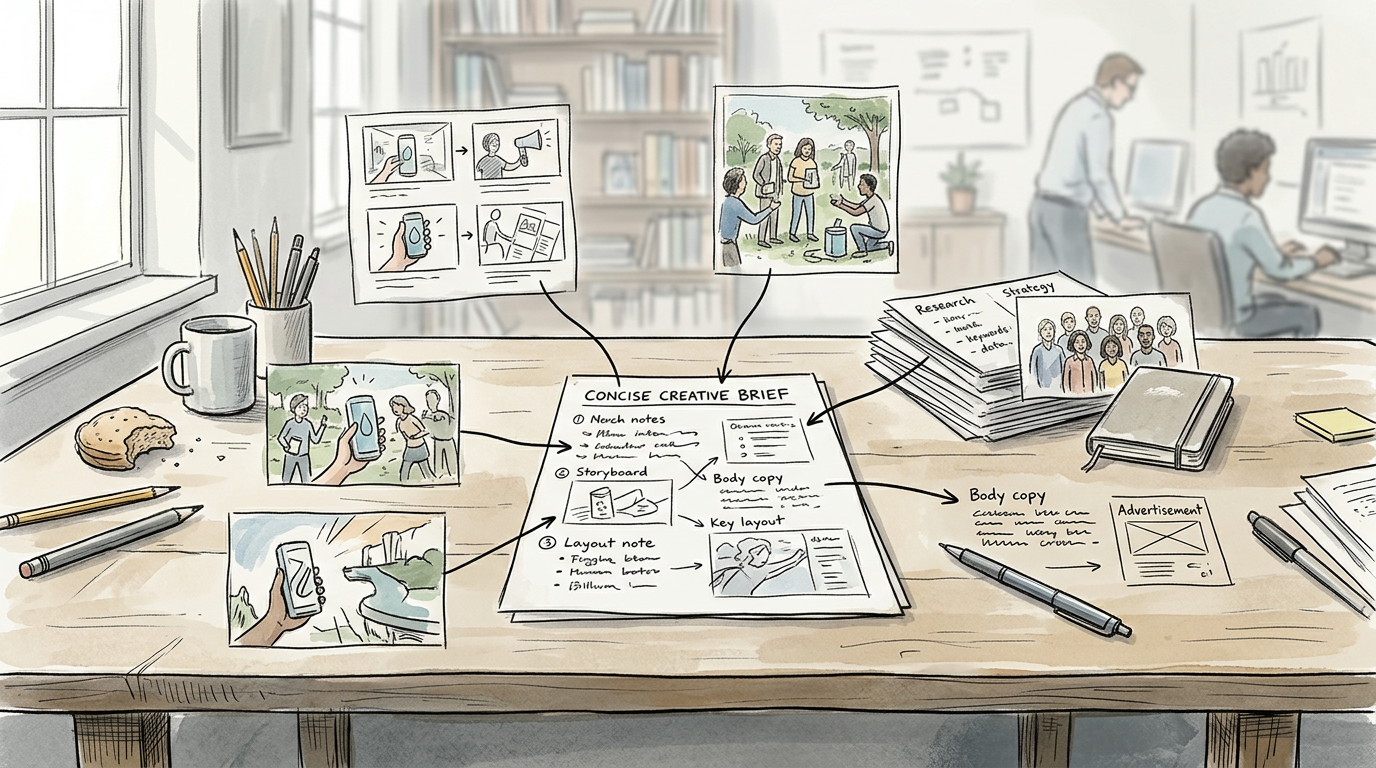
A creative brief is often described as a bridge between strategy and execution. That is accurate, but incomplete. In practice, the brief is also a management tool, a decision framework, and a protection against waste. When it works, it gives creative teams enough clarity to solve the right problem and enough latitude to discover a strong idea. When it fails, even talented teams can produce work that is polished, on-brand, and strategically misaligned.
That tension matters because advertising and marketing organizations frequently ask briefs to do two contradictory things at once. They want a brief to sharpen focus, but they also want it to preserve creative possibility. The strongest briefs do both. They define what the communication must accomplish, for whom, and on what grounds, without pre-writing the headline, prescribing the visual trope, or forcing every execution into a predetermined format.
For creative teams, that distinction is not procedural. It shapes the work itself. A vague brief leads to exploratory labor with no shared standard for evaluating ideas. An overdetermined brief turns creatives into decorators of decisions that have already been made. Either way, the result is usually revision, friction, and compromised work.
## A creative brief is not the ad in paragraph form
The most common failure in briefing is confusion between strategy and execution. Strategy identifies the communication task. Execution is how that task is expressed in copy, imagery, sound, sequence, design, interaction, and production choices.
A brief should answer questions such as these:
– What problem are we solving?
– Who exactly are we trying to move?
– What change in understanding, feeling, or behavior do we want?
– What is the central proposition or organizing idea the work should communicate?
– Why should the audience believe it?
– What category, cultural, channel, or brand context matters?
– What constraints are real and unavoidable?
What it should not do is smuggle in premature creative decisions under the label of strategy. “Make it TikTok-first,” “open with a joke,” “show three use cases,” “use animation,” or “make it look premium and minimalist” may or may not be useful executional suggestions, but they are not substitutes for strategic clarity. They can narrow the field before the real problem has been understood.
That does not mean briefs should be abstract. A useful brief is concrete about the business situation, audience tension, and message task. It simply stops short of deciding the form of the solution.
## The brief defines the problem before the team starts solving it
Good creative work usually begins with a precise articulation of the problem. Not a broad business ambition, but the specific communication problem the work can address.
For example, “drive growth among younger buyers” is not yet a usable creative problem. It says what the business wants, not what the communication must do. A stronger brief might identify that younger buyers are aware of the brand but assume it is designed for an older life stage, and that the advertising must reframe the brand as relevant to a first apartment, first child, or first promotion. That is a communication problem with creative implications.
The distinction matters because creative teams develop ideas from tensions, misperceptions, habits, and overlooked motivations. If the brief defines the problem only at the level of a sales target or demographic ambition, the work often defaults to generic signaling. The brand appears in younger media, uses younger-looking talent, or adopts a younger tone without addressing the barrier that actually needs to change.
This is where a brief creates focus. It names the obstacle clearly enough that creative teams can attack it from multiple angles. A copywriter might pursue reframing language. An art director might explore visual codes that signal relevance without forced youth cues. A film team might build a story around a category moment the audience recognizes. Different routes, same problem.
## Audience definition should illuminate behavior, not just describe a segment
Briefs routinely include an audience box, but many stop at age, income, life stage, or a broad persona. That may be useful for media or market sizing, but it is rarely enough to shape creative choices.
Creative teams need to understand how the audience sees the category, what they already believe, what they resist, what they notice, and what kind of evidence feels credible to them. The audience section should help explain not just who the people are, but what kind of communication can move them.
A business-to-business brief, for instance, may target procurement leads, operations executives, and technical evaluators in the same buying process. Treating that as a single audience often produces muddled work because each group has different concerns and thresholds for proof. The brief should clarify who the communication is primarily trying to influence and what response is realistic from that audience in that context.
The same principle applies in consumer work. A brief that says the audience is “busy parents” is broad. A better brief identifies a specific behavioral pattern or emotional pressure point. Are these parents trying to avoid hassle? Reduce guilt? Feel more in control? Stretch a budget without appearing to compromise quality? Each framing points toward different propositions, tones, and forms of proof.
This level of specificity does not limit creativity. It makes creativity more relevant.
## Objectives should describe the desired change, not just the desired activity
One reason briefs become bloated is that they try to satisfy every stakeholder objective at once. Increase awareness, drive consideration, communicate innovation, support premium pricing, improve trust, grow usage, educate new users, and generate immediate response can all appear in a single document. The result is not ambition. It is diffusion.
A useful brief identifies the primary communication objective and distinguishes it from secondary business hopes. That objective should describe the change the work is supposed to produce. Is the goal to make the brand easier to remember at purchase? To persuade skeptical buyers that a product difference matters? To encourage trial by reducing perceived risk? To help current customers use more of the product or use it differently?
Creative teams make different decisions depending on the answer. If the objective is comprehension, clarity and proof matter heavily. If the objective is memorability in a parity category, distinctiveness and brand linkage become critical. If the objective is response, friction in the path to action matters as much as tone or concept.
Without that prioritization, creative review becomes unstable. One round rewards entertainment, the next asks for more information, and the next worries about branding. Teams are not failing in those situations because they lack ideas. They are being evaluated against shifting, unranked goals.
## The proposition is the hinge between strategy and creative development
If the creative brief has a center of gravity, it is the proposition. Sometimes called the single-minded message, key takeaway, or core idea, the proposition should capture what the audience should come away believing or understanding.
This is not the tagline. It is not a product claim copied from a sales deck. It is not a list of features. It is the strategic thought the execution must bring to life.
Strong propositions are specific enough to direct creative thinking and broad enough to allow multiple expressions. “This software automates reporting” may be factually true, but it gives the team little to build from unless the communication problem is purely educational. “Get back the hours reporting steals from actual decision-making” carries a sharper implication about audience frustration, value, and possible creative direction. It can become demonstration, testimonial, scenario, direct response copy, or visual metaphor.
A proposition also helps teams distinguish between interesting ideas and useful ones. A film treatment may be beautifully crafted, but if the audience comes away remembering mood rather than message, the idea has drifted. A headline may be clever, but if it does not express the proposition or set up the proof, it is ornamental.
This is where briefs often fail through overloading. Multiple propositions are usually evidence that the strategic choice has not been made. Creative teams can work with nuance, but they cannot optimize one piece of communication around six equally weighted thoughts.
## Reasons to believe keep the work from floating free of proof
The proposition tells the audience what the communication wants them to understand. The reasons to believe explain why they should accept it.
These can take many forms: product features, demonstrations, data, endorsements, user experience, heritage, process, ingredients, design decisions, guarantees, pricing structure, or category comparisons. What matters is not that the brief contains proof points, but that it identifies proof the audience will actually find meaningful.
This is an important creative distinction. Some evidence is technically true but creatively weak because it does not change the audience’s judgment. Other evidence may be far more potent because it is easy to grasp, easy to visualize, or tightly connected to a real concern.
For copywriters, reasons to believe shape argument, pacing, and structure. In a direct response email, they can determine whether the opening promise survives the click. In a video script, they influence where proof appears in relation to narrative or demonstration. In social formats, they affect whether the message can be absorbed in seconds without losing credibility.
For art directors and designers, reasons to believe can become visible structure. A superior ingredient may justify close-up product imagery or process visualization. A performance claim may call for side-by-side demonstration rather than atmospheric branding. A service promise may require interface design, motion graphics, or testimonial framing that makes an intangible benefit legible.
A brief that ignores proof often pushes creative work toward unsupported assertion. A brief that drowns teams in undifferentiated proof can be just as unhelpful. The task is to identify which reasons to believe can most effectively support the proposition for this audience in this medium.
## Context is not background filler
Many briefs are loaded with category information, historical brand details, stakeholder commentary, and prior campaign summaries. Some of that context is necessary. Much of it is inert.
Useful context helps creative teams understand the environment in which the work will appear and the meanings it must navigate. That can include category conventions, recent competitor behavior, cultural sensitivities, channel realities, seasonal timing, prior brand messaging, legal restrictions, or research about existing perceptions.
The question is whether the context sharpens judgment. If the category is saturated with the same proof claim, the team needs to know that because a direct repetition may disappear into the blur. If the brand has spent years building a specific memory structure, the team should understand what assets or cues matter. If the audience encounters the message in a low-attention mobile environment, the brief should reflect that reality because it affects how much complexity the execution can carry.
Context becomes especially important in multi-format campaigns. A concept that works in a two-minute film may not survive six-second cutdowns, paid social placements, retail media units, or CRM follow-up unless the brief has already clarified what the audience must retain across those touchpoints. In that sense, context is not peripheral to creativity. It helps determine the form the creative system needs to take.
## Constraints can improve the work when they are honest
Creative teams generally do better with real constraints than with hidden ones. A brief that implies open possibility while key decisions have already been made sets the project up for frustration. If there are mandatory product shots, legal requirements, limited production budgets, localization needs, retailer restrictions, platform limitations, or timelines that eliminate certain approaches, they should be in the brief.
That does not mean constraints should dominate the document. But they need to be stated clearly enough that the team can build ideas that survive contact with production and distribution.
In some cases, constraints improve the quality of thinking. A limited budget may encourage a concept built around smart writing, recognizable behavior, or disciplined design rather than expensive spectacle. A need for modular assets may push the team toward a campaign idea that can hold together across multiple versions. A mandatory proof point may force the proposition to become more concrete.
The danger is not constraint itself. The danger is strategic evasion, where the brief pretends that execution is open while the process later rejects work for reasons that were knowable at the start.
## What a brief should leave open
Because briefs are meant to create focus, some organizations overcorrect and attempt to script the answer. They describe the tone, visual style, message hierarchy, narrative arc, opening scene, social mechanic, and closing line before the creative development process has really begun.
That usually produces one of two outcomes. Either the work feels generic because the team is implementing someone else’s half-formed execution, or the team spends early rounds quietly trying to break free of the brief instead of building from it.
A useful brief leaves room in several important areas.
It should leave room for the form of the idea. If the proposition is clear, the solution could become a demonstration campaign, a humorous campaign, a testimonial system, a visual mnemonic, a content series, a landing-page architecture, or a design-led retail experience.
It should leave room for tone, within strategic guardrails. The same proposition may be communicated through warmth, urgency, wit, reassurance, authority, or matter-of-fact clarity depending on the audience and medium.
It should leave room for discovery in craft. The best expression of a strategic thought often emerges through writing, sketching, prototyping, editing, or production exploration, not from the brief itself.
And it should leave room for creative teams to bring expertise that the brief writer may not possess. Copywriters understand how argument and rhythm affect reading. Art directors understand attention, hierarchy, and visual memory. Designers understand how systems behave across formats. Directors, editors, and producers understand what performance, pacing, sound, and format can add or subtract. A brief that respects those disciplines does not try to impersonate them.
## How the brief shapes copy and art direction without dictating either
One sign of a strong brief is that different creative teams can generate meaningfully different routes from it while still addressing the same strategic task.
In copywriting, the brief influences what kind of writing is needed. If the communication problem is misunderstanding, the copy may need to be more explanatory. If the problem is indifference in a familiar category, a more pointed headline or reframing device may be required. If the audience is skeptical, the structure may need to lead quickly to evidence. If the medium is audio, the language must carry imagery, rhythm, and clarity without visual reinforcement.
But none of those conclusions should be mechanically embedded in the brief as line-level instructions. The brief provides the message task. The writer discovers the language.
The same applies to art direction and design. A brief may establish that the audience needs to grasp a product difference immediately, that branding must register fast in a cluttered feed, or that the brand needs to signal greater approachability without losing expertise. Those are strategic requirements with visual consequences. They may affect hierarchy, scale, color use, casting, composition, interface treatment, typography, or motion. Still, the brief should not foreclose exploration by declaring, for example, that the answer is “clean minimalism” or “bold Gen Z graphics.”
Visual style is not strategy. It is one means of expressing strategy.
## A brief should improve collaboration, not just documentation
The quality of the document matters, but the quality of the conversation around it matters just as much. Many weak briefs are not weak because the writer lacks intelligence or effort. They are weak because the brief is treated as a form to complete rather than a decision to align around.
Creative teams, strategists, account leaders, media planners, clients, analysts, and production leads often hold different pieces of the truth. The audience may behave differently on one platform than another. A claim may be compelling in research but hard to prove on screen. A product feature may matter more to current users than new prospects. A legal line may change the headline possibilities. If those realities are not surfaced before creative development, the brief becomes less a guide than a temporary fiction.
That is why the briefing process should allow questioning. Creatives should be able to challenge unclear objectives, overloaded messages, unsupported assumptions, and contradictory mandates without being seen as difficult. Strategy and account teams should be able to test whether the proposition is sharp enough to generate work. Production and media should be able to flag downstream implications before ideas harden around unrealistic assumptions.
Good briefs often emerge from this kind of friction. Not interpersonal conflict for its own sake, but disciplined interrogation of what the work needs to do.
## Briefs also shape the feedback process
One practical reason briefs matter is that they create a standard for evaluating work. Without that standard, reviews often drift into preference. One person likes the line. Another dislikes the casting. A third wants more product. A fourth wants more emotion. None of those reactions are irrelevant, but without a shared strategic frame they remain reactions, not useful critique.
A well-constructed brief helps teams ask better questions in review. Does this route express the proposition clearly? Does it address the actual barrier identified in the problem statement? Will this audience understand the benefit quickly enough in this medium? Is the proof integrated or bolted on? Do the brand cues register strongly enough for the expected attention level? Can this concept hold together across required versions?
That kind of feedback identifies problems rather than prescribing arbitrary solutions. It gives creative teams something more actionable than “make it punchier” or “it needs to pop.” It also protects against late-stage strategic rewrites disguised as executional notes.
Just as important, a brief can reveal when the issue is not the work but the strategy. If multiple routes keep failing for the same reason, the problem may be that the proposition is weak, the objective is unrealistic, or the proof is unconvincing. In that sense, the brief should remain a living reference point, not a ceremonial artifact forgotten after kickoff.
## Leadership responsibility: the brief sets the culture of the work
Creative leadership is often discussed in terms of taste, standards, and inspiration. Those matter, but leaders also shape the conditions under which good work becomes possible. Brief quality is one of those conditions.
When leaders tolerate vague briefing, they shift the burden of strategic resolution onto downstream creative labor. Teams compensate by generating more options, revising more rounds, and absorbing contradictions that should have been resolved earlier. The visible symptom is creative inefficiency, but the deeper issue is organizational indecision.
When leaders over-specify briefs, they create a culture of compliance rather than invention. Teams become less likely to challenge assumptions or bring surprising solutions because they know the answer has effectively been chosen already.
A stronger leadership stance treats the brief as a disciplined but incomplete document. Disciplined because it must make real choices. Incomplete because the creative value has not yet been found. That stance encourages sharper strategy upstream and more confident exploration downstream.
It also reinforces accountability. If the work misses the mark, leaders can examine whether the brief defined the right problem, whether the review process stayed anchored to the brief, and whether constraints were clear from the start. Creative outcomes are rarely the responsibility of one function alone.
## How to recognize a brief that is helping the work
Useful briefs tend to show their value early. Teams can restate the problem in similar terms. Creative routes diverge in form but not in strategic aim. Feedback conversations become more precise. Fewer rounds are spent debating what the assignment is. Production planning begins earlier because the idea system is coherent enough to scope. Clients and internal teams can disagree productively because they are evaluating against declared objectives rather than private expectations.
By contrast, weak briefs leave predictable traces. Teams ask what the real goal is after concepts have already begun. Different stakeholders quote different priorities from the same document. The work keeps oscillating between emotional and informational modes because the objective was never ranked. Brand linkage gets patched in late. Production becomes a negotiation over unresolved strategy.
None of this means a good brief guarantees a good campaign. Execution still matters enormously. Writing can be flat. Design can obscure rather than clarify. A film can overplay story and underplay brand. A modular campaign can collapse in versioning. But a strong brief improves the odds that talent and effort are applied to the right challenge.
## The brief’s real value is not control. It is useful freedom.
The best creative briefs do not narrow the work to one visible answer. They narrow it to one coherent problem. That is a crucial difference.
By defining the audience, objective, proposition, proof, context, and constraints with discipline, a strong brief reduces confusion without reducing imagination. It gives copywriters, art directors, designers, strategists, producers, and clients a common frame for making decisions. It helps teams generate ideas that are not merely attractive or entertaining, but appropriate to the audience, workable in the medium, and relevant to the business task.
In that sense, the creative brief should shape the work long before the first headline is written or layout is sketched. It should determine what the work must achieve and what truths it has to work with. But it should stop short of deciding how the idea must appear. That remaining space is where creative discovery happens.
For organizations that want better work, the lesson is simple but demanding. Write briefs that make the strategic choices the creative team should not have to guess. Then leave the execution open enough that the team can find something stronger than what anyone could have prescribed in advance.
Leave a Reply