
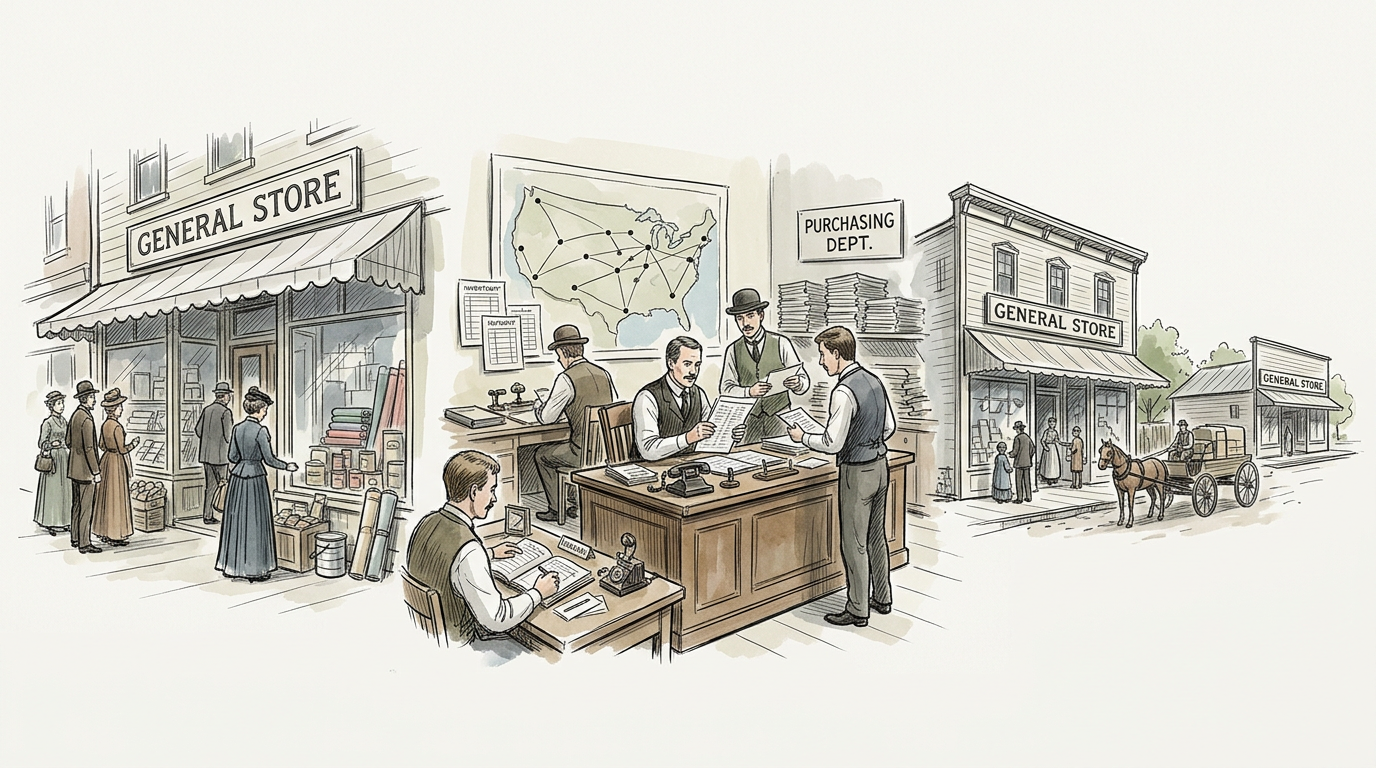
Long before marketers spoke about omnichannel distribution, category management, trade promotion, or private-label strategy, the rise of chain stores had already forced businesses to rethink how goods moved, how prices were set, how brands were built, and who controlled the consumer relationship. From the late nineteenth century through the middle decades of the twentieth, chain retailing changed marketing not simply by creating larger merchants, but by reorganizing the connection between producers, intermediaries, and households.
What made chain stores historically important was not just scale. It was coordination. Chains centralized buying, standardized store layouts and merchandising, imposed consistent pricing policies, systematized inventory flows, expanded private-label programs, and learned how to replicate retail formats across geographies. In doing so, they changed the balance of power between manufacturers and retailers and helped define many of the distribution and marketing practices that remain familiar today.
Before the chain store: fragmented retail and local discretion
In the nineteenth century, much of American retailing still ran through independent general stores, druggists, grocers, dry goods merchants, and specialty shops. Distribution was layered and local. Manufacturers often sold through wholesalers or jobbers, who in turn supplied retailers. Retail pricing varied widely by town, by merchant, and sometimes by customer. Credit was common. Merchandising was inconsistent. Many goods were sold in bulk rather than in standardized branded packages.
This system had advantages in a geographically large country with uneven transportation and communications. Local merchants understood local demand, extended credit, and carried mixed assortments for nearby households. But as industrial production expanded after the Civil War, manufacturers increasingly needed more predictable channels to move larger volumes of standardized goods. Railroads widened markets, urban populations grew, and packaged consumer goods became more common. Those changes created an opening for retail systems that could buy in volume and sell in repeatable ways across multiple locations.
Chain stores emerged within this broader transformation. They were not the first large retailers. Department stores had already demonstrated the power of scale, merchandising, and centralized management in urban settings. Mail-order firms such as Montgomery Ward and Sears, Roebuck showed that standardized assortments and centralized purchasing could reach dispersed consumers. But chain stores extended those principles into neighborhood-based, multiunit retailing.
The early rise of chains
Multiunit retail organizations appeared in several sectors during the late nineteenth century. The Great Atlantic & Pacific Tea Company, founded in 1859, became one of the most influential examples. Originally a tea and coffee business, A&P expanded into grocery retailing and by the early twentieth century had become a major force in food distribution. In the drug trade, F.W. Woolworth developed its variety-store system after opening its successful Lancaster, Pennsylvania, store in 1879. United Cigar Stores, founded in 1901, spread quickly. Walgreens, founded in Chicago in 1901, expanded from a single drugstore into a chain. J.C. Penney began in 1902 as part of the Golden Rule store movement and developed into a national dry goods and apparel chain.
By the 1910s and 1920s, chain retailing had become a visible and controversial part of the American marketplace. The U.S. Census Bureau tracked chain-store growth, and trade publications devoted growing attention to chain operations, buying methods, and competitive effects. Grocery chains, drug chains, shoe chains, variety chains, and apparel chains expanded through urban and small-town markets alike.
The timing mattered. Chain growth coincided with cheaper transportation, wider use of the telephone, better accounting methods, improved warehousing, branded packaged goods, and managerial systems capable of supervising many outlets at once. These were not glamorous innovations, but they were decisive. Chain retailing depended less on a single dramatic invention than on the ability to coordinate purchasing, pricing, replenishment, and reporting across dispersed stores.
Centralized purchasing and the redistribution of market power
The defining business practice of the chain store was centralized purchasing. Instead of individual storekeepers buying independently from local wholesalers, headquarters or regional offices negotiated purchases for many stores at once. This changed marketing relationships in several ways.
First, chains increased bargaining power over manufacturers and wholesalers. Volume buying allowed chains to demand lower prices, better terms, special packs, promotional allowances, and reliable delivery. In groceries especially, large chains could bypass some traditional wholesale intermediaries and deal more directly with producers. This put pressure on wholesalers whose role had long rested on breaking bulk and servicing many small retailers.
Second, centralized buying changed the structure of manufacturer selling. Producers increasingly had to market not only to consumers and independent retailers, but also to large chain buyers with measurable volume and considerable leverage. Selling to a chain required attention to slotting, assortment decisions, case quantities, package formats, margins, and delivery schedules. The buyer became a strategic audience.
Third, chains generated more disciplined demand information. Headquarters could aggregate sales from many stores and observe which goods turned quickly, where seasonal patterns varied, and how pricing affected movement. The quality of such data was limited by the era’s reporting systems, and early chains did not possess modern point-of-sale visibility. Even so, compared with fragmented independent retailing, chain organizations had a stronger basis for centralized merchandise planning. That development foreshadowed the later rise of category management, retail analytics, and sophisticated sales forecasting.
The pressure chains put on manufacturers became a major issue in trade relations and public policy. In the 1920s and 1930s, critics argued that chain stores used their buying power to secure unfair advantages. Defenders argued that scale reduced costs and passed savings to consumers. Those debates influenced federal regulation, including the Robinson-Patman Act of 1936, which sought to curb certain forms of price discrimination in wholesale transactions. The law did not stop chain growth, but it reflected how deeply distribution politics had become tied to the new retail structure.
Standardized stores and the replication of retail experience
Chain stores also changed marketing by standardizing the retail environment. A chain unit in one city increasingly resembled a chain unit in another. Store names, signage, fixtures, assortments, service routines, and visual merchandising were designed to be recognizable and repeatable.
This mattered because it made retail format itself a marketing asset. Consumers did not have to learn a new buying environment every time they moved neighborhoods or traveled. Standardization signaled reliability, familiarity, and predictable value. In effect, the store became a brand.
F.W. Woolworth’s variety stores, A&P’s grocery outlets, and J.C. Penney’s stores all benefited from this principle, though each applied it differently. Variety chains emphasized fixed low prices and rapidly turning assortments. Grocery chains emphasized convenience, standardized staples, and later self-service formats. Apparel and dry-goods chains used consistency to build trust around quality and fair dealing.
Standardization also changed internal management. Headquarters could issue instructions on display methods, assortment planning, store operations, and promotional timing. That reduced local autonomy, but it increased the chain’s ability to execute common strategies. In modern terms, chain retail made operating model and brand model more tightly connected.
This development had consequences for marketing as an organizational function. Retailers needed merchandise managers, district supervisors, store planners, buyers, statisticians, and later market researchers who could think beyond a single location. The managerial problem was no longer merely running a store. It was designing a retail system.
Fixed and visible pricing
Chain retailing accelerated the normalization of fixed prices in many categories. Earlier retail traditions had often involved bargaining, discretionary markups, uneven credit terms, and local price variation. Chain stores relied more heavily on visible, standardized prices that could be communicated clearly across many locations.
The fixed-price model had already been advanced by department stores and variety stores, but chains extended it more broadly into everyday household purchasing. Woolworth became closely associated with the five-and-ten-cent format, though in practice assortment and pricing evolved over time. A&P and other grocery chains used low-price positioning to attract regular traffic. J.C. Penney emphasized what it called the “Golden Rule” approach and became known for price integrity and value.
For consumers, price standardization reduced uncertainty. For retailers, it simplified training, merchandising, and promotion. For manufacturers, it introduced a new challenge. Nationally advertised goods could no longer rely on wide local variation in retail presentation and price. Brand owners had to think more carefully about resale conditions, pack sizes, list prices, dealer margins, and competitive positioning inside chains.
These tensions fed directly into twentieth-century debates over resale price maintenance. Manufacturers of branded goods often wanted more control over retail price in order to protect dealer margins and brand image, while chains frequently sought freedom to use branded merchandise as price leaders. Court decisions and statutes, including the Miller-Tydings Act of 1937 and later the Consumer Goods Pricing Act of 1975, marked stages in the long contest over vertical pricing control. Chain retail was one of the central reasons those conflicts became so important.
Inventory control and the beginnings of modern retail coordination
The growth of chains required more disciplined inventory management than most independent stores had historically used. Multiunit operations needed systems for ordering, replenishment, warehousing, shrink control, stock balancing, and sales reporting. Early chain-store methods were manual and often cumbersome, relying on ledgers, standardized forms, telephones, and later tabulating and accounting equipment. But they represented an important step toward modern retail management.
In grocery retail especially, inventory turnover was a central concern. A chain could not rely on local improvisation if it expected to sell large volumes of low-margin goods. Centralized oversight allowed chains to compare store performance, reduce overstocks, and align orders more closely with demand patterns. It also encouraged assortment discipline. Slow sellers could be identified and replaced more systematically than in many independent stores.
By the interwar period, chain executives and trade journals increasingly treated stock control, turnover, gross margin, and operating expense as measurable levers of retail performance. Marketing and distribution were becoming more quantitative. The question was not simply what consumers liked in a broad cultural sense, but what combinations of assortment, price, and stock movement produced sustainable volume and return.
This managerial orientation helped shift marketing away from a narrow emphasis on persuasion and toward a broader concern with flows, systems, and customer service. Later developments such as supermarket scanning, computerized replenishment, and retailer-managed analytics built on foundations that chain retail had already established in organizational form.
Private labels and the retailer as brand owner
One of the most important ways chain stores changed marketing was by expanding private labels. Retailers had long sold store brands or unbranded goods in some form, but large chains gave private labels a new scale and strategic purpose.
A&P is a particularly important case. In the early twentieth century, the company sold substantial volumes of private-label coffee, tea, baking powder, canned goods, and other staples. By controlling buying, packaging, and distribution, A&P could offer these goods at attractive prices while retaining greater control over margins. The chain was not merely reselling manufacturers’ brands. It was competing with them.
Private labels altered the relationship between manufacturers and retailers in fundamental ways. National brand producers sought consumer demand pull through packaging, trademarks, and advertising. Chains responded by using their access to shelf space, pricing authority, and customer traffic to promote retailer-controlled alternatives. This reduced manufacturer leverage and made distribution access itself a strategic battleground.
The growth of private labels also complicated the history of branding. Branding did not belong only to manufacturers. Chains demonstrated that retailers could create trust through store reputation and attach that trust to their own merchandise lines. In categories where quality could be standardized and communicated economically, private labels became a powerful instrument of differentiation and margin management.
This remains one of the clearest historical links between early chain retailing and modern marketing practice. Today’s retailer-owned brands, from grocery basics to premium lifestyle lines, are part of a long tradition in which merchants use customer access, purchasing scale, and category knowledge to become brand strategists in their own right.
Geographic expansion and the nationalization of retail demand
As chains spread across cities, regions, and eventually the nation, they helped nationalize retail demand. A manufacturer that once sold through a patchwork of wholesalers and independent stores could now reach many households through a small number of growing retail systems. That changed the economics of product planning, packaging, and sales organization.
Geographic expansion was enabled by rail distribution, improved roads, expanding motor transport, telephone communication, and increasingly professionalized management structures. Chain headquarters could scout markets, choose sites, estimate population and purchasing power, and extend proven store formats into new territories. This was not modern location analytics, but it was an early and consequential form of market planning.
The spread of chain stores also changed consumer expectations. Families in different towns increasingly encountered similar assortments, prices, and retail experiences. That made national consumption patterns more feasible. A product that fit chain requirements could gain broad distribution faster than under a purely local retail model. The reverse was also true: products that failed to fit chain economics might struggle despite local appeal.
Geographic replication therefore reshaped marketing work inside manufacturing firms. Sales organizations had to manage national or regional accounts. Package design had to travel well and fit standardized shelving or display practices. Production planning had to support larger, coordinated orders. Promotions increasingly had to align with chain calendars and territories. Distribution and marketing could no longer be treated as separate worlds.
How chains affected manufacturers’ marketing strategy
The rise of chain retailing did not destroy manufacturer branding. In many categories, it intensified it. Large retailers were powerful customers, but they were also powerful gatekeepers. Manufacturers needed ways to maintain bargaining strength and preserve consumer preference even when chains pressed for concessions or promoted private labels.
This encouraged several strategic responses.
National branding became more important for many producers of packaged goods. If consumers entered a chain store specifically seeking a branded soap, cereal, cigarette, or canned good, the retailer’s freedom to substitute an alternative was constrained. Trade and consumer marketing had to work together.
Packaging gained strategic significance. Standardized retail environments made visual recognition more valuable. A consistent package could perform across many stores and geographies.
Sales management became more specialized. Manufacturers increasingly needed account handling, merchandising support, promotional planning, and field intelligence tailored to chain accounts.
Trade promotion and cooperative arrangements expanded, though practices varied by era and category. Chains expected allowances, display support, and sometimes exclusive deals or tailored assortments. Manufacturers had to weigh volume opportunities against margin pressure and channel conflict.
These developments reinforced a broader historical truth: marketing did not evolve solely as an external communication function. It developed partly in response to changes in distribution structure. Chain retail forced manufacturers to become more sophisticated in channel strategy, pricing policy, package planning, and retail execution.
Chain stores, self-service, and the supermarket era
The chain-store story did not end with the first generation of grocery, variety, and drug chains. It evolved alongside major shifts in retail format, especially self-service and the supermarket.
Clarence Saunders’s Piggly Wiggly, founded in Memphis in 1916, is widely recognized as an early self-service grocery chain. Self-service was not simply a store-layout innovation. It changed the marketing significance of packaging, shelf display, signage, and in-store price communication. Products had to sell themselves more directly at the shelf because clerks were less central to the transaction.
The supermarket model, which took clearer form in the 1930s, further intensified the importance of scale, turnover, and standardized merchandising. Michael J. Cullen’s King Kullen, opened in 1930 on Long Island, is often cited as an early supermarket. Whether one treats it as the first true supermarket or as one of several formative examples, the larger point is that big-box food retail fused chain organization with high-volume self-service distribution.
Supermarkets enlarged the bargaining stakes between manufacturers and retailers. Shelf space, promotional displays, category breadth, and consumer traffic all became more measurable and contested. Marketing in packaged goods became inseparable from retail execution. Consumer demand still mattered, but so did the retailer’s ability to place, price, and replenish merchandise at scale.
This environment eventually encouraged more formal market research, panel data, and store auditing. Firms such as Nielsen, founded in 1923 by Arthur C. Nielsen Sr., helped manufacturers and retailers measure sales and market shares with greater consistency. That research infrastructure did not arise because chain stores alone existed, but chain retail made standardized measurement more useful and often more feasible.
Opposition, regulation, and the politics of chain retail
Chain stores were never accepted without resistance. Independent merchants, wholesalers, some civic groups, and various policymakers argued that chains threatened local business, concentrated buying power, and undermined community control. During the 1920s and 1930s, anti-chain sentiment became strong enough to produce taxes and legislative proposals in several states and at the federal level.
The most famous episodes involved grocery chains, especially A&P, whose scale made it a lightning rod. Congressional inquiries and public debate focused on whether chains created efficiencies that benefited consumers or exercised power in ways that distorted competition. In 1944, the federal government brought an antitrust case against A&P and related entities, alleging anti-competitive practices. The litigation reflected long-running concern about the company’s vertical integration, buying power, and pricing methods.
These controversies matter to marketing history because they reveal that distribution systems are never neutral. They allocate power. Chain stores changed who could influence assortment, pricing, and brand visibility. They also shaped public debates about fairness, market access, and consumer welfare that continue in new forms around mass merchants, ecommerce platforms, and digital marketplaces.
From chain-store management to modern retail marketing
By the middle of the twentieth century, many practices associated with modern retail marketing were already visible in chain organizations, even if the terminology was different.
Centralized purchasing anticipated strategic sourcing and key account management.
Standardized store design anticipated retail branding and customer experience management.
Fixed, visible pricing anticipated everyday price communication and large-scale promotional planning.
Inventory systems anticipated data-driven merchandising and supply-chain coordination.
Private labels anticipated portfolio strategy, channel conflict management, and retailer brand architecture.
Geographic replication anticipated format strategy, trade area planning, and scalable growth models.
The institutional consequences were equally important. Chain retail encouraged the development of merchandising departments, buying offices, district management, store operations systems, research functions, and formalized training. It created business roles that were recognizably part of marketing, even when firms still described them in terms of sales, merchandise, or distribution.
Academic marketing also took shape during this era in close dialogue with changes in distribution. Early twentieth-century marketing scholars in the United States often focused less on persuasion than on channels, institutions, functions, and the movement of goods. Texts and courses in distribution and marketing reflected a business world in which wholesaling, retail organization, standardization, and market coordination were pressing managerial concerns. Chain stores were not incidental to that intellectual development. They were one reason the field of marketing paid such sustained attention to channels and institutions.
Why this history still matters
Chain stores changed marketing because they made distribution strategy a central source of competitive advantage. They demonstrated that retail organization could shape demand, not merely respond to it. They showed that customer relationships could be mediated by the store format as much as by the manufacturer’s brand. And they established that control over purchasing, shelf space, data, and pricing could be just as consequential as control over product design or promotion.
That legacy remains visible across contemporary marketing. Big-box retailers negotiate with consumer packaged goods companies from positions built on scale and traffic. Private labels continue to challenge national brands by combining price, margin control, and retailer trust. Merchandising and inventory analytics remain inseparable from customer strategy. Retailers still use geographic expansion and format replication to standardize experience while adapting selectively to local demand. Digital commerce platforms now replay many older chain-store dynamics in new technical forms, including centralized control, seller dependence, pricing visibility, and marketplace power.
The history of chain stores therefore belongs at the center of marketing history, not at its edges. It explains how marketing became a matter of systems as well as messages, of institutional power as well as consumer persuasion. When chain retail reorganized distribution, it also reorganized marketing itself.
Leave a Reply