
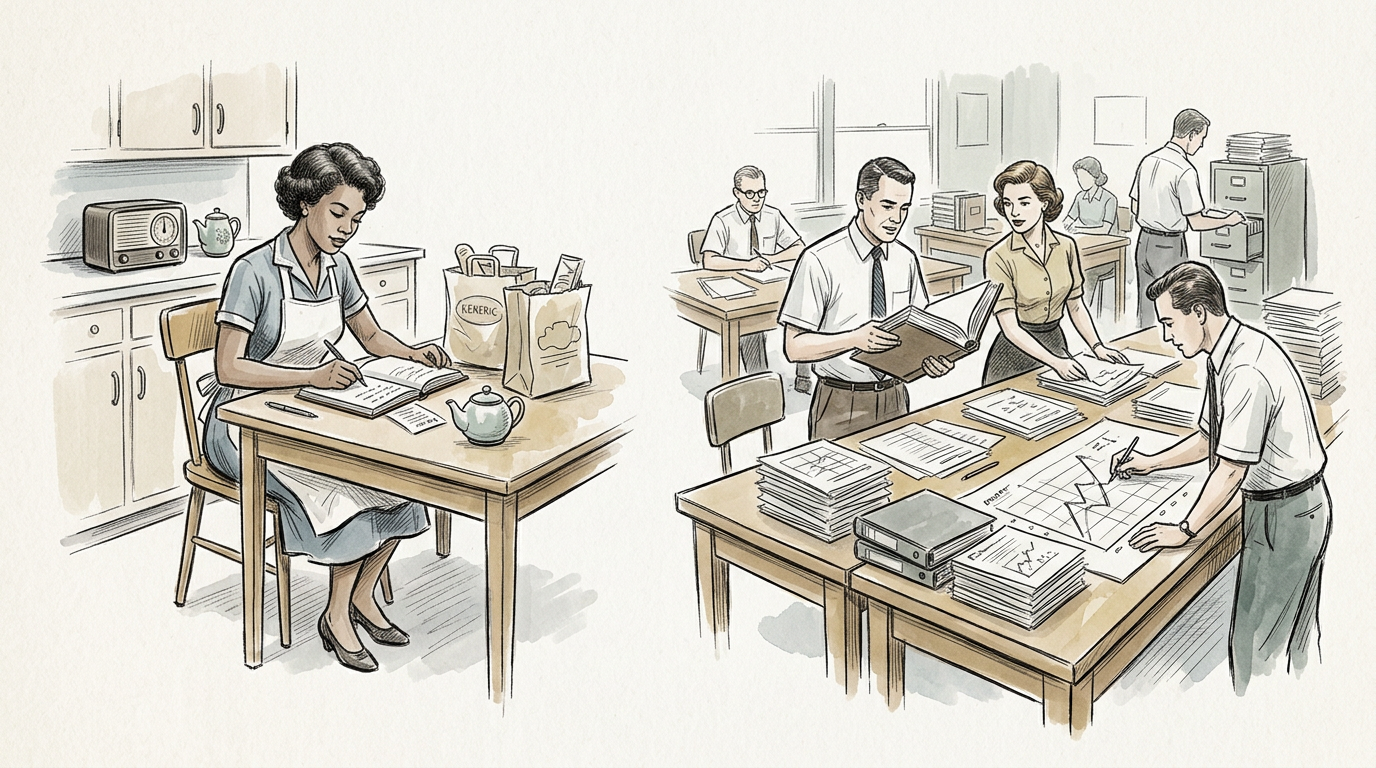
Before recurring consumer panels became standard tools of market research, most firms had to infer demand from fragments. They could examine factory shipments, wholesaler orders, retailer inventories, salesmen’s reports, or occasional surveys, but those sources rarely showed how the same households behaved over time. A manufacturer might know that sales rose in one quarter and fell in the next without knowing whether existing buyers were purchasing less often, whether new households had entered the category, or whether customers had switched brands after a promotion. The development of consumer panels addressed that problem by turning repeated observation into a practical business instrument.
The central historical importance of panels is not simply that they produced more data. They changed the unit of analysis. Instead of treating each purchase or survey response as a disconnected event, panels made it possible to follow continuity and change at the household or individual level. That shift mattered for brand management, media planning, product testing, pricing, retail strategy, and the broader professionalization of marketing research. It also introduced enduring methodological problems involving recruitment, panel conditioning, attrition, and representativeness that remain relevant in today’s digital measurement systems.
From one-time surveys to repeated observation
Modern market research emerged in the late nineteenth and early twentieth centuries alongside national distribution, mass-circulation media, branded packaged goods, chain retailing, and more formal business administration. As producers became more distant from final consumers, they needed structured ways to understand demand. Early commercial research relied heavily on trade information, retailer reports, economic statistics, and ad hoc investigations. By the 1910s and 1920s, firms and research suppliers were experimenting with surveys, test markets, store audits, and audience measurement, but most techniques still offered snapshots rather than moving pictures.
A recurring panel promised something different. If the same households kept records of what they bought, read, heard, or thought, a researcher could compare behavior across weeks, months, or years. That made it possible to study repeat purchasing, brand loyalty, trial, switching, seasonality, response to promotions, and the diffusion of new products. In methodological terms, panels introduced longitudinal analysis into business decision-making long before contemporary marketers used that language routinely.
The idea had roots in social research and official statistics as well as in commercial practice. Government agencies and social investigators had long revisited the same units to understand labor, agriculture, or living conditions. What commercial researchers did was adapt repeated reporting to the needs of branded consumer markets, where managers wanted timely measures of household buying and media exposure.
The rise of the household purchase panel
One of the best-documented early large-scale examples in U.S. market research is the household consumer panel developed by Arthur C. Nielsen. Nielsen founded the A.C. Nielsen Company in 1923, initially focusing on engineering performance surveys for industrial clients. During the 1930s, as branded consumer goods companies sought more systematic market information in the difficult economic conditions of the Depression, Nielsen expanded into food and drug store auditing and then into consumer purchasing measurement.
In 1933, the company introduced what became known as the Nielsen Food and Drug Index, based on store audits. Store audits helped estimate sales movement through retail channels, but they still did not fully explain household behavior. Nielsen’s answer was the Consumer Purchasing Panel, launched in 1936. Participating households kept records of their purchases, providing a continuous read on what consumers actually bought for home use. The panel became a major innovation in commercial research because it complemented retail audits rather than replacing them. Audits showed what moved through stores; the panel showed what entered households.
That distinction mattered. A shipment or a store sale could reflect trade loading, stockpiling, distribution changes, or retail promotions. Household records were closer to actual consumption decisions. For manufacturers of packaged goods, the panel offered a way to evaluate whether a coupon, price cut, package redesign, or advertising campaign generated trial, repeat purchase, or switching from a rival brand.
By the mid-twentieth century, panel data had become increasingly important to consumer packaged goods marketing. Large manufacturers could combine audit data, panel records, and regional distribution information to make more disciplined decisions about merchandising, pricing, package sizes, and new-product launches. The resulting research infrastructure supported the postwar rise of brand management, category analysis, and more formal sales forecasting.
Why panels solved a different business problem than surveys
A one-time survey can estimate awareness, preference, or recent purchase at a given moment. A panel can examine sequence. That difference may sound technical, but historically it changed what marketers believed they could know.
With panel data, researchers could ask questions such as these:
- How many households tried a product during an introductory period?
- How many bought it again within a defined window?
- Did promotion attract heavy users of the category or mostly bargain hunters?
- Did households buy larger pack sizes after repeat use?
- How long did it take before a rival brand regained share?
- Did the campaign coincide with more category buying overall, or only with brand switching?
These are now familiar questions in customer analytics, but historically they represented an important expansion in marketing’s analytical reach. Panels helped move marketing away from relying solely on aggregate sales trends and managerial intuition. They provided evidence about behavior over time, which in turn encouraged more explicit theories of loyalty, trial, repeat, and market segmentation.
They also fit the needs of postwar consumer markets. As supermarkets expanded, self-service retailing spread, product assortments grew, and television accelerated national branding, competition within categories intensified. Firms no longer needed only total demand estimates. They needed to understand household repertoires, frequency, and switching patterns inside increasingly crowded markets.
Diary methods, recording systems, and the discipline of participation
Early panels depended on consumer labor. Households were recruited and asked to keep diaries, save package labels, record purchases, note prices, or complete periodic questionnaires. This was not passive measurement. It required literacy, time, memory, and willingness to comply with instructions. The practical difficulties of obtaining reliable repeated reports shaped the history of panel research as much as the statistical theories behind it.
The diary method was especially important. In media research as well as purchase measurement, diaries allowed researchers to collect repeated data at relatively low cost before electronic metering became widespread. But diaries also introduced familiar problems. Respondents forgot purchases, filled in records late, simplified their reporting, or altered behavior because they knew they were being observed. Some households were more conscientious than others, which could affect data quality.
Panel operators therefore developed extensive field procedures. They trained participants, sent reminders, checked forms for completeness, replaced dropouts, and created editing rules to identify implausible entries. Much of the professional expertise of early panel research lay not in abstract theory alone but in building an organization capable of sustaining regular compliance at scale.
This operational side of panel history deserves emphasis because it reveals how marketing research became a specialized business function. Longitudinal measurement required sample design, field management, coding, tabulation, quality control, and client interpretation. It encouraged the growth of research suppliers whose value depended on organizational discipline and standardized methods, not only on occasional investigative talent.
Panels and the development of audience measurement
The logic of repeated observation also transformed media research. Before national television became central to brand strategy, advertisers and broadcasters were already struggling to measure audiences consistently. Radio audience research in the 1930s and 1940s relied on several methods, including telephone recall and diaries. Firms such as C. E. Hooper and the Cooperative Analysis of Broadcasting used different approaches to estimate listening. The broader historical point is that media planners wanted more than isolated estimates. They wanted to know regular exposure patterns and program loyalties.
A.C. Nielsen again became important here. In 1942 the company began the Nielsen Radio Index, and in 1950 it introduced the Nielsen Television Index. Television research combined interviews, diaries, and later electronic recording devices. The Audimeter, originally developed earlier for radio set monitoring and adapted for television, enabled more automated collection of tuning behavior in panel homes. Over time, national and local television ratings relied on carefully maintained panels that balanced cost, technical feasibility, and representativeness.
For marketers, media panels made it possible to link reach and frequency concepts to recurring household measurement. They also reinforced the idea that strategic decisions should rest on patterned behavior rather than anecdote. Media buying, programming, sponsorship, and later spot advertising all benefited from systems that could compare audience use over time.
Still, media panels shared many of the same weaknesses as purchase panels. Recruitment was difficult. Not all households agreed to install devices or keep diaries. Some demographic groups were easier to recruit than others. Panel homes could become unusually aware of their own media habits. The history of ratings controversies, particularly in television, repeatedly returned to these issues.
The postwar expansion of syndicated panel research
After World War II, rising household consumption, suburbanization, supermarket growth, and the increasing scale of national brands created favorable conditions for syndicated research services. Rather than conducting a custom study for one client, research firms could maintain standing panels and sell standardized insights to multiple manufacturers, retailers, and media buyers. This business model lowered the cost per client and helped establish common market metrics across industries.
Panels became especially valuable in packaged goods categories where purchase frequency was high and brand competition intense. Marketers could track penetration, repeat rates, average purchase volume, interpurchase time, and brand switching with greater precision than most earlier methods allowed. The data also supported test-market analysis. If a company changed packaging or introduced a coupon in one region, panel records could show how households responded compared with control markets.
By the 1950s and 1960s, panel-based measurement had become embedded in mainstream marketing practice. It influenced how managers thought about loyalty and segmentation, and it supported the rise of more quantitative marketing analysis in business schools and corporate planning departments. As computing improved, larger datasets became easier to process, making panel information more analytically useful.
Academic marketing and related fields also benefited. Longitudinal consumer data encouraged more rigorous work on purchase probability, repeat-buying models, media exposure, and household heterogeneity. The boundary between commercial research practice and academic marketing science remained porous. Researchers in each sphere borrowed concepts, methods, and empirical problems from the other.
Representativeness was always the central tension
The business appeal of panels rested on continuity, but continuity created a methodological tension. The longer a panel remained in the field, the more valuable it became for trend analysis. At the same time, the longer it remained in the field, the more likely it was to drift away from the broader population.
This happened for several reasons. Some participants dropped out because of fatigue, moves, or changed circumstances. Others became more skilled and perhaps more artificial in their reporting. Newly recruited households might differ from long-term members. Certain groups, including very busy households, people wary of surveillance, and those with unstable housing, could be harder to recruit or retain. The result was a persistent representativeness challenge.
Researchers responded with weighting, stratification, quotas, replacement procedures, and periodic sample refreshment. They compared panel composition with census benchmarks and other external controls. Yet no technique fully eliminated the tension between behavioral continuity and representational quality. That was true in the era of paper diaries and remains true with online panels, scanner panels, and app-based tracking.
For marketers, this limitation is historically important because it shaped the interpretation of data. Panel figures often looked highly precise, but they were estimates built from managed samples, not literal counts of the entire market. Experienced researchers understood this. Problems arose when managers treated panel outputs as if the method itself guaranteed perfect objectivity.
From household diaries to scanner panels
The next major transformation came with developments in computing, barcoding, and electronic point-of-sale systems. In the 1970s and especially the 1980s, scanner technology changed retail measurement by making store-level transaction capture faster and more detailed. At the same time, panel firms could ask households to identify purchases in ways that reduced some of the burdens of manual diary entry.
Nielsen’s home measurement systems evolved into scanner-based consumer panels, and Information Resources, Inc., founded in 1979, became a major force in scanner data and test-market analytics. Universal Product Codes, introduced in the early 1970s and used in the first commercial UPC scan in 1974, gave researchers standardized product identifiers that greatly improved matching between household records and retail sales data.
This was not the end of the panel idea but its modernization. The underlying logic remained longitudinal: follow the same households over time to understand purchasing patterns. What changed was the accuracy, granularity, and speed of capture. Scanner panels made it easier to record brand, size, flavor, price, promotion status, and retail outlet. They also supported more sophisticated analyses of trial, pantry loading, coupon redemption, and cross-category behavior.
The scanner era deepened marketing’s reliance on measurable consumer response. Consumer packaged goods firms increasingly integrated panel data into category management, trade promotion evaluation, new-product forecasting, and retailer negotiations. Yet even in this more automated environment, recruitment and representativeness did not disappear. Households still had to join panels, remain active, and comply with procedures. Better technology reduced some reporting error while introducing new forms of participation bias.
Attitudinal and opinion panels expanded the model
Not all panels were built to measure purchases or media exposure. Recontact studies and standing survey panels also became common tools for tracking attitudes, intentions, satisfaction, and lifestyle change. In these formats, the same respondents answered questions repeatedly across waves. This made it possible to study not only what people bought but how their stated preferences and beliefs changed.
Such panels supported political polling, public opinion research, customer satisfaction measurement, and later online market research communities. For marketers, attitudinal panels were useful when behavior alone could not explain an outcome. A decline in repeat purchase, for example, might be linked to changing product perceptions, economic anxiety, or dissatisfaction with availability. Repeated interviewing could surface those patterns.
At the same time, attitudinal panels raised additional concerns. Repeated questioning can sensitize respondents to brands or issues. People may become better survey takers without becoming more representative consumers. The convenience of recontact can also tempt organizations to overuse the same respondents. These are not new digital-era concerns but long-standing features of panel methodology.
Consumer panels and the professionalization of marketing research
The historical significance of consumer panels extends beyond technique. Panels helped define marketing research as a professional field with specialized standards, infrastructure, and language. Operating a panel required decisions about sampling frames, household classification, response incentives, validation, weighting, and reporting intervals. Those choices had to be documented, defended, and improved over time.
Industry bodies contributed to this professionalization. Organizations such as the American Marketing Association and market research trade associations provided forums for discussing methodology, ethics, and standards. Business schools trained managers to interpret longitudinal data more critically. As marketing research became more institutionalized, panel data became one of the core forms of evidence through which firms justified strategic decisions.
Panels also encouraged a more consumer-centered view of the market. Instead of seeing demand only through shipments or retail orders, managers could analyze consumption from the household outward. This shift supported later concepts such as customer lifetime value, loyalty measurement, household penetration, and relationship marketing, even though those frameworks emerged in different periods and under different technical conditions.
What panels could reveal, and what they could not
Historically, consumer panels were powerful because they could show behavioral dynamics hidden by aggregate statistics. They were especially useful for understanding:
- Trial versus repeat purchase
- Brand switching and repertoire buying
- Promotional response
- Category seasonality
- Household differences in purchase frequency and volume
- Media exposure patterns over time
- Adoption curves for new products
But panels had clear limits. They often underrepresented hard-to-reach populations. They could not always capture out-of-home consumption well. Self-reported data could be incomplete or inaccurate. Longitudinal continuity could come at the cost of freshness. And panel behavior did not explain every business outcome. Product formulation, shelf placement, distribution gains, macroeconomic change, and competitor actions all affected sales in ways that panel data alone could not resolve.
This is why the history of consumer panels is best understood as part of a broader marketing information system. Panels became most valuable when combined with retail audits, store scanner data, test markets, pricing records, distribution measures, and qualitative research. Their contribution was distinctive, but never self-sufficient.
From panel diaries to digital exhaust
Contemporary marketers often speak as if continuous customer measurement began with loyalty cards, cookies, mobile apps, or platform analytics. In historical terms, those systems are better understood as successors to the panel tradition than as complete departures from it. The technologies are different, but the underlying aspiration is familiar: identify units consistently, observe them repeatedly, and infer patterns of behavior over time.
Digital systems have reduced some of the burdens that earlier panels imposed on participants. Transaction records can be captured automatically. Exposure can be inferred from logged behavior. Data volumes are vastly larger. Yet the old methodological questions remain. Who is included in the observed population? Who opts out? What behaviors go unmeasured? How does the act of participation shape the data? How should analysts correct for imbalance? These are panel questions, even when the word panel is no longer used.
That continuity matters for modern marketing practice. It reminds professionals that longitudinal data has always offered strategic advantages and always required caution. A dashboard with millions of rows does not eliminate the need to ask whether the observed users represent the market that management thinks it is measuring.
Consumer panels changed market research by making repetition analytically meaningful. They allowed marketers to distinguish trial from loyalty, exposure from habit, and short-term sales effects from longer-term customer behavior. They also forced the field to confront a reality that remains central to all measurement: knowing more over time is valuable, but only if researchers remain clear about who is being observed, how the observations are collected, and what the data can legitimately support. In that sense, the history of consumer panels is not a closed chapter in analog research. It is one of the main foundations of modern marketing analytics.
Leave a Reply