
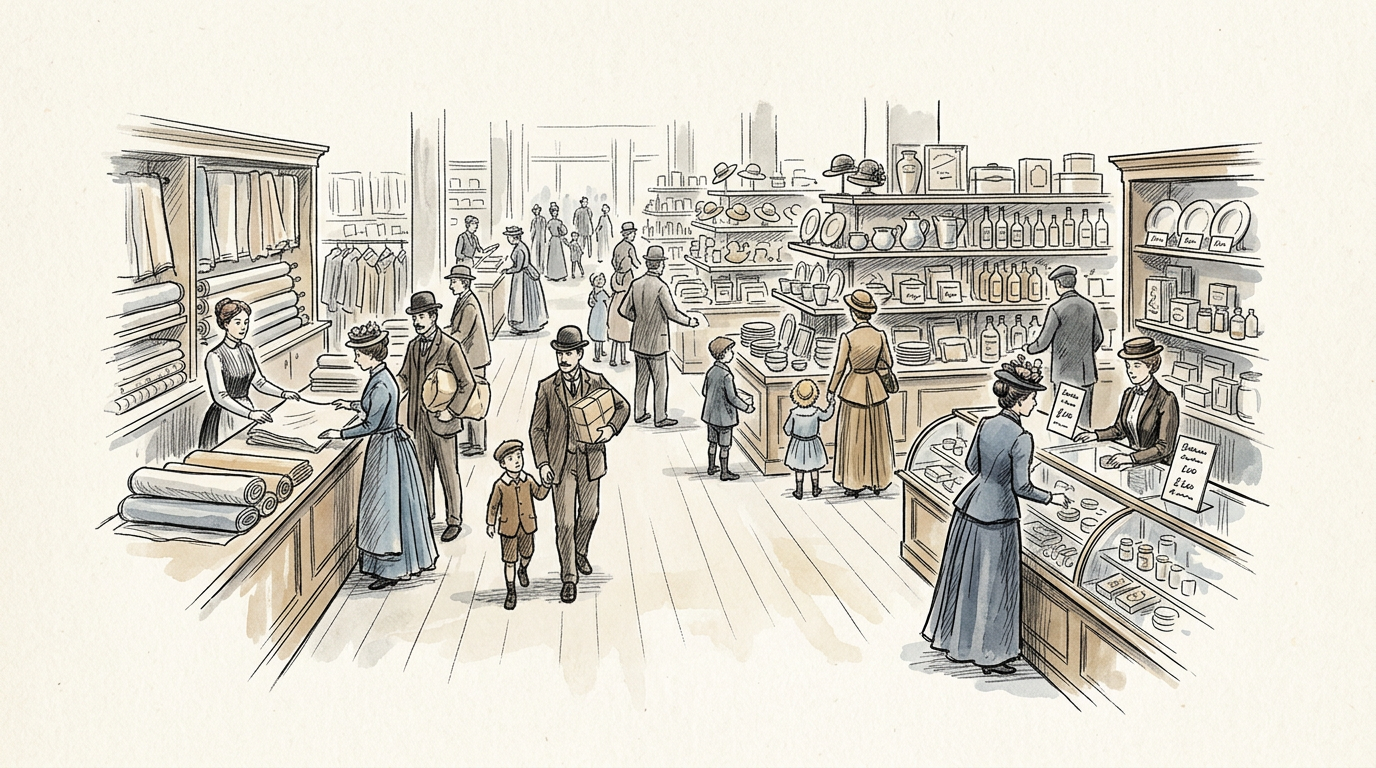
Long before “retail marketing” became a recognized specialty, the department store helped define what modern marketing could be. In the nineteenth and early twentieth centuries, department stores brought together merchandising, pricing policy, display, promotion, customer service, data-minded administration, and urban consumer observation in ways that changed both retailing and manufacturing. They did not invent every practice associated with modern marketing, and their development varied by country and city. But they created one of the first large-scale business environments in which assortment, presentation, price communication, consumer traffic, seasonal demand, and brand relationships had to be managed as an integrated system.
That mattered because earlier retail structures operated differently. General stores, specialty shops, market stalls, and small dry-goods merchants usually sold narrower assortments, served smaller trading areas, relied more heavily on personal bargaining or informal credit, and often organized commerce around the authority of the shopkeeper rather than the managed experience of the customer. Department stores emerged in expanding nineteenth-century cities under new conditions: industrial production increased the supply of standardized goods; railroads and steamship networks widened sourcing and distribution; improvements in plate glass, iron construction, elevators, and urban transit changed store design and customer access; and growing middle-class and clerical populations created larger urban markets for ready-made goods and household consumption.
Within that setting, the department store became a major institution in the history of marketing because it helped reorganize the relationship among producers, retailers, and consumers. It made merchandising more systematic, prices more visible, branding more consequential, promotion more regularized, and shopping more consciously shaped as an experience.
From specialized shops to organized mass retail
Historians differ on which business deserves to be called the first true department store, partly because the form developed gradually. In Paris, Le Bon Marché, transformed under Aristide Boucicaut beginning in the 1850s, is often treated as the model because it assembled multiple departments, fixed pricing, broad assortments, large-scale display, return policies, and intensive promotional methods in a single enterprise. Other French stores, including Printemps, founded in 1865, extended the format. In Britain, stores such as Whiteleys and later Selfridges adapted related principles to London retail. In the United States, large dry-goods houses evolved into department stores in the mid to late nineteenth century, with firms such as A.T. Stewart in New York, Wanamaker’s in Philadelphia, Marshall Field & Co. in Chicago, and later Macy’s helping institutionalize the format.
A.T. Stewart’s Marble Palace, opened in New York in 1848, is frequently cited as an important precursor in the United States because it concentrated women’s dry goods in an unprecedented retail setting and emphasized fixed prices and display. John Wanamaker opened his Philadelphia department store in the former Pennsylvania Railroad depot in 1876 and became widely known for managerial organization, promotional activity, and customer service policies. Marshall Field & Co., building on Chicago’s expanding wholesale and retail economy after the Civil War, refined service, display, and merchandising discipline in ways that influenced American retail practice. These firms were not identical, and none alone “invented” modern marketing. But together they showed how large urban retail organizations could integrate selling, assortment planning, presentation, and public communication at scale.
The word “department” was itself significant. It referred not only to product categories but also to administrative logic. Large stores divided merchandise into managed units, each with buyers, sales goals, stock responsibilities, and display obligations. That structure made retailing more analyzable. A store no longer simply sold goods; it measured performance by line, season, floor area, and turnover. In effect, the department store became one of the earliest mass-market laboratories for category management.
Merchandising as a managed system
One of the department store’s most important contributions to marketing history was the elevation of merchandising from a local trade habit to a strategic managerial function. Buyers traveled, negotiated with manufacturers and wholesalers, monitored fashion changes, and adjusted assortments to local demand. Departments had to be stocked in ways that balanced novelty, continuity, margin, and turnover. This was not marketing in the later textbook sense, but it was undeniably part of the historical development of market-oriented business practice.
Earlier retailers often bought opportunistically. Department stores still hunted for advantageous supply, but the scale of their operations required something more systematic. They needed planned assortments that could attract foot traffic across income tiers and shopping occasions. A dress goods department, a housewares section, a furniture floor, or a toy department did not merely fill space. Each contributed to a larger traffic pattern and to the store’s identity in the urban market.
That changed the retailer’s role. Instead of acting mainly as a local intermediary moving goods from producer to buyer, the department store curated demand. It decided which products deserved visibility, which styles represented current taste, which price points could anchor a sale, and which departments could support one another. This was an important step toward modern retail marketing, where assortment architecture and space allocation function as forms of market strategy.
Department stores also helped normalize seasonal merchandising. Holiday selling existed earlier, but stores expanded the scale and coordination of seasonal promotions, including back-to-school, Easter, and especially Christmas merchandising. Windows, interior displays, gift suggestions, children’s attractions, and price-led promotions turned the calendar into a commercial planning framework. Modern promotional retailing still rests on this seasonal logic.
Fixed prices, marked prices, and the marketing meaning of trust
Another major shift was pricing. In many earlier retail settings, haggling, uneven treatment, and price opacity were common. Department stores did not eliminate bargaining from all commerce, and fixed-price selling had antecedents in earlier retail reforms. But they did help popularize marked prices as part of a public retail promise. The posted price was efficient, but it was also a marketing device. It communicated order, fairness, modernity, and accessibility to a broader customer base, especially women shopping without male intermediaries in urban stores.
This pricing shift had several effects. It sped transactions, supported higher sales volume, made comparison shopping more practical, and reduced dependence on the salesperson’s discretion. It also gave stores stronger control over promotional communication. Once prices were standardized and visible, merchants could advertise reductions, specials, and clearances in more credible and legible ways. “Bargain” retailing did not begin with department stores, but department stores made bargain communication more systematic by tying it to printed price notices, themed sales events, and recognizable store policy.
Fixed pricing also linked closely to other trust-building practices: money-back guarantees, exchanges, delivery service, and quality claims. John Wanamaker became especially associated with return and refund policies, though such policies varied in application across firms and periods. The larger point is that department stores increasingly marketed reliability, not just merchandise. They sought repeat patronage by reducing the perceived risk of urban shopping among customers who were buying more goods in impersonal, high-volume environments.
This was historically important because modern marketing often depends on reducing uncertainty. Department stores did so through visible prices, service policies, and reputational assurances rather than through abstract branding theory alone.
Display and the creation of the selling environment
If fixed prices changed the logic of retail exchange, large-scale display changed the logic of customer attention. Department stores exploited architectural and visual technologies that smaller shops could not match easily. Large plate-glass windows allowed merchandise to be presented to pedestrians as a public spectacle. Gas lighting and, later, electric lighting extended visibility and dramatized interiors. Elevators, broad aisles, counters, cases, signage, mannequins, and decorated selling floors created a guided environment for browsing as well as buying.
The store window became one of the most influential merchandising media of the late nineteenth and early twentieth centuries. It linked urban circulation to demand formation. Passersby who had not entered with purchase intentions could be converted through curiosity, aspiration, or perceived opportunity. In that respect, window display functioned as an intermediate form between advertising and merchandising. It was not mass media in the usual sense, but it was promotional communication embedded in place.
Interior display mattered just as much. Goods were grouped, arranged, and staged to encourage comparison, impulse buying, and cross-category awareness. Modern concepts such as planograms and shopper marketing were still far in the future, but the department store established an early precedent: selling depended not only on what a retailer stocked but on how goods were spatially organized and visually interpreted.
This changed relations with producers as well. Manufacturers increasingly needed favorable placement and visible representation within powerful stores. As retail space became a scarce promotional asset, the retailer’s merchandising judgment gained influence over which products moved. That dynamic remains central today in slotting, endcaps, category captaincy, and retail media, even though the tools and metrics have changed.
The store as media channel
Department stores also altered promotion by becoming important media producers in their own right. They bought newspaper space at scale, developed recurring copy styles, issued circulars and catalogs, and used publicity, events, and themed spectacles to sustain traffic. In some cities, major stores became among the largest newspaper advertisers, though their significance was broader than spending levels alone. They helped normalize retail promotion as a regular, planned business function rather than an occasional announcement.
Wanamaker’s stores, for example, were known for extensive use of newspaper advertising and promotional innovation, but they were far from alone. Macy’s, Marshall Field, and other large stores relied heavily on print to announce assortments, sales, imported goods, household necessities, and seasonal events. Their notices often combined price information, product education, service reassurance, and urgency cues. In doing so, they connected merchandising decisions directly to communications strategy.
This helped shape a key principle in marketing history: promotion worked best when tied to inventory, price, and assortment management rather than treated as an isolated creative exercise. A sale had to be supplied. A featured item had to be available in quantity. A department promoted in print had to deliver a coherent in-store experience. Department stores therefore pushed promotion toward operational integration.
Their catalogs are also part of this story, even if mail-order firms such as Montgomery Ward and Sears, Roebuck developed the most famous catalog systems. Many department stores issued catalogs or mail-order materials for regional customers, extending store identity beyond the city center. This blurred distinctions between urban retailing and distance selling and foreshadowed later omnichannel logic: the same merchant could cultivate demand in print, fulfill through organized stock systems, and reinforce trust through brand reputation.
Women consumers, social space, and the management of experience
Department stores changed marketing not only by selling more goods but by redefining the conditions of shopping. Historians of retail and consumer culture have shown that these stores became major public spaces for women in nineteenth- and early twentieth-century cities. Restaurants, lounges, reading rooms, restrooms, parcel checks, and child-oriented attractions made the store a more hospitable environment for lengthy visits. Shopping became less purely transactional and more experiential, social, and routine.
That development should not be romanticized. Department stores operated within class and gender hierarchies, often disciplined employee behavior strictly, and did not offer equal access or equal dignity to all consumers. Many stores participated in broader patterns of exclusion, whether through selective service, discriminatory employment practices, or racial segregation and unequal treatment in some regions and periods. Still, as marketing history, the key point is that retailers increasingly recognized that environment, convenience, and emotional comfort affected demand.
The customer was no longer simply a buyer at a counter. The customer became a visitor moving through a managed atmosphere. That required new forms of observation. Store managers watched traffic, monitored departments, studied busy hours, evaluated display performance, and gathered informal intelligence from sales staff. Formal market research departments were still developing in the early twentieth century, but department stores practiced a practical precursor to shopper insight by treating consumer movement and response as information for decision-making.
This is one of the clearest lines from department stores to contemporary marketing. Today’s customer experience programs, store analytics, loyalty systems, and path-to-purchase studies use digital tools. The underlying managerial question is older: how do people behave in a retail environment, what encourages conversion, and what increases repeat patronage?
Private labels, national brands, and retailer power
Department stores developed during a period when the balance of power between retailers and manufacturers was still shifting. In the nineteenth century, many goods remained unbranded or weakly branded by later standards. Packaging improvements, trademark law, national transportation, and mass advertising gradually strengthened manufacturer brands, especially in packaged goods. But department stores did not simply surrender authority to national brands. They often maintained strong store identities, developed private-label or exclusive merchandise, and used their reputations as quality guarantees.
This relationship was consequential for marketing history. The rise of large retailers created a second center of brand power. Consumers might trust a manufacturer’s trademark, but they also trusted the store’s curation. “Store brands” and exclusive arrangements allowed department stores to differentiate assortments, protect margins, and reduce direct comparability. At the same time, highly advertised national brands could draw shoppers who wanted recognized quality and consistent products.
The resulting tension between manufacturer branding and retailer control remains familiar. Modern retailers negotiate over placement, promotion, data access, category definition, and private-label competition. Department stores were among the earliest institutions to demonstrate that branding power would be shared, and contested, between producers and retailers.
They also influenced packaging and product standardization. Goods intended for large-scale display and broad urban distribution had to be more legible, more comparable, and often more consistently made. Ready-to-wear apparel, branded household goods, and standardized dimensions all fit more easily into department-store merchandising systems than highly variable custom goods did. In that sense, retail format influenced product design.
Data, administration, and the routinization of demand management
Large department stores were information businesses long before digital marketing. Their operations required bookkeeping systems, stock records, sales summaries, purchasing reports, and departmental accountability. Cash registers, pioneered in the late nineteenth century and widely diffused in retail, improved transaction control. Pneumatic tubes, speaking tubes, telephone systems, and later more sophisticated office machinery supported internal coordination. These technologies mattered because scale made intuition alone insufficient.
Department stores needed to know what sold, where it sold, when it sold, and at what margin. They tracked markdowns, shrinkage, inventory levels, and departmental performance. Retail historians have shown that buyers and managers increasingly relied on periodic reports to guide reordering and clearance decisions. These were not modern dashboards, but they represented an important stage in the evolution of marketing measurement.
The business problem was straightforward. Once a retailer carried thousands of items across multiple departments, poor stock control and mistimed promotions could destroy profitability. To manage demand, stores had to align assortment, price, promotion, and replenishment. That administrative discipline later became central to merchandise planning, retail forecasting, and marketing analytics.
The department store also created new roles that resemble later marketing functions. Buyers acted partly as category strategists. Display managers shaped visual communication. promotion managers coordinated events and selling themes. Customer service policies had to be formalized. Credit offices handled installment and charge-account relationships in some settings. These responsibilities were not yet assembled under a single “marketing department,” but they formed an organizational base from which modern retail marketing could emerge.
Department stores and the professionalization of retail marketing
By the early twentieth century, retailing had become a serious subject of business education and trade discussion. Universities began teaching distribution, merchandising, and marketing topics as business schools developed. Early marketing scholarship often focused not first on branding or communications but on channels, distribution, wholesaling, retail institutions, and market functions. Department stores therefore sat near the center of the academic field’s early concerns.
Trade publications and business manuals circulated ideas about window display, salesmanship, stock control, store layout, and promotional planning. Organizations that studied retail methods contributed to the professionalization of merchandising. The National Retail Dry Goods Association, founded in 1911 and later known as the National Retail Federation, reflected the growing scale and organizational complexity of retail interests. Department stores were not the whole of marketing education, but they provided some of its most visible practical cases.
This helps explain why the history of marketing cannot be reduced to the history of advertising agencies or brand slogans. Some of the field’s most formative problems arose inside retail institutions: how to classify consumers, allocate space, set prices, move seasonal inventory, coordinate promotion with stock, train selling staff, and create repeat traffic. Those are marketing problems in a foundational sense.
The limits of the department-store model
Department stores were influential, but their dominance was never complete or permanent. Mail-order houses, chain stores, variety stores, supermarkets, discounters, specialty retailers, shopping centers, and later ecommerce each changed the retail landscape. Department stores often struggled when suburbanization shifted traffic away from traditional downtowns, when automobile-oriented shopping altered trip patterns, and when discount formats challenged their pricing structures in the mid-twentieth century.
It is also important not to overstate their uniformity. Parisian, British, and American department stores developed under different legal, urban, and class conditions. High-fashion metropolitan stores differed from regional stores. Some emphasized luxury and service; others pursued broader middle-market volume. Some cultivated exclusivity; others relied on promotional pricing. The “department store” was a retail family, not a single formula.
Even so, many later forms borrowed heavily from its practices. Chain stores adopted standardization and display discipline. Supermarkets expanded self-service merchandising and high-volume price communication. Shopping malls inherited the department store’s role as anchor and traffic generator. Big-box stores and ecommerce platforms extended data-driven assortment management. Today’s omnichannel retailers still wrestle with problems that department stores made visible at scale: balancing experience with efficiency, private label with national brands, curated presentation with broad selection, and promotional urgency with margin control.
Why department stores matter in marketing history
Department stores changed marketing because they made the market manageable in new ways. They turned assortment into strategy, price into public policy, display into a selling medium, promotion into a coordinated traffic tool, and customer accommodation into a deliberate part of demand creation. They also shifted power relations. Producers increasingly had to contend with retailers that controlled access to urban consumers. Consumers encountered goods in settings designed to shape comparison, aspiration, and convenience. Retail managers developed administrative methods that anticipated later marketing analysis.
Modern marketing often speaks in the language of brands, channels, customer experience, analytics, and integrated planning. Department stores did not originate all of those ideas in their current form. But they created one of the earliest large commercial systems in which those functions had to work together every day. That is their lasting significance. They did not merely sell products in large buildings. They helped establish marketing as a coordinated practice of understanding demand, organizing supply, shaping choice, and managing the consumer’s encounter with the market.
Leave a Reply