
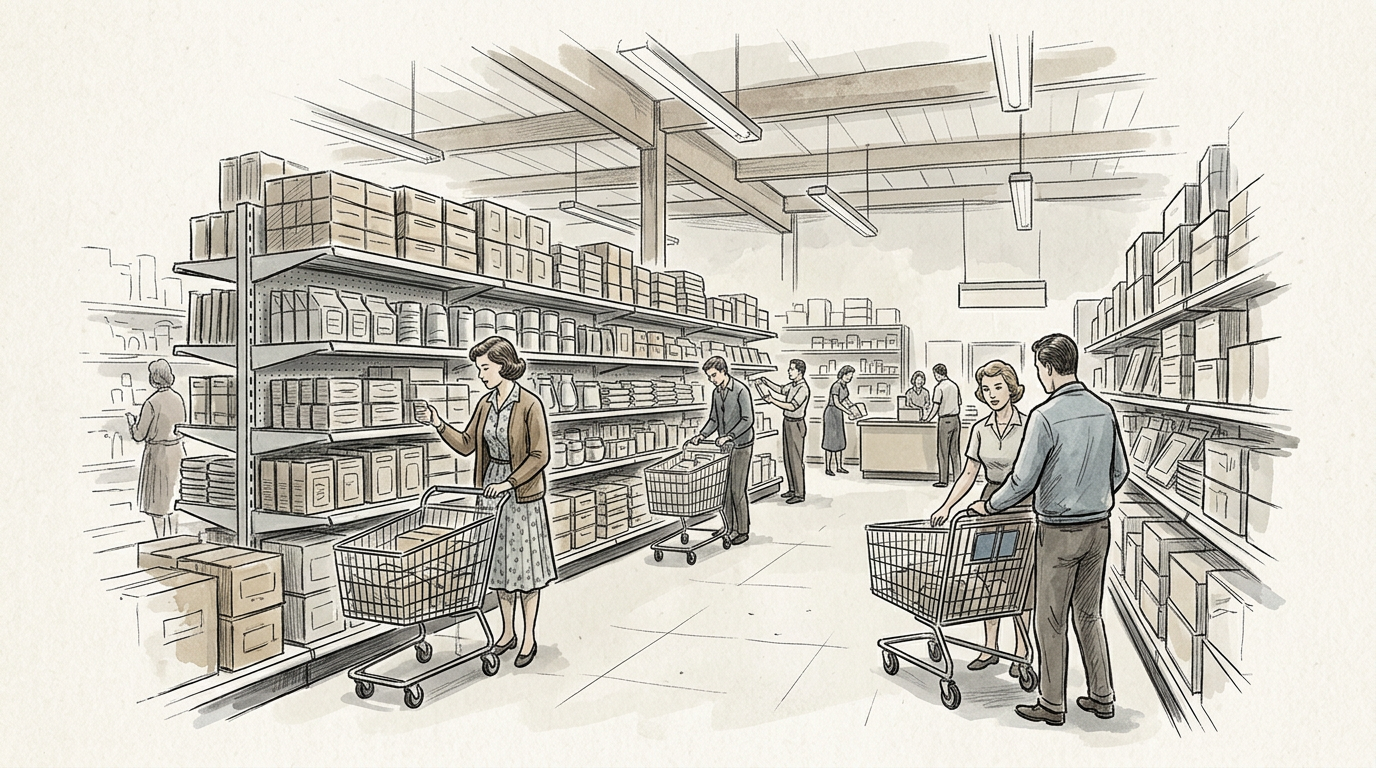
Discount retail did not simply lower prices. It changed the way merchants defined the market, selected store locations, built assortments, negotiated with suppliers, managed inventory, and communicated value to mass consumers. In doing so, it altered the practical meaning of the marketing mix in retailing. Price became an organizing principle rather than an occasional promotional tool. Place shifted toward large, accessible stores outside traditional downtown districts. Product assortment was rethought around turnover, self-service, and broad household demand. Promotion increasingly centered on price image, circulars, signage, and repeatable value claims rather than high-touch service or merchant prestige.
That transformation took shape most clearly in the United States after World War II, although it drew on older retail precedents. By the late 19th and early 20th centuries, merchants such as A.T. Stewart, Marshall Field, Sears, Roebuck, and Montgomery Ward had already shown that scale, merchandising discipline, and new distribution systems could remake consumer markets. Chain stores such as A&P and Woolworth also demonstrated that standardization, purchasing power, and efficient operations could support lower prices. But postwar discount retail created a distinct model. It combined self-service, large-format stores, suburban and highway-oriented locations, rapid stock movement, lean staffing, and an explicit promise to sell branded goods and everyday necessities for less than traditional department stores, variety stores, and many local independents.
By the 1960s, discounting had become one of the most important forces in American retail marketing. In that single year, 1962, several companies that would define the field opened their first discount stores, including Walmart in Rogers, Arkansas; Kmart in Garden City, Michigan; and Target in Roseville, Minnesota. Those openings did not mark the start of discount retail, but they symbolized a structural shift already underway. Retail competition was moving toward scale, data, logistics, and operating discipline. Marketing strategy in retail would increasingly be built through systems rather than atmosphere alone.
What discount retail challenged
Before discount chains rose to national importance, much of American general merchandise retailing was organized around different assumptions. Downtown department stores competed through service, fashion authority, credit, display, and civic prestige. Variety stores sold low-priced goods, but in smaller footprints and often with a narrower merchandising logic. Independent merchants relied heavily on location convenience, personal relationships, and local reputation. Even where prices were advertised aggressively, the store model itself often involved more labor, more sales assistance, and less centralized inventory control than later discount formats.
These older formats served real consumer needs, and they did not disappear overnight. But by the mid-20th century, several conditions made them vulnerable. Suburbanization redirected shopping traffic away from downtowns. Automobile ownership changed how far households could travel for routine purchases. Rising household formation and the growth of mass consumption increased demand for a broad mix of affordable home goods, apparel basics, toys, and seasonal merchandise. Improvements in packaging, trucking, warehousing, and store fixtures made self-service more practical outside grocery retail. At the same time, consumers who had become accustomed to national brands wanted lower prices without necessarily sacrificing reliability.
Discount retailers addressed that combination of demand and infrastructure. They did not win primarily by persuading consumers to desire shopping in a new way. They won by reorganizing the economics of how common goods reached mass households.
Early discounting and the legal context
The idea of selling for less than established retailers was not new in the postwar era. But the growth of dedicated discount stores depended partly on changes in price regulation. One important context was the decline of resale price maintenance, which had allowed manufacturers in some cases to influence minimum retail prices. The federal Miller-Tydings Act of 1937 and the McGuire Act of 1952 had supported fair-trade laws in many states. These laws were often defended by small retailers who feared price cutting by chains.
That system weakened dramatically after the Supreme Court’s 1951 decision in Schwegmann Bros. v. Calvert Distillers Corp., which limited aspects of enforcement, and it effectively collapsed after Congress passed the Consumer Goods Pricing Act of 1975, repealing the federal support for fair trade. Long before 1975, however, discounters had already expanded by exploiting areas where price competition was possible and by building business models around high turnover and lower margins.
Postwar discount pioneers included E.J. Korvette, founded in 1948 by Eugene Ferkauf and Joseph Taub. Korvette is frequently cited in retail history because it helped establish the modern discount department store format, especially in the Northeast. It sold nationally known brands at reduced prices, operated with leaner service, and benefited from membership-style positioning in its early years. Histories of the sector also point to Sol Price, who opened FedMart in San Diego in 1954. FedMart used membership retailing, large stores, and disciplined cost control to sell a wide assortment at low prices. Price later founded Price Club in 1976, which would become a major ancestor of warehouse club retailing. Harry Cunningham, who led S.S. Kresge’s move into Kmart, is another central figure because he translated discounting into a large corporate chain strategy.
What mattered in marketing terms was that these merchants were not merely running sales more often. They were reengineering the relationship among pricing, store operations, and customer expectations.
Price moved from tactic to identity
In traditional retailing, price had long been part of competition, but discount stores made low price the most visible and durable element of their value proposition. That required more than cutting tags. A retailer promising low prices every week had to design the entire business around cost control and velocity.
This is where the marketing mix changed most dramatically. Price could no longer be separated neatly from product, place, and promotion. Lower margins required higher volume. Higher volume required stores large enough to move substantial assortments efficiently. Large stores required sites with lower occupancy costs and good automobile access. Fast movement required merchandise planning based less on individualized service and more on predictable demand patterns, replenishment discipline, and standardized presentation. Promotion had to support a price image broad enough to influence basket building across categories, not just one advertised special at a time.
By the 1960s and 1970s, retailers increasingly understood that consumers formed judgments about a store’s overall price position, not just the price of isolated items. Weekly circulars, newspaper inserts, window banners, shelf cards, and later television spots and direct mail reinforced that storewide impression. In effect, discount chains were managing price perception as a brand asset.
This had lasting consequences for marketing practice. Retail marketers had to think about elasticity, traffic generation, comparison shopping, and margin structure in more integrated ways. Merchandising, operations, and purchasing became inseparable from brand positioning. The “offer” was the operating model.
Assortment as a mass-market strategy
Discount retail also changed the “product” element of the marketing mix, though in retail the product was really an assortment strategy. Department stores had traditionally organized goods through classification, service, and aspiration. Discounters organized them through breadth, accessibility, and turnover.
The discount store offered a wide range of routine household consumption in one trip: apparel basics, housewares, health and beauty aids, toys, hardware, seasonal goods, small appliances, and later consumables. This was not the same as carrying everything. Successful discounters simplified choice where possible, emphasized fast-moving lines, and used national brands to reassure price-sensitive shoppers that lower cost did not mean dubious quality. Private labels would later become more important, but branded general merchandise helped early discounters communicate legitimacy.
Assortment decisions were therefore deeply strategic. A retailer had to stock enough categories to become a destination, but not in ways that recreated the high costs of full-service department stores. The choice architecture of discount stores reflected a mass-market logic: practical goods, visible prices, easy substitution, and self-service browsing. Merchandising fixtures, aisle layouts, endcaps, and promotional bins all supported this model.
As chains grew, assortment planning became more centralized and analytical. Merchants used store records, supplier information, regional comparisons, and seasonal patterns to decide what should be carried broadly and what should vary by market. This was an early retail form of segmentation. The store format itself targeted a broad value-oriented consumer, but category mixes and local inventory increasingly reflected demographic and geographic differences. Later retail information systems made this more precise, but the marketing principle was already established: value retailing could be standardized and locally adapted at the same time.
Place shifted from downtown prestige to accessible scale
Location strategy may be the least glamorous part of marketing history, but in discount retail it was fundamental. Discounters prospered by going where postwar consumers lived and drove. The move to suburban sites, highway corridors, and eventually freestanding or shopping-center locations with ample parking was not just real estate opportunism. It was a redefinition of market access.
Traditional downtown retail had depended on pedestrian traffic, transit links, and concentration of commercial prestige. Discount retail depended on automobile convenience, larger parcels, lower land costs, and the ability to build big boxes that could hold high-volume assortments. Place, in other words, became a cost and demand equation. Cheaper land on the edge of growing communities made larger stores feasible. Larger stores supported broader assortments and higher turnover. Parking reduced friction for families buying multiple categories in one trip. Regional expansion strategies then tied store networks to distribution economies.
This shift corresponded to postwar suburbanization documented in census trends, highway construction, and shopping-center development. Victor Gruen’s regional shopping center concept influenced mid-century retail geography, though many discount stores also thrived outside enclosed mall environments. Over time, chains learned that convenience could mean not centrality but route efficiency. A store placed along ordinary household travel patterns could outperform a more prestigious urban address.
For marketers, location was no longer only about being “in town” or “on the main street.” It became part of segmentation, traffic planning, market coverage, and brand promise. Retail site selection increasingly relied on demographics, drive-time estimates, competitive mapping, and later geospatial analysis. Much of that discipline matured because discount chains had to align growth with volume economics.
Self-service and simplified service changed the customer relationship
Discount retailers did not eliminate service. They reallocated it. Instead of extensive one-to-one selling assistance, they emphasized store design, signage, product visibility, and operational reliability. Consumers did more of the work themselves: locating items, comparing prices, and transporting purchases through the store. In return, they received lower prices and wider selection.
This mattered historically because it changed how value was communicated. The retail “experience” in discounting was not built primarily through pampering or prestige. It was built through predictability. Customers could expect broad merchandise, visible prices, convenient parking, and functional store layouts. That predictability became a marketing asset.
The shift paralleled earlier self-service developments in grocery retail, where chains such as Piggly Wiggly had shown the labor-saving and merchandising potential of allowing customers to select goods directly from shelves. Discount general merchandise stores applied related logic to a broader set of categories. Packaging, branded labeling, barcode systems later on, and improved point-of-sale processes all made self-service more workable across the store.
For marketing management, this meant that operations themselves communicated brand meaning. Clean aisles, in-stock basics, shelf labeling, checkout speed, and returns handling were not merely operational details. They shaped consumer trust in the low-price promise. The history of discounting therefore complicates the common textbook habit of separating marketing from operations too sharply. In retail, and especially in discount retail, the separation was never very stable.
The rise of scale retailers in the 1960s
The burst of discount expansion in the early 1960s came from firms with different backgrounds. S.S. Kresge, a long-established variety store company, opened the first Kmart in 1962. Dayton’s, a department store company based in Minneapolis, opened the first Target the same year as a discount format with stronger design and merchandising ambitions than some rivals. Sam Walton, who had experience in Ben Franklin franchised variety stores, opened the first Walmart in Rogers, Arkansas, also in 1962, pursuing small-town and regional expansion that larger competitors initially undervalued.
Despite their differences, these chains shared several strategic principles. They used scale buying to support low prices. They treated store growth as a system rather than a series of local merchant outposts. They relied on broad assortments that encouraged one-stop shopping. They simplified service levels relative to department stores. And they sought to build a storewide value image that could travel across markets.
Trade publications and company histories from the period show how quickly retail management began to treat distribution, store planning, and merchandise control as strategic capabilities. A chain could not simply announce low prices and hope suppliers or customers would absorb the consequences. Margin discipline had to be matched by inventory turns, labor controls, and consistent traffic.
By the early 1970s, discount stores had become a central fact of American retail competition. According to historical data published by the U.S. Census Bureau and widely cited in retail research, discount department store sales rose rapidly during the 1960s and early 1970s, reshaping general merchandise retailing. Not every chain prospered. Korvette, despite its early influence, faltered amid management and financial problems. Others merged, retrenched, or disappeared. But the model endured because it solved a broad market problem more effectively than older retail formats in many communities.
Operations became marketing
If one theme defines the longer legacy of discount retail, it is the fusion of operations and marketing. Lower prices could not be sustained through promotional energy alone. They depended on procurement, distribution, inventory control, store labor productivity, and increasingly sophisticated information systems.
This became especially clear from the 1970s forward. Walmart’s later rise, for example, is often explained through culture or founder mythology, but the documented record points strongly to logistics, distribution center discipline, information sharing, and careful market-by-market expansion. Histories of the company and analyses by scholars such as Nelson Lichtenstein emphasize operational capabilities alongside merchandising and pricing. The same is true more broadly across discount retail. Kmart’s long strength owed much to scale and market presence before later operational weaknesses undermined competitiveness. Target refined discount positioning by combining value with merchandising differentiation and a stronger design reputation, but that positioning still rested on large-scale supply and store systems.
By the late 20th century, scanners, universal product codes, electronic data interchange, and retail data analysis transformed the field further. The first UPC scan at a retail checkout is commonly dated to 1974 at a Marsh supermarket in Troy, Ohio, a grocery milestone with consequences far beyond food retailing. Over time, such systems improved item-level tracking, replenishment, category analysis, and promotional measurement across retail sectors. Discounters were especially positioned to benefit because their business model depended on speed, scale, and margin precision.
This operational turn influenced the profession of marketing itself. Retail marketers needed fluency in assortment planning, pricing architecture, trade economics, shopper behavior, and supply constraints. The old division in which merchandising, distribution, and promotion could be treated as loosely related functions became harder to maintain. Category management, trade marketing, shopper marketing, and retail analytics all owe something to the environment discount retail helped create.
How manufacturers had to adjust
Discount retail did not only change retailers. It changed brand manufacturers and their marketing departments. As discount chains gained leverage, manufacturers had to rethink packaging, case sizes, trade allowances, channel strategy, and pricing policies. A brand could not rely solely on department store presentation or fragmented wholesaler relationships if a growing share of volume came through large, price-driven chains.
National brands benefited from discount retail because branded goods reassured consumers and helped stores signal comparable quality at lower prices. But they also came under pressure. Discounters resisted channel arrangements that limited price flexibility. Large retailers demanded better terms, cooperative promotions, and more dependable supply. Over time, they also strengthened private labels, which gave retailers greater control over margin and differentiation.
The implications for marketing management were substantial. Brand teams increasingly had to coordinate consumer marketing with trade marketing and retail account strategy. Packaging had to work on open shelves in high-traffic self-service environments. Promotions had to deliver measurable lift without permanently damaging price image. Manufacturers needed better insight into retailer economics, not just consumer attitudes.
This was one reason market research and retail data became more valuable. Understanding consumers in the abstract was no longer enough. Marketers had to understand store traffic, basket behavior, promotional responsiveness, and regional variation in discount-oriented shopping.
From discounting to everyday low price and category competition
Over time, discount retail generated multiple strategic variations. Some chains leaned heavily on advertised specials and promotional events. Others, most famously Walmart in later decades, became associated with everyday low price positioning. The distinction mattered because it reflected different theories of customer trust and demand management.
Promotional discounting can drive traffic through temporary deals, but it may also train shoppers to wait for sales. Everyday low price seeks to reduce that volatility by persuading customers that they do not need to time purchases carefully. Scholars of retailing and pricing have treated this as a meaningful difference in market strategy, even though actual practice is often more mixed than the labels suggest.
Discount logic also moved into specialized retail formats. Warehouse clubs, off-price apparel chains, home improvement superstores, and category killers all adopted versions of the model. Each adjusted the marketing mix differently. Warehouse clubs used membership, limited assortment, bulk packaging, and treasure-hunt merchandising. Off-price retailers used opportunistic buying and branded fashion at reduced prices. Home improvement chains used large-format assortments and self-service with selective expertise. But all reflected the larger historical lesson of discount retail: price leadership worked best when embedded in a coherent system of assortment, place, and operations.
Consumer culture and the politics of low prices
The success of discount retail reflected consumer agency as much as managerial innovation. Shoppers were not simply seduced by lower posted prices. They actively reorganized household purchasing around car trips, weekly routines, suburban growth, and budget constraints. Discount stores became useful because they fit changing patterns of work, family life, and consumption.
At the same time, the social effects of discount retail were uneven. The expansion of large chains intensified pressure on downtown merchants, smaller independents, and some regional department stores. Labor models often emphasized cost control over service intensity. Later waves of scale retail also raised controversies around supplier power, wages, local business displacement, and community development. These are part of the historical record and should not be ignored when assessing the sector’s influence.
Still, from a marketing history standpoint, the key point is not that consumers always preferred cheapness above all else. It is that millions of consumers accepted trade-offs among service, ambiance, selection, and price in ways that restructured retail competition. Discount chains learned to interpret those trade-offs systematically and profitably.
Why discount retail changed the marketing mix
The classic four-part marketing mix, popularized in the 1960s after E. Jerome McCarthy’s Basic Marketing: A Managerial Approach, is often taught as a general framework for planning product, price, place, and promotion. Discount retail provides a useful historical test of that framework because it shows how tightly those elements can be linked in practice.
Price in discount retail was not a detachable decision. It depended on product assortment choices, store format, supply economics, labor levels, and real estate strategy. Place was not merely a matter of choosing a location. It involved suburban growth patterns, car access, parking, building size, and network expansion. Product was not just what a manufacturer made. In retail it meant the curation of categories, brands, package forms, and inventory depth. Promotion was not simply messaging. It was the maintenance of a credible low-price image through recurring proof points.
In that sense, discount retail helped push marketing away from a narrow communications orientation and toward a more integrated managerial one. Retail success required coordination across merchandising, pricing, research, logistics, finance, and store operations. Modern concepts such as value proposition, customer experience, category management, omnichannel convenience, and data-driven pricing all reflect that integration, even when used in settings far removed from the original discount department store.
What remains visible today
Contemporary retail marketers still work in the world discount retail helped create. Consumers compare prices across channels almost instantly. Large-format store economics continue to influence national chains even as ecommerce changes traffic patterns. Private labels, loyalty systems, retail media, and dynamic pricing all operate within a competitive environment where value perception is constantly measured and contested.
The enduring lesson is not that low price always wins. Many retailers have prospered by offering premium service, design authority, specialization, or experiential value. The historical lesson is more specific. Discount retailers proved that pricing strategy could not be treated as a superficial promotional choice. When lower margins were paired with high volume, simplified service, broad assortments, and location strategies built around modern mobility, they created a different kind of marketing system.
That system changed retailing because it changed what marketers had to manage. The store itself became a disciplined bundle of economic promises: accessible location, credible assortment, operational efficiency, and visible value. Discount retail therefore deserves attention not only as a chapter in merchant competition, but as a major turning point in the history of marketing practice.
Leave a Reply