
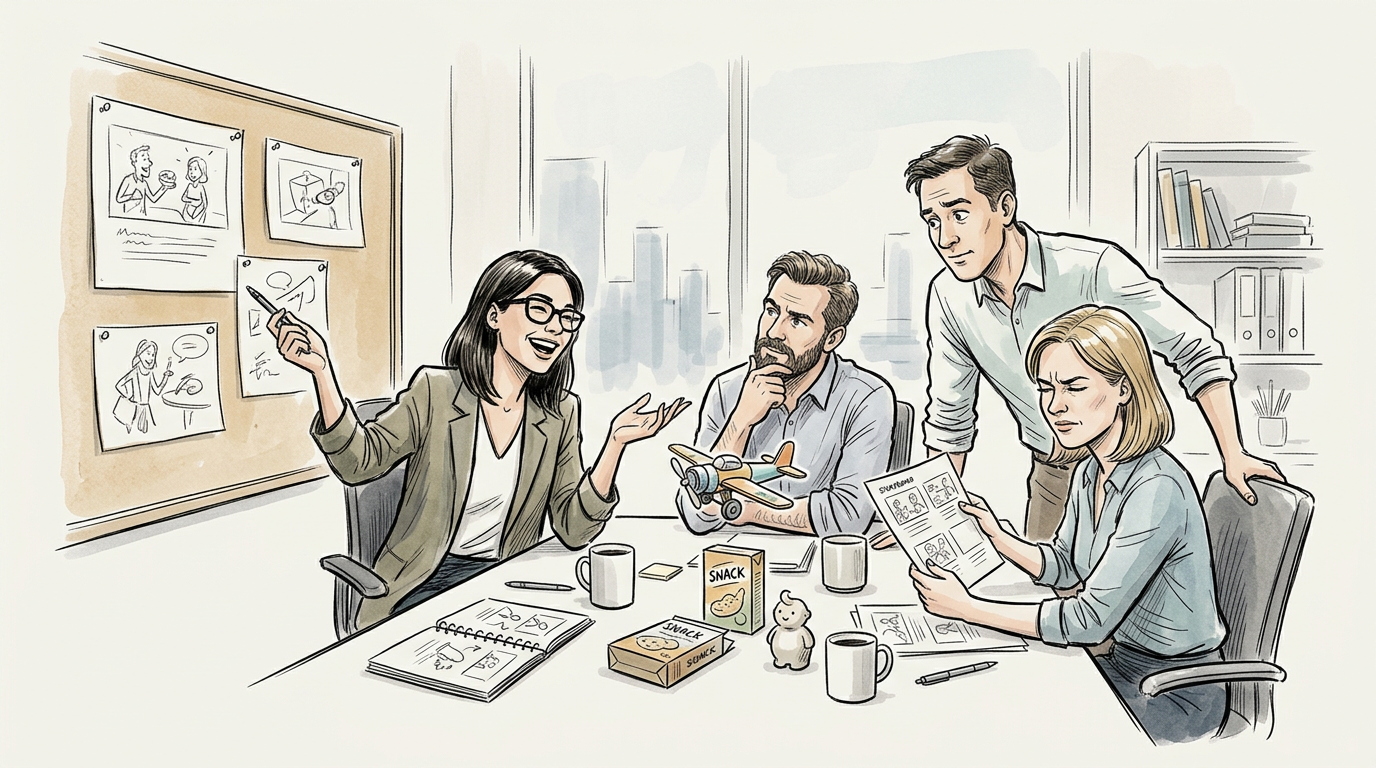
Humor remains one of the most tempting tools in advertising because it can do several valuable things at once. It can earn attention in cluttered environments, lower resistance to persuasion, make a message feel more human, and improve the odds that people will remember an execution long enough to talk about it or act on it. But humor also creates one of the most persistent creative traps in the business. Teams often confuse a strong joke with a strong ad.
That confusion matters because advertising is not evaluated on whether it gets a laugh in a conference room, on set, or in a focus group clip reel. It is evaluated on whether it helps the audience understand, remember, and respond in ways that support the brand’s objective. A joke can sharpen a proposition, but it can also distract from it. It can make a brand seem more likable, but it can also flatten a serious claim, age badly across contexts, or create memory for the entertainment and not the advertiser.
For creative teams, the practical question is not whether humor “works” in the abstract. It is whether a specific kind of humor helps a specific brand communicate a specific message to a specific audience in a specific medium. The difference between effective humorous advertising and expensive comedic detours usually comes down to relevance, audience fit, brand linkage, tone, timing, and execution discipline.
Humor is a strategic choice, not a personality trait
When humor appears in a brief or in early concepting, it is often discussed as if it were a style preference. A client wants the brand to feel lighter. A creative team wants to avoid category sameness. A social team wants content that people might share. Those can all be legitimate reasons to explore humor, but they are not yet strategic reasons.
The strategic question is what humor is supposed to do for the communication. In some cases, it helps reframe a familiar category problem. In others, it makes a dense or unappealing subject more approachable. It can also exaggerate a pain point, dramatize a product truth, expose category absurdity, or create an emotional release that improves receptivity to the selling message.
That distinction separates humor as decoration from humor as an idea. If the joke can be removed and the ad still says the same thing just as clearly, then the humor may be ornamental. If the humor is the mechanism that makes the proposition understandable, memorable, or persuasive, then it is doing strategic work.
Consider the long-running appeal of Geico’s “Hump Day” spot, created by The Martin Agency. The joke is simple and broadly accessible, but the execution is not strategically empty. The ad uses a repetitive office ritual and an absurd interruption to create a memorable association with the middle of the week, then ties that memory to the Geico brand. Whether one sees that ad as creatively elegant or overexposed, it demonstrates an important principle: the humor is built to create recall and cultural repetition, not merely to amuse the room. Adweek’s oral history of the campaign and Geico campaign archives help document how tightly the company and agency linked entertainment value to memorability and brand presence rather than to comedy for its own sake (adweek.com/brand-marketing/oral-history-geicos-hump-day-ad-165183).
Humor is therefore best treated as a strategic device with a job to do. Once that job is clear, the creative team can determine what form of humor actually supports it.
Relevance determines whether a joke strengthens the idea
A humorous execution is most durable when the joke emerges from the product truth, brand behavior, or audience situation rather than being imposed on top of it. Relevance does not mean the ad must literally joke about the product itself. It means the comedic mechanism should be connected to the communication task.
This is where many humorous concepts fail. A team lands on an amusing scenario, a funny voice, or a sharp line, but the material could just as easily sell another brand or no brand at all. The joke then becomes portable entertainment. That may still produce views or short-term engagement, but it weakens persuasion because the memory structure belongs to the comic device rather than to the advertiser.
Relevant humor usually works in one of a few ways. It can dramatize the benefit by exaggerating the before-state problem. It can express the brand’s point of view on a category convention. It can reveal an audience truth that the brand is uniquely positioned to solve. Or it can turn the product itself into the source of the comedic payoff.
Old Spice’s “The Man Your Man Could Smell Like,” from Wieden+Kennedy, is a useful case because its absurdity still serves a simple strategic proposition. The rapid scene shifts, heightened language, and impossible transitions are funny, but the humor is not random surrealism. It expresses the fantasy logic of fragrance advertising while simultaneously parodying category conventions and making the brand newly visible to both male buyers and female shoppers. The campaign’s documented impact on attention and sales has been widely discussed, including by Cannes and major trade coverage, but the creative lesson is narrower and more useful: the joke system translated a stale category presentation into a brand-linked selling framework rather than replacing the selling framework with spectacle (wk.com/work/old-spice-the-man-your-man-could-smell-like).
Relevance also affects copywriting. A funny headline or script line should not merely signal cleverness. It should clarify the proposition, sharpen the contrast, or create a memorable path into the proof. In direct response, email, or landing page environments, humor that delays comprehension can reduce performance. In video or social, a stronger comedic setup may be worth the extra seconds if it improves retention and brand recall. The point is not that one medium is “better” for humor. It is that the relevance burden changes with the communication task.
Audience fit matters more than internal taste
Humor is one of the easiest places for creative teams to mistake their own sensibilities for audience insight. A line that reads as dry and sophisticated to one group may read as flat or elitist to another. A broad gag that tests well in a general market may feel tonally off to a niche audience. A meme-driven joke may create quick affinity in a narrow cultural pocket while alienating older buyers or becoming incomprehensible within weeks.
Audience fit requires more than demographic matching. It involves cultural fluency, situational appropriateness, and an understanding of what the audience is willing to give attention to in the context where the ad appears. The same joke can function differently in a six-second pre-roll, a retail display, a B2B conference opener, a podcast host read, or a social reply from a brand account.
This is particularly important when brands adopt humor styles that originate in internet culture. Deadpan understatement, anti-brand irony, self-aware low-budget aesthetics, and intentionally awkward dialogue can all be effective, but only when the audience recognizes the code and the brand has permission to use it. Otherwise the result can feel like mimicry without understanding.
Audience fit is also why humor can be especially risky in categories involving health, finance, safety, or grief-adjacent issues. That does not mean such categories must be solemn. It means the room for tonal error is smaller, the brand’s credibility burden is higher, and the audience’s threshold for perceived trivialization is lower.
Creative review should therefore ask not “Is this funny?” but “Funny to whom, in what context, and in service of what response?” That question tends to produce better decisions than any debate about whether a joke is objectively good.
Memorability is useful only if the brand comes with it
One reason humor remains attractive is that it often improves attention and recall. The broader research literature has long suggested that humor can increase liking and memory under the right conditions, though results vary with product category, execution quality, audience, and how brand information is integrated. The more practical industry lesson is not that humor guarantees memorability, but that memorability alone is not enough.
People frequently remember a funny ad while forgetting who it was for. This is the classic brand-linkage problem. The execution wins attention, but the advertiser rents the laugh rather than owning it. In effect, the humor becomes a separate asset detached from the brand.
Brand linkage is partly a writing problem and partly a design and production problem. In scripts, the product or brand needs to be structurally present, not tacked on as a closing mention after a self-contained sketch. In visual work, product cues, packaging, distinctive brand assets, and clear brand presence need to appear in ways that feel integrated rather than interruptive. In audio, the same applies to sonic branding, voice, and naming cadence. A joke that depends on concealment may work against brand retention if the reveal arrives too late or too weakly.
This is one reason some highly shareable humorous ads underperform as advertising despite strong entertainment metrics. View counts, reposts, and applause for a comedic premise may conceal poor comprehension of the selling point. Kantar’s work on creative effectiveness has repeatedly emphasized the importance of branding in context, not just as frequency of logo appearance but as meaningful integration that helps people encode who is speaking and why it matters (kantar.com/inspiration/advertising-media).
For art directors and designers, this means visual restraint is not automatically a virtue if it obscures the source. A humorous print ad with a beautifully spare composition may win admiration while under-signaling the advertiser. Conversely, a cluttered brand insertion can kill the joke. The craft challenge is to make the brand feel native to the comedic device. When that happens, the audience remembers the laugh and the source together.
Tone is where humor often succeeds or fails
Humor does not exist outside tone. Sarcasm, slapstick, absurdism, parody, deadpan, wit, satire, self-deprecation, and observational comedy all create different relationships with the audience and the brand. Choosing among them is not simply a matter of comic taste. It is a positioning decision.
A premium brand may use understatement to project confidence. A challenger brand may use mockery to puncture category norms. A service brand may use self-aware humor to make a frustrating process feel less intimidating. A mass retailer may use broad comedy because speed of comprehension matters more than nuance. The tonal choice should follow the brand role and the audience expectation.
Problems emerge when tone and brand promise diverge. A brand asking to be trusted with serious life decisions can use humor, but it must do so without signaling carelessness. A wellness brand built on empathy can use irony, but not if the irony feels dismissive of the audience’s concern. A heritage luxury brand can experiment with silliness, but if the execution undermines the codes that create value in the first place, the joke may cost more than it earns.
Tone is also where cross-functional collaboration becomes essential. Strategists may identify the audience tension that humor can unlock. Copywriters may define the voice. Art directors may determine whether the humor lives in composition, juxtaposition, timing, or visual exaggeration. Directors, editors, and performers may shift the entire reading through pacing and delivery. Clients and legal teams may correctly identify sensitivities that the creative team underestimated. Humor rarely survives siloed development well because tone is distributed across every executional decision.
Timing shapes both comedy and risk
Timing in humorous advertising operates at three levels: cultural timing, media timing, and comic timing.
Cultural timing refers to when the joke enters the world. A line that feels sharp in one moment may feel careless in another because the surrounding news cycle, public mood, or category conversation has changed. Brands that work quickly in social environments know this problem well. Humor can make a brand feel responsive, but it can also produce reputational damage when teams confuse speed with judgment.
Media timing concerns where the audience encounters the joke and how much time the format allows. A humorous outdoor execution needs near-instant comprehension. A sixty-second film can sustain setup and reversal. A podcast ad can use personality and conversational rhythm in ways display advertising cannot. The amount of cognitive work the audience will tolerate varies widely by medium, and so does the amount of delay before the selling point appears.
Comic timing is the executional rhythm inside the work. Editors, animators, directors, and performers often determine whether a script is amusing, flat, or confusing. A pause that is too long can call attention to the effort. A cut that is too fast can bury the punchline. A supers line on screen can either complete the joke or step on it. A product demo can either be the payoff or kill momentum depending on sequencing. In humorous work, production craft is not cosmetic. It is part of the writing.
This is why rough animatics, table reads, offline edits, and prototype testing can be especially useful for comedy-driven campaigns. Humor is notoriously difficult to evaluate from boards alone because rhythm is often the difference between concept and result.
Distraction is the central danger
The core risk of humor is distraction. People may enjoy the performance, quote the line, share the clip, or remember the setup while missing the message or misreading the brand. This can happen in obvious ways, such as celebrity comedy that overwhelms the product, but it also happens in subtler ways. The joke may shift attention to a side character. The visual gag may ask the viewer to solve a puzzle unrelated to the proposition. The script may spend too much time on setup and too little on payoff. Or the joke may reward knowingness while leaving less-engaged viewers behind.
Distraction is not always visible in internal review because teams already know the brief. They automatically connect the joke back to the intended message. Audiences do not have that advantage. They see only what the work actually makes clear.
One practical review question helps here: if a viewer recounts this ad to someone else, what are they most likely to repeat? If the answer is the comic situation but not the brand or benefit, the work may be entertaining but strategically weak.
Another useful test is to strip the execution down to its proposition. Can the team state, in one plain sentence, what the audience is meant to take away? If not, the humor may be masking a strategic blur. Comedy cannot rescue a confused brief. It can only make confusion more enjoyable in the moment.
Copywriting for humor requires clarity as well as wit
Funny copy is often judged by punchline quality when it should be judged by structural control. Setups must be legible. Escalation must feel motivated. The payoff must land quickly enough to reward attention but clearly enough to support the message. And every line that does not contribute to that movement should earn its place.
In short formats, humor often depends on compression. A headline, subject line, or bumper script may need to establish context and deliver a twist within seconds. In longer formats, the challenge is different. The writing must sustain tone without exhausting the audience or delaying the product point so long that brand linkage erodes.
Humorous copy also requires discipline around voice. Many brands default to generic snark because it is easier to write than distinctive wit. But broad sarcasm is not a substitute for brand voice. It often creates sameness, especially in social channels where multiple categories now use the same internet-inflected posture. A more effective approach is to define what the brand finds funny, what it would never joke about, and how humor relates to its underlying character.
That guidance is especially important for versioning. Campaigns rarely live in a single hero execution. They extend across social posts, cutdowns, CRM, landing pages, retail assets, and customer-service adjacencies. A joke that works in a launch film may not survive in a checkout page or a product email. Copy systems need to preserve the strategic role of humor without forcing a comedic tone into every placement.
Art direction and design can carry the joke or collapse it
Humor in visual work is often discussed as though it resides only in the concept, but art direction determines how quickly and accurately the audience receives that concept. Scale, cropping, juxtaposition, facial expression, color, typography, and layout can all change whether a visual joke reads instantly, reads eventually, or does not read at all.
For print and outdoor, visual hierarchy matters as much as comic ingenuity. If the eye goes first to the wrong element, the joke can misfire. If a headline and image compete rather than collaborate, the viewer may miss the turn that creates meaning. If branding enters too timidly, the execution may become a poster for its own gag.
In motion, production design and performance style shape comedic tone. A polished cinematic treatment can make absurdity feel deliberate and premium. A looser handheld approach can make the same material feel spontaneous or chaotic. Wardrobe, props, casting, and set detail can intensify observational humor by grounding it in recognizable truth. They can also overdecorate a simple idea until it becomes fussy.
Design teams also need to think about durability. Some visual jokes are highly legible but disposable because they rely on a transient reference. Others are more resilient because they express a broader human truth or category tension. The objective should determine which is appropriate. A fast-turn social activation can exploit short-lived visual language. A brand platform probably should not depend on it.
Feedback on humorous work should diagnose, not just react
Humor invites some of the least useful feedback in the creative process. “I don’t get it.” “It’s not funny.” “Can we make it funnier?” “My spouse would hate this.” None of these comments identifies the actual problem.
Better feedback distinguishes between reaction and diagnosis. If a joke is unclear, reviewers should specify what information the audience is missing and at what point confusion begins. If the tone feels off, they should connect that concern to the brand role, audience expectation, or category context. If brand linkage is weak, they should point to where the ad’s structure fails to connect the laugh to the advertiser.
This approach is especially important in client review. Humor can polarize decision-makers because taste differences are real and often strongly felt. Creative leaders need to anchor the discussion in the brief and the communication objective, not in a contest over who has the best comic instincts. That may require showing multiple tonal territories, clarifying why a certain humor style was chosen, or explaining which parts of an execution are load-bearing for the idea and which are flexible.
It also means acknowledging when a joke is not doing enough work. Teams sometimes defend weak comedic concepts with excessive explanation because they personally enjoy the material. The most effective creative presentations frame the role of humor clearly, show how the execution delivers on the objective, and remain honest about the risks. Overperforming the room rarely fixes underperforming work.
Creative leadership sets the standard for when humor earns its place
In some creative cultures, making the funniest work in the room carries disproportionate status. That can energize teams, but it can also produce avoidable waste if leaders reward comedic flair without strategic accountability. The result is often work that is entertaining in isolation but difficult to extend, hard to approve, or weak in market.
Stronger creative leadership treats humor as one option among many for solving the communication problem. Sometimes the right answer is a joke. Sometimes it is a demonstration, a testimonial, a simple comparison, or a direct statement with no comic layer at all. Leaders who insist on this distinction help teams avoid forcing levity into situations where clarity or trust should dominate.
They also create better conditions for development. Humor benefits from iteration, performance testing, editorial rigor, and open disagreement. Writers need space to generate volume. Art directors need freedom to explore how visual framing changes the read. Producers need to flag when practical constraints will affect timing or performance. Strategists need permission to say when a joke obscures the proposition. None of that works well in environments where comedy is treated as untouchable once it entertains senior people.
Creative leaders should also be alert to inclusivity risks. Humor can reinforce stereotypes, flatten cultural difference into shorthand, or rely on insider assumptions that narrow the audience unnecessarily. Diverse perspectives in development and review do not guarantee safety, but they improve the odds that teams will catch avoidable blind spots before the market does.
How to evaluate whether humorous creative actually worked
The right evaluation framework depends on the objective. For some campaigns, humor is mainly being used to improve attention and memorability. For others, it is expected to improve consideration, response, or sales. Those are not the same tasks, and they should not be measured as if they were.
Useful questions include:
- Did the audience understand the message?
- Did they correctly identify the brand?
- Did the humor improve recall of the proposition or only recall of the execution?
- Did the tone support the intended brand impression?
- Did the work create any backlash, confusion, or misinterpretation?
- Did the humorous treatment outperform a more direct alternative on the metrics that matter for this objective?
What should not be treated as automatic proof of effectiveness is equally important. Industry awards may recognize craft or originality, but they do not by themselves prove communication success. Social engagement may indicate entertainment value, but not persuasion. Internal enthusiasm may reflect novelty, not audience fit.
The IPA, Kantar, System1, and other effectiveness-oriented organizations have all contributed useful perspectives on how emotion, distinctiveness, and branding influence performance, but the practical takeaway for creative teams is straightforward. A humorous ad succeeds when the laughter supports the business task. If the audience enjoys the work but the brand, message, or desired action remains weak, then the humor has not justified itself.
When humor is the wrong tool
It is worth stating clearly that some communication problems are better solved without humor. If the audience needs reassurance more than release, directness may be stronger. If a new product requires explanation, demonstration may be more valuable than a comic setup. If a category issue is urgent or emotionally fraught, humor may reduce perceived seriousness in ways that damage trust.
Even then, the choice is not necessarily between comedy and solemnity. Work can be warm, light, or personable without being joke-led. Some brands mistake the absence of humor for stiffness, when what they actually need is clarity with humanity. Creative maturity includes knowing when restraint communicates more effectively than entertainment.
Humor works best when it is in service of something clearer
The most effective humorous advertising does not ask the audience to admire the brand for trying to be funny. It uses humor to make a point easier to notice, easier to grasp, and easier to remember. That is a more demanding standard than “make them laugh,” but it is the standard that creative work ultimately has to meet.
For practitioners, the lesson is not to avoid humor. It is to discipline it. Start with the communication objective. Define what the audience should take away. Choose a humor style the brand can credibly own. Make sure the joke is relevant to the proposition, legible in the medium, and integrated with distinctive brand cues. Review the work for distraction, not just entertainment value. And evaluate it based on message, memory, brand linkage, and response, not on room temperature applause.
Being funny can help creative work travel further and land harder. It can also pull the work off strategy with surprising speed. In advertising, the joke is not the job. The job is the job, and humor earns its place only when it helps do it.
Leave a Reply