
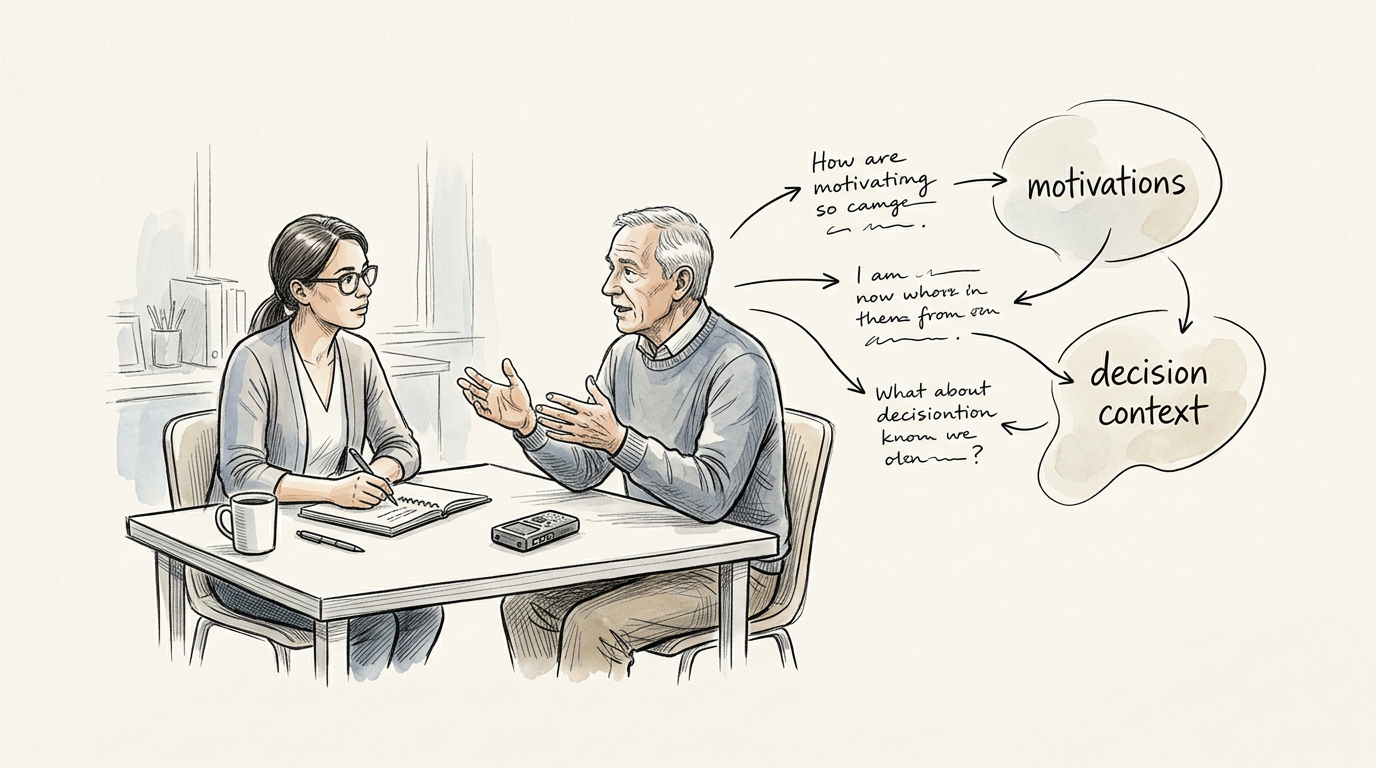
Brand strategy often relies on abstractions: target segments, attribute ratings, awareness measures, preference scores, and funnel stages. Those tools matter, but they do not always explain why people describe a category the way they do, what tradeoffs they are actually managing, or how a brand becomes meaningful in a lived context. In-depth interviews, sometimes called IDIs, remain one of the most useful methods for answering those questions. Conducted well, they do not simply collect opinions. They reveal how consumers make sense of choices, what language they use without prompting, which tensions shape decisions, and how memory, identity, trust, and experience influence brand perception over time.
For brand leaders, that distinction is important. A brand is not only a set of messages issued by an organization. It is also a pattern of recognition, associations, expectations, and judgments formed in the minds of customers, noncustomers, employees, partners, and other audiences. In-depth interviews are particularly valuable when professionals need to understand that interpretive side of branding: how people categorize brands, what they notice, what they ignore, what they remember inaccurately, and what they believe a brand signals about quality, status, values, or fit.
This is where interviews differ from both surveys and creative testing. A survey can measure how many people agree with a statement. An in-depth interview can help explain what respondents think that statement means, why they answer the way they do, and whether the brand team is even asking the right question in the first place.
Why one-on-one interviews matter in branding
Brand decisions often fail when organizations assume that customer behavior is self-explanatory. A drop in consideration may be read as a pricing issue when it is really a trust issue. Weak recall may be blamed on media weight when the deeper problem is that the brand’s verbal and visual cues are insufficiently distinctive in memory. A proposed rebrand may be framed internally as modernization while audiences experience it as loss of familiarity, credibility, or category clarity.
One-on-one interviews help uncover these gaps because they create room for detail. Unlike focus groups, they reduce the pressure to conform publicly, perform expertise, or align with a dominant participant. That matters when the subject is personal, socially sensitive, identity-laden, or cognitively complex. People may be more candid in an individual conversation about financial anxieties, health concerns, luxury purchases, switching regret, sustainability skepticism, or the social meaning attached to a brand choice.
For branding work, interviews are especially useful when teams need to understand:
- How people describe a category in their own words rather than in marketer language.
- What cues trigger brand recognition and which cues go unnoticed.
- What associations consumers attach to names, symbols, sounds, packaging, retail environments, or service experiences.
- How people interpret claims such as premium, innovative, trustworthy, authentic, or sustainable.
- Why customers remain loyal, drift away, or use multiple brands for different occasions.
- How a parent brand affects sub-brands, endorsements, and extensions.
- What emotional, functional, and social tensions shape choice.
That last point is often where the strongest insight emerges. Consumers do not merely compare feature lists. They balance competing motivations: wanting convenience without sacrificing quality, seeking status without appearing pretentious, valuing low prices while fearing false economy, or wanting novelty without losing the reassurance of a familiar brand. Interviews can reveal these tensions with nuance that is difficult to obtain through closed-ended instruments alone.
What interviews can reveal that quantitative data often cannot
In branding, the value of qualitative work is not that it produces colorful quotations for presentations. Its value is diagnostic. It shows how meaning is formed.
A respondent might say they buy a particular grocery brand because it is “cleaner.” In a survey, that may look like a favorable quality perception. In an interview, “cleaner” may turn out to mean ingredient transparency, simpler packaging design, a less cluttered shelf presence, a family-owned story, or simply a product experience associated with fewer unpleasant surprises. Those are very different strategic implications.
The same applies to positioning language. A company may want to occupy a space around reliability, expertise, simplicity, progress, or care. Interviews can show whether customers interpret those concepts in the intended way. “Reliable” can suggest durable and dependable, but it can also imply unexciting. “Premium” can mean superior and worth paying for, but it can also signal exclusion, waste, or image inflation. “Authentic” may resonate with one audience and sound manufactured to another.
This makes in-depth interviews particularly relevant in several branding contexts:
Positioning development. Interviews can surface unmet needs, category frustrations, ignored occasions, or emotional stakes that create openings for more meaningful differentiation.
Naming. They can reveal pronunciation barriers, unintended associations, cultural interpretations, memorability issues, and whether a name feels credible for the category and flexible enough for future growth.
Brand architecture. Interviews help show whether customers understand the relationship between the corporate brand, product brands, sub-brands, and endorsed offers, or whether the architecture creates confusion, duplication, or misplaced expectations.
Rebranding. Before changing identity systems, portfolios, or messaging, interviews can uncover what existing audiences actually value, what assets they use to recognize the brand, and which changes risk eroding trust.
Distinctive assets. Interviews can reveal whether people recognize a color, shape, mascot, sonic cue, tagline, package structure, or naming convention as belonging to the brand, or whether those elements matter more internally than externally.
The central role of probing
The quality of an in-depth interview depends less on the existence of a discussion guide than on how skillfully the interviewer probes. Consumers rarely present motivations in neat, fully articulated form. They speak in shortcuts, post-rationalizations, borrowed category language, and half-formed judgments. Good probing is what moves the conversation from surface explanation to interpretive value.
If a participant says, “I just trust that brand more,” the interview does not end there. Trust in branding is not a primitive fact. It is built from signals. An effective interviewer asks what made the brand seem trustworthy, when that perception began, what would weaken it, and whether the trust comes from product performance, customer service, recommendations, familiarity, visibility, heritage, guarantees, reputation, or simple inertia.
Similarly, when respondents use broad evaluative terms such as modern, easy, premium, safe, natural, or innovative, probing helps separate the word from its meaning. What specifically made it feel modern? Compared with what? Does modernity in this category feel reassuring or risky? Did that perception come from the product itself, the brand name, the interface, the retail environment, or communications?
This is not interrogation. It is disciplined curiosity. Strong interviewers know how to pursue depth without leading the witness. They clarify language, ask for examples, test contrasts, revisit earlier statements, and explore exceptions. They also pay attention to sequence. Sometimes the most useful question is not “why?” but “what happened next?” or “how did you decide that?” Decision processes often become clearer when respondents reconstruct events rather than summarize attitudes.
Probing is also essential for understanding brand memory. People may confidently recall why they chose a brand, yet the true role of awareness, habit, shelf visibility, search rankings, peer recommendation, or default settings may only emerge when the interviewer asks about the full path to purchase or use.
Interviewer skill shapes the evidence
Because interviews are conversational, some organizations underestimate how much interviewer skill affects the quality of findings. In practice, the interviewer is part of the instrument.
A skilled moderator does several things at once. The interviewer builds enough rapport for candor, keeps the conversation aligned with research objectives, notices emotionally charged moments, identifies contradictions without creating defensiveness, and knows when a throwaway remark deserves ten more minutes. The interviewer also has to manage silence productively. Respondents often disclose more after a pause than during a rapid series of prompts.
Equally important, experienced interviewers understand the difference between exploration and confirmation. Branding teams sometimes enter qualitative work hoping consumers will validate a favored positioning platform, architecture change, or renaming direction. That temptation can distort questioning. Leading prompts, selective follow-ups, and enthusiastic affirmation can all bias the conversation toward what the organization wants to hear. The result may be persuasive internal theater rather than useful evidence.
Mode matters too. According to the Pew Research Center’s overview of survey and interview methodology, mode can affect disclosure, comfort, and response patterns depending on topic and audience. In-depth interviews may be conducted by phone, video, in person, or asynchronously in some qualitative designs, and each format changes what can be observed and how candidly people may respond. Video may help with package or interface review. Phone can sometimes increase openness for sensitive topics by reducing self-consciousness. In-person interviews may reveal contextual cues from homes, stores, or service environments. There is no universally superior mode. The right choice depends on the branding question.
Sample selection is a strategic decision, not a recruiting task
The usefulness of in-depth interviews is often won or lost before the first conversation begins. Sample selection should reflect the brand problem being investigated, not a generic desire to “talk to customers.”
If the objective is to understand barriers to trial, interviewing only current loyalists will produce the wrong evidence. If the goal is to assess a potential brand extension, it may be necessary to include current customers, lapsed users, competitive users, and category rejecters. If a company is evaluating architecture, researchers may need people who know the parent brand but not the sub-brands, as well as people who know the sub-brand without recognizing the parent connection.
In branding, smart sampling often includes contrasts, such as:
- Loyal customers versus recent defectors.
- High-frequency users versus light users.
- People aware of the brand versus people aware only of competitors.
- Customers who recognize distinctive assets versus those who confuse them.
- Core market users versus adjacent segments under consideration for growth.
Qualitative research does not seek statistical representativeness in the same way as a large-scale survey. Its purpose is depth and pattern discovery, not population estimation. That does not mean “any sample will do.” It means sample design should be purposeful. Researchers should recruit based on hypotheses, decision context, category involvement, and the kinds of comparisons needed to interpret what is heard.
For brand work, this often means looking beyond existing customers. Noncustomers can be especially valuable because they reveal the category heuristics, misconceptions, indifference, or exclusionary signals that prevent a brand from even entering consideration. Brands frequently overlearn from their heaviest users and underlearn from people who do not notice them, do not understand them, or do not think they are for people like them.
From consumer language to brand strategy
One of the most practical benefits of in-depth interviews is the language they surface. Not all customer language should be copied directly into messaging, but it often reveals how people frame problems and benefits in ways internal teams miss.
This matters because positioning is not simply a creative theme or public slogan. It is a strategic choice about how a brand seeks to be understood relative to alternatives. That understanding depends on concepts people actually use and recognize. Interviews can expose a disconnect between internal vocabulary and external perception. A company may describe itself as delivering integrated solutions while customers experience it as reducing hassle, preventing mistakes, or helping them feel prepared. The latter formulations may provide stronger foundations for positioning because they connect to lived outcomes rather than organizational abstractions.
The same principle applies to identity and expression. Visual and verbal systems work best when they encode meaningful distinctions that audiences can perceive and remember. Interviews can help teams understand whether a proposed name feels trustworthy or cold, whether a descriptor clarifies or constrains, whether a symbol feels category-generic or recognizably linked to the brand, and whether a tone of voice supports the intended reputation.
This is also why in-depth interviews can be useful before quantitative concept testing. They help refine the hypotheses, sharpen the wording, and ensure the subsequent measurement is based on realistic interpretations rather than internal assumptions.
Interpretation is where many organizations overreach
In-depth interviews are powerful, but they do not produce simple truth on demand. Respondents are not transparent windows into the mind, and qualitative findings require disciplined interpretation.
People do not always know why they did something. They may reconstruct motives after the fact. They may present themselves in socially acceptable terms. They may overstate deliberation in routine decisions or understate emotional influences in identity-relevant purchases. For that reason, interview data should be interpreted as evidence of meaning-making, not as infallible proof of hidden causality.
Researchers and brand teams should be careful not to mistake vivid anecdotes for broad patterns. A compelling quote can illuminate a strategic issue, but it does not automatically indicate prevalence. Nor should a few enthusiastic reactions to a positioning direction be treated as market validation. In-depth interviews are strongest when they reveal the structure of perceptions, tradeoffs, and interpretations that can then inform broader decision-making, often alongside other methods.
That mixed-method discipline is well established in research practice. The Insights Association, a major U.S. trade organization for the market research and analytics field, emphasizes methodological rigor, respondent protections, and fitness for purpose across qualitative and quantitative approaches. In branding, this means interviews are often best used in combination with surveys, behavioral data, social listening, search analysis, customer experience feedback, and market performance indicators. The interview explains what a dashboard alone cannot, but it does not replace every other source of evidence.
Where interviews are especially valuable in brand management
For ongoing brand management, in-depth interviews are most effective when used against a specific strategic question rather than as a general “voice of the customer” exercise. Several use cases stand out.
Diagnosing weak differentiation. When customers can recognize a brand but struggle to articulate why they should choose it, interviews can uncover whether the problem is parity in the category, vague brand language, poor reasons to believe, or a mismatch between the brand’s intended position and consumer priorities.
Understanding erosion in trust or reputation. Reputation changes are often visible in broad metrics only after meaning has already shifted. Interviews can expose early signs of disappointment, confusion, skepticism, or value misalignment before they fully appear in market-level indicators.
Evaluating architecture complexity. As portfolios expand through innovation and acquisition, interviews can show whether consumers understand what belongs together, what is redundant, and where endorsement helps or hinders comprehension.
Guiding rebrands and revitalization. Before changing names, identities, or positioning, interviews can reveal which existing assets still carry equity and which elements signal irrelevance, inconsistency, or category drift.
Assessing distinctive assets. A brand may invest heavily in visual or sonic cues that internal teams believe are ownable. Interviews can help determine whether audiences actually notice, name, or connect those assets to the brand in memory.
Branding questions are rarely answered by asking only about the brand
Another advantage of in-depth interviews is that they allow researchers to zoom out from the brand itself. Many branding problems are really category interpretation problems. Consumers do not encounter a brand in isolation. They compare it with norms, habits, social expectations, and competing reference points.
This is why interviews should often include the broader context of the decision. What alternatives were considered? What had gone wrong before? What role did another person play? What default assumptions shaped the search? What signaled that one option was “for people like me” and another was not? These contextual details frequently matter more than direct reactions to logos, claims, or ads.
For example, a consumer’s explanation for not choosing a brand may initially sound like a product objection. With deeper exploration, the issue may turn out to be category fit, fear of regret, perceived effort, lack of social proof, or discomfort with the brand’s cultural signals. That is a branding insight because it concerns how the brand is understood, not merely what it communicates.
What professionals should take from the method
In-depth interviews remain one of the most effective ways to uncover the human material from which brands are built: language, expectations, narratives, anxieties, aspirations, routines, and judgments. They are particularly valuable when brand teams need to understand not just what people do, but how they interpret what they do and what a brand means within that process.
Their strategic value lies in four disciplines. First, careful sampling ensures the organization is hearing from the right people for the right question. Second, skilled probing turns generic opinions into usable insight about motivations, tensions, and decision processes. Third, disciplined interviewing reduces the risk of collecting confirmation instead of discovery. Fourth, careful interpretation connects what consumers say to broader brand questions about positioning, architecture, distinctiveness, trust, and equity.
For branding professionals, the lesson is straightforward. Consumer motivations are rarely sitting on the surface waiting to be recorded verbatim. They have to be elicited, examined, and interpreted with care. In-depth interviews do that best when they are treated not as a softer alternative to measurement, but as a rigorous method for understanding how brands are actually perceived, chosen, remembered, and judged.
Leave a Reply