
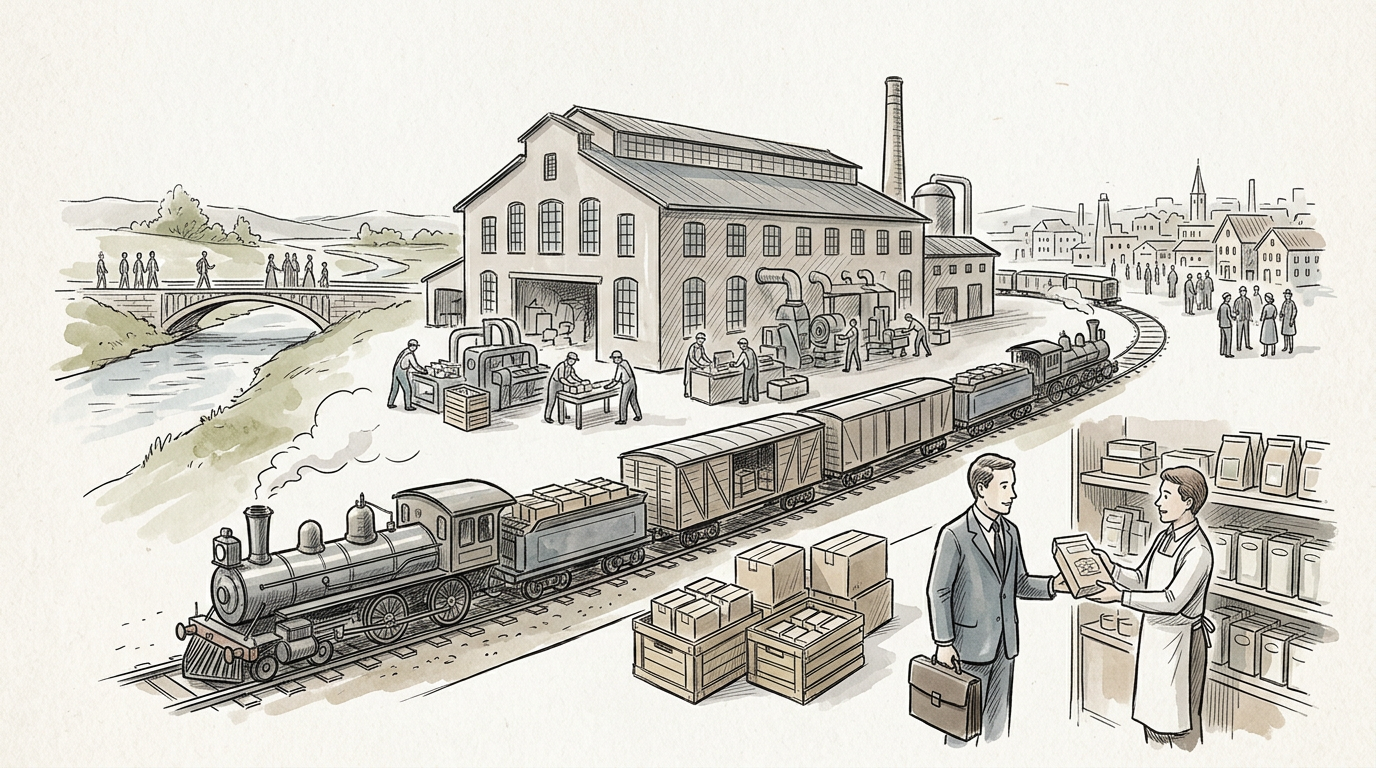
Industrialization did not create marketing from nothing. Long before factories, merchants had to price goods, build reputations, secure distribution, and persuade buyers. What industrialization changed was the scale, speed, and complexity of those tasks. As production expanded in the nineteenth and early twentieth centuries, firms could no longer depend on local familiarity, small-batch selling, or irregular trade networks. They needed systematic ways to move larger volumes of goods across wider territories, identify customers they would never meet in person, distinguish one producer’s output from another’s, and coordinate the growing distance between manufacture and consumption. Many of the practices now recognized as core marketing functions emerged from those pressures.
The history matters because modern marketing still carries the imprint of industrial-era business problems. Brand management, packaging, channel strategy, consumer research, and national market segmentation were not abstract innovations waiting to be invented. They developed because industrial production created chronic organizational challenges: too much output for local demand, too many intermediaries to manage informally, too many similar goods competing for attention, and too many consumers spread across regions, classes, and retail environments to be understood through intuition alone.
Before industrial scale, markets were narrower and more personal
In preindustrial and early industrial economies, many producers sold within limited geographic areas. Distribution was constrained by transportation costs, storage difficulties, and communication delays. Consumers often bought from local shopkeepers, itinerant merchants, or directly from craftsmen and small manufacturers. Product identification mattered, but trust was frequently attached to the retailer, wholesaler, or local producer rather than to a widely recognized manufacturer’s brand.
This did not mean markets were unsophisticated. By the eighteenth century, merchants already used printed notices, shop signs, packaging marks, and reputation-based selling. But the organizational problem was different. Production volumes were lower, product standardization was weaker, and market relationships were more local. A flour mill, soap maker, or textile producer did not necessarily need a national identity if trade remained regional and transactions were mediated by known local sellers.
Industrialization altered that balance. Mechanized production increased output. Railroads and steamships reduced transport time and cost. Telegraphy accelerated commercial coordination. Urban growth concentrated demand in new ways, while national distribution networks made it possible to sell across state and regional boundaries. Once firms could produce more than nearby buyers could absorb, demand creation became a strategic necessity rather than a helpful supplement.
Mass production created a demand problem as well as a manufacturing opportunity
By the mid-nineteenth century, industrial systems in the United States and Europe were turning out standardized goods at unprecedented scale. The problem for manufacturers was not simply how to make more products. It was how to sell them predictably enough to keep factories running efficiently.
Mass production rewarded throughput. Fixed investment in machinery, plants, and transportation infrastructure encouraged high-volume output. That output, in turn, required broader and more reliable markets. Manufacturers increasingly had to think beyond immediate orders and local trade relationships. They needed demand that could be planned, replenished, and expanded.
This shift helps explain why marketing history cannot be reduced to advertising history. Industrial firms certainly used advertising more heavily over time, especially as newspapers and magazines expanded circulation. But their challenge was broader. They needed better wholesaling systems, more dependable retail placement, clearer product identification, standardized packaging, pricing structures that worked across regions, and later, formal departments to manage these interdependent functions.
In practice, industrialization pushed businesses toward what later became a market-oriented view of operations. Producers could no longer assume that making more goods automatically meant selling more goods. The market had to be organized.
Transportation and communication turned local trade into coordinated markets
Industrial marketing depended on physical and informational infrastructure. Railroads were especially important in the United States after the 1850s. They connected agricultural regions, industrial cities, wholesalers, and retailers into larger trading systems. The telegraph allowed faster ordering, inventory coordination, and price transmission. By the late nineteenth century, improvements in printing and postal services also supported broader circulation of catalogs, trade publications, and branded promotional materials.
These systems changed the relationship between producers and intermediaries. Manufacturers could ship farther and more frequently. Wholesalers could aggregate and redistribute goods at larger scale. Retailers could offer more standardized assortments. But the increased reach of the system also made market coordination more difficult. A producer selling into multiple cities and states could not rely on purely personal relationships or ad hoc selling practices. Questions of channel control, resale conditions, shelf presence, and inventory turnover became increasingly important.
The new infrastructure also encouraged a shift from bulk goods to identifiable manufactured goods. When products moved long distances through complex distribution channels, standardization and recognition mattered more. Packaging, labeling, and trademarks became practical tools for preserving identity through the channel, not merely decorative additions.
National brands emerged from the need to identify and standardize goods
One of the clearest marketing consequences of industrialization was the rise of national brands. This development is often oversimplified into a story about logos or slogans, but its roots were operational as much as promotional.
When producers sold goods in bulk, retailers often controlled how those goods were presented and sometimes relabeled them. That arrangement limited the manufacturer’s ability to guarantee consistency or build direct consumer recognition. Industrial firms increasingly sought to overcome this by packaging goods in uniform units under proprietary names. The package became a vehicle for standard quality claims, product information, legal identification, and repeat purchase behavior.
Trademark law helped. In the United States, the federal Trademark Act of 1870 was struck down by the Supreme Court in 1879, but a narrower federal trademark law followed in 1881, with a broader act in 1905. These legal developments did not invent branding, but they strengthened the institutional framework that allowed firms to protect names and marks across wider territories.
Packaged consumer goods expanded rapidly in the late nineteenth century. Producers such as Procter & Gamble, the National Biscuit Company, and Quaker Oats used standardized packaging and brand identity to reassure consumers who were increasingly purchasing goods produced far from home. In categories where quality could be uncertain or adulteration was a concern, branded packaging signaled consistency. That signal mattered especially in urban markets where buyers could not personally know the producer.
The creation of the National Biscuit Company in 1898 through the consolidation of baking firms is a useful example of how industrial scale and marketing became intertwined. Nabisco’s branded, packaged crackers and biscuits were not simply factory-made foods. They were products designed for broad distribution and repeat recognition. Packaging protected freshness, but it also protected identity. The famous Uneeda Biscuit launch in 1898 is often remembered for its advertising, yet its larger significance was that industrial food production, packaging technology, and national distribution had become integrated with brand strategy.
In this sense, the national brand was a marketing solution to an industrial problem. Standardized output needed standardized meaning in the marketplace.
Packaged goods changed the balance of power between manufacturers and retailers
Industrialization did not eliminate intermediaries. In many cases it made them more important. But it did change the terms of competition between manufacturers and retailers.
In a bulk-goods environment, retailers often exercised substantial control over what consumers bought. Shopkeepers could recommend one barrel of flour, one soap, or one tea over another, and the consumer might have little basis for preferring a specific producer. Branded packaged goods gave manufacturers a way to bypass some of that dependence by creating consumer recognition that traveled into the store. If a shopper asked for a named product, the retailer’s discretion narrowed.
This was one reason many retailers were initially skeptical of manufacturer branding. It could reduce retailer control, shift margin structures, and encourage comparison across stores. Yet branded packaged goods also reduced some selling burdens for retailers. Standardized units simplified stocking and display. Known brands could increase traffic and reduce the need to explain every purchase. Over time, a more complex balance emerged in which manufacturers built demand while retailers controlled access to shelf space and final purchase conditions.
That tension remains central to modern marketing. Trade promotion, merchandising allowances, private labels, channel conflict, and category management all reflect later versions of the same structural issue: industrial producers need access to consumers, but intermediaries control important points of contact.
Department stores, chain stores, and mail-order houses expanded the market
Industrialization transformed retail alongside manufacturing. Large urban department stores in the late nineteenth century reorganized merchandising, pricing, display, and customer experience. Stores such as Wanamaker’s in Philadelphia and Marshall Field’s in Chicago offered broad assortments, fixed prices, extensive promotion, and increasingly sophisticated management systems. They did not merely sell products; they created environments in which comparison shopping, seasonal buying, and branded consumption could flourish.
Fixed pricing was historically important. Earlier retail bargaining practices made scaling more difficult. Department stores helped normalize posted prices, turnover-based merchandising, and promotional events. These practices made retail more legible to both consumers and manufacturers. Manufacturers selling branded goods into such environments faced new opportunities for consistent placement and wider circulation.
Chain retailing added another layer. The Great Atlantic & Pacific Tea Company, founded in the nineteenth century and expanded rapidly by the early twentieth, showed how chain systems could centralize buying, standardize assortment, and coordinate promotion over multiple locations. Chains changed negotiations with manufacturers because they bought in volume and imposed more formal merchandising expectations.
Mail-order firms broadened the geography of the consumer market even further. Montgomery Ward issued its first mail-order catalog in 1872, and Sears, Roebuck and Co., founded in the 1880s, turned catalog retailing into a national institution by the 1890s. These businesses relied on railroads, postal networks, print technology, and increasingly standardized product descriptions. They sold to consumers beyond major cities and gave manufacturers access to households that conventional retail channels reached unevenly.
Mail-order marketing anticipated many later practices associated with direct marketing. Catalogs required audience selection, offer design, response handling, pricing clarity, trust-building copy, and customer service systems. Long before digital commerce, industrial-era marketers were learning that when the seller was physically distant, the offer itself had to carry more informational and persuasive weight.
Packaging became a marketing technology
Industrialization made packaging more than a container. It became a crucial interface between production, distribution, retail, and consumption.
Advances in paperboard, canning, glass manufacture, printing, and labeling supported the growth of branded consumer goods. Packaging helped preserve products, extend shelf life, improve shipping efficiency, and standardize quantities. It also made products easier to display and compare in retail settings. As self-service retail formats spread later in the twentieth century, these functions became even more important, but the foundations were laid much earlier.
Packaging also addressed trust. In markets where adulteration and inconsistent quality were common concerns, sealed and labeled packages conveyed a claim of reliability. This was especially significant in foods, medicines, soaps, and household goods. The package told consumers who made the product, what quantity they were buying, and increasingly what standards they should expect.
The link between packaging and regulation also mattered. The Pure Food and Drug Act of 1906 in the United States did not create honest labeling overnight, and enforcement was uneven, but it strengthened the expectation that packaged products should disclose and identify. As government standards expanded, marketing claims had to operate within a more formal legal environment. Industrial marketing developed not only through business ingenuity but also through regulatory structures that shaped what could be promised and how products had to be presented.
Distribution became a strategic marketing function
As industrial output increased, manufacturers had to treat distribution as more than a logistical afterthought. Marketing history often distinguishes among product, price, promotion, and place, but in the industrial era, what later came to be called “place” was often the decisive problem.
A producer could have an efficient factory and a recognizable brand yet still fail if goods did not reach retailers consistently, arrived damaged, were priced uncompetitively after freight and wholesaler margins, or lacked support in local markets. Decisions about territory, warehousing, exclusive arrangements, sales representation, and wholesaler relationships became integral to market development.
Early marketing educators recognized this. When university courses in marketing emerged in the early twentieth century, they often grew out of “distribution” studies rather than from advertising instruction. The University of Michigan, the University of Pennsylvania, the University of Wisconsin, and Harvard were among the institutions teaching courses related to marketing or distribution in the first decade of the twentieth century. Arch Wilkinson Shaw’s work at Harvard and Ralph Starr Butler’s teaching and writing are frequently cited in the history of marketing education because they treated marketing as a problem of moving goods through channels, not merely promoting them.
This academic emphasis reflected business reality. Industrial firms needed trained managers who understood wholesaling, retailing, transportation, market organization, and demand conditions. Marketing became legible as a business function partly because distribution had become too complex to leave entirely to informal trade custom.
Mass markets increased the need for product differentiation
Industrialization expanded output, but it also increased the danger of commoditization. If multiple firms could manufacture similar soap, flour, canned goods, or cigarettes at scale, producers needed ways to reduce pure price competition.
Branding was one response, but not the only one. Manufacturers differentiated through packaging, quality guarantees, proprietary formulations, line extensions, point-of-sale materials, and increasingly coordinated sales policies. Product names and trademarks helped consumers recognize goods, but differentiation also depended on maintaining distribution, consistent quality, and retail visibility.
This helps explain why modern marketing developed as an interdisciplinary business function. Differentiation was not solely a communication task. It required decisions in production, product design, packaging, pricing, and channel strategy. In many firms, responsibilities that would later be grouped under “marketing” were still divided among sales managers, advertising managers, production executives, and general management. Industrialization forced these activities into closer coordination even before formal marketing departments became common.
By the early twentieth century, some large firms began to institutionalize this coordination more explicitly. The eventual rise of brand management, often associated with Procter & Gamble’s 1931 memorandum by Neil H. McElroy, is better understood as a later organizational solution to a problem that industrialization had already created: how to manage differentiated products systematically in competitive, large-scale markets.
Salesmanship was no longer enough
In earlier commercial settings, the salesperson or local merchant often served as the central market interpreter. Industrial scale weakened the sufficiency of that model. A manufacturer selling through thousands of outlets could not rely on individual salesmen alone to understand demand across regions and social groups.
Trade press from the late nineteenth and early twentieth centuries shows a growing concern with systematic selling, sales management, market statistics, and dealer relations. Firms gathered information from sales reports, wholesalers, field representatives, and retailers. These methods were uneven and often impressionistic by modern standards, but they marked a transition from purely personal judgment toward organized market intelligence.
As markets widened, managers increasingly asked new questions. Which regions bought more of a given product? Which price points moved volume? Which package size worked in urban tenements versus rural households? Which store formats favored branded goods? Which consumer groups responded to premium offers or installment terms? Industrialization made such questions economically necessary because mistakes in output planning or distribution could be costly at scale.
This was one of the historical conditions that later supported formal market research. The rise of consumer research in the twentieth century did not happen because marketers suddenly became curious about the human mind. It happened because industrial markets became too extensive and too segmented to navigate through anecdote alone.
Modern market research grew out of industrial complexity
By the early twentieth century, efforts to gather systematic market information were becoming more organized. Trade associations, government bureaus, publishers, and private firms all contributed to a broader culture of market measurement. Circulation auditing, retail store checks, consumer surveys, and statistical studies gradually became more common.
Some of the best-known commercial research organizations emerged in this period. Charles Coolidge Parlin, hired by Curtis Publishing in 1911, is often described as an early market researcher because his studies examined trade structures and business conditions in categories such as farm equipment and automobiles. His work was not “consumer insights” in the contemporary sense, but it represented an effort to replace unsupported opinion with empirical inquiry about markets.
In 1923, Arthur C. Nielsen Sr. founded the A.C. Nielsen Company, which became influential in retail and later media measurement. George Gallup’s work in public opinion research belongs partly to a different history, but the broader interwar period clearly showed growing confidence in sampling, surveys, and quantified market knowledge. These methods developed unevenly and had limitations, including biases in sampling frames and interpretation, yet they reflected the same underlying industrial need: firms required better evidence to allocate production, distribution, and promotional resources.
Consumer research also took shape within changing academic fields, including psychology, economics, and business education. Marketers increasingly treated consumers not just as anonymous buyers but as populations whose habits, incomes, household structures, and preferences could be studied. Segmentation in its modern textbook form came later, especially with Wendell R. Smith’s 1956 article “Product Differentiation and Market Segmentation as Alternative Marketing Strategies,” but the practical roots of segment thinking can be traced to industrial-era efforts to sort markets by geography, class, use case, and channel.
Marketing became a recognized business function
Industrialization did not produce an immediate, universal “marketing department.” In many companies, responsibilities remained dispersed well into the twentieth century. Sales often dominated. Advertising might report elsewhere. Distribution could be handled through logistics or trade management. Product decisions might remain with production or general management.
Even so, the long-term trend was toward greater specialization and coordination. As firms managed multiple products, broader territories, and more complex channels, they needed executives who could integrate pricing, packaging, trade relationships, sales support, and market information. The growth of business schools, trade associations, and professional publications reinforced that change by defining marketing as a distinct field of expertise.
The American Marketing Society was founded in 1931, and the National Association of Teachers of Advertising and Marketing formed in 1930. Those organizations merged in 1937 to create the American Marketing Association. The dates matter because they show that by the interwar years, marketing had become recognizable enough as a profession and academic subject to support formal institutions. That institutionalization rested on developments set in motion decades earlier by industrial production and mass distribution.
Textbooks also helped standardize the field. Early works treated marketing as distribution, trade channels, and market organization rather than as a narrow communications specialty. Over time, the discipline broadened to include consumer behavior, strategy, product management, and analytical methods. But the industrial-era core remained visible: marketing existed to connect productive capacity with organized demand.
Industrial consumer culture was shaped, not simply imposed
It would be misleading to describe industrial-era consumers as passive recipients of manufacturer strategy. Consumers adapted, resisted, and selected among the new goods and retail systems available to them. Some embraced packaged products for their convenience, consistency, and status associations. Others distrusted factory-made goods or preferred local sellers. Price remained decisive for many households, especially working-class families managing unstable incomes.
Industrialization also produced uneven access and unequal representation. National marketing often reflected middle-class assumptions about household roles, consumption standards, race, and gender. Retail systems and brand imagery could exclude as well as include. The expansion of consumer markets created opportunities, but it also reinforced social hierarchies and stereotypes that later became embedded in segmentation and merchandising practices.
Recognizing this complexity is important for marketing history. Industrialization expanded marketers’ ability to organize demand, but it did not give them unlimited control over consumers. Market success still depended on whether goods fit household budgets, routines, tastes, and trust. The consumer was not merely the endpoint of a distribution system. Consumer response shaped which industrial marketing practices survived.
What industrialization changed in marketing practice
Looking across the nineteenth and early twentieth centuries, several durable changes stand out.
First, industrialization widened the distance between producer and consumer. Marketing had to bridge that distance with brands, packaging, channels, and information.
Second, it made demand creation a managerial problem. Firms with large fixed production capacity could not rely on incidental local sales.
Third, it increased the importance of intermediaries while also encouraging manufacturers to reduce dependence on retailer discretion through branding and packaging.
Fourth, it turned distribution into a strategic field of management. Transportation, wholesaling, retail formats, and territorial coverage became central to market success.
Fifth, it raised the value of systematic market knowledge. As markets grew more geographically and socially diverse, research became increasingly necessary.
Sixth, it encouraged organizational specialization. Over time, businesses created roles and departments to coordinate the market-facing consequences of industrial scale.
These developments did not unfold neatly or uniformly. Some industries moved faster than others. Regional differences persisted. Many firms remained sales-led for decades. Yet the broad historical pattern is clear. Industrialization transformed marketing from a set of merchant practices into a more formal system for connecting large-scale production with large-scale consumption.
The modern marketer still works inside that inheritance. National brands, packaged goods strategy, retailer-manufacturer bargaining, category management, customer insight, and channel coordination all bear the marks of an era when factories could produce more than local markets could absorb. Industrialization did not just increase output. It changed the basic question businesses had to answer. The challenge was no longer only how to make goods efficiently, but how to organize markets capable of receiving them. That challenge is one of the main reasons marketing became a profession.
Leave a Reply