
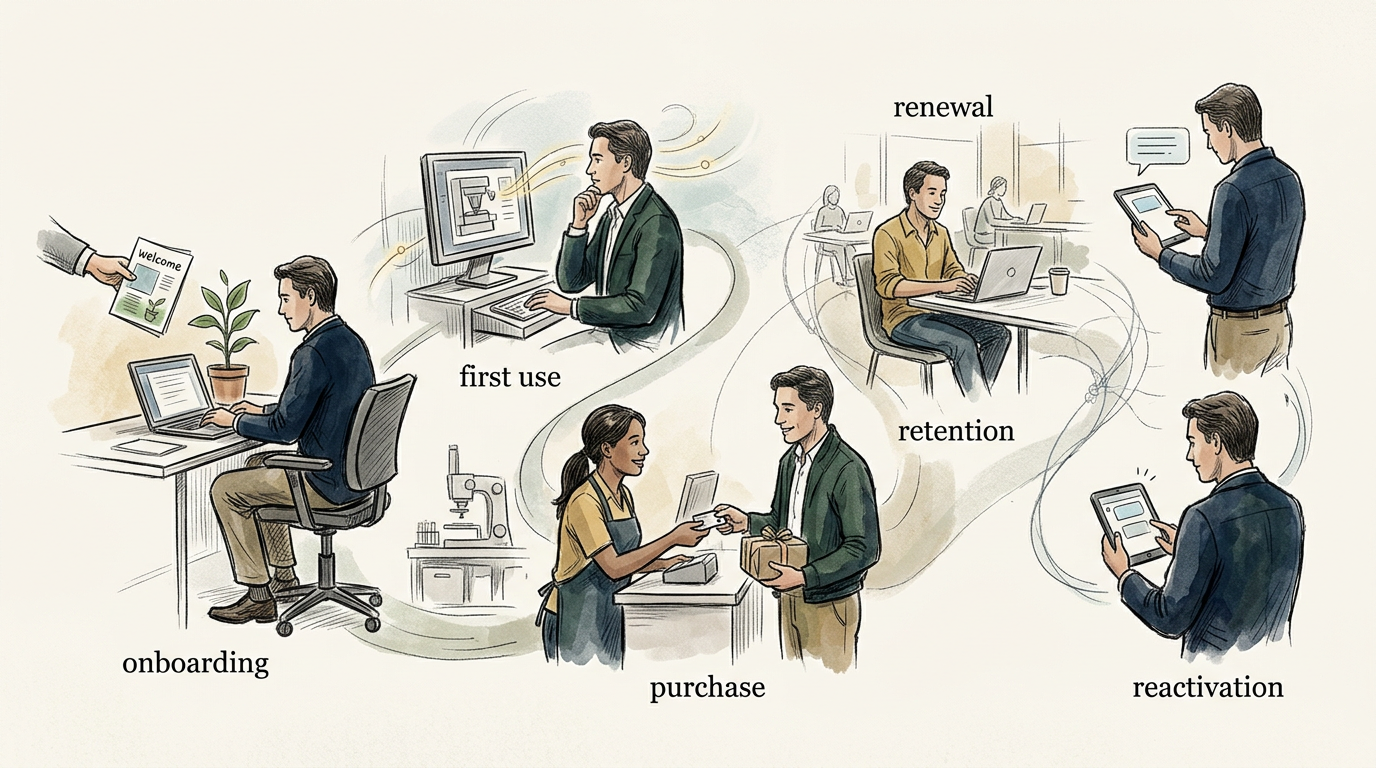
Lifecycle marketing is often described as sending the right message at the right time. That shorthand is useful, but incomplete. In practice, lifecycle marketing is not primarily a messaging calendar. It is the design of digital communications and customer experiences around what people are actually trying to do at different points in their relationship with a brand.
That distinction matters because many organizations still approach lifecycle work as a volume problem. If acquisition slows, they add more promotional email. If trial users fail to convert, they create longer nurture tracks. If repeat purchase rates decline, they increase remarketing. The result is frequently more touches without more relevance. Customers experience pressure rather than progress, and marketers mistake activity for orchestration.
A sound lifecycle program works differently. It ties websites, email, paid media, CRM data, ecommerce flows, in-product prompts, service communications, and measurement systems to meaningful stages such as onboarding, activation, purchase, use, retention, renewal, and reactivation. More important, it responds to customer behavior within those stages. It asks what a person needs next, what friction is preventing movement, and which channel is best suited to reduce uncertainty or support action.
Seen this way, lifecycle marketing is less about automating campaigns and more about managing transitions.
Lifecycle marketing is a customer progression system, not just a communications plan
Most lifecycle frameworks are built around recognizable moments:
- Onboarding: helping a new subscriber, buyer, or account holder get started.
- Activation: moving someone to a first meaningful action that signals value received.
- Purchase or conversion: completing an order, submitting a lead form, starting a paid subscription, or booking a service.
- Use or adoption: supporting product usage, feature discovery, replenishment, or repeat engagement.
- Retention: sustaining value over time and reducing churn.
- Renewal: guiding contract, membership, or subscription continuation.
- Reactivation: attempting to win back lapsing or inactive customers.
These stages are planning tools, not literal descriptions of every path. People do not move through them cleanly. A customer may purchase before subscribing to email, search for support content before fully onboarding, abandon a cart and later convert through branded search, or remain technically active while showing clear signs of declining value. Lifecycle marketing should therefore be built around signals and thresholds rather than rigid calendars.
In digital marketing terms, this means using events, behavioral data, and channel logic to determine when communication is warranted. An onboarding program might begin after account creation, but branch according to whether the customer completed setup, used a key feature, opened help content, or contacted support. A replenishment message might trigger from expected consumption timing, but should be adjusted if the customer already reordered through another channel. A reactivation campaign should distinguish between a customer who stopped opening email and one who stopped buying altogether. Those are different problems, and they call for different responses.
What lifecycle marketing is designed to accomplish
At its best, lifecycle marketing improves the economics and experience of digital customer relationships. Its purpose is not simply to increase sends, impressions, or touches. It is designed to accomplish several more substantive objectives.
First, it reduces time to value. A customer who quickly understands how to use a product, navigate an account area, complete a profile, or place a second order is more likely to remain engaged. Onboarding and activation communications are valuable because they shorten the gap between conversion and benefit.
Second, it reduces friction at important moments. Many digital drop-offs are not failures of persuasion. They are failures of clarity, timing, trust, or usability. A lifecycle program can surface setup instructions, return policies, passwordless login options, delivery updates, support resources, comparison information, or contextual reminders when those details matter most.
Third, it increases customer quality, not just customer count. Strong acquisition marketing can still produce weak long-term outcomes if the wrong audiences convert or if first-time buyers never become repeat customers. Lifecycle systems help marketers evaluate whether initial conversions turn into valuable relationships.
Fourth, it supports retention and lifetime value. Depending on the business model, this may mean repeat purchase, subscription renewal, product usage, reduced churn, cross-sell, upsell, lower return rates, or stronger advocacy.
Finally, it improves measurement. Lifecycle marketing forces organizations to define what progression actually looks like. That often creates better operational discipline around stage definitions, event tracking, CRM integration, and performance evaluation.
Behavior should drive lifecycle communication
The central operational choice in lifecycle marketing is whether communication is based mainly on schedule or on behavior.
Calendar-based communication still has a role. Monthly statements, membership reminders, seasonal merchandising, editorial newsletters, and scheduled promotions can all be appropriate. Problems arise when marketers treat every lifecycle problem as a reason to increase scheduled volume. A customer who has not used a product may need help content, not another discount. A trial user who never completed setup may need a clearer path to activation, not a longer nurture sequence. A subscriber approaching renewal may need proof of value delivered, not a generic renewal notice.
Behavior-based lifecycle programs rely on signals such as:
- Account creation or email signup
- First login or first session after registration
- Product view, category view, or site search behavior
- Cart creation, checkout initiation, and abandonment
- Purchase history, order frequency, and average order value
- Feature use or content consumption
- Inactivity over a defined period
- Support interactions or service issues
- Subscription end dates or contract milestones
- Email engagement, preference changes, and unsubscribe behavior
These signals are not useful on their own. They need interpretation. A cart abandonment trigger, for example, is often treated as universally valuable, but it may be a poor experience if inventory is volatile, the user was only comparing options, or the follow-up arrives after the purchase was completed on another device. Likewise, a “we miss you” campaign can be mistimed if inactivity is normal for the product category. Relevance depends on behavioral context and business model, not merely on the existence of a trigger.
Onboarding is where lifecycle marketing often succeeds or fails
Onboarding deserves special attention because it is frequently the stage with the widest gap between marketing expectations and customer experience. Teams celebrate acquisition, then lose momentum immediately after conversion. The customer receives a welcome message, but the website, account area, app, product education, support content, and service operations do not help them reach value quickly.
Good onboarding starts with a practical question: what does a successful first week, first session, or first purchase cycle look like? The answer varies by category.
For an ecommerce brand, onboarding may mean confirming the order, setting delivery expectations, explaining returns, gathering preferences, encouraging account creation, and making reordering simple. For a subscription service, it may mean completing profile data, setting preferences, demonstrating product use, and prompting a first meaningful action. For a B2B lead-generation program, it may mean responding quickly, routing the lead appropriately, and delivering relevant educational content before sales outreach.
Email is often the backbone of onboarding because it is durable, direct, and comparatively inexpensive. But email alone is rarely enough. The website or logged-in experience must carry the customer forward once they click. If the welcome email promises an easy setup and the landing page is cluttered, slow, confusing on mobile, or inaccessible to assistive technologies, the lifecycle message has not solved the actual problem.
This is where lifecycle marketing intersects with conversion and user experience work. Marketers should evaluate whether onboarding content reduces specific forms of friction:
- Does the customer understand what to do next?
- Can they find the next step without searching the entire site?
- Are forms asking only for information that is genuinely necessary at that stage?
- Is trust reinforced through clear policies, help resources, and transparent expectations?
- Are instructions written for real users rather than internal teams?
- Does the mobile experience support completion?
Activation metrics should reflect these realities. Open rates on welcome emails may indicate initial attention, but they do not prove that onboarding worked. More meaningful measures often include first login, first purchase after signup, first key feature use, first reorder, completion of setup, or time to first value.
Activation requires a defined value moment
Lifecycle programs often struggle because “activation” is left vague. If teams cannot define the action that signals customer value, they cannot design effective communications around it.
A value moment should be meaningful enough to correlate with future retention or revenue, not just early enough to be easy to achieve. In some businesses, account registration is not activation. Neither is app installation, pageview depth, or email open rate. Those may be useful precursors, but they are often weak indicators of lasting value.
A better activation event is one that demonstrates the customer has crossed from curiosity into use. Examples include completing a profile that enables personalization, placing a first order, creating a project, using a core feature, saving payment information for replenishment, or downloading and applying a purchased resource.
Once that event is defined, lifecycle communications can support movement toward it. The relevant messages may involve education, reassurance, reminders, social proof, use cases, setup help, or incentives, depending on the barriers observed. The point is not to create a long sequence. The point is to remove the obstacles that delay or prevent activation.
Professionals should also recognize that some activation problems are not communication problems. If users consistently fail to reach a value moment, the issue may be product complexity, pricing mismatch, weak audience targeting, technical defects, or misleading acquisition messaging. Lifecycle automation cannot compensate indefinitely for structural problems upstream.
Purchase-stage lifecycle marketing extends beyond cart recovery
Many marketers associate purchase-stage lifecycle work with abandoned cart emails or checkout retargeting. Those tactics can be effective, particularly in ecommerce, but they represent only a narrow slice of the purchase experience.
A more complete purchase-stage program considers the full conversion path:
- How customers discover products or offers through search, navigation, merchandising, and recommendations
- Whether product pages answer the questions required for confidence
- How pricing, shipping, delivery, returns, warranties, and availability are presented
- Whether checkout creates avoidable friction through forced account creation, weak payment options, or unclear error handling
- How paid media and email traffic align with landing page content and conversion intent
Search is particularly important at this stage because it often captures active demand. Organic search can bring in prospects who are comparing options, seeking details, or looking for solutions to specific problems. Paid search can support high-intent queries where the brand wants controlled visibility, message testing, or coverage for competitive and category terms. But neither channel operates independently of lifecycle strategy. Search is often one of the ways customers re-enter the journey after an earlier touch.
A customer may receive a promotional email, ignore it, later search for the brand name, read reviews, revisit a product page through direct traffic, and then convert via paid search on a branded term. Last-click reporting would over-credit the final channel. Lifecycle measurement requires a broader view of the interaction.
Purchase-stage messages should also respond to hesitation with relevance. If a customer repeatedly visits sizing information, support content that clarifies fit may matter more than another discount. If a prospect downloads a pricing guide but does not request a demo, follow-up content should address evaluation criteria or implementation concerns, not merely repeat the same call to action.
Use-stage and post-purchase marketing are often underdeveloped
Once a purchase occurs, many digital programs become disproportionately promotional. That can be a costly mistake. The post-purchase period is one of the most important stages in the lifecycle because expectations are high, attention is available, and future loyalty is still uncertain.
In ecommerce, post-purchase communication should reinforce confidence and reduce avoidable service burden. Order confirmation, shipping updates, delivery timing, returns information, care instructions, and support access all contribute to experience quality. Transactional messages often have high visibility because customers are actively looking for them. They should therefore be treated as customer experience assets, not just operational notices.
For products that require setup, assembly, or recurring use, post-purchase journeys can increase satisfaction by helping customers use what they bought successfully. This may include how-to content, replenishment timing, compatibility guidance, feature education, troubleshooting resources, or reminders tied to expected usage cycles.
For subscription and SaaS businesses, product-use communication becomes even more important. Retention depends less on promotional frequency and more on whether customers continue to receive value. Usage milestones, adoption prompts, educational content, account health checks, and support interventions may all be appropriate, but they should be connected to actual behavior. A customer who is highly engaged likely needs something different from a customer who logged in once and never returned.
This is one reason lifecycle marketing cannot be owned entirely by an email team. Effective retention often depends on integrations across product analytics, CRM systems, support data, account management, ecommerce systems, and on-site personalization.
Retention is not simply more messaging to existing customers
Retention marketing is sometimes treated as the owned-channel equivalent of acquisition: identify a target audience and send more offers to it. That approach can generate short-term revenue, but it is not a durable retention strategy.
Retention is best understood as the sustained continuation of value. Communication supports it, but does not create it by itself. A customer remains because the product is useful, the service experience is acceptable, the pricing feels justified, the ordering process is manageable, and the brand’s digital systems reduce friction rather than add to it.
This means retention programs should be designed around customer needs and business rhythms. In retail and ecommerce, retention may focus on replenishment reminders, loyalty value, complementary products, service messages, and repeat purchase triggers based on realistic usage intervals. In subscription businesses, retention may involve feature adoption, milestone reporting, usage summaries, training content, billing clarity, and renewal readiness. In lead-based businesses, retention may mean staying relevant after the first conversion so that the customer returns when the next need emerges.
Segmentation is essential here. A high-value repeat customer, a discount-dependent buyer, a dormant subscriber, and a new first-time purchaser should not all receive the same cadence or offer logic. Relevance is not merely a personalization token in an email subject line. It is the alignment of content, timing, and call to action with observed behavior and likely customer need.
Marketers should also monitor signs of retention fatigue. Rising unsubscribe rates, declining click quality, increasing spam complaints, lower direct engagement, and weaker repeat purchase despite higher send volume can all indicate that communications are becoming less useful. According to Google, bulk senders targeting Gmail accounts must meet requirements that include support for one-click unsubscribe in marketing messages and keeping reported spam rates low, with more detailed standards outlined in Google’s sender guidelines at support.google.com/a/answer/81126. Those requirements are not merely technical compliance issues. They reinforce a broader marketing reality: lifecycle communication that feels excessive or irrelevant eventually damages deliverability as well as customer trust.
Renewal programs should prove value, not just announce deadlines
Renewal-stage marketing is especially important in membership, subscription, software, and service contracts, but the principle extends more broadly to any recurring relationship. Too many renewal programs are built around reminders of expiration rather than evidence of value.
A stronger approach begins earlier. If customers are asked to renew only when a deadline approaches, the brand has little room to recover from weak adoption or unresolved dissatisfaction. Renewal marketing should therefore draw on usage data, service interactions, account status, savings realized, milestones reached, or outcomes delivered. The objective is not simply to notify. It is to help the customer recognize why continuation is worthwhile.
Digital channels support this in different ways. Email can deliver reminders and summaries. Account dashboards can display usage or benefit data in context. Paid media can reinforce awareness for at-risk users who are difficult to reach through email alone. On-site messaging can surface renewal information at login or billing moments. CRM workflows can route high-risk accounts to human outreach when behavior indicates the need for intervention.
The core principle is that renewal should feel like a continuation decision supported by evidence, not an administrative trap. Hidden renewal terms, confusing cancellation paths, and manipulative urgency may improve short-term retention on paper, but they create regulatory, reputational, and customer-experience risks.
Reactivation is not the same as retention
Reactivation targets customers or subscribers whose engagement has already deteriorated. That may mean lapsed purchasing, declining product usage, unresponsiveness to email, or expiration without renewal. Because these audiences are heterogeneous, blanket win-back campaigns often underperform.
A useful reactivation strategy starts by identifying what, exactly, has lapsed. Consider several distinct conditions:
- The customer still opens email but has not purchased recently.
- The customer purchased once but never developed a repeat habit.
- The customer remains subscribed but has stopped using the product.
- The customer has become unreachable because of deliverability or list decay.
- The customer left after a service problem, return issue, or poor onboarding experience.
Each scenario implies a different intervention. Discounting may persuade a price-sensitive repeat buyer, but it may do little for a customer who stopped because the product failed to fit their needs. Educational content may help a dormant user rediscover utility, but it may be irrelevant to someone who churned after repeated technical issues.
Reactivation also requires restraint. Continuing to send to persistently unengaged addresses can hurt list health and obscure real performance. Inactive audiences should be evaluated not only for revival potential but also for suppression or sunset policies. A large database can create the illusion of marketing reach while undermining deliverability and inflating operational noise.
Automation is useful when it reflects journey logic
Lifecycle marketing often depends on marketing automation, customer data platforms, CRM workflows, recommendation engines, and ad platform audience syncing. These systems make it possible to trigger communication from behavior, suppress messages based on recent activity, personalize content, and coordinate across channels. But automation is only as good as the logic and data behind it.
A well-designed automated journey usually has several characteristics. It is based on meaningful triggers rather than arbitrary schedules. It has clear entry and exit rules. It suppresses customers who already completed the desired action. It accounts for conflicting communications from other teams. It respects frequency limits. It defines escalation paths for exceptions, such as support cases, cancellations, or returns. And it is reviewed regularly rather than left running indefinitely.
Poorly designed automation does the opposite. It multiplies messages because every team launches its own triggered flow. It ignores recency, channel overlap, and customer state. It keeps sending a sequence after conversion. It treats email opens as strong intent signals despite privacy-related measurement limitations. It assumes CRM fields are accurate when they may be stale or inconsistently populated.
Apple’s Mail Privacy Protection, for example, can obscure the meaning of email open rates by preloading remote content in many circumstances, making opens a less reliable indicator of human attention for some audiences. Apple describes the feature in its platform privacy materials at support.apple.com/guide/iphone/protect-mail-activity-iphf084865c7/ios. For lifecycle marketers, the implication is practical: triggers and performance evaluation should rely more heavily on downstream behaviors such as clicks, site visits, purchases, product usage, and account actions than on opens alone.
Automation should therefore be understood as an enabling system, not a strategy by itself. The professional question is not whether a brand has automated journeys. It is whether those journeys make the customer experience more coherent.
Lifecycle marketing depends on measurement that reflects progression
Because lifecycle programs span channels and time periods, measurement is one of the discipline’s greatest challenges. It is easy to count sends, clicks, and conversions. It is harder to determine whether the program improved customer progression in a meaningful way.
Useful lifecycle measurement starts with stage-specific objectives and definitions. Examples might include:
- Onboarding: setup completion rate, first login, account verification, time to first value
- Activation: first key action, first purchase, first feature use, activation rate by acquisition source
- Purchase: checkout completion, lead-to-opportunity progression, cart recovery contribution, average order value
- Use: repeat usage, support deflection, content engagement tied to adoption, reorder interval
- Retention: repeat purchase rate, churn rate, subscription continuation, customer lifetime value
- Renewal: renewal rate, downgrade rate, save rate after intervention
- Reactivation: return-to-purchase rate, restored usage, list recovery efficiency, incremental revenue from win-back cohorts
These measures should be read in context. A rise in repeat purchase rate could reflect improved retention, but it could also result from heavier discounting that harms margin. A strong reactivation campaign may look successful on gross revenue while still underperforming after accounting for incentives, media spend, or the cannibalization of customers who would have returned anyway.
Professionals should also distinguish descriptive metrics from causal evidence. Attribution reporting can show that a customer touched email, paid search, direct traffic, and display before renewing, but it cannot fully explain which touch changed behavior. Last-click attribution is particularly limited in lifecycle contexts because many later-stage interactions are navigational or administrative rather than persuasive. Brands should treat attribution as directional evidence for channel coordination, not as a precise record of causal influence.
When stakes are high, incrementality methods are more informative. Holdout groups, geo experiments, suppression testing, or randomized audience testing can help determine whether a lifecycle campaign changed behavior beyond what would have happened anyway. These approaches are operationally harder, but they are often necessary when mature programs risk claiming credit for customers who were already likely to purchase, renew, or return.
Customer journeys cross channels, devices, and teams
One reason lifecycle marketing is difficult to execute well is that customer journeys are not contained within a single platform. A person may discover a brand through search, sign up on mobile, abandon on desktop, return through direct traffic, receive an email reminder, click a support article, convert in an app, and later respond to a replenishment campaign. The journey also crosses internal boundaries: acquisition, ecommerce, CRM, product, analytics, customer service, and paid media teams may each own part of the experience.
As a result, lifecycle marketing requires operational coordination as much as creative strategy. Teams need consistent stage definitions, shared event naming, data governance, frequency rules, suppression logic, and handoffs between systems. If the ad platform continues retargeting a customer after purchase because CRM data is delayed, the brand wastes spend and risks looking disorganized. If the website captures a preference that the email system cannot use, personalization becomes superficial. If support interactions are invisible to marketing automation, the customer may receive upsell messages during a service failure.
This systems view is one of the most important professional implications of lifecycle work. Effective programs are rarely the result of a single campaign idea. They are usually the result of cleaner operations.
Websites and digital experiences are part of lifecycle marketing, not downstream destinations
It is tempting to frame lifecycle marketing as something that sends people to a website, where “the site team” then takes over. In reality, the website or app is part of the lifecycle system itself.
If a retention email drives customers to an account area that does not clearly surface
Leave a Reply