
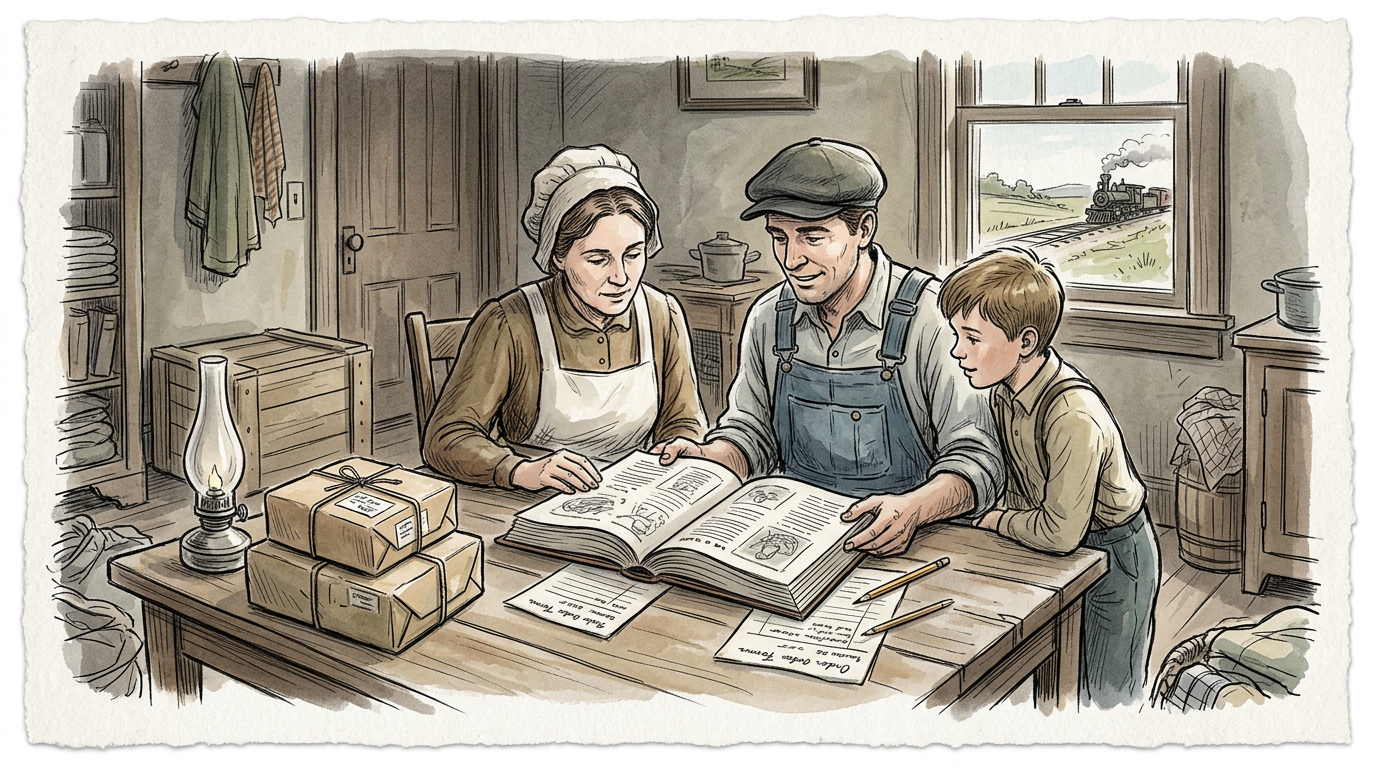
Long before ecommerce made “endless aisle” a familiar idea, mail-order catalogs reorganized how American consumers encountered the market. They did more than circulate product images and prices through the mail. Catalog firms built systems that linked demand generation, merchandising, inventory planning, fulfillment, transportation, payments, customer service, and returns. In doing so, they helped expand consumer markets beyond the reach of local stores and traveling salesmen, especially for rural households that had limited access to urban assortments and often faced uneven pricing.
The rise of mail-order was not simply a story of persuasive selling at a distance. It was a major development in retail marketing and distribution. Catalog merchants created practical ways to standardize product information, set published prices, aggregate national demand, and deliver goods across long distances. They also developed methods for earning trust among customers who could not inspect merchandise before purchase and might never meet the seller. Many practices that later became central to direct marketing, database management, customer service, and omnichannel retailing can be understood more clearly when placed in the history of catalog commerce.
Before national mail-order, local retail shaped what consumers could buy
In the mid-nineteenth century, much of the United States remained a difficult retail environment. Urban department stores and specialty merchants offered large assortments, but many consumers lived far from those markets. Rural households often depended on general stores, peddlers, regional jobbers, or periodic trips to town. Selection could be narrow, seasonal availability inconsistent, and prices opaque. Credit arrangements varied, and transportation constraints affected both cost and reliability.
These conditions mattered because marketing depends on more than demand. It also depends on access. A consumer may want a product, recognize its usefulness, and have some means to pay, yet still face a market structured by distance, local monopoly, weak information, or unreliable supply. Before large-scale mail-order, producers and merchants had only limited means of serving dispersed national demand directly.
Several nineteenth-century developments began to change those conditions. Railroad expansion reduced travel time and connected inland communities to wholesale centers. The telegraph improved commercial communication. Advances in printing lowered the cost of producing illustrated sales materials. Most important for rural parcel commerce, the federal postal system gradually expanded its reach. Even so, nationwide retail access did not emerge automatically from infrastructure alone. It required firms that could translate transportation and communication networks into organized marketing systems.
The first large mail-order houses grew out of distribution opportunities
Aaron Montgomery Ward is central to that transition. In 1872, Ward established Montgomery Ward & Co. in Chicago, a city whose railroad connections and wholesale markets made it an important distribution hub. Ward’s basic commercial idea was not merely to advertise nationally but to sell directly to customers, initially farmers and residents of small towns, by bypassing some layers of intermediaries. The company’s early offering took the form of a simple price list, which soon developed into a catalog.
Ward’s approach addressed specific frustrations in rural retailing. By publishing prices and product descriptions, he offered customers a way to compare value without relying solely on local merchants. The catalog promised standardized terms from a known supplier rather than highly localized bargaining or uncertain markups. This should not be romanticized into a pure war on middlemen, a phrase often repeated in later company lore. Intermediaries remained essential throughout the distribution system, including rail carriers, express companies, postal services, wholesalers, and local freight agents. But the mail-order house did alter which intermediaries shaped the consumer’s buying decision.
Ward also made trust a central marketing issue. Selling sight unseen required more than product supply. It required procedures customers could understand and believe. Published descriptions, stated prices, guarantees, and return policies all helped reduce perceived risk. So did the very material presence of the catalog, which made the merchant seem stable, systematic, and reachable.
Sears, Roebuck and Co., founded in the 1890s after Richard W. Sears began selling watches by mail in the 1880s, expanded the scale and ambition of the catalog model. Alvah C. Roebuck joined Sears in the early years, and Julius Rosenwald later became a decisive managerial and financial force after joining the company in 1895. Sears used Chicago’s transportation advantages much as Montgomery Ward had, but it pushed assortment breadth and organizational scale further. By the turn of the twentieth century, the large general catalog had become a national retail institution.
Rural Free Delivery and Parcel Post made the catalog system more practical
Mail-order firms depended on customer communications moving reliably in both directions. That requirement helps explain why postal reforms were so important. Rural Free Delivery, introduced experimentally in the 1890s and made permanent in 1902 by the U.S. Post Office Department, gave many farm households more regular access to mail service. Consumers no longer needed to travel as often to distant post offices to receive catalogs, place orders, or correspond about problems.
Parcel Post, launched in 1913, was equally significant. Prior to its introduction, the shipment of many goods depended on private express companies or freight arrangements that could be costly or inconvenient for smaller packages. Parcel Post widened the practical range of items that could move through a national direct-to-consumer system. The result was not the creation of mail-order from nothing, since major catalog houses already existed, but a substantial expansion in efficiency, reach, and routine use.
These postal developments mattered for marketing because they changed the economics of serving dispersed customers. They lowered some of the friction involved in customer acquisition, order handling, and delivery. They also encouraged consumers to treat remote purchasing as an ordinary part of household provisioning rather than an exceptional event.
The catalog was a merchandising system, not just a selling document
It is tempting to describe catalogs as precursors to modern advertising inserts or ecommerce pages, but that understates their historical role. A major catalog was closer to a portable store, a structured assortment, and a decision aid combined.
Catalog firms had to make choices that remain recognizably marketing decisions today:
- Which categories merited inclusion based on likely demand, seasonality, and shipping feasibility.
- How broad or narrow an assortment should be within each category.
- How to describe quality when the customer could not physically inspect the item.
- How to organize pages so shoppers could navigate large inventories.
- How to use price points to appeal to different household budgets.
- How to manage own labels, manufacturer brands, and unbranded goods.
- How to present guarantees, ordering instructions, and delivery expectations clearly enough to reduce hesitation.
In this sense, cataloging was merchandising at scale. It converted a warehouse assortment into a readable market offering. Product descriptions were not cosmetic copy alone. They carried much of the burden that a sales clerk, shelf display, or in-store comparison might carry in a physical store. Size charts, material descriptions, usage claims, testimonials, illustrations, and comparative language all served as substitutes for direct inspection.
This descriptive function became especially important in categories such as clothing, tools, household goods, furniture, watches, and agricultural supplies. The merchant had to anticipate consumer questions in advance and encode the answers on the page. That challenge encouraged a more systematic approach to product information than many local stores had provided.
Published prices changed expectations about fairness and comparison
One of the most consequential features of catalog retailing was the publication of prices for large audiences. In many local markets during the nineteenth century, prices could vary by place, season, customer relationship, and credit terms. The general catalog did not eliminate all variation, but it gave customers a benchmark.
Standardized pricing had several effects. It made comparison more feasible across locations. It allowed households to plan purchases in advance. It reduced the role of negotiation in many transactions. It also helped create an expectation that a merchant should be prepared to state terms openly and consistently.
That expectation became important in the broader professionalization of marketing. Published prices required merchants to think carefully about margin structure, shipping costs, assortment strategy, and competitive positioning. Catalog pricing was not merely a sales detail. It was a disciplined exercise in market making across geography.
The historical record also suggests limits. Standardized prices did not mean all consumers experienced identical total costs, since freight, delivery conditions, local taxes, and payment constraints still varied. Nor did catalogs abolish local retail competition. Many consumers continued to buy from nearby merchants for urgent needs, perishables, bulky goods, credit convenience, or personal service. Mail-order expanded market access, but it did not replace all other forms of retail.
Trust, guarantees, and returns were essential marketing innovations
Distance retail posed a credibility problem. Consumers could not test goods before buying, and sellers could not rely on face-to-face persuasion or store ambiance to reassure them. Mail-order firms therefore invested in policies and language designed to reduce uncertainty.
Montgomery Ward became well known for satisfaction guarantees, and Sears likewise emphasized return privileges and customer accommodation. Such practices were not acts of generosity detached from commercial calculation. They were tools for reducing the perceived risk of remote purchase, encouraging trial, and building repeat business. In modern terms, they lowered the customer’s switching costs and increased confidence in the transaction.
These policies had operational consequences. A promise of satisfaction required procedures for complaint handling, reverse logistics, account reconciliation, and fraud control. It also required careful internal alignment between merchandising claims and fulfillment accuracy. A generous promise that could not be executed consistently would undermine the brand rather than strengthen it.
The trust problem also influenced catalog writing and design. Merchants used detailed ordering instructions, explanations of materials and workmanship, and language intended to signal reliability. In categories where fit or performance uncertainty was high, they often included more detailed product information than was common in many local newspaper advertisements. This was a practical necessity of selling at a distance, not simply a stylistic preference.
National assortments changed consumer expectations
Large mail-order houses did more than deliver individual goods. They broadened consumers’ sense of what was available to buy. A household in a small town could compare styles, grades, sizes, and price levels on a scale previously associated with major city stores. For consumers far from urban retail centers, the catalog served as a market map.
This shift had cultural effects, but it should first be understood as a marketing development. Assortment visibility changed demand by making comparison easier and by teaching customers to think in categories and alternatives. The catalog organized the market into navigable choices. It helped consumers imagine replacing, upgrading, or diversifying purchases that might otherwise have remained habitual or locally constrained.
The national assortment also reinforced the position of branded goods. As manufacturers built wider distribution through rail networks, wholesalers, and retailers, catalogs provided one more channel in which brands could be named, described, and compared. At the same time, catalog houses frequently promoted private-label or house-branded alternatives, using their control over the selling environment to shape value perceptions and margins. This mix of manufacturer brands and retailer-controlled offerings remains a familiar feature of modern merchandising.
Mail-order firms became information businesses as well as merchants
To operate effectively, catalog companies had to maintain extensive records on customers, orders, product movement, suppliers, and seasonal patterns. This did not amount to modern CRM or predictive analytics, but it did create early large-scale systems for direct customer management.
Catalog merchants needed to know who requested catalogs, who ordered, what they bought, how often they purchased, which regions responded to certain goods, and when inventory should be replenished. Names and addresses had value because they represented reachable demand. House lists became business assets. Customer correspondence generated practical insight into complaints, preferences, fit problems, and delivery obstacles.
This administrative side of cataloging deserves more attention in marketing history because it anticipated later direct marketing logic. The catalog was not only mass communication. It was addressable commerce. It linked a named household to an order, a shipment, a payment, and potentially a future mailing. That closed loop between promotion and transaction would become central to twentieth-century direct marketing and, much later, to digital performance marketing.
Sears and Montgomery Ward both developed large clerical and logistical organizations to process this flow of information. By the early twentieth century, catalog retailing required sophisticated coordination among buyers, printers, mailing operations, warehouse staff, railway connections, and customer correspondence departments. In organizational terms, it pushed marketing, merchandising, and distribution into closer integration.
Women, households, and the management of consumption
The historical audience for catalogs was not simply “the farmer” in a generic sense. Household consumption decisions were often shaped by women who used catalogs to compare textiles, clothing, housewares, furnishings, and other domestic goods, even when men formally placed orders or controlled cash expenditures. Historians of consumption have shown that mail-order materials entered the household as reference tools, aspiration guides, and practical purchasing instruments.
That matters because marketing history should not treat demand as abstract. Catalog firms succeeded in part because they adapted to the rhythms of household planning. Consumers could consult catalogs repeatedly, discuss alternatives, wait for funds, and coordinate purchases across family members. The slower tempo of mail-order, compared with store buying, gave the catalog unusual staying power as a planning document.
Catalogs also reached communities that felt socially and geographically distant from elite urban retail culture. They democratized access in one sense by broadening availability, but access remained conditioned by income, shipping cost, literacy, and postal reliability. The expansion of consumer markets was real, though uneven.
Mail-order and local retail were both rivals and complements
The growth of catalog commerce often created tension with local merchants, who complained that outside firms siphoned trade from towns without contributing equally to local civic life or extending the same forms of credit and service. Such criticisms were not trivial. Rural retailers did more than sell goods; they were often lenders, gathering places, and intermediaries in local economies.
Yet the relationship between mail-order and local retail was not purely zero-sum. Consumers used catalogs selectively. They might order durable goods, apparel, or specialty items by mail while continuing to buy groceries, feed, fuel, medicines, and urgent necessities locally. In many categories, mail-order increased price pressure and assortment expectations without fully displacing nearby stores.
Over time, some major catalog companies themselves moved toward store-based retailing. Sears opened its first retail store in 1925, well after it had become a mail-order giant. That move reflected changing demographics, rising automobile ownership, urban and suburban growth, and the continued appeal of physical shopping for many goods. The point is not that mail-order “failed,” but that retail channels evolved in response to shifting patterns of access and convenience. Catalog retail had expanded the market; later formats built on the expectations it helped create.
The catalog influenced modern brand and product management
Catalog merchants had to make disciplined decisions about assortment architecture, category presentation, product versioning, and quality signaling. Those choices intersected with the later development of formal merchandising and product management.
A large catalog page effectively forced merchants to define a good-better-best ladder, identify target customer segments by spending power and need, and articulate meaningful differences among product options. This resembled later segmentation and positioning logic, even if firms did not yet use those modern terms systematically.
The catalog environment also sharpened the distinction between merchant-controlled and manufacturer-controlled selling. When a retailer owned the page, it could determine product context, comparison sets, descriptive emphasis, and prominence. That power over presentation helped retailers shape brand meaning rather than merely passively distribute it. In that respect, cataloging was an important stage in the broader history of retailer branding and private-label strategy.
Specialty mail-order broadened the model beyond the general catalog
Although Sears and Montgomery Ward dominate popular memory, the broader mail-order field included many specialty firms. Seed companies, farm supply houses, book clubs, clothing sellers, record clubs, and hobby merchants all adapted direct selling methods to narrower segments. L.L.Bean, for example, began in 1912 with a direct-mail effort centered on the Maine Hunting Shoe and built a business on product specialization, guarantees, and repeat customer relationships.
Specialty mail-order demonstrated that the catalog model was not limited to being a rural substitute for the department store. It could also serve customers whose needs were distinctive enough that local stores carried limited stock or lacked expertise. This is historically significant because it points toward later niche marketing. Direct contact with dispersed but identifiable buyers allowed firms to profit from demand that was geographically scattered yet commercially meaningful in aggregate.
In that sense, mail-order helped show that markets could be built through addressability and relevance, not only through broad physical presence.
Catalog circulation became an early form of targeted marketing
As the industry matured, firms became more selective about who received catalogs and which books they received. General catalogs were expensive to print and mail. Not every household had equal value to the merchant, and not every category justified universal circulation.
This encouraged increasingly deliberate list management and segmentation by geography, past purchase behavior, household type, or product interest. Again, these practices should not be overstated into modern data science. The available records and analytical tools were limited by the technologies of the time. But the logic was unmistakable. Catalog distribution was a marketing decision tied to expected response and lifetime value, even if those terms were not yet standard.
Twentieth-century direct marketers would later formalize many of these ideas through test panels, response analysis, recency-frequency-monetary models, and house-file optimization. Catalog commerce did not invent all of those techniques, but it created an environment in which measurable customer-level marketing made business sense.
Infrastructure, not copy alone, determined performance
Mail-order history is sometimes flattened into a story about colorful books and persuasive product descriptions. In practice, performance depended just as much on warehousing, inventory discipline, transportation coordination, supplier reliability, and service recovery.
A catalog that generated demand faster than a firm could fulfill it created backorders, substitutions, complaints, and reputational damage. Conversely, efficient fulfillment could strengthen trust and encourage repeat orders. This operational dimension is central to understanding the catalog as a marketing innovation. It joined promise and delivery more tightly than many forms of local retailing did because the customer’s willingness to reorder depended heavily on the total remote experience.
That historical lesson remains relevant. Modern marketers often discuss customer experience as though it emerged with digital channels. Catalog firms faced a closely related challenge much earlier. Their version of customer experience included discoverability, information quality, ordering ease, payment clarity, delivery predictability, and returns handling. Those are still core marketing concerns.
The decline of the general catalog did not end catalog logic
The large all-purpose catalog became less central over the twentieth century as department stores, chain stores, discount retailers, shopping centers, and later ecommerce changed how consumers accessed assortments. Montgomery Ward ceased catalog operations in 1985, and Sears ended production of its long-running “Big Book” in 1993. Those dates are useful markers, but they should not be mistaken for the end of catalog influence.
Many catalog principles survived and migrated into other channels. Specialty catalogs remained important in apparel, home goods, gifts, and enthusiast markets. Direct mail continued to rely on list management, offer testing, and response measurement. Later database marketing and CRM extended the same basic idea of managing named customer relationships over time. Ecommerce platforms, in turn, revived and expanded several catalog functions: searchable assortments, standardized descriptions, remote comparison, published prices, fulfillment tracking, and home delivery.
Seen this way, the catalog was not a dead retail artifact replaced by the internet. It was one of the major historical ancestors of modern direct and distance commerce.
Why mail-order matters in marketing history
Mail-order catalogs expanded consumer markets because they solved a set of linked business problems. They made distant demand visible and reachable. They translated warehouse inventory into structured assortments. They standardized product information and pricing for broad audiences. They built trust mechanisms for transactions without physical inspection. They connected customer records to repeat selling. And they relied on distribution systems sturdy enough to turn printed promises into delivered goods.
Those developments matter because they show marketing becoming more than selling or promotion. In the catalog era, marketing took shape as a coordinated system for understanding and serving dispersed markets through information, logistics, merchandising, and customer management. The firms that mastered mail-order were not successful simply because they mailed attractive books. They were successful when they aligned market knowledge, assortment planning, pricing discipline, operational execution, and customer confidence.
Modern marketers work in a far faster and more data-rich environment, but the underlying questions remain familiar. How do you serve customers who are not physically present? How do you create trust at a distance? How do you use information to match assortments to demand? How do you make comparison easier without destroying margin? How do you connect promotion to fulfillment and repeat purchase?
Mail-order catalogs did not answer those questions once and for all. But they helped make them central to marketing as a professional business function. That is why their history belongs not only to retail or postal history, and not merely to advertising history, but to the larger history of how marketers learned to build national markets.
Leave a Reply