
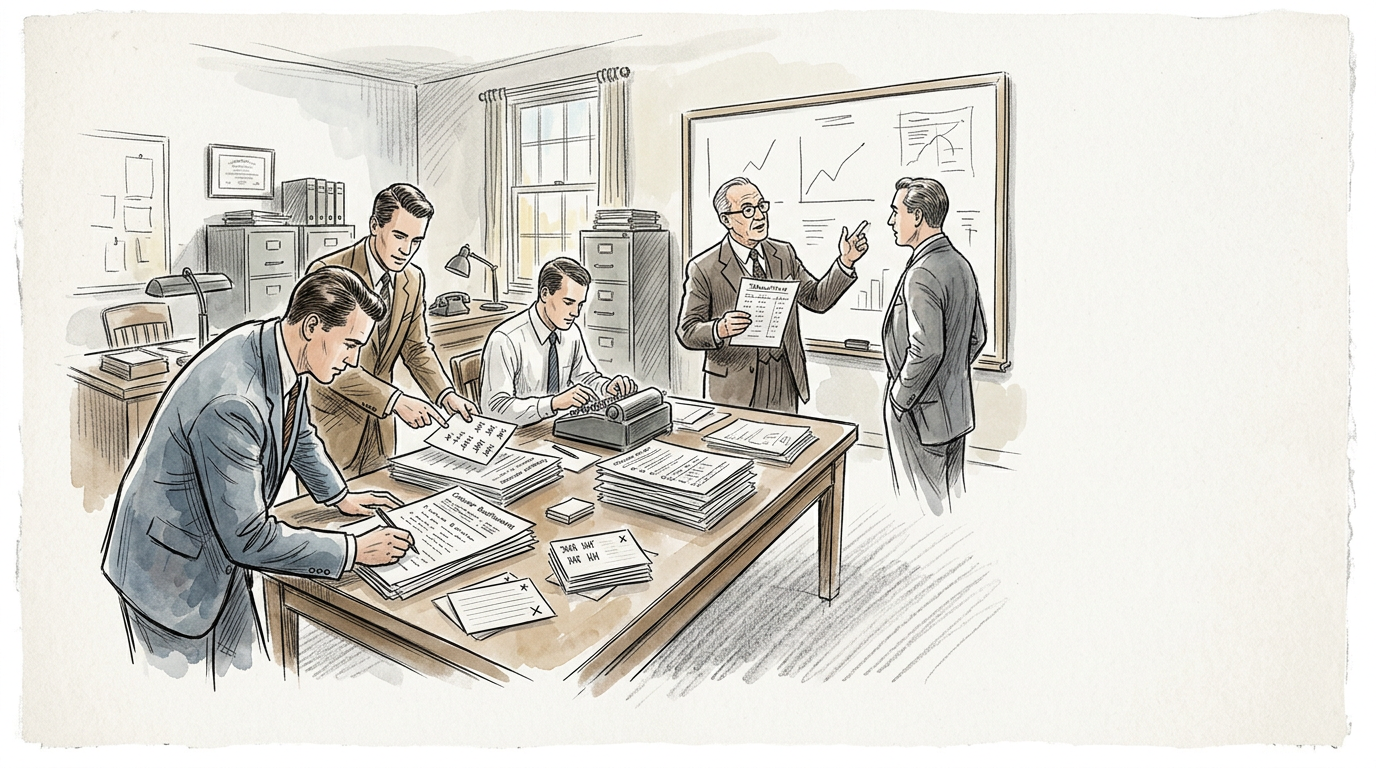
Market research did not begin as a specialized corporate function with formal questionnaires, sampling procedures, and dashboards of quantified results. It emerged gradually as American and European businesses confronted a basic problem of modern commerce: once production, distribution, and retailing expanded beyond local markets, managers could no longer rely on face-to-face familiarity, merchant instinct, or anecdotal reports from salesmen to know what customers wanted, what stores were selling, or how prices and products were performing. The profession developed in response to distance, scale, and complexity.
By the early twentieth century, manufacturers were shipping branded goods into national markets, chain stores and department stores were changing retail competition, mass media were widening the reach of sales messages, and large firms were delegating authority across regions and product lines. In that environment, market knowledge had to be gathered more systematically. What became market research was not one invention or one founder’s creation. It was a convergence of older commercial reporting practices, statistical methods, social surveying, opinion polling, psychology, retail auditing, and corporate administration. Over time, those strands were organized into a recognizable profession with its own departments, firms, trade associations, standards, and educational pathways.
Before market research was a profession, market knowledge was local and fragmented
For much of the nineteenth century, most businesses learned about demand through direct commercial contact. Shopkeepers observed buying patterns at the counter. Traveling salesmen reported conditions from the field. Wholesalers and jobbers transmitted information about local tastes, creditworthiness, and competitor activity. Merchants also read trade papers, monitored crop conditions and transport costs, and watched census data where available. This was market intelligence, but it was rarely separated from selling, merchandising, or distribution.
As industrialization advanced, this older system became less adequate. National brands in packaged goods, proprietary medicines, farm equipment, and household products depended on markets far removed from the factory. Railroads and telegraph networks allowed goods and information to move at unprecedented speed, but they also enlarged the gap between producers and end consumers. Producers increasingly sold through layers of intermediaries rather than directly to buyers. As a result, manufacturers often knew production volumes and shipments better than actual consumer demand.
This was one of the central managerial problems that market research would later address. A business could have strong factory output and broad distribution but weak knowledge of who was buying, why they were buying, how often they were repurchasing, and what alternatives they were considering. Early marketing institutions formed around exactly this problem.
Academic marketing itself took shape in this context. Courses in marketing and distribution began appearing in American universities in the early twentieth century as business schools tried to explain the movement of goods from producer to consumer. Works such as Arch Wilkinson Shaw’s writing on market distribution and Paul T. Cherington’s studies of merchandising and advertising reflected a new effort to analyze markets as systems rather than as a series of isolated transactions. The concern was not only how to persuade buyers, but also how to understand channels, territories, consumer demand, and commercial information.
The statistical state and the modern corporation created the conditions for research
The rise of market research depended on institutional developments outside marketing as well. Governments were expanding statistical reporting. The U.S. Census Bureau, created in its permanent form in 1902, provided increasingly detailed demographic and industrial information. Agricultural reports, labor statistics, import and export records, and urban population counts all helped firms estimate the size and geography of markets. These data were imperfect for marketing decisions, but they encouraged a new habit of managerial quantification.
At the same time, the modern multiunit corporation required more formal internal reporting. As firms grew, executives needed comparable information across regions, products, and sales forces. Accounting systems became more sophisticated. Sales analysis by territory, product line, and account developed further. Trade associations also compiled industry figures and circulated market bulletins. In other words, the move toward market research was part of a wider movement toward managerial control through records, reports, and statistics.
This mattered because research became credible inside firms not simply as a technical tool but as a management aid. Executives facing larger inventories, broader distribution, and greater promotional expense increasingly wanted evidence that could travel upward through the organization. A salesman’s impression or a branch manager’s intuition still had value, but it no longer seemed sufficient for decisions involving national pricing, package redesign, product launches, or regional expansion.
Charles Coolidge Parlin and the first organized commercial research work
One of the most important documented turning points came in 1911, when the Curtis Publishing Company hired Charles Coolidge Parlin to conduct what is widely recognized as one of the first sustained commercial market research programs in the United States. Curtis, publisher of mass-circulation magazines such as The Saturday Evening Post and Ladies’ Home Journal, had a practical reason for supporting such work. It needed stronger evidence about markets in order to help persuade national advertisers and to position itself as more than a seller of advertising space.
Parlin’s work, later associated with Curtis’s Commercial Research Division, did not resemble modern online surveys or digital analytics. It relied on extensive field investigation, interviews, observation, trade contacts, and the assembly of data from multiple sources. He produced influential studies of industries including farm implements, automobiles, department stores, and groceries. His reports attempted to map how goods were bought and sold, who the relevant intermediaries were, and what broad patterns of demand and distribution characterized a market.
What made Parlin important was not that he single-handedly invented market research. Rather, he demonstrated that a business could dedicate staff and budget to the organized study of markets as an ongoing function. His work showed that research could address strategic questions beyond immediate sales results. It could help management understand channel structure, regional potential, retail practices, and consumer purchasing conditions. That was a major step away from the older dependence on informal market familiarity.
The University of Pennsylvania’s history of the Wharton School and later scholarship on early marketing thought have documented Parlin’s role in connecting commercial practice with the emerging academic language of marketing and distribution. His work also helped legitimize the idea that information about markets had commercial value in its own right.
Trade journals, publishers, and agencies helped normalize research
Early market research spread not only through manufacturing firms but also through adjacent institutions that benefited from better market knowledge. Publishers wanted circulation and readership information. Advertising agencies needed evidence to support media decisions and client recommendations. Trade journals published surveys of retail practices, dealer sentiment, and consumer demand. Retailers and manufacturers commissioned special studies to understand specific territories or product classes.
This ecosystem mattered because professions usually emerge through repeated commercial use before they are fully theorized. Research gained legitimacy because different parts of the marketing system found it useful for their own purposes. A publisher might study household purchasing habits to attract advertisers. A manufacturer might analyze dealer stocks and consumer preferences to refine packaging or pricing. A chain retailer might investigate traffic patterns, category turnover, and regional assortment needs. These were not all the same activity, but together they broadened the notion that business decisions should be informed by organized evidence.
Advertising agencies played a role, though not the central role. Agencies such as J. Walter Thompson developed research functions in the interwar period, often to support account planning, media selection, copy testing, and audience analysis. The significance for marketing history is that research was increasingly treated as part of market strategy, not only as support for promotion. Audience measurement, readership analysis, and consumer study overlapped with broader questions of segmentation and product positioning.
The 1920s and 1930s turned research into a recognizable business service
The 1920s saw rapid growth in branded consumer goods, chain retailing, installment buying, national magazine circulation, and radio. It also saw the spread of business-minded management culture in large firms. These changes increased the demand for more standardized market information. Research firms and corporate departments began to offer or conduct store audits, dealer checks, consumer surveys, product-use studies, and market sizing exercises.
One of the best-known commercial developments was the founding of A.C. Nielsen in 1923. Nielsen’s company initially focused on industrial performance surveys, but it became especially important for retail measurement. Its retail audit methods helped manufacturers and retailers estimate market shares and track sales movement by brand and category. This represented a significant shift in what counted as market knowledge. Instead of relying only on shipment data or reports from sales representatives, firms could use external measurement systems to compare their performance against competitors in a more structured way.
The interwar years also saw the growth of survey interviewing and opinion measurement. Daniel Starch developed methods for measuring readership and advertising response in the 1920s. George Gallup, trained in journalism and psychology, later became prominent for opinion polling techniques in the 1930s. Gallup is more often remembered in political polling history, but the wider significance for marketing is methodological. Polling demonstrated that organizations could use sampling to estimate attitudes and behaviors in larger populations without talking to every individual. That principle became foundational for commercial surveys.
The Literary Digest polling failure in 1936, contrasted with Gallup’s more successful sample-based methods, is often cited in survey history for political reasons. Its broader professional importance was that it dramatized the difference between large but biased data collections and smaller, more carefully designed samples. Market research would continue to struggle with representativeness, questionnaire effects, and response bias, but by the late 1930s a more technical language of sampling and survey design had entered commercial practice.
During the same period, psychology influenced research methods as well. Businesses and agencies became interested in motives, habits, memory, attention, and consumer attitudes. Some of this work was rigorous by the standards of the time; some was speculative. But it expanded the field beyond counting units sold. Research increasingly aimed to explain not just what markets did, but why buyers chose among alternatives.
Research departments emerged because managers could no longer synthesize the market alone
The rise of dedicated research departments inside corporations was tied to organizational growth. As companies widened their product lines and territories, senior executives could not personally absorb all relevant sales reports, distributor feedback, store checks, and consumer correspondence. Nor could sales departments alone be trusted to supply neutral information, since sales organizations were often rewarded for immediate volume rather than long-range analysis.
By the 1920s and 1930s, many larger companies in packaged goods, durable goods, retailing, and publishing had begun to formalize research functions. These units were called by various names: commercial research, market analysis, consumer research, sales research, merchandising research. The variation is historically important because it shows that the modern “marketing research department” did not appear fully formed. Responsibilities were distributed unevenly across companies. In some firms, research sat near sales. In others, it was tied to advertising, product planning, merchandising, or executive management.
The business problem, however, was consistent. Management needed a structured way to answer questions such as these:
- How large is the market, and where is it growing?
- Which retail channels are gaining share?
- What package sizes and price points move fastest?
- How do consumers use the product in the household?
- Which regions respond differently to the same offer?
- How much of a sales change reflects distribution rather than preference?
These are now familiar marketing questions. Historically, their importance lies in the fact that they had become too consequential to leave entirely to informal judgment. Research departments professionalized market knowledge by making those questions part of routine organizational work.
The Great Depression increased the demand for disciplined information
Economic crisis accelerated the practical importance of research. In the 1930s, shrinking purchasing power, volatile demand, and intensified competition made waste more visible. Companies had stronger incentives to understand what consumers could afford, which product features justified a purchase, and how retailers were adjusting assortments and margins. Research became a tool not only for growth but also for survival.
The Depression also sharpened interest in income segmentation, price sensitivity, and consumer confidence. Household budgets mattered in more explicit ways. Businesses looked for data that could distinguish temporary decline from structural market change. Retailers experimented with different assortments and promotional tactics. Manufacturers studied package sizes, lower-price lines, and regional demand variation.
This period helped establish an enduring link between research and managerial accountability. When resources were constrained, executives wanted stronger justification for product launches, media expenditures, and inventory commitments. Research was valuable because it could reduce uncertainty, even if it could not eliminate it.
Professional associations and standards made research a field rather than an activity
A profession requires more than demand for services. It also requires institutions that define acceptable practice, circulate methods, and create occupational identity. Market research moved in that direction during the first half of the twentieth century.
The American Marketing Society was formed in 1931 and the National Association of Marketing Teachers in 1933; the two groups merged in 1937 to form the American Marketing Association. That merger matters because it linked practitioners and academics at a time when marketing was still consolidating its intellectual and organizational boundaries. Research methods, terminology, and case evidence circulated through journals, conferences, and textbooks, helping to standardize what counted as marketing knowledge.
On the commercial side, the market research field developed its own organizations. The Market Research Society in the United Kingdom traces its origins to the late 1940s, and in the United States the marketing and opinion research field eventually organized through bodies that later became part of the Insights Association. These institutions promoted discussion of method, ethics, sampling, interviewing standards, and professional training.
Trade publications also played a major role. Journals, handbooks, and conference proceedings allowed practitioners to compare techniques and report results. This is one reason market research became a profession rather than merely a collection of internal company tasks. Practitioners came to see themselves as engaged in a specialized form of business inquiry requiring technical judgment.
After World War II, research expanded with consumer markets and managerial planning
The decades after World War II brought conditions that greatly favored the expansion of professional market research. Mass consumer markets grew, suburban retail patterns changed distribution, television altered media planning, and large corporations institutionalized long-range planning. At the same time, business schools expanded and quantitative methods gained status in management education.
In this environment, research broadened from descriptive inquiry into a more integrated decision support system. Consumer panels, brand tracking, usage and attitude studies, concept testing, package testing, and test marketing became more common. Survey research benefited from better statistical techniques and growing familiarity with probability sampling. Mainframe computing later made it easier to tabulate larger data sets and cross-classify results by income, geography, household type, and product usage.
Panel research was especially important. By repeatedly collecting data from the same households or retail outlets, firms could observe continuity and change rather than isolated snapshots. This improved understanding of brand switching, repeat purchase, and the effects of promotions over time. Such tools fit the needs of postwar brand management, where companies sought not only broad awareness but also sustained market share in competitive packaged-goods categories.
The rise of brand management itself reinforced the demand for research. Procter & Gamble’s well-known brand management system, often traced to a 1931 internal memorandum by Neil H. McElroy, did not create market research, but it helped institutionalize a decision structure that depended on category information, consumer feedback, and comparative performance measures. Brand managers needed regular market intelligence to make recommendations on product reformulation, positioning, packaging, and promotional support. Research therefore became embedded in organizational routine.
Motivation research, depth interviews, and qualitative methods widened the field
Not all postwar developments moved toward ever more mechanical quantification. In the 1940s and 1950s, qualitative and psychologically oriented approaches also gained prominence. Ernest Dichter and others popularized motivation research, arguing that conventional surveys often missed symbolic and emotional aspects of consumption. Depth interviews and projective techniques were used to explore meanings associated with products, brands, and household routines.
Some claims made by motivation researchers were later criticized as overstated, impressionistic, or insufficiently validated. Those criticisms are part of the history. But the movement mattered because it widened professional understanding of what research might cover. It suggested that consumer behavior could not be reduced to price and distribution alone, and that interviews and interpretive methods had a place alongside tabulations and ratings. Modern qualitative research, ethnography, and customer insight work owe part of their lineage to these debates, even if current standards are different.
The profession thus developed through tension, not consensus. Researchers argued over rigor, representativeness, psychological interpretation, and the proper relationship between data and managerial judgment. That disagreement was productive. It forced clearer distinctions among audience measurement, retail audits, sample surveys, focus groups, and observational methods.
Research became more technical as marketing itself became more segmented
From the 1950s through the 1970s, marketing strategy increasingly emphasized segmentation, product differentiation, and portfolio management. Wendell R. Smith’s influential 1956 article “Product Differentiation and Market Segmentation as Alternative Marketing Strategies,” published in the Journal of Marketing, helped codify an approach already emerging in practice. As firms moved away from treating the mass market as uniform, research had to identify meaningful differences among consumers, situations, and channels.
This period also saw the development of increasingly sophisticated analytical tools. Multivariate analysis, attitude scaling, conjoint-related approaches, and improved forecasting models entered commercial use at different rates depending on the industry. Computerization supported larger and more complex data handling. Scanner-based retail data, introduced later in the twentieth century, further improved the speed and granularity of sales measurement.
Yet the deeper historical point is not simply that methods became more advanced. It is that managerial expectations changed. Executives increasingly assumed that marketing decisions should be informed by formal evidence. Research was no longer an occasional special project. It became part of annual planning, new-product screening, pricing decisions, distribution reviews, and customer satisfaction programs.
Direct marketing and databases changed research from episodic measurement to ongoing customer knowledge
Another major step in professionalization came through direct marketing and database practices. Long before digital platforms, catalogers, mail-order firms, magazine publishers, and continuity marketers kept customer records and tested offers. Companies such as Sears, Roebuck and Montgomery Ward had long relied on systematic information about orders, territories, seasonality, and response. By the late twentieth century, improved computing power made it increasingly practical to merge transactional, demographic, and behavioral information at scale.
This changed the relationship between research and action. Instead of studying a market only through periodic surveys, firms could analyze customer files, response rates, recency and frequency patterns, and lifetime value proxies. Database marketing turned research into an operational tool for targeting, retention, and relationship management. It also blurred old boundaries between market research, analytics, direct marketing, and customer management.
Historically, this is one reason modern marketers should avoid treating data-driven customer insight as entirely new. Many core ideas behind CRM, loyalty analysis, and personalization emerged from earlier forms of list management, panel data, direct response testing, and statistical segmentation. Digital tools increased scale and speed, but they built on older professional habits of measuring customers systematically.
Academic marketing research helped define the profession’s language and limits
As market research developed in business, academic marketing helped stabilize its concepts. Journals, textbooks, and graduate training translated scattered practices into more formal frameworks. Marketing scholars worked on buyer behavior, measurement, channels, diffusion, segmentation, and decision models. The discipline increasingly borrowed from economics, statistics, psychology, sociology, and later computer science.
This relationship between academia and practice was never seamless. Practitioners often needed speed, cost control, and actionable direction more than methodological elegance. Scholars often sought conceptual clarity and replicable findings. Even so, the interaction mattered. It professionalized market research by making methods discussable, teachable, and critiqueable across organizations.
It also exposed limitations. Survey responses did not always predict behavior. Samples could underrepresent important populations. Retail audits measured movement, not motives. Focus groups could generate useful language but distort prevalence. Statistical sophistication could create false confidence when underlying data were weak. These are not recent discoveries. They are longstanding features of the profession’s history.
Why the profession emerged when it did
Market research became a profession when several historical forces converged:
Industrial and retail scale made informal knowledge insufficient. National distribution and multiunit retailing distanced decision-makers from everyday buying behavior.
Managerial complexity created demand for comparable evidence. Larger organizations needed standardized information that could circulate beyond local branches and individual sales territories.
Statistical and survey methods became more available. Government statistics, opinion polling, sampling theory, and business tabulation practices gave firms usable tools.
Marketing itself became an organizational function. As responsibility for products, brands, pricing, channels, and consumers became more differentiated, research gained a stable role.
Professional institutions reinforced standards. Associations, journals, conferences, and specialized firms turned scattered practices into recognized expertise.
Technology lowered the cost of handling information. From tabulating machines to mainframes to customer databases, each wave expanded what researchers could measure and analyze.
No single factor explains the transition. Research did not become professional because executives suddenly discovered objectivity, nor because one method proved universally superior. It emerged because modern markets created recurring information problems that intuition alone could not solve.
What this history still explains about modern marketing
The history of market research is ultimately the history of how marketing learned to operate under conditions of uncertainty at scale. Research gave firms a way to ask structured questions about markets they could not directly see. It helped bridge the distance between factories and households, headquarters and stores, brands and buyers. It also changed the internal status of marketing. Once consumer and channel knowledge could be gathered systematically, interpreted professionally, and used repeatedly, marketing moved closer to the center of managerial decision-making.
That legacy remains visible today. Contemporary marketers work with digital analytics, customer data platforms, A/B testing, social listening, and machine learning. But the underlying professional problem is familiar: how to convert scattered signals from a large, changing market into decisions about products, prices, channels, and customer relationships. The profession of market research emerged when businesses first confronted that problem in a sustained way.
Its history is useful precisely because it discourages easy myths. Market research was never a straight march from instinct to perfect measurement. It has always involved incomplete data, methodological argument, organizational politics, and interpretation. Yet it became indispensable because modern marketing could not function for long without a disciplined way to know its markets.
Leave a Reply