
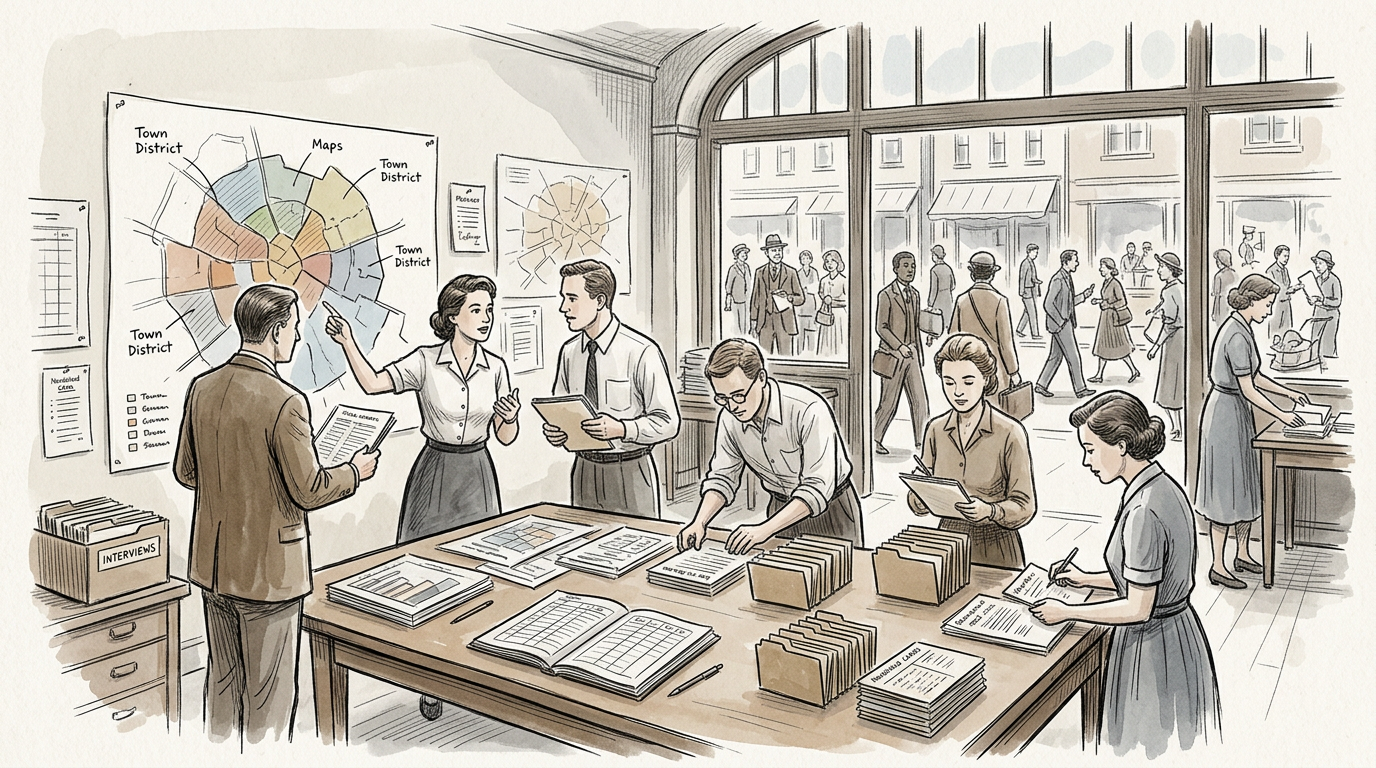
Market segmentation is so familiar in contemporary marketing that it can seem timeless. Marketers routinely divide audiences by age, income, geography, usage patterns, attitudes, life stage, or predicted value, then adjust products, pricing, channels, and communications accordingly. But segmentation was not always the default way to think about markets. It developed gradually as firms, retailers, researchers, and academics came to recognize a practical problem that mass production had first obscured and then intensified: markets were large enough to support standardization, yet varied enough that treating all buyers alike left money on the table.
The history of segmentation is therefore not just the story of a concept in textbooks. It is part of the larger history of marketing becoming a specialized business function and academic discipline. As manufacturers expanded beyond local trade, as retailers created more differentiated assortments, as market research improved, and as postwar consumer societies grew more complex, marketers needed more precise ways to identify whom they were serving and why. Segmentation became one of the central answers.
Before segmentation, markets were often organized by place, class, and trade custom
Long before marketers used the term “segmentation,” merchants recognized that buyers differed. Nineteenth-century retailers often stocked merchandise by locality, season, income, occupation, or ethnic community. Mail-order firms learned that rural households wanted different goods and purchasing arrangements than urban department store customers. Manufacturers selling through wholesalers and jobbers knew that regional distribution patterns mattered. Producers of proprietary medicines, agricultural equipment, ready-made clothing, and household goods all encountered differences in demand.
Still, these distinctions were not yet a fully articulated segmentation framework. In much of the late nineteenth and early twentieth centuries, firms expanding into national markets were preoccupied with a different challenge: how to make and distribute standardized goods at scale. Railroad networks, national magazines, improved printing, branded packaging, trademark law, and chain and department store retailing all made broader distribution possible. In that environment, many business leaders pursued what would later be called mass marketing. The operational logic was clear. Standard products lowered production costs, simplified distribution, and made national promotion more efficient.
This was the era in which many firms behaved as though a large national market could be addressed with a relatively uniform offer. That did not mean all consumers actually wanted the same thing. It meant that the institutions of modern mass marketing, especially branded packaged goods and national distribution, rewarded standardization.
Even in that period, however, cracks in the homogeneous-market assumption were visible. Department stores differentiated merchandise for distinct price strata and social uses. Mail-order catalogs varied their assortments for farm families, newly urban consumers, and regional climates. Women’s ready-to-wear producers tracked changing tastes by age and occasion. Magazine publishers developed circulation claims based on reader type and geography. The practice came before the formal theory.
Early twentieth-century marketing thought began naming market differences
The academic field of marketing emerged in the United States in the early twentieth century, initially with a strong emphasis on distribution, trade channels, and functions of marketing rather than on consumer targeting in the modern sense. Early textbooks and courses at institutions such as the University of Michigan, the University of Wisconsin, Harvard, and others examined how goods moved from producer to consumer, how middlemen operated, and how markets were organized.
As the field developed, scholars increasingly described differences among consumers and buying situations. Arch W. Shaw, whose work in the 1910s helped define marketing as a business activity, emphasized planning and functional coordination. Paul D. Converse, Ralph Starr Butler, and Melvin T. Copeland contributed to the classification of goods, channels, and buying patterns. Copeland’s product classifications, especially his distinctions among convenience, shopping, and specialty goods in the 1920s, were not segmentation in the later STP sense, but they recognized that consumer behavior varied by product type and buying effort. That mattered because it implied that markets could not be understood solely in aggregate.
By the interwar period, business practice was also becoming more differentiated. Automakers offered model variations by price and status. National food and household brands increasingly produced package sizes for different household budgets and retail settings. Publishers and broadcasters sold audiences by circulation territory, household composition, and purchasing power. Marketing did not yet possess a settled segmentation vocabulary, but firms were already sorting markets by observable differences.
General Motors and the managerial case for differentiated markets
One of the most frequently cited developments in the history of segmentation is Alfred P. Sloan Jr.’s strategy at General Motors in the 1920s. Sloan did not invent segmentation as a theory, and it would be misleading to portray GM as the single origin point. But GM’s approach helped demonstrate the managerial value of serving stratified demand rather than relying on one standardized product formula.
In contrast to Ford’s long commitment to the Model T, GM organized a portfolio of car brands at ascending price levels, coordinated through what Sloan described in his 1963 memoir My Years with General Motors as a “car for every purse and purpose.” That phrase has become shorthand for market differentiation. More important than the slogan was the system behind it: product lines targeted to different income levels and preferences, annual model change, dealer coordination, consumer credit through General Motors Acceptance Corporation, and brand ladders that encouraged customers to trade up over time.
GM’s strategy was enabled by rising incomes, installment buying, urban and suburban mobility, and a consumer culture in which automobiles had social as well as transportation value. The company was not merely advertising to different buyers. It was building segmentation into product policy, pricing, retail distribution, and brand architecture.
That model had broad influence. It showed that differentiated demand could be organized profitably inside a large national corporation. It also revealed an enduring truth of segmentation: it is not simply an audience-description exercise. It becomes strategically significant when the firm changes its offer, not just its message.
Market research made segmentation more systematic
Segmentation became more central as marketers gained better tools for studying demand. In the early twentieth century, firms relied heavily on sales reports, dealer feedback, credit records, trade knowledge, and circulation figures. During the 1920s and 1930s, market research developed into a more recognizable function. Daniel Starch’s work on readership and advertising research, George Gallup’s survey methods, and the expansion of commercial research services helped normalize the idea that customer groups could be measured rather than merely inferred.
The growth of consumer panels and audience measurement was especially important. Arthur C. Nielsen founded the A.C. Nielsen Company in 1923. Nielsen became known first for market-share measurement and later for radio audience measurement beginning in the 1930s. These systems did not create segmentation by themselves, but they strengthened a data-oriented culture in which differences among households, regions, and usage patterns could be quantified and compared.
The Great Depression also sharpened attention to differences in purchasing power. Income strata mattered more visibly when consumers traded down, deferred purchases, or shifted package sizes and retail outlets. Researchers and managers had to ask which customers remained profitable, which products were vulnerable, and which local markets behaved differently under economic stress. That was a practical pressure toward segmentation, even if the language remained uneven.
By the 1940s and 1950s, survey research, household panels, syndicated data, and statistical analysis gave marketers more confidence in slicing the market into meaningful groups. The rise of television and broad national media might suggest a renewed era of pure mass marketing, but the opposite was happening beneath the surface. Standardized media buying often coexisted with increasingly segmented planning in product development, retailing, package design, and promotion.
Wendell R. Smith gave segmentation its classic formulation
The article most often treated as the foundational academic statement of segmentation is Wendell R. Smith’s “Product Differentiation and Market Segmentation as Alternative Marketing Strategies,” published in the Journal of Marketing in July 1956 by the American Marketing Association. Smith did not claim that firms had never divided markets before. His contribution was to define segmentation clearly and place it at the center of strategy.
Smith argued that heterogeneous demand was the starting point. Rather than viewing a market as a single undifferentiated whole, firms could divide it into smaller segments whose members shared common characteristics or responses. He distinguished market segmentation from product differentiation, though in practice the two often interacted. Product differentiation, in Smith’s treatment, altered the offer to make it distinct in buyers’ eyes, often across a broad market. Segmentation, by contrast, began with recognition that different groups might require different market offerings or marketing programs.
This mattered because it translated scattered business practices into a coherent marketing logic. Segmentation was no longer just something astute merchants or product managers did instinctively. It became a formal approach to demand analysis.
Smith’s timing was significant. Postwar prosperity had enlarged consumer markets, but it had also multiplied consumer choices. Baby boom households, suburban growth, expanded credit, television, self-service retailing, and growing national competition all created conditions in which finer market distinctions could be profitable. As product categories matured, manufacturers could no longer rely only on broad market expansion. They increasingly needed share growth within crowded categories. Segmentation offered a way to find and defend positions.
Demographic segmentation became the most practical early framework
Although marketers had long noticed differences in age, sex, income, family status, and occupation, demographic segmentation became especially prominent in the mid-twentieth century because it was operationally convenient. Demographic variables were relatively easy to observe, available in government census data, and usable in media planning, retail expansion, and sales forecasting.
The U.S. Census Bureau had, of course, collected population data long before modern segmentation theory. What changed was how marketers used that information. Postwar firms increasingly mapped demand using household formation, family size, income distribution, educational attainment, and migration patterns. Suburbanization made household demographics particularly valuable. Appliance makers, packaged-goods firms, homebuilders, financial services companies, and retailers all used demographic profiles to estimate where demand was growing and which product lines fit local markets.
Trade publications and business books from the 1950s and 1960s show how routinely marketers discussed age groups, family life cycle, and income brackets. The “teenager” emerged as a commercially recognized market category during the postwar decades, not because adolescence had suddenly appeared, but because rising disposable income, school-centered youth culture, and media industries made that age segment newly consequential. The same was true of “young marrieds,” retirees, and later dual-income households.
Demographic segmentation remained attractive because it linked easily to business decisions. Package sizes could be adjusted for family size. Product assortments could be aligned with income tiers. Store locations could be chosen based on neighborhood composition. Media could be bought according to age and sex audiences. Direct mail lists could be rented using household characteristics.
Its limitations were also evident. Demographics could describe who buyers were, but not always why they bought, what benefits they sought, or how intensively they used a category. Two households with similar incomes might have very different tastes, habits, and purchase motives. That gap would drive later developments.
Geographic segmentation grew with national distribution and local retail intelligence
Geographic segmentation has deep roots because commerce has always varied by climate, settlement pattern, culture, and transportation networks. But it became a more deliberate marketing system as firms expanded nationally and then internationally. Regional differences in consumption were visible in food preferences, apparel, housing, language, weather-sensitive products, and retail formats.
National manufacturers learned that a single distribution strategy rarely fit all territories. Package assortments, shipping schedules, and merchandising systems had to reflect local demand. Chain stores and supermarket operators refined these distinctions. As self-service grocery retailing spread in the mid-twentieth century, retailers relied on local sales data and neighborhood knowledge to adjust assortments. Producers in turn confronted a more segmented selling environment.
By the 1960s and 1970s, improvements in computers, store-level reporting, and scanner technology sharpened geographic segmentation. The introduction of the Universal Product Code in the 1970s and the growth of point-of-sale data in subsequent decades made it easier to compare purchasing patterns by region, store cluster, and neighborhood type. Retailers and packaged-goods manufacturers could now observe geographic variation in near real time rather than relying mainly on field reports or periodic surveys.
Geodemographic systems later combined location and household characteristics in more formal ways. PRIZM, developed by Claritas in the 1970s, became one of the best-known examples, clustering neighborhoods by demographic and lifestyle patterns. Such systems translated census and local market data into actionable territory planning tools for direct mail, retail site selection, media buying, and merchandising.
Geographic segmentation demonstrated that “place” in marketing was never just a distribution problem. It was also a demand pattern.
Behavioral segmentation emerged from usage data and purchase observation
Behavioral segmentation focuses on what customers do: how often they buy, how much they use, what occasions trigger purchase, which benefits they seek, and how loyal or price-sensitive they appear. Its history is closely tied to the development of measurable customer records.
Some behavioral distinctions had long existed in commercial practice. Retailers recognized regulars and occasional shoppers. Sales managers separated heavy accounts from light accounts. Mail-order houses tracked recency and frequency in rudimentary forms well before digital databases. Coupon redemption, catalog response, and repeat ordering all revealed behavioral differences.
What changed in the mid-twentieth century was the increasing ability to formalize those patterns. Consumer panels, retail audits, and syndicated data made category usage more measurable. Later, scanner systems, loyalty programs, and database marketing would greatly expand this capacity, but the conceptual shift was already underway by the 1950s and 1960s.
A major milestone came with benefit segmentation. In 1968, Russell H. Haley published “Benefit Segmentation: A Decision-Oriented Research Tool” in the Journal of Marketing. Haley argued that the causal force behind market segments often lay not in descriptive characteristics such as age or income but in the specific benefits consumers sought from a product category. Toothpaste buyers, for example, might prioritize economy, taste, cosmetic effect, or medicinal claims. Demographic variables might correlate with those preferences, but they did not define them.
Benefit segmentation was historically important because it moved the field closer to actionable demand differences rooted in purchase motivation and product choice. It gave product managers a way to organize competition around customer value sought rather than around surface descriptors alone.
Behavioral segmentation also expanded through direct marketing. Catalogers, subscription businesses, credit card issuers, and later airlines and hotel chains built systems around frequency, loyalty, and lifetime value. The direct marketing field, represented by firms using customer files and response measurement, often advanced practical behavioral segmentation faster than broad-reach brand advertising did. Marketers who had to pay for postage, telemarketing time, or database processing could not afford to treat all customers alike.
Psychographic segmentation reflected both new research ambition and new uncertainty
Psychographic segmentation emerged from the effort to understand consumers in terms of attitudes, interests, opinions, activities, aspirations, and lifestyles. It gained prominence in the 1960s and 1970s, when affluence, social change, youth culture, and a more expressive consumer marketplace made purely demographic descriptions feel insufficient.
The intellectual background included motivation research, consumer psychology, and sociological studies of status and taste. Earlier researchers such as Ernest Dichter had explored symbolic and emotional dimensions of consumption, though motivation research also attracted criticism for overinterpretation and methodological looseness. By the late 1960s, more formal lifestyle research was becoming common in market analysis.
One influential development was the Activities, Interests, and Opinions framework, often shortened to AIO, used in consumer research to describe lifestyle patterns. Another was the Values and Lifestyles system, or VALS, introduced by SRI International in 1978 under the direction of Arnold Mitchell. VALS attempted to classify U.S. consumers according to psychological orientation and resources. It quickly attracted business attention because it seemed to explain why demographically similar households made different consumption choices.
Psychographics helped marketers in categories tied to identity, taste, media use, leisure, and self-expression. Apparel, automotive, travel, financial services, food, and media brands all used lifestyle-based segmentation to position offerings more precisely. Retailers and magazine publishers also benefited from psychographic distinctions, especially when audience identity mattered as much as basic household traits.
At the same time, psychographics exposed a recurring problem in segmentation history: not every elegant research typology translates into durable business practice. Some lifestyle schemes were too broad, too unstable, too dependent on proprietary methods, or too disconnected from actual buying behavior. Psychographic segmentation widened the field’s conceptual ambition, but it also reminded marketers that segments must be measurable, reachable, and economically meaningful.
Business-to-business marketing developed its own segmentation logic
Segmentation is often discussed as though it originated primarily in consumer packaged goods, but business-to-business marketing developed parallel approaches. Industrial marketers had long divided customers by industry, plant size, region, application, and purchasing volume. As procurement systems grew more complex in the twentieth century, suppliers increasingly segmented accounts by technical needs, usage intensity, channel role, and service requirements.
Academic attention to industrial segmentation expanded in the postwar period, especially as business marketing became a more distinct subfield. Organizational buying behavior, buying centers, and account classification encouraged marketers to move beyond simple industry categories. Firms selling machinery, chemicals, office systems, and later software and professional services all had to distinguish among customer types in ways that affected product configuration, sales support, distribution, and pricing.
This history matters because it shows segmentation was never only about consumer lifestyle imagery. In many industries, segmentation developed as a hard managerial necessity tied to service costs, sales force deployment, customization, and long-term account value.
Segmentation became central to modern strategy through STP
By the late 1960s and 1970s, segmentation was increasingly joined to targeting and positioning in marketing planning. This linkage helped make segmentation central rather than peripheral. It was no longer just one analytical technique among many. It became the first step in deciding which customers a firm would serve, how it would compete, and what value proposition it would emphasize.
The broader strategic turn in marketing was shaped by both scholarship and practice. The growth of product management, portfolio planning, and formal annual marketing plans required clearer choices about where to allocate resources. Competitive pressure in mature consumer markets made “everyone” an impractical target. Firms needed a rationale for selective investment.
Positioning theory, especially as articulated by Al Ries and Jack Trout in the 1970s in the context of market communication and competitive perception, interacted with segmentation even though it emerged from a somewhat different lineage. A company could not effectively position a brand without clarity about which segment it wanted to occupy in the customer’s mind. In business schools and textbooks, segmentation-targeting-positioning eventually became a standard planning sequence.
This standardization also reflected the professionalization of marketing. As the field matured, managers, consultants, researchers, and educators needed common frameworks that could be taught, repeated, and embedded in organizational processes. Segmentation moved from being a useful habit of good merchants and product managers to being an expected competence of the marketing function.
Retailing, databases, and digital systems made segmentation more granular
The late twentieth century transformed segmentation from a mostly periodic analytical exercise into a more continuous operating capability. Several developments were central.
First, retail data improved dramatically. Scanner data, category management, and retailer-manufacturer information sharing made it easier to observe variation by store, region, promotion response, and purchase bundle. Second, database marketing expanded. Customer records that once supported mailing lists now informed more sophisticated models of recency, frequency, monetary value, churn risk, and cross-sell potential. Third, loyalty programs gave firms direct behavioral histories tied to identifiable households.
Airlines’ frequent-flyer programs, launched in the early 1980s, showed how segmentation could be combined with retention strategy and differential rewards. Financial services companies, catalog merchants, and nonprofit fundraisers also developed increasingly refined customer scoring models. By the 1990s, CRM systems promised a unified customer view, though in practice firms varied widely in how effectively they used these tools.
Digital commerce and platform-based marketing then expanded segmentation still further. Web analytics, search behavior, email response, mobile location data, and algorithmic classification created new forms of real-time audience selection. Yet this digital turn did not replace earlier segmentation history so much as intensify it. Many “new” digital practices, including propensity modeling, lookalike targeting, triggered messaging, and personalization, build on older direct-marketing principles: identify meaningful differences, measure response, and adjust the offer.
What changed was speed, scale, and automation. Segments that once had to be inferred from surveys or census tables could now be updated continuously from transactional and behavioral signals.
Needs-based segmentation became a bridge between research and strategy
As segmentation matured, marketers increasingly sought approaches that connected observed differences to the underlying job the customer was trying to accomplish. Needs-based segmentation grew from dissatisfaction with descriptive schemes that were easy to tabulate but weak at explaining demand.
Its roots can be found in several streams of marketing thought: benefit segmentation, consumer behavior research, service quality studies, innovation research, and consultative business marketing. By the late twentieth century, many firms and consultancies were organizing segments around clusters of needs, desired outcomes, or use cases rather than around demographics alone.
This was especially important in categories where the same buyer could behave differently by occasion. A traveler might want speed on one occasion, reassurance on another, and luxury on a third. A business customer might prioritize cost reduction, integration, compliance, or support depending on application. A needs-based approach allowed marketers to align product design, service levels, channel choice, and messaging more closely with the circumstances of demand.
The enduring appeal of needs-based segmentation is that it returns to Smith’s central insight about heterogeneous demand. The most useful segments are not merely groups that look different. They are groups whose differences matter for strategy.
Segmentation also produced problems, limits, and criticism
The history of segmentation is not a story of steady methodological improvement without complications. Marketers and scholars have long warned that segments can be arbitrary, unstable, or commercially irrelevant. A segment must be meaningful enough to act on, large or profitable enough to serve, and distinct enough to justify differential treatment. Otherwise it becomes a research artifact.
Several recurring problems appear across the history:
- Overreliance on easily available variables, especially demographics, even when they poorly predict behavior.
- False precision in survey-based lifestyle clusters that cannot be translated into product, channel, or pricing decisions.
- Organizational inability to act on segment insights because production, sales, or retail systems remain geared to uniform offers.
- Ethical and legal concerns when segmentation overlaps with discrimination, exclusion, privacy invasion, or unequal access.
- Excessive fragmentation, which can raise costs, confuse brand identity, and reduce scale efficiencies.
There is also a larger historical tension between segmentation and mass-market institutions. Many firms still rely on scale economics, broad-reach media, national distribution, and standardized product platforms. Segmentation has therefore rarely meant abandoning mass marketing altogether. More often, it has meant balancing efficiency with differentiation.
This tension remains visible today. A company may build for scale, distribute nationally, and still segment by channel, value tier, life stage, or usage occasion. The operational challenge is not to choose one philosophy forever but to decide where variation matters enough to justify complexity.
Why segmentation became central to marketing
Segmentation became central because it solved several problems that intensified as markets modernized.
It helped producers address demand diversity without abandoning systematic planning. It gave managers a way to connect market research to product policy, brand architecture, pricing, distribution, and promotion. It allowed retailers to match assortments more closely to local and behavioral demand. It helped academics explain why aggregate demand models were often too blunt for managerial decision-making. And it supported the professional identity
Leave a Reply