
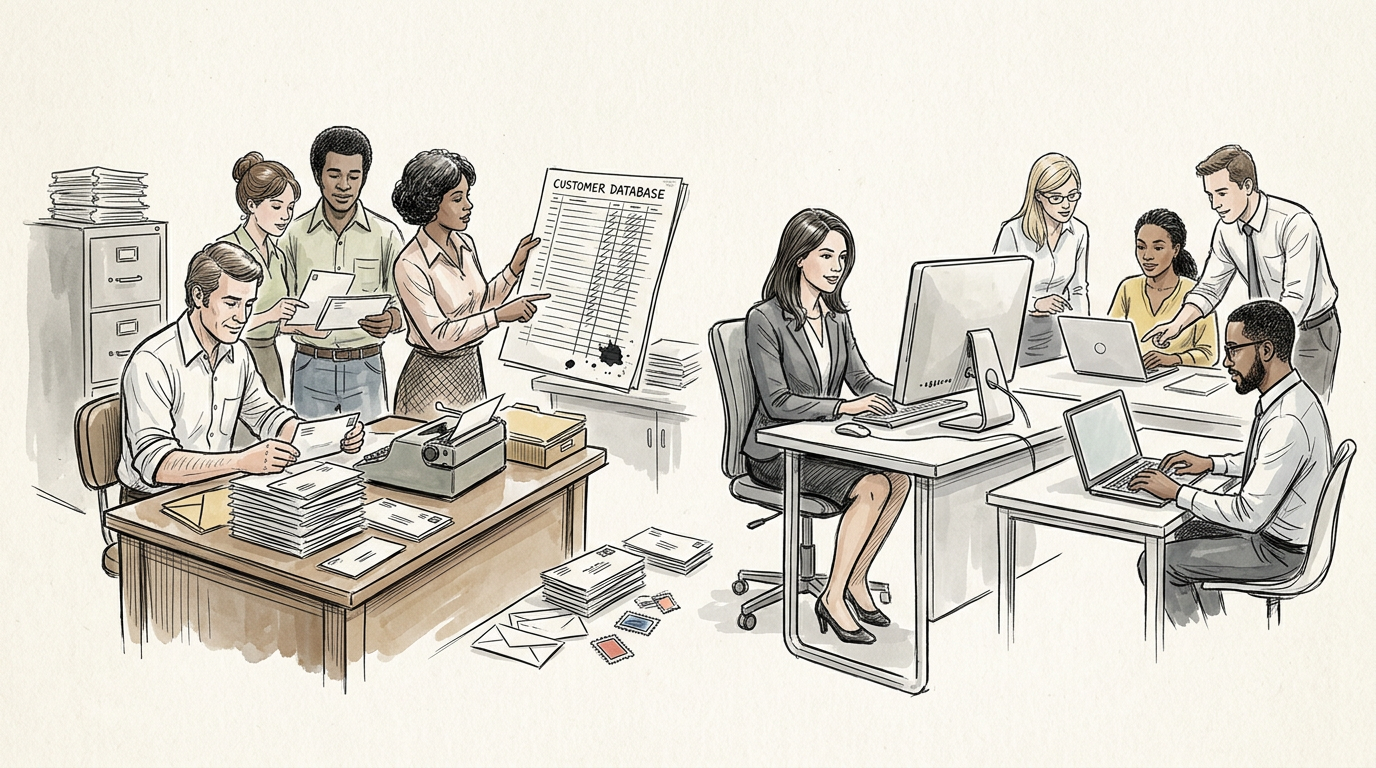
Modern marketing automation is often described as a digital-era breakthrough, and more recently as a prelude to or subset of AI-driven marketing. Historically, that framing is too narrow. Long before contemporary AI systems, marketers were building automated ways to identify prospects, trigger communications, manage customer records, and sequence follow-up across time. What changed over the twentieth and early twenty-first centuries was not the underlying ambition to systematize customer contact, but the speed, scale, and technical sophistication with which firms could do it.
The lineage runs through mail-order retailing, list management, coupon redemption, continuity programs, customer files, call centers, database marketing, CRM, campaign-management software, and email service platforms. At each stage, marketers were trying to solve a practical problem: how to reach the right customer with the right offer at the right moment without treating every contact as a one-time transaction. In that sense, marketing automation grew from direct marketing not merely because both rely on measurable response, but because direct marketing created the operational logic on which later automation was built.
Before software, marketers were already automating decisions
Long before software vendors sold “marketing automation,” direct marketers had developed repeatable systems for targeting and follow-up. In the late nineteenth and early twentieth centuries, mail-order firms such as Sears, Roebuck and Co. and Montgomery Ward depended on customer names, addresses, purchase histories, and geographic information to circulate catalogs and special offers. Their systems were labor-intensive, but they were still systematic. Mailing lists were maintained, segmented, corrected, and reused because indiscriminate circulation was expensive.
As national distribution expanded through railroads, parcel post, and improvements in printing, catalogs became more than sales documents. They were instruments for market selection. Firms could test offers by region, season, or product line and use response to guide future circulation. The U.S. Post Office’s introduction of Rural Free Delivery in 1896 and Parcel Post in 1913 materially widened the reach of direct-to-household selling. Those developments mattered to marketing history because they made customer-file management economically valuable at scale.
By the early twentieth century, list brokers and direct mail specialists were helping firms treat names as business assets. Trade publications and direct mail manuals discussed response rates, record-keeping, house lists versus compiled lists, and the importance of continuity in customer contact. The language was different from today’s talk of workflows and journeys, but the managerial problem was familiar: once a prospect responded, what should happen next, and how could that process be repeated reliably?
Triggered marketing, in a basic sense, already existed. If a customer requested a catalog, redeemed a coupon, entered a contest, or bought a specific product, that action could place the customer into a subsequent stream of mailings. The trigger was not an API call or a machine-learning score. It was a card file, ledger entry, keyed list, or later a punched-card record. But the principle was the same. A customer action changed the next communication.
Direct marketing made measurability central
The professional culture of direct marketing gave later automation one of its defining features: accountability. General advertising often struggled to connect exposure to response at the individual level. Direct marketing, by contrast, was built around return coupons, coded order forms, source keys, list tracking, and mail-date comparisons. Marketers knew that mailing costs were high enough to require discipline.
That culture became more formal over time. The Direct Mail Advertising Association, founded in 1917 and later renamed the Direct Marketing Association, helped consolidate direct marketing as a distinct professional field. Its institutional history, preserved through the ANA after the DMA’s 2018 acquisition, reflects the sector’s long focus on addressability, lists, response, and measurement. See ANA’s DMA history: https://www.ana.net/content/show/id/about-the-ana-dma.
Direct marketers developed working methods that now appear foundational to automation platforms:
- Maintaining persistent customer and prospect records
- Assigning source codes to campaigns and media
- Segmenting audiences based on prior behavior or inferred value
- Sequencing follow-up messages rather than sending isolated appeals
- Testing alternative offers, formats, and timing
- Measuring results by customer, list, offer, and cohort
These methods did not depend on digital channels. They depended on the idea that customer contact could be organized as an ongoing, rule-based process. That was the conceptual bridge from direct mail to automation.
Customer files became databases
The shift from manual records to computerized databases after World War II changed the scale of what direct marketers could do. Large organizations had used tabulating systems and punched-card equipment earlier in the century, especially for accounting and operations. But as commercial computing expanded in the 1950s and 1960s, customer information became increasingly available for marketing purposes.
This transition did not happen overnight, and early systems were often controlled by data-processing departments rather than marketing teams. That organizational point matters. Responsibilities now associated with marketing automation were once split among mail-order managers, circulation departments, customer service operations, IT, and finance. Marketing’s later ownership of automated customer communication was itself a historical development.
By the 1960s and 1970s, firms in financial services, publishing, travel, fundraising, continuity selling, and catalog retail had become especially sophisticated users of customer databases. Industries with recurring transactions had strong incentives to maintain active files, identify lapsing customers, and trigger retention or upsell communications. Credit cards, subscription businesses, and membership organizations were particularly important because they generated repeatable behavioral data.
The spread of ZIP Codes after 1963 also improved geographic targeting and list hygiene. Combined with advancing data-processing capacity, postal standardization made direct mail campaigns easier to sort, model, and deploy at larger scale. In parallel, toll-free telephone service, introduced nationally through AT&T’s 800 number system in 1967, supported more measurable direct response systems by making immediate customer action easier.
What emerged was not yet “marketing automation” in modern software terms, but an increasingly automated marketing operation. Customer events such as a first purchase, an expiration date, a missed renewal, or a catalog request could trigger predefined communications. The logic remained sequential and rule-based.
The rise of database marketing in the 1980s
If one period most clearly connects older direct marketing to modern automation, it is the database marketing era of the 1980s. During these years, marketers began speaking more explicitly about integrated customer data as a strategic asset, not simply an administrative necessity.
A central figure was Robert D. “Bob” Stone, a major practitioner and author in direct marketing whose books helped codify list selection, response measurement, and customer-centered planning. Another was Lester Wunderman, whose agency work and later writing argued that direct marketing should be understood as a disciplined method for building relationships through measurable interaction rather than as a minor adjunct to mass advertising. Wunderman’s later claim to have coined the term “direct marketing” is widely repeated, but the phrase appeared in use before his public prominence on the subject; his historical importance is better grounded in his influence on the field’s development than in a simple origin story.
The broader change of the 1980s was that relational databases and falling computing costs made it more practical to merge transaction records, demographic overlays, and campaign histories. Instead of treating each mailing list as a static asset, marketers could construct richer customer views and prioritize future action accordingly.
This was also the period in which statistical techniques became more embedded in direct marketing practice. Response modeling, decile analysis, recency-frequency-monetary value methods, and test-versus-control discipline helped marketers decide not only whom to contact but what sequence should follow a particular response pattern. The growing field of database marketing drew on earlier direct mail logic but pushed it toward more systematic decisioning.
The professional and legal environment was changing as well. As firms gathered more customer data, privacy concerns increased. Direct marketers defended customer databases as tools for relevance and efficiency, while critics raised concerns about surveillance, list trading, and unwanted solicitation. Those tensions were not created by social media or AI. They were already present in the database marketing era.
CRM formalized the customer record as a business system
The 1990s brought a different but related development: customer relationship management, or CRM. The term covered a range of software and management practices, and in practice it often overlapped with sales-force automation, call-center systems, and service databases. Even so, CRM mattered to marketing history because it reframed the customer file as a cross-functional system rather than a list used mainly for campaigns.
The roots of CRM lay partly in earlier contact-management tools and enterprise software. Siebel Systems, founded in 1993, became one of the most visible companies in this space, especially for large enterprises seeking integrated views of customer interactions across sales and service. Gartner and other analysts helped popularize CRM as a category in the 1990s. Marketers did not invent CRM alone, but they increasingly relied on it because campaign decisions became more effective when linked to service records, purchase history, and account status.
This is one of the key points in the history of automation. Modern marketing automation did not emerge only from email technology. It emerged from the convergence of direct-response thinking with enterprise customer-data systems. Once firms could centralize more customer information and update it more quickly, they could trigger communications based on broader definitions of customer behavior: not just a mail-order purchase, but a support call, policy renewal, abandoned application, service lapse, or change in account value.
In academic terms, the period also intersected with growing interest in relationship marketing. One influential contribution was Leonard L. Berry’s 1983 formulation of relationship marketing in services. Later work by scholars such as Christian Grönroos and Evert Gummesson expanded the conversation. These theories did not create automated marketing systems, but they gave marketers a language for thinking beyond one-time transactions. In practice, direct marketers and CRM vendors translated that orientation into retention programs, lifecycle communications, and event-based contact strategies.
The result was not always elegant. Many CRM implementations were costly and cumbersome, and organizations often struggled to integrate data across departments. Still, the period established an enduring idea: customer communication should respond to customer status over time, not merely to a fixed campaign calendar.
Email turned sequential direct marketing into always-on automation
Email did not invent automated customer communication, but it changed its economics dramatically. Direct mail had always involved printing, materials, and postage costs, which encouraged careful selection and constrained frequency. Email reduced marginal distribution costs enough to make ongoing, triggered contact far more practical for a wider range of businesses.
Commercial email developed unevenly in the 1990s. The growth of the public internet, browser adoption after the introduction of Mosaic in 1993, and the rise of ecommerce created the technical and commercial setting for email-based customer relationship programs. Early email marketing often resembled digital direct mail: batch sends to lists, basic personalization fields, and response tracking through opens, clicks, and conversions.
What pushed the medium toward automation was the same business problem direct marketers had faced for generations. A firm acquired a prospect or customer. What should happen next? Welcome messages, cart reminders, replenishment prompts, reactivation campaigns, renewal notices, onboarding sequences, and post-purchase cross-sell flows all have analogues in earlier direct marketing practice. The difference was that email made these sequences faster to launch, easier to revise, and cheaper to repeat.
Several software firms were important in this transition. Salesforce, founded in 1999, helped popularize cloud-based CRM. Eloqua, founded in 1999, became a significant early marketing automation platform for business-to-business marketing, particularly around lead nurturing and scoring. Silverpop, founded in 1999, and Marketo, founded in 2006, also played major roles in shaping the category. HubSpot, founded in 2006, connected automation to inbound marketing and digital content strategy. These firms did not all define the category in the same way, but together they normalized software that could manage customer data, trigger messages, score leads, and orchestrate campaigns across time.
By the 2000s, “drip marketing” and “lead nurturing” had become common industry terms. Both concepts were rooted in direct marketing continuity practices. Automated sequences sent after a webinar registration or white-paper download were technologically newer than follow-up mailings after a catalog request, but they served a comparable strategic function. They moved prospects through a staged process using preplanned rules and measurable responses.
Campaign-management software connected rules, channels, and timing
As databases, CRM systems, and digital channels expanded, marketers needed tools that could coordinate more than one communication at a time. Campaign-management software emerged to meet that need. Enterprise vendors including Unica, Epiphany, Aprimo, and SAS developed systems that could select audiences, manage rules, suppress conflicting contacts, and track responses across campaigns.
These platforms are an important part of the history because they brought industrial discipline to multi-step customer communication. In large firms, the challenge was no longer merely sending one triggered offer. It was deciding which message among many should go to which customer under which conditions. That required prioritization logic, frequency caps, suppression rules, and increasingly granular segmentation.
Campaign-management systems also reflected institutional changes within marketing departments. Database marketers, CRM teams, email specialists, and analysts began to work more closely together, though often with IT support. The organization of marketing changed because the tools required more coordination among creative, analytics, operations, channel management, and customer-data functions.
This period also exposed an enduring tension in automation: efficiency versus relevance. The more easily communications could be automated, the greater the temptation to increase volume. Marketers gained power to trigger more messages, but customers also developed sharper expectations about timing, frequency, and usefulness. Unsubscribe rates, spam complaints, deliverability problems, and regulatory scrutiny all reminded marketers that automation did not guarantee customer value.
The legal context reinforced that lesson. In the United States, the CAN-SPAM Act of 2003 established national rules for commercial email. In Europe and elsewhere, privacy and consent regimes evolved differently, later culminating in rules such as the General Data Protection Regulation. These developments did not halt automation, but they shaped what responsible automation required in practice: permission standards, preference management, data governance, and clearer accountability for customer communications.
Automation expanded beyond email, but its logic remained direct-marketing logic
By the 2010s, marketing automation platforms were increasingly tied to websites, mobile messaging, social platforms, ad tech, and ecommerce systems. Behavioral triggers could include page visits, form fills, search activity, purchases, app events, loyalty actions, and store interactions. Cloud computing made implementation easier for smaller firms, while APIs allowed broader integration across software tools.
Yet the underlying logic remained recognizably direct-marketing logic:
- Identify a customer or prospect
- Maintain a persistent record
- Observe a behavior or status change
- Apply decision rules or scores
- Deliver a timed communication
- Measure response and update the record
What modern platforms added was scale, speed, and channel coordination. Instead of a clerk pulling a renewal file or a mail house preparing a lapse sequence, software could execute the process continuously. Instead of one catalog follow-up cycle, firms could run dozens of concurrent customer journeys. Instead of weekly response reports, dashboards could update in near real time.
That technical expansion should not obscure continuity. Much of what contemporary marketers describe as lifecycle marketing, journey orchestration, personalization, lead management, retention automation, and customer reactivation rests on methods developed in direct marketing and database marketing long before today’s AI systems.
Why AI is not the origin point
Recent marketing discussions often collapse automation, personalization, prediction, and AI into a single story. Historically, they are related but distinct. Rule-based automation predates predictive scoring, and predictive scoring predates contemporary generative AI. A triggered welcome series, a renewal notice sent 30 days before expiration, or a suppression rule preventing duplicate offers are forms of marketing automation even when no machine learning is involved.
Predictive analytics did become more influential over time. Credit scoring, churn modeling, propensity models, and look-alike techniques gave marketers increasingly sophisticated ways to decide which automated action should occur. But these methods extended a much older direct-marketing commitment to measurable selection and response optimization. They did not create the idea of automated customer communication from scratch.
This distinction matters because it clarifies what is historically new and what is not. Contemporary AI systems may improve content generation, send-time optimization, audience prediction, or conversational interaction. They may also alter how marketers manage scale and creative variation. But the professional foundations of automation were laid by direct marketers who built customer files, coded responses, sequenced offers, and tied communication to observed behavior.
To say that automated targeting predates AI is not to minimize current technological change. It is to describe it accurately. AI entered a field that already had a century-long history of using rules, records, and response data to systematize market contact.
What this history changed inside the marketing profession
The evolution from direct marketing to automation reshaped marketing as an organizational function. It expanded the importance of operations, analytics, and customer-data stewardship within marketing departments. In earlier periods, a direct mail manager or circulation manager might oversee customer records and follow-up systems. Today, comparable responsibilities may sit with lifecycle marketing teams, CRM managers, marketing operations leaders, revenue operations groups, or customer experience functions.
This history also changed professional expectations. Marketers became more accountable for measurable outcomes over time, not just campaign launches. The profession moved toward persistent customer management, where acquisition, onboarding, retention, reactivation, and loyalty were linked through shared data and sequential decisioning.
Academic marketing also increasingly engaged questions that automation made operationally visible: customer lifetime value, retention economics, relationship quality, switching costs, service recovery, and multi-channel behavior. Not every concept emerged from direct marketing, but direct marketing provided a business environment in which these ideas could be tested and monetized.
At the same time, the history carries warnings. Automated marketing has repeatedly produced problems when efficiency outruns judgment. Overmailing, poor data quality, crude segmentation, hidden surveillance, and depersonalized customer treatment are not recent risks. They are recurring features of systems that privilege contact capacity over customer understanding. The historical record does not support the idea that more automation naturally produces better marketing.
Why the direct-marketing lineage still matters
Understanding marketing automation as an outgrowth of direct marketing changes how the field’s history is interpreted. It places automation within the longer development of marketing as a discipline concerned with segmentation, measurable response, customer records, and repeat relationships. It also corrects the impression that automated targeting began with digital platforms or AI.
The practical inheritance is visible everywhere in modern marketing. Welcome series descend from fulfillment and acknowledgment streams. Cart recovery echoes earlier reminder and continuity practices. CRM-based retention programs descend from subscriber and member renewal systems. Lead nurturing resembles structured direct-response follow-up. Customer journeys are more technologically elaborate than historical mail sequences, but they solve the same managerial problem: how to organize contact over time based on what is known about the customer.
For today’s marketers, this history is useful not because it offers nostalgia, but because it clarifies the field’s enduring questions. What data should be kept? What behavior should trigger response? How much automation improves relevance, and when does it become noise? Which decisions should be standardized, and which require human judgment? Those were direct-marketing questions before they became software settings.
Marketing automation did not suddenly appear when cloud software, ecommerce, or AI became fashionable. It grew from the operational habits of direct marketing, matured through database marketing and CRM, and expanded through email and campaign-management platforms into a broader system for managing customer relationships. The channels changed, the interfaces improved, and the data became richer. The historical core remained strikingly consistent: marketers sought to make customer communication timely, targeted, measurable, and repeatable. Modern automation is best understood not as a break with that history, but as one of its most consequential extensions.
Leave a Reply