
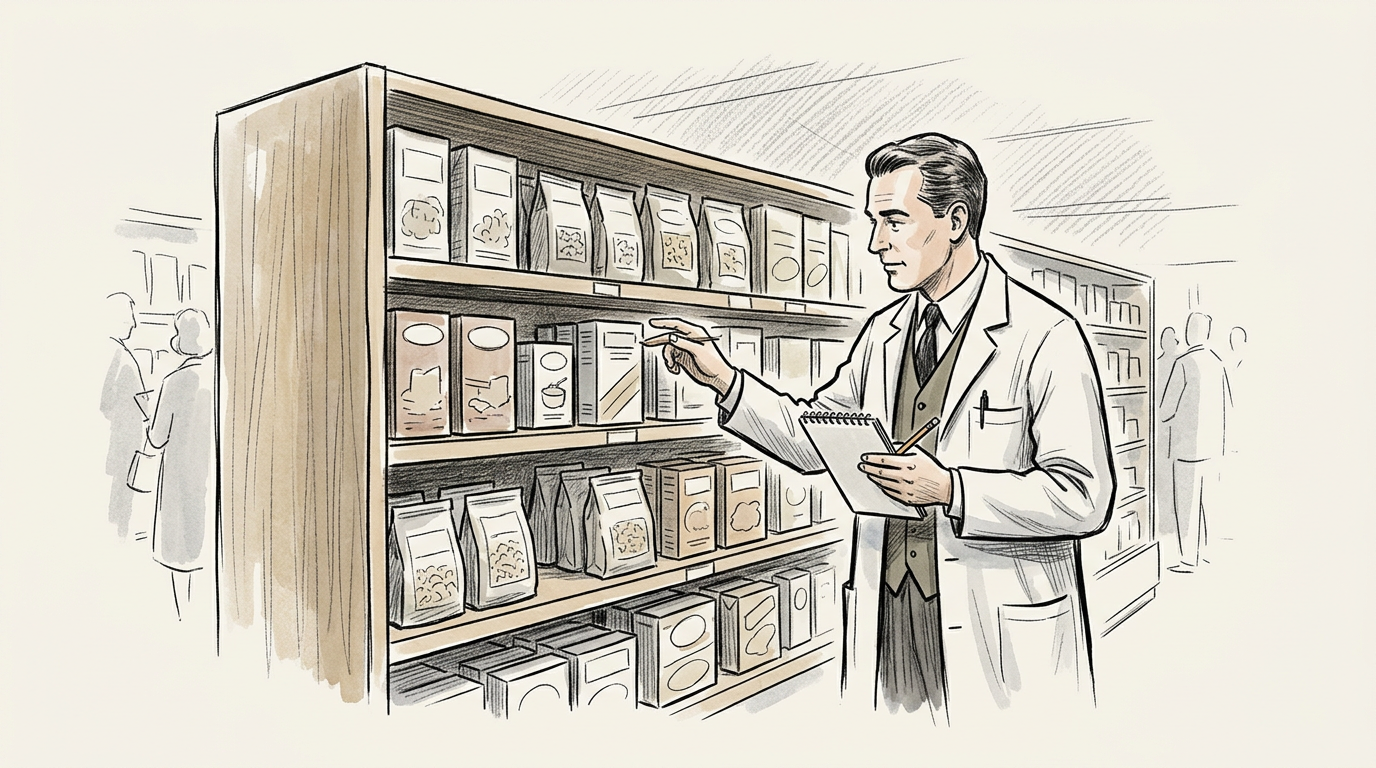
Private labels, now treated as a routine part of assortment architecture and margin management, began as a different kind of retail instrument. They emerged when merchants sought greater control over supply, quality, price, and customer loyalty in markets where manufacturers, wholesalers, and retailers were still negotiating their respective roles. Over time, retailer-owned brands moved from plain, price-led substitutes to carefully tiered portfolios that could signal value, quality, local identity, premium positioning, or category expertise. That evolution changed the balance of power in distribution and forced both retailers and national brand manufacturers to rethink marketing strategy.
The history matters because private labels did not simply add more products to store shelves. They helped define what modern retailers are: not only distributors of other companies’ goods, but brand owners, merchandisers, data users, and market makers in their own right.
Before the modern private label: merchant control, store reputation, and unbranded goods
For much of the nineteenth century, especially in food and household staples, many goods were sold loosely or in bulk through grocers, general stores, and specialty merchants. Product quality was often judged through the retailer’s reputation rather than through a manufacturer’s national brand. In that sense, retailer authority over assortment predated the modern private label. The merchant selected suppliers, set prices, and stood behind the product.
What changed in the late nineteenth and early twentieth centuries was the growth of packaged goods and national distribution. Industrial production, rail transportation, improved printing, trademark protection, and mass circulation media made it increasingly practical for manufacturers to build recognizable brands that traveled beyond local markets. National branded packaged goods reduced some uncertainty for consumers and gave manufacturers more leverage with retailers. That shift is central to private-label history: retailer-owned brands gained importance whenever merchants wanted to recover strategic control that national brands had begun to capture.
Private labels therefore developed alongside, not before, manufacturer branding. They were one answer to a structural business problem: how could a retailer avoid becoming merely a resale outlet for brands built by someone else?
Chain stores and the early twentieth-century expansion of retailer brands
The rise of chain retailing gave private labels a stronger institutional base. By the early twentieth century, chains such as Great Atlantic & Pacific Tea Company, Kroger, and later Safeway had scale advantages in buying, logistics, store operations, and merchandising. Scale also made retailer-controlled brands more feasible. A chain with many outlets could justify dedicated sourcing, standardized packaging, coordinated pricing, and repeated promotion across a store network.
These early retailer brands were not always marketed in the same way modern private labels are, but they served familiar functions. They gave chains bargaining leverage with outside manufacturers, enabled sharper price positioning, and tied product quality to store identity. Kroger, founded in 1883, moved early into manufacturing and packing activities, integrating bakery, meat, and grocery functions to support its retail operations. A&P likewise developed extensive control over sourcing and proprietary lines as part of its effort to lower costs and standardize the consumer offer.
This expansion took place in the broader context of chain-store growth and anti-chain-store controversy. Chains were criticized by some independents and wholesalers for their buying power and market reach. Proprietary store brands became part of that controversy because they signaled that large retailers were no longer simply intermediaries. They were building vertically coordinated systems that blurred the line between retailer and manufacturer.
At this stage, however, private labels were not yet uniformly associated with “cheap alternatives.” They often represented reliability and store accountability as much as low price. In categories where packaging and standardization still reassured shoppers, a retailer’s own brand could serve as a promise that the merchant had curated and stood behind the product.
Sears, mail order, and the retailer as marketer
Mail-order retail helps clarify another dimension of private-label development. Sears, Roebuck and Co. sold an extraordinary range of merchandise through catalogs and later stores, using house brands across categories including tools, tires, appliances, and home goods. Kenmore, introduced in 1927 for washing machines, and Craftsman, launched in 1927 for tools, became two of the best-known retailer-owned brands in the United States.
These brands demonstrated an important historical point: private labels were never confined to bargain groceries. In categories where retailer trust, service, and merchandising mattered, a house brand could become a major market-facing asset. Sears used catalog distribution, merchandising discipline, and category expertise to make its owned brands meaningful to consumers. They were not merely anonymous low-price placeholders. They became part of how Sears differentiated itself and organized customer expectations across a very broad assortment.
That development foreshadowed a later shift in supermarket private labels. Retailers could use owned brands not just to undercut national brands on price, but to claim authority in a category, occupy specific quality positions, and extend store identity into the product itself.
The postwar supermarket era and the “generic” reputation problem
After World War II, supermarket growth, suburbanization, mass consumption, consumer packaged goods expansion, and television advertising strengthened national brands. Large manufacturers built enormous awareness and loyalty through broad media investment and category innovation. In many categories, retailer brands were overshadowed. Supermarkets still carried proprietary goods, but manufacturer brands often defined category norms.
In this environment, many private labels drifted toward a narrower strategic role: price fighting. Their packaging was often less developed, quality could be inconsistent, and merchandising support was limited. The growth of self-service retail actually raised the stakes for packaging and visual identity. In older service-oriented formats, clerks could explain or recommend products. In supermarkets, packaging and shelf presence had to do more work. National brands usually had the advantage.
The “generic” wave of the 1970s made this reputation problem more visible. During a period of inflation and economic pressure, some retailers expanded plain-packaged, no-frills products designed to communicate savings directly. The approach resonated with some shoppers but also reinforced a long-lasting assumption that retailer-owned products were primarily low-end substitutes. Generics and private labels were not identical, but they were often linked in the public mind.
This is one of the key turning points in private-label history. The low-price role was real and commercially useful, yet it constrained retailer branding. To move beyond tactical margin capture, retailers would need to improve quality management, packaging, positioning, and portfolio logic.
European retailers and the strategic reinvention of own-label brands
The transformation of private labels into sophisticated brand systems is especially associated with developments in European retail from the 1970s forward. Different national markets followed different paths, but several large retailers demonstrated that owned brands could become central to store strategy rather than peripheral price tools.
Carrefour in France, Tesco and Sainsbury’s in the United Kingdom, and later Aldi and Lidl in Germany and across Europe showed different models of retailer brand power. Carrefour introduced “produits libres” in 1976, a stripped-down line intended to deliver lower prices by reducing packaging and marketing costs. The concept was important not because it invented retailer brands, which long predated it, but because it publicly reframed the relationship among branding, packaging, and value in a period of consumer price sensitivity.
British grocery retail then pushed the model further. By the 1980s and 1990s, major UK chains had expanded own-label programs well beyond economy tiers. Retailers invested in quality assurance, product development, consumer research, packaging design, and line architecture. Tesco’s eventual use of multiple own-label tiers, including value and premium ranges such as Tesco Finest, illustrated a mature retail-brand strategy. Sainsbury’s and Marks & Spencer also showed that retailer brands could anchor quality perceptions, not merely low prices. Marks & Spencer in particular built much of its food and apparel offer around products sold under its own control, with close supplier coordination and strong store-level brand identity.
These European developments mattered internationally because they showed that private labels could support full-spectrum segmentation. A retailer could use separate owned brands, sub-brands, or tier labels to target different income levels, occasions, category needs, and quality expectations within the same store network. That required capabilities more commonly associated with manufacturers: product specification, package design, quality testing, demand forecasting, brand architecture, and long-term supplier development.
Private-label history is therefore also the history of the retailer acquiring manufacturer-like marketing competencies.
Why retailers gained more room to build private-label portfolios
Several structural shifts made the late twentieth-century expansion of private labels more feasible.
First, retail concentration increased in many markets. Larger chains had the scale to spread product development and packaging costs across more stores and to negotiate effectively with contract manufacturers.
Second, scanning technology changed retail knowledge. The [Universal Product Code](https://www.gs1us.org/upcs-barcodes-prefixes/what-is-a-upc) was introduced in the early 1970s, and the first live retail scan took place in 1974 at a Marsh supermarket in Troy, Ohio. Over time, barcode scanning and point-of-sale data gave retailers much better visibility into category performance, price elasticity, promotional lift, velocity by store, and substitution patterns. That mattered enormously for private labels. Retailers no longer had to rely as heavily on manufacturer-supplied market intelligence or broad category assumptions. They could observe demand directly.
Third, modern category management and electronic data interchange reshaped retailer-manufacturer relations from the 1980s onward. Category management, later popularized in part through the work of Brian F. Harris and the Partnering Group, encouraged retailers to treat categories as strategic business units. In practice, national brand manufacturers often served as “category captains,” supplying analytics and recommendations. Yet the same tools that strengthened some manufacturer influence also equipped retailers to identify white-space opportunities for owned brands. Retailers could see where opening price points were missing, where premiumization had room to grow, or where national brands were earning margins that a store brand could partially recapture.
Fourth, advances in private-label manufacturing improved quality consistency. Dedicated contract manufacturers, better food processing controls, improved packaging technology, and more formal specification systems reduced the gap between national-brand and retailer-brand performance in many categories.
Fifth, consumer attitudes shifted. Recessions certainly accelerated trial, but long-run acceptance of private labels was not caused by economic downturn alone. As quality improved, some consumers came to treat retailer brands as acceptable defaults in everyday categories and as credible alternatives even in premium segments.
From “store brand” to portfolio strategy
By the late twentieth century, the most capable retailers no longer approached private labels as a single undifferentiated line. They developed portfolios.
The logic was straightforward. A single store brand could not effectively serve every pricing and quality objective. If a retailer wanted to attract highly price-sensitive shoppers, defend margins in staple categories, compete with premium national brands, and project expertise in fresh or specialty goods, it needed more than one offer.
This led to the rise of distinct own-label tiers, often including:
- Opening-price or value lines designed to meet hard-discount competition and support price image.
- Core standard private labels positioned as equivalents to leading national brands at somewhat lower prices.
- Premium lines aimed at quality-seeking shoppers, gifting occasions, or categories with higher willingness to pay.
- Category-specific or lifestyle-led brands associated with health, organic, indulgence, convenience, children, or local sourcing.
This was a marketing development, not just a merchandising one. Tiered private-label systems required segmentation, positioning, naming, packaging strategy, and price architecture. Retailers had to decide whether to use the corporate store name prominently, create freestanding sub-brands, or mix the two approaches by category. They also had to manage the risk of confusing shoppers or diluting store identity.
The growth of premium private labels was particularly significant. It challenged the old assumption that retailer-owned brands existed only to trade down. Premium tiers allowed retailers to capture higher margins and signal curation, taste, or category authority. In many markets, these lines also turned the retailer itself into a more visible consumer brand.
Power in the channel: how private labels changed retailer-manufacturer relationships
Private labels altered bargaining power because they gave retailers a credible alternative to exclusive dependence on manufacturer brands. The more successful a retailer became at developing owned products, the more it could negotiate from strength on pricing, trade terms, promotions, and shelf space.
This did not eliminate national brands, nor did it make private labels dominant in every category. In many cases, manufacturer brands remained essential traffic drivers, innovation leaders, or trust anchors. But retailer-owned brands changed the structure of the conversation.
Manufacturers faced several new pressures:
They had to justify price premiums more clearly.
They had to invest in innovation that private labels could not immediately imitate.
They had to defend shelf space in categories where retailers could compare brand performance with their own controlled alternatives.
They had to navigate the uncomfortable reality that a retailer might be both customer and competitor.
That dual relationship became a defining feature of late twentieth-century consumer goods marketing. A supermarket or mass merchant could depend on a major manufacturer’s advertising to stimulate category demand while simultaneously using its own shelf data to build a substitute. In some cases, the same third-party producer might manufacture goods for both national and private labels, further complicating older distinctions between branded identity and production origin.
This is one reason private-label history belongs squarely in marketing history rather than only in retail history. It concerns channel strategy, information asymmetry, brand architecture, pricing, portfolio design, and the professionalization of customer and category knowledge.
Mass merchants, club stores, and the broadening of the model
Private-label development was not limited to supermarkets. Mass merchants, warehouse clubs, drug chains, office supply retailers, home improvement chains, and specialty retailers all adapted the model according to their business formats.
Warehouse clubs offered one especially influential variation. Costco’s Kirkland Signature, introduced in 1995, became a prominent example of a retailer-owned brand positioned not as a bare-minimum alternative but as a quality-led substitute across many categories. Its significance lies less in its launch date than in what it represented strategically: a membership retailer using trust, curation, and scale to create an umbrella brand that could travel from groceries to apparel to household consumables and beyond. The name did not merely fill price gaps. It reinforced the retailer’s value proposition.
Other retailers pursued similar strategies through exclusive labels and private brands in apparel, home, and specialty goods, where design differentiation and margin management were often even more central than in packaged food. Department stores had long used exclusive merchandise and house labels, but the modern era intensified that logic with portfolio planning and more formal brand management.
In these sectors, private labels often solved a different problem than in grocery. Instead of only matching national brands at a lower price, they helped retailers escape direct price comparison, create exclusive assortments, and build identity in categories where fashion, fit, design, or retailer point of view mattered.
Data, loyalty, and the modern private-label feedback loop
The historical development of private labels cannot be separated from the development of customer data. Loyalty programs, point-of-sale systems, syndicated data, shopper research, and later ecommerce analytics gave retailers increasingly detailed visibility into who bought which products, in what combinations, at what prices, and under what promotional conditions.
This was a major shift from earlier eras, when manufacturers often had superior consumer research resources and brand-tracking capabilities. By the 1990s and 2000s, leading retailers could use first-party purchase data to identify switching behavior, target promotions, refine assortment, and assess the incremental role of private labels in customer retention and basket economics.
In practical terms, retailers could ask more sophisticated questions. Was the private label attracting a new shopper, increasing spend per trip, retaining a price-sensitive household, or simply cannibalizing a higher-margin national brand? Which categories were strong entry points for owned brands? Which required national brands to reassure shoppers? How should promotions differ between opening-price lines and premium tiers?
These are recognizably modern marketing questions, but they emerged from a long historical process in which retailers acquired analytical tools once associated more strongly with manufacturers and direct marketers.
Ecommerce, marketplaces, and the new version of an old strategy
Digital commerce did not invent private labels, but it changed the economics and visibility of retailer-owned brands. Online retailing expanded assortment intelligence, search behavior analysis, review monitoring, and dynamic pricing capabilities. It also intensified control over product discovery. On a shelf, national brands and private labels compete physically side by side. In digital environments, retailers and platforms can influence ranking, recommendation, bundling, and subscription options.
This brought the logic of private labels into new forms. Amazon, for example, developed a large set of private brands in the 2010s across categories such as apparel, electronics accessories, and household goods. That strategy drew scrutiny because digital platforms can use marketplace and search data in ways that sharpen the classic retailer advantage: insight into what sells, at what price, and where unmet demand exists. Although ecommerce raised novel policy questions, the underlying marketing logic was historically familiar. Control over customer access and market information could be converted into owned-brand opportunity.
At the same time, digitally native brands and direct-to-consumer commerce complicated the old retailer-versus-manufacturer divide. Some manufacturers could now reach customers more directly, while major retailers expanded omnichannel private-label programs. The result was not a clean displacement of one model by another, but a more contested environment in which control of data, fulfillment, and customer relationship became central to brand power.
Why private labels are no longer just “cheap alternatives”
The historical record shows that private labels were never only one thing. They have served as merchant guarantees, anti-brand value statements, traffic builders, margin enhancers, bargaining tools, assortment differentiators, and premium propositions at different moments and in different formats.
Still, the broad trajectory is clear. Over the twentieth and early twenty-first centuries, the most successful retailer-owned brands moved through three overlapping stages:
First, they functioned largely as merchant-controlled alternatives in a retail system still organizing itself around packaging, standardization, and chain-store scale.
Second, in many markets they became heavily associated with low-price substitution, especially when national brands dominated mass media and product innovation.
Third, they evolved into segmented portfolios managed with increasingly sophisticated branding, research, sourcing, and data capabilities.
That final stage is what most directly shaped modern marketing practice. Private labels now sit at the intersection of brand management, retail media, category strategy, pricing, supply chain coordination, customer analytics, and customer experience.
What this history explains about modern marketing
Private labels evolved as retailers learned to do more than distribute products. They learned to design market offers. That required capabilities once dispersed among merchants, wholesalers, manufacturers, and advertising-supported brand owners. The retailer-owned brand became one of the clearest signs that marketing was no longer confined to a manufacturer’s brand team or sales department.
This history also explains why private labels remain strategically sensitive. They improve margins, support price architecture, and deepen retailer differentiation, but they can also strain manufacturer relationships, create quality-risk exposure, and complicate assortment decisions. Their success depends not on low price alone, but on whether a retailer can align product development, sourcing, brand meaning, data, and shelf or screen presentation.
In other words, the evolution of private labels tracks a larger development in marketing history: the shift from retailing as distribution to retailing as brand stewardship and market governance. The store brand began as a tool of merchant control. It became, over time, a disciplined system for segmenting demand, shaping competition, and defining what the retailer itself stands for in the market.
Leave a Reply